

Getting Unstuck: Pendulation Practice
Feeling stuck? Induce flow with this trauma-informed practice designed to help nudge your system into greater regulation. By noticing the inherent flow in our physiology, we can shift from blockage to flow.
Transcript
Hello,
My name is Banu and I welcome you to this pendulation practice.
Feeling stuck is a common experience many of us have.
We may feel trapped in an emotion such as sadness or anxiety,
Or we can feel stuck with uncomfortable body sensations when we are coping with chronic pain or stress.
We can also feel locked in habitual thought patterns like negative self-talk that is not helpful for our well-being or regulation.
So how do we get unstuck?
Let's try this practice.
You can practice this meditation sitting upright,
Standing,
Or lying down with your eyes open or closed.
If at any time this practice feels too much,
Please honor yourself and take a break looking around your environment or coming back to this meditation at another time.
Now take a few moments to settle into your posture,
Seeing if you can shift your body so you are 5 to 10 percent more comfortable.
Now notice how your chest or belly expands as you inhale and then contracts as you exhale.
Focus your attention on the felt sense of this expansion and contraction,
The rising and falling of your body as it breathes normally.
Now,
Notice how your body expands and contracts sideways and also to your backside as you breathe.
These movements are more subtle but can be felt if you pay close attention.
The process of breathing is really three-dimensional.
In and out,
Rising and falling,
Sideways expanding and contracting,
And the back of our body breathing as well.
Imagine your body lengthening just a tiny bit on each inhale and relaxing back on the exhale.
Breathing and settling,
Rising and falling,
Expanding and contracting,
Lengthening and shortening.
This movement of flow,
This movement of pendulation is happening all the time in our body.
All our muscles either expand and then contract to allow us to move.
Our heart pumps blood throughout our body with the contraction and relaxation of the heart muscles and the vessels.
Our entire digestive tract moves food and nutrients by peristalsis,
The squeezing and releasing of the smooth muscles of the esophagus,
Stomach and colon.
When we experience pain,
Our body instinctually braces and constricts around the pain to protect it.
While this can be helpful in the short term,
Over time it could lead to chronic patterns of bracing and tension that can make pain worse.
This constriction can also happen in our hearts as we struggle with challenging emotions or trauma or show up in thought patterns that become repetitive,
Reducing our mind's capacity for new information or creative insight.
Reconnecting with our body's natural pendulation can increase the sense of flow in our bodies,
Our minds and our hearts and help reestablish regulation and balance.
Our parasympathetic rest and digest,
Part of our nervous system,
Can come back online bringing restorative rest and deeper connection.
Let's add some gentle movement with our breathing now.
Position your hands in front of you with your palms facing each other.
As you inhale,
Slowly open your hands to the side,
Expanding only as far as you're comfortable with.
As you exhale,
Bring your hands back to center.
It's almost as if your hands are like an accordion,
Tracking the sensations and the expansion and contraction of your breathing.
If following the breath is challenging for you,
Place your attention just on the movement of your hands.
Having a focus of external attention can be very helpful when the breath isn't working for you.
What happens as you do this motion of your hands?
Does your breath shift?
Is there a change in your shoulders or any area of muscle tension?
Opening and closing,
Inhaling and exhaling,
Widening and narrowing.
Become curious about where else in your body you feel some pendulation.
Can you feel your heartbeat?
Do you notice a gentle pulse somewhere in your body?
Can you feel gurgling in your stomach or movement in your belly?
It can be hard finding these body cues because they are subtle at first,
So try to be patient with yourself.
You can pendulate with so many body movements.
Here's another one to try.
Open your eyes and softly notice the room or environment where you are.
Then gently close and rest your eyes.
Opening and seeing,
Closing and resting.
What are you noticing as you're doing these subtle movements?
You can also pendulate your body posture,
Curling your body into a gentle ball.
Then unfurling slowly to an upright posture.
Curling down again.
Not expanding to your full height and length.
Notice what this feels like in your body.
Do you notice any shift in your emotions?
What type of thoughts are you noticing as you're pendulating back and forth?
You can use this pendulation meditation if you have pain in your body.
For example,
If your right neck is hurting,
Notice that and then begin slowly pendulating your attention between the right painful side of your neck and the left side of your neck,
Which may have very different sensations.
Focusing back and forth with your attention.
Right side and left side.
Focusing areas of more tension and then areas of less tension.
Be curious to see what happens next in these body areas.
If you are feeling a difficult emotion right now that feels stuck,
Notice where in your body you're experiencing this feeling.
Is there a weight on your chest or tears in your eyes or tightness in your belly?
Let your attention kindly care for these sensations as you let go of the story of your emotion for a few moments.
Just being present with the sensations just as they are.
Right now see if you can find a body area that isn't as heavy or tight and be curious about these sensations.
Shifting your attention back and forth between the heavier tight body sensations and the lighter or different sensations in the more comfortable area of your body can induce flow and shift your sense of stuckness.
As you tap into this resource of pendulation you will find it happening everywhere,
Within and without.
The sound of water in a stream dancing and moving.
Ocean waves rising and falling.
The sway of tree limbs in the wind back and forth.
The rising and setting of the sun and moon.
The buzzing and then quieting of bees getting pollen from flowers.
You might also notice the in and out breath of your dog,
Cat or sleeping infant.
Or the ticking sound of a clock.
This practice of pendulating our attention can nudge our body physiology,
Our heart and mind into greater flow.
When we have more flow we literally have more blood circulating,
More digestive juices flowing,
More creativity and an increased capacity for compassion as well as the awareness of the whole of our experience.
There is pain and there are areas that are more comfortable.
We have a difficult emotion or thought and can remember it won't be there forever.
We can have feelings of being stuck and know that it will shift.
Thank you for practicing pendulation with me today.
I invite you to practice a bit daily and see what happens.
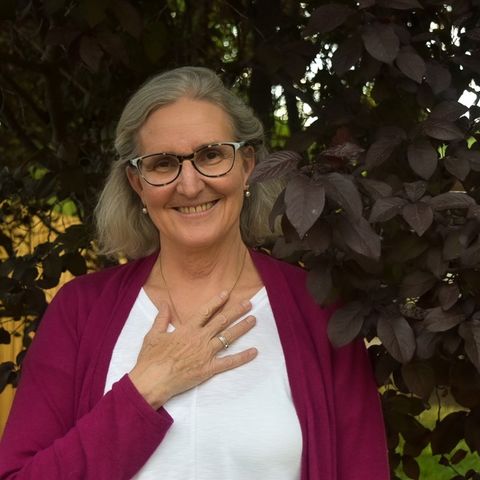
Meet your Teacher

4.8 (731)
Recent Reviews
Ikedra
December 23, 2025
Amazinggggg
Wiesie
August 5, 2025
Powerful concept, new to me. So many things ”best done daily” — not sure “pendulation practice” can go on the list without causing overwhelm, but now I’ve got the idea it might surface that often anyway. x
Anne
July 24, 2025
A really good new project for me - going to practice daily and see where it leads!
Ann
May 27, 2025
That was helpful and felt good. I will do that again. Thank you.
Susan
April 27, 2025
Pendulation Practice I am just about to start chemotherapy treatment and the anxiety can sometimes be overwhelming. I found this practice so helpful. I simply focused on opening and closing my fists to start. Then I noticed tension in my face. I scrunched it up and released. My nose started wiggling on its on. This made me smile and exhale. I’d love a practice that works with facial tension , especially the jaw. Many many thanks. Susan
Michael
April 16, 2025
Excellent!
Lizzy
March 12, 2025
I do deal with body pain, stressful situations, ADD issues, etc., however I found that pendulating the body by physically moving from one position to another really helped rpromote an increased calming effect and awareness inside my body. Thank you Bhanu. 🙏
Erina
March 4, 2025
Wonderful practice, thank you 🙏🏾
Sarena
February 13, 2025
This practice was so insightful and helpful. Flow, balance, breath, mindfulness... One breath at a time. 💞🕊️
Shannon
February 11, 2025
I heard you at the MARC in late January. So happy I found you on Insight! Love your work. "Having a difficult thought AND it will pass". Incredibly helpful to include the "and" assurance. Thank you!!
More from Bhanu Joy Harrison

Related Meditations
Related Teachers
Trusted by 35 million people. It's free.

Get the app