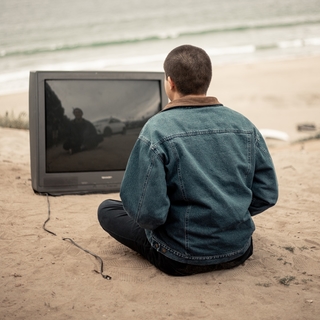
The title of this video is called.
.
.
The God Note.
But just first of all,
This has nothing to do with religion.
Unless you consider creativity religion.
Or maybe creativity as a form of spirituality.
It's going to be me attempting to share with you a little bit about my own creative process and my evolution.
As an artist.
I cringe almost to say I'm an artist.
And yet I know that it's true and I'm increasingly attempting to just embody and own.
That that is the truth and to allow it to be shown and expressed.
In every way,
Through all the things that I do,
Including the things that I do.
And so what I'm going to do eventually,
In a moment we'll slow down.
Settle in.
And then explore together.
What I'm going to do is share with you about my approach to my most recent creative project.
That is here on Insight Timer.
It's called The God Note.
It's an audio course.
So there's an applied plug for that,
Obviously.
If that rubs you the wrong way or is annoying in any way,
I won't be offended if you stop watching,
Maybe a little bit,
But I'll understand at least.
But you don't need to listen to the course.
In order to appreciate the message that I'm attempting to share.
It's just the content,
The example.
For my approach and my hope that is maybe by me talking about it.
Maybe it inspires you in some way or helps you to.
Access your own inner artist.
Maybe a slightly deeper way or opens you to a new possibility or maybe just motivates you to keep creating or to create again.
It strikes me that it might be the meaning of human life.
To create,
Like to create art,
Maybe in the way that a tree produces fruit or an apple.
It might just be that humans are here to express themselves creatively and artistically.
That's what I think anyways.
So I'll share in a moment about.
.
.
My own process,
But why don't we just take a second to Settle in.
Slow down.
Reset.
Always just kind of nice to do that and one way that i like doing that and this will connect to what I shared.
Is to play the sound of a singing bowl,
Not for any esoteric reason or for any reason where I'm like believing in something separate from just what is here,
But just as a ritual.
To help me slow down and reset.
Right now in the bowl,
I have these quotes.
And I like the symbolic gesture of emptying out the quotes,
Emptying out everything that I already know.
And that is the only way for the bowl to be played in the way that it was meant to be played.
The bowl must be empty.
Order to be played.
And that's one little way of thinking about creativity or artistry.
To allow yourself to be empty.
And in that way,
The universe can play its sound uniquely through you.
So let's empty out the bowl.
And maybe take a couple deep breaths if that feels right.
And feel yourself emptying.
Maybe it's emptying out.
All that has been today,
The energy of today,
The momentum of the day so far.
The momentum of the week.
Maybe the momentum,
The accumulated energy.
Of the year or possibly even your entire life.
Just taking a couple deep breaths and releasing on the exhale,
Especially whatever you can.
Feeling yourself empty.
Feeling yourself becoming receptive.
And open like this bowl.
Maybe the body softening,
Releasing.
Noticing whatever might be holding on or tense or flexed.
And allowing those areas.
To release,
Soften,
Open,
Loosen.
Just becoming a little bit more natural.
A little bit more present.
And if you like here,
As I play the sound,
You can allow your eyes to close.
You don't have to,
But if it feels right,
You can allow the eyes to close.
And maybe along with me,
Just becoming the energy,
The vibration of the sound.
Until it totally dissolves.
Dropping into a little bit of silence and then we'll come back together.
And see what's here to explore.
See if you can follow the sound until it.
.
.
Evaporates completely.
In three.
To you And if your eyes were closed.
And just to gradually allow them to reopen.
And maybe feel your day re-beginning just in this moment,
Possibly this video actually starting right now.
We've been here for a little while.
I don't know how long.
But this could be the very beginning as if you just now pressed play and maybe on my end as if I just now hit.
Record and here we are Let me take you back a ways.
This goes back to my.
.
.
Days while I was in a clinical psychology PhD program.
And I was training as a therapist.
Under the supervision of a supervisor.
And so me and my supervisor,
We would meet every week.
And we would talk about my therapy work and the clients that I was working with,
Challenges that I was facing.
And also bigger picture therapy related topics,
Psychotherapy.
And one thing that we would discuss on a regular basis was just.
What therapy is.
Follow me.
I'll connect us to the topic here.
What is there?
And.
.
.
Importantly,
What is therapy without relying on any familiar jargon,
Without relying on any particular theoretical orientation?
There's different.
.
.
Schools of psychology,
They use certain terms,
Cognitive behavioral therapy,
Acceptance and commitment therapy,
Existential therapy,
Humanistic,
All these different things.
They have their ways of saying things.
I am this type of blank,
So I think this and this.
But in our conversations,
His guidance to me was,
Just for now,
Throw all that out.
And see if you can use everyday plain language to describe What's happening in therapy?
As simple as possible.
What is it that we're doing?
The therapist and the client.
And something he said one time that has really stayed with me for a long time and continues to pop into my mind,
Maybe on a weekly,
Even daily basis,
Was that basically what's happening in therapy.
Is You're helping someone get what's inside outside.
Helping someone get what's inside,
Outside.
Doesn't even really matter necessarily if that leads to external changes,
But what you've done is help someone get in touch.
With what's inside them.
Which has a certain weight.
You could consider what is inside you.
Maybe it feels muddy or messy or it's hidden.
And because it's stuck inside,
It has a certain energetic weight.
You know,
It might even be a literal weight that we can't yet measure with our scientific instruments.
Sort of seems like it is,
There's a weight that is carried.
And to help someone access that and be able to articulate it and share it outside in a way that someone else witnesses.
Is to lighten and relieve that weight.
And that might just be the main healing element of therapy.
And I love that.
And I love the practice of trying to articulate what you're doing without relying on Jargon.
And so both of those things connect to me deeply.
Connect deeply to I think the process of creation and artistry.
Getting in touch with what's inside and finding a way to express it outside.
That might just kind of be what it is.
Finding,
You know,
Accessing genuinely what's inside you,
What's inside.
The empty bowl and finding a way to express that outside.
To genuinely find what's inside the empty bowl,
You have to be willing to empty it.
And so that connects to letting go of jargon,
Letting go of the familiar ways of describing things or saying things or the familiar approaches and strategies for creating.
Content or for getting someone to listen to your content or watch your videos,
You know,
Do this thing,
Talk about this topic,
And then you'll get people to listen to you.
It might work,
But it might ultimately be pretty dissatisfying.
Just heard someone the other day say,
Focus on scratching your own itch.
Not on trying to scratch someone else's itch.
Because first of all,
You can't even know if you really scratch their itch,
And it's not satisfying to you ultimately to scratch the other person's itch.
Focus on scratching your own itch.
Then maybe you get to the point where you don't even have to scratch your own itch.
If that makes any sense.
And so this.
I was thinking about this recently as it related to my most recent creative project,
The God Note.
And what I did was I gave myself a limitation,
A rule,
As I moved into the project.
And that was to use no references and no quotes.
And.
.
.
I love references and quotes.
And my last two courses on Insight Timer were on Zen and on the Tao.
It was full of references and full of quotes to.
.
.
Zen and all the different stories of zen and the quotes that are within zen the practices of zen references to the buddha of course And then the Tao,
References to the Tao Te Ching,
The Lao Tzu,
The Zhuang Tzu,
To all these different references.
And I love that stuff.
And I consider it as like colors on my palette.
And I can use a quote in a certain moment,
Situation.
And it's just like,
Yeah,
Perfectly applied here and here and here.
But I was noticing as I was thinking of this,
Like the conversations with my supervisor.
It seemed like it would be important to try to express this stuff.
Now,
In my own words,
Without use of any of those familiar ways of describing things.
Because from my perspective,
They're all talking about the same thing.
Zen,
The Tao,
Hinduism,
And the Upanishads,
And all these ancient texts.
To me,
It seems like they're different ways of saying the same thing,
And they're all of great value.
But they are all referring to the same thing.
That thing cannot ultimately be said because it is not separate from you.
It is the thing that is everything.
So it can never be a.
.
.
Distanced from you can't witness it as a separate object from you so it can't actually be articulated in and of itself,
But you can try.
And so from all these different perspectives,
We've had these wonderful teachings that are all pointing to the same thing.
And so if that is the case,
If they're all referring to the same thing,
I thought,
If not for having access to any of those references,
How would I say it?
What would it sound like?
And so it felt a little bit intimidating and scary with that being the rule,
But also quite liberating and freeing.
To go into this project and say no Buddha,
No Lao Tzu,
No Thich Nhat Hanh,
No Alan Watts,
Probably my favorite source.
Know anything.
How would you say it?
Which also brings up the question of why are you even saying anything?
If it's not about the Tao or it's not about Zen or it's not about mindfulness or meditation practice,
It's not about something else,
Why say anything?
That's a good question.
I think I came to the realization in the course,
Or really I think of it as an album.
That feels the truest if I had to label it.
That why am I saying anything?
Why am I saying anything right now to you?
There is some element of it's connected to maybe wanting you to try listening to the course album.
That is a given.
But really deeply.
It's just to try to express my sound and have it be witnessed.
And maybe.
.
.
Not to fill your mind and not to fill my mind,
But to empty.
Empty.
I think that is the point of my own artistic expression is to lead to an emptying and not a filling.
And this recent project helped me realize that.
And so I think to give myself a limitation in this way,
It was like removing my favorite colors from my artistic.
Palette.
And then by doing that,
It forces me to have to grow as an artist.
And so then what came out was this course called the God Note.
And to me,
The God note,
Again,
There's really no religious affiliation.
It's almost like the inverse of that.
It depends of course how you define the words.
But it just to me means.
.
.
A certain feeling,
The God notes like,
You know,
Like this,
There's a certain.
Certain something.
At the center of everything,
A certain vibration.
That is available in any moment but is often hidden.
But in any moment,
You can access it.
Something might remind you of it.
Maybe the words of another person.
Maybe a song.
That's when it first came into my mind.
Ooh,
That song.
Hits the God note for me right at 2.
56.
You know,
At this certain point in the song,
There's like something that happens and it strikes the God note.
But it doesn't have to be a song.
It could be something you see,
Something you read,
Something you feel,
Maybe a hug.
Something you eat.
Anything could strike that feeling.
And I use that as like,
That's the center point of what the course is.
It's sort of an ode to that feeling,
A tribute to it and an exploration of it.
And I didn't know where it was going to lead.
But that made it really exciting to not know.
And in that way,
It became an artistic discovery,
And I was able to learn about myself along the way and find out.
What I sound like.
Right now.
I will use a quote right here.
And I did break my rule once and I used a quote at one time throughout the course.
And I think that's okay.
Like the rule is there to help not to become a burden or to.
To be beholden to the rule.
And so the quote is from Miles Davis,
And it goes,
It takes a long time to sound like yourself.
It takes a long time to sound like yourself.
And I think that's what this course was,
Is like trying to get in touch a little bit more with what I sound like.
And maybe by the end of the project,
I sound a little bit more like myself.
And I think maybe I'll be finding out what I sound like increasingly for the rest of my life,
Increasingly releasing what I don't sound like,
What I think I should sound like.
The shoulds.
Stop shoulding on yourself,
As a popular psychology saying goes.
Let go of what I think I should be.
What I think you think I should be.
What I think the world should be.
What I think the world thinks I should.
All the should stuff.
So much noise.
It's a release,
Release,
Release.
That's like emptying out the bowl and increasingly finding out,
What do I sound like?
When I allow myself to be empty.
And that is the cost,
I think.
There might be a certain vulnerability to being empty because I don't know what's going to happen.
And so that was the case in the God Note.
And I'm really quite happy with what happened because it led to a story.
It allowed me the freedom for the first time to just go totally into.
.
.
It's fiction and reality.
But it is like a spiritual fiction sort of experience.
And my hope is that it brings you into the feeling of it and that you're directly experiencing the God note with me without me so much talking about it or trying to guide you as a separate.
Entity from me.
It's just an experience is what I hope that it feels like.
And it felt important to just kind of talk about it and process it a little bit with you.
If you're still here listening to me,
Go on about this.
And I just wanted to share that with you.
It's nice to take a moment to reflect on it,
Too,
Because it was a pretty intense period of creation.
It's a 44 day course.
Album um each track four minutes in length each one like a little chapter of the story And.
.
.
It was all-consuming in the period of creation,
And now I'm at the point where it has been born.
It is a creative child.
And I'm attempting to do what I can to support it now that it's out in the world to be potentially experienced by other people,
Judged by other people,
But also maybe enjoyed by other people.
So I don't know if that maybe inspires you to create.
Your own way or maybe to experiment with Creative limitation,
Like creative limitation is a means of allowing for creative expression if there's too much freedom.
You might be paralyzed and not know where to go next.
If there's too much structure,
Then you might be really quite limited in terms of what you can create.
But there is some interesting.
.
.
In between where there's a creative structure,
A canvas that is established.
That then allows you to express your creativity.
And that was the case here.
No use of quotes,
No use of references,
No use of anything else other than just what is arising here.
The present moment.
So I'd be curious if you want to share in the comments if there are any Maybe you've tried something like that before,
Or there's something you would want to experiment with,
Or there's just something you would maybe want to do a little more of.
I want to write a little bit more.
I want to draw a little bit more,
Paint a little bit more.
But it doesn't have to be those conventional forms of art either.
I want to cook a little bit more.
I want to go for walks a little bit more.
Certainly nature is art manifested right in front of you.
But also walking the way that you walk can be a form of art.
I want to have more creative conversations,
More spontaneous conversations,
Whatever it is.
All these things are forms of nourishment,
Forms of food.
Everything is food.
There's an old saying,
Sanskrit,
I think,
Sarvam alam.
Everything is food.
You're always consuming something,
And it's probably.
.
.
You don't have to be dichotomous.
It's a false dichotomy ultimately,
But it's either ego or.
.
.
That other thing.
Here,
Maybe we could call it God.
God-awareness.
My present self.
My truest self.
Or it's the ego.
And the ego is full of separateness and stuff.
You're consuming something right now,
And my hope is that that feeds.
Presence,
But there's so much you can consume that feeds the ego and the ego is hungry and it wants to eat more.
It wants to keep itself alive,
Keep itself in control.
And anytime it notices the other thing,
The real thing.
Starting to take over it's probably going to be like you know It's going to freak out because it's afraid of losing control.
The hope is that the ego can realize it doesn't have to go away.
But it can actually work deeply in harmony with presence,
With God,
While accepting maybe a demotion.
Or a new role,
A role as an expression of that God energy or that present moment energy,
The thing that is not in your control,
The creative energy.
And then the ego can become a channel to express it.
Maybe in this case,
The ego is like the bull.
But the ego can become.
As natural as it possibly can.
And then allow the sound of the universe,
Of the Tao,
Of God.
The guide note.
In as pure a way as possible,
In the way that it only could through you or through me.
Yeah,
So why don't we close with just one more experience of the singing bowl,
Maybe with this term in mind,
The God note.
You could even consider the Big Bang,
You know,
The sound,
The beginning of the universe that is ringing out,
Has always been ringing out.
Is beyond any sense of time.
Is always here.
And here we can maybe just feel it for a few more moments together.
So if you like,
You can allow the eyes to close again.
Reset again.
Notice anything that might just keep tightening back up again and allow it to soften,
Release,
Let go.
Maybe a few deep breaths.
It's always nice to just take a couple deep breaths.
I think I said it already,
But the eyes can be closed.
I'll allow my eyes to close here just for a moment.
Maybe I'll try to hit the singing bowl with my eyes closed to see how that goes.
And then just us together becoming this energy of sound.
Until it dissolves.
The God Note.
Sound of the universe.
Playing through us.
In three.
To 1.
You you You can take a few more deep breaths here.
And if your eyes were closed,
No rush to do this.
You can just allow them to open whenever they.
.
.
Feel like it.
You can allow the body to move however it might like to move as an expression of creative energy.
Everything you do can be a form of art when you allow it to happen from the heart.
Less from up here,
More from down here.
And thank you for being willing to spend this time with me.
My hope is it's just kind of felt good or real.
In some way?
And again,
The course album.
Owen calling it that.
The album is called The God Note.
And it's on my profile if you're interested.
It's a 44 session.
Each one is just four minutes in length.
So they are like little tracks,
Musical tracks.
And I'm curious what it's like for you.
Bye for now.