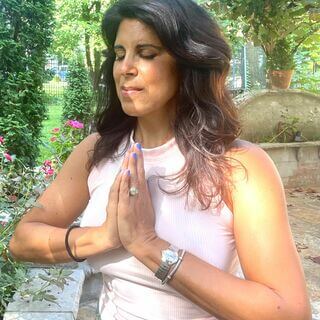
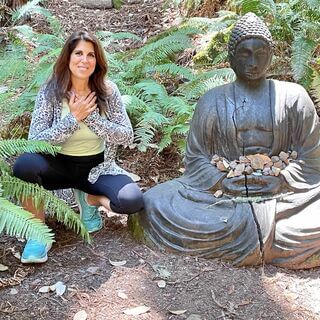
I'm Jonna and thank you for joining me today.
We will demystify the M-words,
Mindfulness and meditation,
Then we'll share in a mindfulness practice together.
So mindfulness can be referred to in many ways.
Look it up on the internet and get infinite definitions for it.
But the way I like to describe it is fitness for the mind,
Also known as mental fitness.
And the way I teach mindfulness and the way I was taught.
Was that it also allows us a certain lens.
Or a way to see the world through.
Specific.
Qualities such as presence being aware of our senses in the moment here and now compassion.
Curiosity.
And non-judgment Often non-judgment is the most difficult part because we are wired to judge.
We judge other people.
We judge what they think of us and how we fit into this world.
In social circumstances because we are wired with tribal instincts and we want to make sure that we belong.
In our tribe or community.
And so non-judgment can become very difficult.
I am going to share a little bit about how I got to be a mindfulness meditation teacher and how it affects my own daily life.
Because often people think that you have to be wired or a certain way or calm to practice mindfulness and meditation.
And that's actually not the case.
In fact,
I describe myself as an innately fidgety over thinker.
So if I can do this practice.
Anyone can.
When we talk about meditation,
Often people don't understand the difference.
And again,
These are just ways of defining words.
They could mean different things to different people.
But the way I like to describe meditation is a deliberate training of our awareness or attention.
So we can say mindfulness is fitness for the mind and meditation could be a fitness class or a way of training the mind in a specific manner.
In which we focus on one thing during the meditation so in the present moment so that could be mindfulness of breath and we would do a breath work meditation or meditating can even involve doing something that you don't necessarily consider to be meditative,
Like cooking,
Where you're really present.
In the act of cooking and you're using all your senses to see and feel and engage in the present moment with your senses so meditating could also be taking a walk in nature or washing your hands could become a meditation where you're sensing and feeling the temperature of the water and deliberately focusing on one specific thing in the present moment I will share a little bit about how I got involved in the world of mindfulness.
In 2006,
I found myself the emergency room with my youngest child she was about two and a half at the time and the doctor walked up to me and said It looks like your daughter has lymphoma,
Which is a cancer of the blood.
And in that moment,
Hearing that news,
My eyes began to well up with tears.
And this was in a split second before I could even speak.
The doctor said to me,
Get yourself together.
You need to be strong.
And I actually,
What I needed in that moment was just a moment to arrive into that news.
The doctor also did not know that I had sat in that emergency room four years prior,
Three seats over,
While my husband was diagnosed with cancer.
So there was still so much residual anguish and fear around that emergency room and then of course getting this news.
That my daughter may have cancer was really difficult and all of us have really difficult moments in life.
After that moment,
We were taken to the pediatric oncology unit at another hospital.
And I was alone in the ambulance with my daughter,
Just the driver and my daughter and I,
And she was sleeping.
And my mind worked like a popcorn popper of worst-case scenario thoughts.
So all I could think about was,
Will she make it to kindergarten?
And how am I gonna do this as a single mom?
And if my husband doesn't make it,
And will she lose her hair?
And why do I care about hair?
And every thought that can pop into a very fearful mind.
And as I got out of the ambulance at the children's hospital where we went,
A nurse walked up to me and the first thing she did was put her hand on my shoulder,
Look into my eyes and say,
How are you,
Mom?
And to this day,
When I think about that moment,
I can feel it.
Receiving compassion was probably the most powerful thing.
That could have happened to me in that moment and as she put her hand on me as she saw me as she saw my suffering i knew i could get through this and in the next few days uh there were a lot of tests done And ultimately,
We found out that she actually did not have cancer.
We did not have a diagnosis for a long time,
So there was still uncertainty.
But the day we got out of the hospital,
I remember thinking.
This feeling that I have,
This elation,
This feeling I couldn't quite describe was so powerful.
I wanted to bottle it up and share it with everyone.
And essentially that feeling was gratitude.
Just a few days before,
I wouldn't have thought twice about having a child that did not have cancer.
But in that moment,
I was so grateful.
And gratefulness is also a part of mindfulness.
Moment gratitude is also associated with the feeling of abundance and often mindfulness is overlooked,
But mindfulness can help us.
Achieve different emotions by having different thoughts and different perspectives on the world with intention.
So I'll share with you what these qualities of mindfulness look like in daily life.
I was recently in Trader Joe's,
A grocery store if you're not familiar with it.
And I had the opportunity to use my lessons in mindfulness in a rather imperfect moment.
So if we talk about mindfulness as having the qualities of presence,
Compassion,
Curiosity,
And non-judgment,
Which sounds just like a checklist.
What does that look like in daily life?
So as I was walking up to the cash register at Trader Joe's and carrying my basket,
I finally got to the cashier and it was my turn.
Yet the person in front of me was not budging.
In fact,
She was talking to the cashier and I was starting to get agitated.
In fact,
I gave it about a whole minute of my time.
And I noticed in my body this agitation.
Bye.
And because i practice mindfulness i knew the question to ask was what am i thinking and what am i feeling All my feelings were.
Anger and being triggered and my thoughts were Who does that?
Who keeps talking to the cashier when it's my turn?
Now,
Who does that can sound like a question,
Which we would infer as having curiosity.
But there was no curiosity in my thought.
Who does that was full of judgment.
I had already decided who does that.
Someone selfish with nothing better to do.
So as soon as I realized judgment i knew that the opposite of judgment is actually curiosity and i don't know that because i'm amazing or anything special i know that because i study and practice mindfulness so i ask myself a question to bring on curiosity What am I not seeing?
And i am not seeing anything except the story in my head which was one of judgment thinking who does that so i opened up my mind and my senses to listen and see what was in front of me and i began to hear the conversation between the cashier and the woman in front of me And I realized she had chosen his line very specifically to check on him and see how he and his family were doing.
And he shared that his wife and newborn baby are out of ICU.
And then he started explaining that his baby was going to survive and his wife was going to survive after the wife went into premature labor hundreds of miles from their home.
To his colleagues at Trader Joe's in their floral shirts and naming each one.
Who donated vacation time to him.
So each time he leaves work,
He does not lose pay when he goes to see his wife and baby who he just found out are both going to survive.
So this absolute wave of compassion comes over me.
I can certainly identify with what it feels like to worry about the life of your spouse or your child.
And I think most people know what it feels like.
To have that fear of losing someone we love.
I also had a lot of shame and shame can be defined as the belief that I am unworthy of love and belonging because I was judging this beautiful human who intentionally got in line to offer compassion to the cashier.
So in that moment of shame and of self-judgment,
I turned to a practice that I learned in mindfulness called self-compassion.
And I just said to myself,
Compassion in a moment of failure or mistake or something for which I felt shame.
I filled my cup.
Now,
What we don't do instinctively is often the opposite of that.
We justify because feeling shame is so difficult.
We choose to justify our behaviors or our thoughts in that case.
So if I had not done that,
It would have been very easy for me to look at the line of people behind me and justify why I was annoyed and frustrated.
They would have probably applauded me.
And I would have left Trader Joe's about four or five minutes earlier to justify pushing this woman out of my way.
But instead,
I had this beautiful moment of human connection with two former strangers and I left Trader Joe's.
Liking me I liked who I was because if I had just justified and let the shame be pushed down into my subconscious mind i would have held on to that because i'm aware of my emotions and my thoughts And I am subconsciously aware of thoughts I really don't want to face.
But by inviting that moment of self-compassion for myself,
I was able to fill my cup.
Like myself.
And actually adjust my behavior and i was kinder and more compassionate so this idea of being present with compassion with curiosity and with non-judgment can change our whole perspective on life and it's in the little moments that that is is a practice for us So I invite you to.
Use these qualities of mindfulness in your own daily life.
And we're going to end this session with a self-compassion practice.
So gently close your eyes.
And find a seat that you can sustain for just a few minutes.
We'll do a really basic practice.
So as you close your eyes,
Just settle into your body.
And notice the sensations in the body.
Perhaps you can ask yourself,
What am I feeling?
And what am I?
And name it so your thoughts and feelings are known to the mind.
And felt in the body.
And if you're not quite sure what you're thinking or there are too many thoughts,
Just release the pressure to think and instead Focus on the feelings of felt senses in the body.
And now I invite you to bring to mind something with which you're struggling.
It can be anything that's causing you just a little bit of emotional distress.
For suffering.
You don't need to overthink it.
Anything that comes to mind is meaningful.
So it could be a habit or something that happened.
Someone maybe hurt you or you hurt someone or there's just a difficult situation.
And as it comes to mind,
Just name it in a few words.
And now we'll bring in the three components of mindful self-compassion.
The first is simply mindfulness,
Allowing this experience to be known by the mind and felt in the body without denying or negating it,
Without saying it shouldn't have happened or it shouldn't happen.
It did happen or is happening.
Allow it.
Feel it.
And really focus on what it feels like in the body.
As you bring awareness to this There may be a part of the body where you're holding that pain or suffering or a sensation.
Just let your body feel it.
And now I invite you to bring in the second part of mindful self-compassion,
Common humanity.
Know your connection to others.
Know others suffer with whatever it is you are suffering.
So it doesn't have to be the identical situation,
But the emotion,
The feeling,
And perhaps the repeated thoughts.
Are human.
You can even say to yourself,
All humans suffer.
Anyone in my situation but also feel suffering.
And now,
The third component of mindful self-compassion,
Self-kindness.
I invite you to put your hand on your heart or on a part of the body that feels nurturing.
And I want you to say to yourself,
It's okay,
Sweetheart,
Or dude,
Or buddy,
Or nickname.
It's okay to feel this.
Okay to suffer.
In this moment.
You are nurturing yourself instead of being another judge to your experience or to your suffering you are caring for yourself Let's take one breath together as fellow humans who suffer.
Inhale in compassion for ourselves.
And exhaling that compassion outward to each other.
You can let your hand rest and gently open your eyes.
Thank you for sharing this moment with me.
May you bring self compassion into your life as well as presence.
Curiosity.
Compassion for everything around you,
And non-judgment.
And don't judge as you judge.
It's very human.