Hello,
Hello,
Welcome to this.
Three-part series on the four feminine archetypes.
I'm very excited to be here with you today talking about these things.
This part,
We will be talking about what the four female archetypes are,
How they relate to you as a woman,
And how they relate to your menstrual cycle as well as your cycles throughout your life on a weekly,
Monthly,
Yearly.
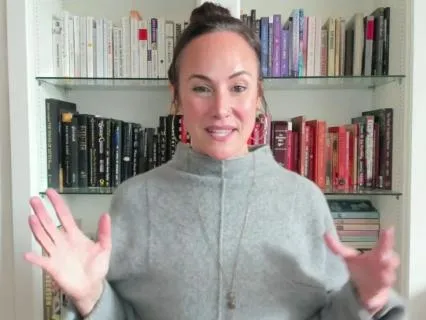
A lifetime level but first my name is jessica amos i'm a mindfulness and meditation teacher i'm a life coach and i'm the founder of stay with yourself which is the practice of being who you are where you are,
Learning to honor yourself in each moment,
Learning to honor yourself in each season,
In each cycle,
Wherever you are.
And that's very much at the heart of what we're talking about and why we are talking about the archetypes so that you can identify where you're at right now and honor yourself right now today.
And then also set yourself up to honor yourself tomorrow and next week and next month throughout the years by understanding that as women.
We have these ever-changing,
Beautiful cycles that we get to tap into for deep wisdom,
For deep creativity,
For great love.
And connection in the world.
Okay,
So let's get into these four female archetypes.
The first is maiden.
And then we have the mother.
The Wild Woman,
And the Crone.
And for a long time,
I was really obsessed with just these three,
The Maiden Mother Crone.
And then someone introduced to me this wild woman.
I was like,
Oh,
That right there,
That's the missing piece.
And the thing I want to talk to you most about today.
Is how we embody all four of these archetypes at all times throughout our life.
And you might be in any number of these phases in terms of your age in life,
But you might be embodying a different archetype,
Even if your age isn't quite lined up with that archetype.
So we'll get into that in a minute.
But before we do that,
I do wanna let you know that for parts two and three,
To talk more about these archetypes and how they tie into your menstrual cycle and your energy.
And how they even represent even more deeply like the seasons,
Spring,
Summer,
Autumn,
Winter,
By week throughout your cycle.
And then for part four,
We're gonna talk about how to really work.
With your cycle and the archetypes in order to.
Really live a deeply fulfilling,
Connected,
Soulful,
Heart led.
Life.
Okay,
So I love it.
I love it.
I love it.
So let's just start talking about the archetypes and what they represent.
And we're just going to keep it really simple with that today.
And I'll give you a little assignment at the end that you can work on before you watch part two.
Okay.
I love it.
So.
Maiden mother,
Wild woman,
Crone.
And the maiden phase is typically associated with ages like zero to 25.
We usually start our menstrual cycle right in the middle of that phase when we're either preteen or in our teens.
And the maiden phase is associated with spring.
Hello,
Spring.
It's creative.
It's the time right after menstruation.
So if we're looking at our menstrual cycle.
Spring and maiden energy is right after our monthly bleed.
And then we have the mother phase and mother is tied to summer.
Summer energy,
Which is very active.
It's very outgoing.
It's all about connection.
It's all about really,
Really being connected to other people in life and the world.
And that is when we are ovulating.
That's our ovulation phase.
So that is when we're the most.
Fertile and we really have like so much going on.
That phase and then right after ovulation before our actual menstruation comes the wild woman phase.
And this is the point where like we start to feel like some maybe from really strong emotions is where we get the most emotional.
We start setting boundaries.
So here we're like really social maybe last week in our mother phase.
And now this week we're like starting to set boundaries.
Everything we were maybe creating and starting to create and projects we started in our maiden phase just two weeks ago,
Starting to be like,
You know,
Maybe let's get rid of some of the superfluous stuff we don't want to do.
So it feels a little more erratic.
There's more boundaries around it.
It's preparing to bleed.
It's the wild woman phase.
It's autumn.
And we're starting to let some things go,
Kind of like dropping our leaves.
And then the crone phase,
Which represents winter.
This is the time when we just turn inward.
It's a time of stillness.
It's a time of rest.
It's a time to just be reflective and really start to listen to our inner wisdom.
It's a very meditative and inward focused.
Time.
So I love looking at the archetypes as seasons,
Spring,
Summer,
Autumn,
Winter.
So it doesn't have to be.
Maiden mother wild woman crone but they do kind of represent throughout the seasons just like you know um maiden is zero to 20 25 a mother's age is like 25 to 50 ish uh the wild woman is kind of 50 to 75 ish and then the chrome 75 plus But a really important thing to note about the archetypes is that we carry all of these archetypes inside of ourselves all the time.
So you can see,
You know,
Someone who's an actual crone,
She's 70 or 80 or 90 years old and she has this child-likeness,
Maiden-like quality to her.
We can be a child and have the wild woman living very much alive in us or,
You know,
We can be in our maiden phase and be very nurturing,
Same as a mother or in our mother phase and feeling more reflective and intuitive.
Really,
We have all these archetypes flowing through us at all times.
So no matter your age,
Whatever age range you're in,
You can identify with any number of the archetypes.
And there's probably a primary archetype that you are really relating to at this time in your life,
Not just in your menstrual cycle,
Not just where you're at in your cycle,
But where you're at just in your cycle of life,
Your season of life,
Whatever's going on for you.
You.
Is to just sit and write down these four archetypes,
Maiden,
Mother,
Wild woman,
Crone.
You can write down spring,
Summer,
Autumn,
Winter,
And there are different aspects of creativity,
Connection,
Letting go and turning inward,
And just which one of those phases are you in.
And along with that,
You can also,
I'm going to encourage you in parts two and three as well to go and listen to my seasonal courses.
I have four seasonal courses.
I have spring,
Summer,
Autumn,
And winter courses.
They're titled Spring Renewal.
Summer slowdown,
Autumn ease,
And winter restoration.
And if you dive into those courses based on whatever season you feel like you're in right now,
Even if it's summer,
But you feel like you're in your winter phase,
Your crone phase,
You can go listen to the winter course.
And that will really guide you in maybe how to honor where you're at in whatever archetype,
Female archetype you are embodying in your life right now.
And you can even listen to these courses.
Based on where you're at in your cycle too.
So we'll talk more about that later,
But I hope you really just enjoyed this high level conversation about the female archetypes.
I invite you to reach out,
Ask questions if you have them,
And just really reflect before part two on.
You know where you're at,
Okay?
Thank you so much for being here.
Until next time.
May you stay with yourself today and always.