I wanna say something that might frustrate you.
You will never ever.
Live a stress-free life.
Not with the morning routine.
Not with the meditation app.
Not with that.
Breath work,
Not with that journaling,
Not with cold plunges or a five-step evening wind-down routine.
Stress.
Not a problem to solve.
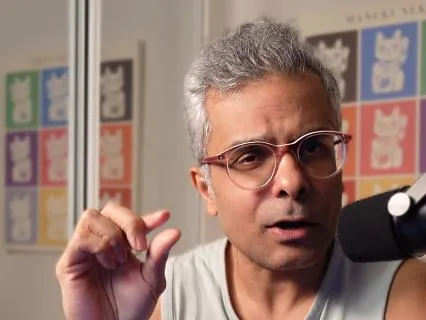
Welcome to daily practice with Nikhil.
Discuss all the questions that arises within us.
In a safe and sound But here's what I want you to know from research,
From personal practice and from working with real human beings.
In real messy lives.
That you absolutely can change your relationship with stress.
So completely,
So fundamentally.
That it stops running you.
That's the video today,
So welcome.
This is not about removing stress from your life.
This is the freedom.
You have been craving for.
To control it.
So stay with me and we will figure this thing out.
Most of you might be aware that 77% of people in the world experience physical symptoms.
Of stress related lives.
The WHO being stressed.
The human brain processes 70,
000.
80,
000 Thoughts per day.
And apparently 80% of them are negative ones.
So there is this link between what we think and how stress can be.
Manifested in ourselves.
And yet here's the radical thing.
And it's gone.
He's not your enemy.
The stress response,
What scientists call the HPA axis,
The hypothalamus,
Pituitary and adrenal.
Cascade which has evolved over thousands of years to keep us alive and survive.
It floods our body with cortisol and adrenaline.
Sharpens our focus,
Activates.
Our muscles and prepares us to fight flee or freeze.
So it is quite literally a gift of survival.
The problem is not the stress response.
System.
Has not caught up.
With modern life.
Our bodies can tell the difference between something that is out there in the world and something that is within us.
It cannot differentiate.
Between a predator in the wild and a passive aggressive email from you.
He responds to both as if It was something to be attended to.
Something that is risky.
And research comes back all the time.
And found that chronic stress literally reshapes the brain.
It thickens areas of the amygdala,
The brain's alarm system,
So you're constantly alert and alarmed in situations.
Weakens the prefrontal cortex,
That is the seat of this rational thought.
Perspective and self-regulation.
So there's this conflict between always on alarm and how do we regulate it?
And it became a self perpetual loop.
So chronic stress shrinks the hippocampus,
Which is the area which affects memory,
Learning.
And emotional regulation.
So that is kind of the.
.
.
Take.
On what stresses by everything you've tried as it was.
So why do most stress management?
Splendid is fading.
Not because people aren't trying.
They are trying enormously hard.
They're downloading the apps,
Booking those yoga retreats,
Buying the supplements.
The reason most approaches fail is because they treat stress as something to be removed.
Rather than as information to be understood.
So when you're stressed,
Your nervous system is communicating something.
And we have to look at it what it is communicating.
It might be,
This matters to me.
It might be.
.
.
Have crossed my own boundary.
It might be.
.
.
I am living.
.
.
Someone tells us life.
So when you numb,
Distract,
Suppress or medicate the signal away You cut the wire.
Without ever reading the message.
And we all have fallen into it at some point in our lives.
Avoidance-based coping.
Alcohol,
Passive consumption,
Overwork,
People-pleasing.
Creates what psychologists call.
Experiential avoidance.
Research again shown that.
.
.
Acceptance and commitment therapy shows that more aggressively we try to suppress an emotion.
Suddenly.
We try to suppress.
And emotion.
The louder.
And more frequent it becomes.
But you know that this.
.
.
What's up there?
In the consciousness of many beings already.
The Buddhists believe the second arrow.
The first arrow is the painful experience.
The second arrow.
.
.
The one We shoot at ourselves.
Is our resistance to that experience.
Our Judgement that we shouldn't feel this way.
Most of our suffering is down to the second arrow.
And this is where contemplative practices,
Traditions.
.
.
Which are thousands of years old for something as modern.
Humans.
He's only now catching up with.
And it is the fact that.
.
.
We cannot remove these difficult experiences.
But we can cultivate the capacity to hold it.
For thousands of years these contemplative traditions.
Without a similar truth.
That human suffering Is not.
.
.
What happens?
To us but from our relationship.
To what happens to us.
Marcus Aurelius wrote in Meditations.
You have the power.
Over your mind.
From outside events.
Realize this and you will find strength.
The Stoics called it the dichotomy of control,
A radical daily practice of distinguishing what is within your power and what is not.
The Daoist spoke of Wubei.
Effortless action.
Moving with.
.
.
Current of life.
Rather than fighting against it.
Modern neuroscience is now confirming.
Peace.
Traditions.
Ideas of Suffering.
And.
.
.
It is important to understand that this is what we are left with now.
So even looking at ourselves.
In a mindful pause can have dramatic impact in the way we handle the moment.
And conducts.
Thinking differently.
We start to cultivate a different.
.
.
Response to the situation.
And here is why mindfulness and traditions and practices such as this.
Help.
And I find most beautiful is.
.
.
This process.
This entire practice of trying to understand the mind.
And work with ourselves.
Can be liberating.
And mindfulness doesn't.
Ask you to be calm it doesn't ask you to clear your mind it doesn't ask you to stop feeling It asks you to witness your experience without being Swallow bite.
To become the sky rather than the weather.
Passing through it,
Which is a metaphor we might have heard many times.
And the point I want to try to make is.
.
.
This is a learnable skin.
Trainable capacity.
I know it from my own practice where I've had the benefit of learning mindfulness and experiencing it and also teaching it to people.
I found that these are practices.
That we can develop So I encourage you to take few steps in that direction.
And it always starts with baby.
We will be looking at the still method.
This is what I want you to take away from today.
It's not a five step system,
Not a hack.
It is a practice,
Something you return to.
Every single day.
Because consistency is where transformation.
.
.
Yes.
I call this the still practice.
So five elements,
Five to ten minutes.
You can do this first thing in the morning or when stress starts to.
.
.
Catch up with you.
So the first step of still method is.
.
.
First stop.
So the moment you notice the tension in your jaw,
Your shoulders,
Your chest.
Encourage you to stop.
Completely.
Even for 30 seconds.
Chronic stress thrives on momentum one thing after another and it just keeps latching at your.
.
.
Emotions latching at your feelings and it keeps dragging you into this loop so stopping by just paying attention to what is happening is probably the most crucial element and this is where i think a lot of traditional practices have helped to just pause.
The sense that you can pause is another liberating aspect of it.
Living.
And stopping is not a weakness.
It is actually first sign of self-governance.
People stop before they do something.
That's gonna hurt themselves.
So it is important to take that moment to stop.
As soon as you notice or whenever you notice,
Sometimes you may be right middle of whatever is stressing you out.
And what all the stresses are in your environment.
Still.
I would say two to three breaths.
Breathe in through your nose for four counts.
Hold for two.
And exhale.
For 6.
And doing this three times.
This is not a metaverse.
This is physiology.
The extended exhale activates vagus nerve,
The primary pathway for parasympathetic nervous system.
It's a fancy way of saying that you feel calmer when you have a longer exhale.
Within few few seconds or a minute You start to see the shift.
From fight to flight.
And this is called Sometimes referred to as the physiological side,
The fastest known way to reduce acute stress.
In real time.
Then we move into Inquire.
Now with that small window open.
Ask one honest question.
What am I feeling right now?
Not what you think,
You feel.
Not what makes sense to feel.
What you actually feel.
I'm anxious.
I'm exhausted.
I am overwhelmed.
I am grieving.
I am sad.
And as soon as you start to label these emotions.
Something curious happens.
It's time to be.
.
.
Less attention to it or you start to detach.
From that emotion And for the next 30 seconds.
.
.
Let it be.
Let it sink.
Let it be there.
No need to change anything.
And this is where one of the traditional practices Talk about.
.
.
Non-resistance.
And this is a practice we have to get involved because they.
.
.
Society we live in.
Is.
.
.
Completely obsessed with resistance,
Friction and changing things to friction.
With analysis.
Wishing it was different.
So,
Stopping.
And inquiring and letting it be can be a bit of a challenge.
In your body in this moment.
But we can do it.
The simple way is to just without judging it or noticing your judgments without judging it could be difficult because we are again trained to judge everything we see so it might be just paying attention to the judgments arising maybe writing it down maybe letting things be I invite you to find your own way.
Maybe you can speak about it Just let it be.
And this is what we can cultivate.
And then Most of the practices stop at that point.
And I think it's important to take the next step,
Which is.
.
.
What I call locating in an anchor.
So bringing your attention to point of sensory reality which means like something you can latch on to.
The weight of your feet on the floor,
The temperature of the room,
The breath,
The sound of the room.
Makes.
And this is grounding because this helps you to come back.
To this moment.
And it reorients your nervous system to the present moment.
Not the future.
To,
Uh,
Believe the boat.
Northern regretted past right here right now this breath this moment That is where.
.
.
Your power life.
So.
After the still method,
You may have many questions.
I invite you to take this moment to.
.
.
Explore within yourself what that means,
What has come up.
Take down notes,
Record yourself.
However,
He was to process what's happened and my chief do that.
I just wanted to say something before we close.
Stress will come.
It'll always be there.
This is not a failure of your life.
Or even your practice.
You now know that you have a choice.
That you did not have.
Before.
The choice to respond.
Rather than react.
To witness.
Rather than to be consumed.
To return.
Again and again.
To the still place inside you,
That stress.
Cannot reach.
So that is not a stress-free life.
That is something better.
That is.
.
.
A free life.
So if this has landed for you,
Share it with someone who needs it today.
And let me know how this goes.
And I will see you in the next practice.
Thank you for listening in.
My name is Nikhil.
I will.
And this has been.
.
.
Daily practice with Nikhil.
Practice makes progress and more.