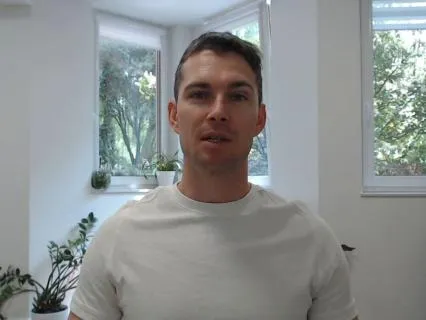
The concept and the practice of anchoring our attention in the present moment can be done in a variety of ways.
Today I'm going to be showing you how to use breath,
Body,
And senses.
To anchor your attention in the present moment.
Our mind can be in all sorts of places.
In the past present and future.
And we spend a lot of the day,
A lot of our time in this thinking space.
In this conceptual imaginary visual filled with symbols and language and stories place.
And when we do so,
Yes,
We can accomplish a lot.
I mean look around,
This has all.
.
.
Happened started with an idea.
However.
.
.
Our life is always unfolding in the present moment.
Our life is always happening here and now.
Moment by moment.
Concept and the practice of anchoring our attention in the present moment can be achieved.
By breath,
Body and senses.
A few more words about.
.
.
Anchoring and then we'll actually practice this together.
Why Anchor?
Anchor is used in ships.
In boats to keep them from drifting out to sea.
The anchor his body,
Breath and senses.
The boat is the mine.
In order for the mind not to drift out to sea,
We have the anchor that keeps it at bay,
Keeps it in the present moment.
This can be really useful when connecting.
In communication.
In experiencing the moment and what's happening.
And when the mind is particularly busy,
Or there's a difficulty present,
Or the emotions are high.
Then it can also be very useful to bring the mind back.
To a more grounded,
Centered.
Perhaps calm,
Compassionate,
Logical,
Creative.
Mode.
Because often the mind wanders into reactive mode.
From our autopilots.
Our automatic mode from are traumas of the past.
Saying all that.
Let's explore breath.
Body and senses as anchors.
Let's start with breathing,
And in particular,
The sensations of breathing.
And the invitation now is to focus your attention.
To the sensations of breathing wherever you feel them the most.
That might be in belly,
That might be in chest,
That might be around neck.
Nostrils,
Lips.
The invitation is to explore the.
.
.
The feeling,
The sensation,
The movement,
The pressure.
Of breathing.
That direct experience of breathing.
And what you'll notice is the mind can still be active.
We could be thinking about this.
We could be thinking about other things.
Yet.
The quality or the perspective quality and the perspective.
Potentially changes.
When we're both experiencing something in the present moment and having the mind running.
Maybe more in the background.
As you listen.
You are able to be more grounded and to sense more,
To understand more.
Holistically,
Fully what I am saying.
You're able to process the language,
The instructions,
And still feel sense be a bit with the breath anchored in breathing And with practice,
You can also do this while speaking.
I can speak to you all right now.
And be anchored in the breathing.
And with that,
I can connect with you more,
Be more present,
Be more aware of what's happening around me,
Inside.
The mind has the capacity to.
.
.
To think and feel.
Concepts,
And direct experience.
So the breath can be one of those anchors that you can keep in mind.
As you're navigating,
As you're living.
Another anchor you can explore is the body.
Different parts of the body.
For some people,
The anchor of the feet,
Sensing the feet,
Contact.
If you're seated the sit bones.
Or the butt cheeks can be an anchor,
The sensation,
The pressure,
The weight.
Directly experiencing that.
Hands,
Can be another anchor.
Whole body or particular parts of the body some People might feel this part more than this one or this part of the body is more traumatizing or triggering so you can focus on another one.
Perhaps when you're wanting to think more or be in the conceptual space,
Then.
.
.
Focusing on maybe a soft anchor.
However,
If something is is wanting you or needing for you to be very present,
You might focus on a lot of anchors at once or the full body breathing.
You can also use any of your senses.
Taste,
Always in the present moment.
Sight.
We can anchor our attention on something we see,
Something we hear.
Touch.
And.
.
.
Some people.
.
.
Call.
We call it the sense of thinking,
Or the mind can be a sense.
And while this might be more advanced for some people,
You can actually use thoughts.
Mantras,
Affirmation,
Words,
A particular phrase.
To ground you back into the present moment.
Because thinking always happens now as well.
Even when you're thinking about future or thinking about past,
You're still thinking about that here and now.
I invite you to practice this,
To explore this.
Even right now,
As you are continuing to listen,
What anchor can help me be more grounded?
And also to practice this throughout the day.
Practice it in different occasions,
In different scenarios.
It is a lifelong practice to explore how we can maintain.
More present moment awareness.
To be more anchored.
Moment by moment.
To be more anchored in the here and now.
This is the concept and the practice of anchors.
Thank you so much.
Till next time.