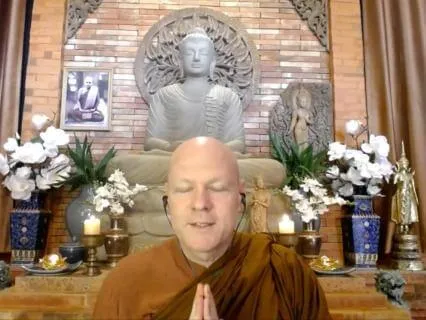
Good morning to our friends in Southeast Asia and Australia.
Good evening to our friends in North America.
I've been invited to give some.
.
.
Dharma sharing to the group in Canada.
It's my.
.
.
Honor and pleasure.
Thank you for the invitation.
The subject that I have been asked to talk about is.
.
.
How do we apply the seven factors of enlightenment in our daily life?
So it's a very.
.
.
Juicy.
And.
.
.
The seven Bojangha,
The seven enlightenment factors.
What's the first one?
For Django Sati.
Sankapo,
Mindfulness.
So we were just doing a guided meditation.
We were doing breath meditation.
A wonderful way to sharpen.
Clarify and establish this quality.
Presence of mind.
Truth discerning awareness.
So in the.
.
.
Anapanasati Sutra.
Thought by long putter.
Lord Buddha explains in the introduction.
That by sincerely and consistently practicing breath meditation,
The four foundations of mindfulness can be.
Fully cultivated.
And in the process of fully cultivating these four foundations of mindfulness,
The seven factors of enlightenment.
Are brought to fruition.
So that's very.
.
.
Important to note.
I often feel that breath meditation is underestimated as a practice.
Many people feel that.
They should do a little bit of breath meditation so that they can apply their mindfulness in other areas.
And here Lord Buddha is saying,
Actually.
Breath meditation.
In itself.
Is a practice that can fully fulfill the four foundations of mindfulness.
Bring to fruition completion.
The seven factors of enlightenment.
The other thing he says,
Of course,
Is that in bringing to fruition the seven factors of enlightenment,
The mind is liberated.
It's a very fabulous paragraph.
It starts with breast meditation and it ends with enlightenment.
One paragraph.
So we should notice this.
Of course,
Not everybody has all day to practice breath meditation.
But it's important,
The reason I'm making the point is.
.
.
I think we do underestimate its value.
Because when we come to SIT,
And you practice your breath meditation.
You will be aware.
Of feelings in the body.
You'll be aware of the body has come to sit.
And you'll be aware of feelings in the body.
So you're already developing mindfulness of the posture.
You know what posture you're in.
You're already developing your mindfulness of feelings that arise.
And when you give your attention to the feelings.
Associated with breathing.
Of mindfulness of feelings and then what happens?
You're trying to be.
Mindful of the breath and you have all sorts of thoughts,
Don't you?
And you might have dullness.
And so you become aware of various other mind objects.
And as the quality of mindfulness gets sharper,
Hopefully you begin to know this one's a wholesome one,
This one's an unwholesome one,
This one's a neutral one.
Begin to recognize what is a spiritual power.
And what is a hindrance.
So a great deal of benefit comes from simply sitting down and closing the eyes and setting the intention to be aware of the in and out breathing.
Develop a lot of mindfulness and wisdom if one does it correctly.
So I do recommend starting your day.
With breast meditation before you get busy with other things because it's through this act of meditating.
Former meditation,
Trying to make one object the object of the mind.
That's what.
.
.
Develop some energy another of the seven factors of enlightenment And that's what gives the presence of mind enough integrity and clarity that you can then try to apply it to other postures and other activities throughout your day.
If we are hoping to.
Apply the seven factors of enlightenment,
Cultivate the seven factors of enlightenment in our daily life.
I would recommend beginning with breath meditation.
In the day in the morning before you get busy with other things.
So that would also mean Not looking at your phone yet,
Turning it off.
And just possibly having it in a different room because these are devices.
Sending the mind out a lot,
Other people,
Other places,
Opening the mind to the Lokadhatu,
The worldly element.
And the mind gets all sorts of sense impressions about all sorts of things.
Don't do that straight away.
When you wake up in the morning.
Meditate.
Established clarity.
Before you expose the mind to all of those things.
The next factor of enlightenment is investigation into Dhamma.
This is very important.
So this is where having a sense of paying attention.
Mindfulness is sometimes translated as truth discerning awareness.
I like that description.
But there is delusion in the mind.
There wasn't delusion in the mind,
We'd be liberated already.
And the problem with delusion.
.
.
Is that it deludes the mind.
So you might not necessarily know that you're deluded.
When we are deluded,
Oftentimes we don't know,
Unfortunately.
This is why we need this quality of mindfulness.
We need to start shining.
Light and clarity into the murkiness,
The grayness,
The darkness so that we can start seeing these things.
Illuminate your mind with mindfulness.
So we need to recognize solutions.
And we need to apply antidotes.
So this is investigation into dharma.
This can also be reflective meditations.
So suppose,
For example,
You tend to think a lot about the future.
If you're a person who thinks a lot about the future and worries a lot about the future,
Lord Buddha recommended the death meditation.
So this is an investigation.
You investigate the fact that you could die today.
Through any number of means.
You also should pay attention,
Should ask yourself,
Of the various plans that I've made?
How many of them went as I planned them.
Because.
.
.
If we recognize truthfully that oftentimes the way we plan things is not how things go.
Then we might not invest as much energy.
You might have a loose plan,
A plan A,
A plan B.
A way that we hope things will go.
But then you start paying more attention to the way things are going or what is possible.
And so.
We need to recognize what is What are your frequent flyers in terms of delusion?
What are you obsessed about?
What takes away energy from the present moment and what what destroys your clarity.
Not good.
Describes the five hindrances as bandits,
As robbers.
Which steal peacefulness.
That's a very.
.
.
That's a very clear word.
The Buddha didn't say these 500s are your friends sometimes.
The Buddha said the 500s are robbers.
So what are they?
You've got your sensual craving.
Then you've got your irritation,
Your aversion,
Anger.
Soft and torpor,
Dullness,
Sleepiness.
And so the investigation of Dharma is also kind of noticing what is present in the mind.
And what are you doing that feeds it,
If it's a hindrance?
And what are the remedies that you might need to apply or the antidotes in aiming to make your mind a bit more balanced?
So the next hindrance,
Of course,
Is restlessness,
Worry,
Anxiety.
And the last is doubt.
So if we are a person who's very prone to restlessness and anxiety and worry,
What are things that you can do to stop exposing yourself to things that stimulate that?
So if restlessness and worry takes away a lot of your clarity.
And a lot of your wellbeing.
Is probably wise to limit the amount of news that you listen to and limit the amount of social media that you expose yourself to.
These days,
You open up your WhatsApp or your line or whatever it is,
And you literally never know what's going to come in.
You're opening your sensitive mind to the worldly loka datu,
The entire world,
In a way that wasn't possible 10,
15,
20 years ago.
But nowadays,
You can see something.
Wonderful,
Inspiring,
Uplifting,
And you can see something horrible,
Or you can hear some news which is terrible.
This day in age we hear news about everywhere all the time.
It wasn't possible 50 years ago,
A century ago.
It might take six months to hear what happened four valleys away.
So we need to recognize that.
A different time.
Technology has changed things.
And it's sensible to have boundaries with it.
So how much entertainment do you expose your mind to?
How much distraction?
I think it's very important.
You know,
You've invited me.
I'm a forest monk living in Thailand on a mountain,
Sincere meditator.
You've invited me to give you some dharma reflections.
So I'm going to be a bit firm with you.
Please allow me.
Many people feel,
I'm just going to challenge you a little bit.
Many people feel that their spiritual practice is the most important thing in their life.
If you have this mindfulness and investigation into Dhamma,
I want you to ask yourself,
Is it?
Is it really?
What I would like you to notice is how much time do you spend on social media and watching entertainment compared to how much time you meditate.
I would like you to notice how much you talk about Politics.
News the economy.
And relationships.
Compared to how much you investigate them.
And I think that most people will have to come to the conclusion that their spiritual practice is one of the important things in their life.
But possibly coming in at second or third.
And that's normal.
I'm not saying this in a scolding way.
But what I'm saying to you is.
If liberation is something that you really want,
The seven factors of enlightenment leading to liberation.
Then we do need to make our spiritual practice the most.
Important thing.
And if our spiritual practice is the most important thing,
I would suggest that that would be demonstrated.
By the fact that when we get up in the morning,
It's the first thing we do.
And then as we go throughout our day,
We will also find more time during the day to do some more.
And we wouldn't put our head down on the pillow at the end of the day unless we'd done a bit more before sleeping.
So a very sincere spiritual practice with liberation as its goal.
I believe,
Will have practice in morning,
Afternoon,
And evening,
Every day.
And then you have a powerful spiritual practice.
And then you are realistically laying the causes for some other of these facts of enlightenment.
With regards investigating Dhamma,
Knowing the quality of your mind,
Knowing the texture of your mind,
Knowing what's affecting it.
Knowing what you do to feed that.
Giving some consideration as to how you protect your mind and nourish the wholesome and abandon the unwholesome.
Put a sensible amount of constraint and restraint on entertainment and distraction.
Be careful with harsh,
Critical speech and gossiping.
I think something happens in social media,
Doesn't it?
Whereas it's a bit like road rage.
When you're in a aluminium and glass container.
You can get angry at other people because there's this perception of separation.
So if you were face to face,
You might not yell at a person.
But if they bumped into you slightly,
But if they're in a different car,
You might.
Because it's perceived separation.
They won't hit you back if you hit them.
And I think with the anonymity of comments in social media,
People can start becoming quite harsh and rude and mean in a way that they probably wouldn't be.
But it does still affect the mind.
So paying attention,
What kind of comments do you make?
How are these things affecting your mind?
I think most of us can notice that in general.
The world seems to be becoming more polarized.
The left is going more left.
The right is going more right.
You're either very pro-vaccine or you're very anti-vaccine.
There's not much in the middle anymore.
And Lord Buddha is explaining to us that if we Aspire to be,
Ajahnana often says,
Keep the mind in the middle.
It's the shortcut for practice.
The fastest way to liberation is to keep the mind in the middle.
Not allowing it to be swayed by liking and disliking too much.
That's the first hindrance.
And the second hydrant.
It's also the falling into the pleasure side.
On the falling into the.
.
.
Austerity side,
Which is not the middle way.
Trying to not fall into excessive sensuality,
Liking and loving.
Getting passionate,
Trying not to fall into excessive austerity.
Self-torture hating getting angry So what can we do to support our mind to be more in the middle and to have more clarity?
So this investigation into Dharma is very important.
It's not like just reading lists.
That I'm.
.
.
Is something I don't know.
My teacher explains that the Dhamma wheel is something which rolls in your mind,
In your heart.
So right mindfulness,
Right concentration.
Right speech which is going to come from right thought.
This is all in your heart,
In your mind.
And Tanajanana explains that.
When the dharma wheel is turning in the heart.
It's destroying greed,
Hatred and delusion and ignorance.
But if we neglect to have these qualities functioning in the heart,
Then greed,
Hatred and delusion are actually destroying the Dhamma.
So that's where the holy war is.
We need to be establishing right mindfulness.
We need to be establishing right thought so that we have right speech,
Which will manifest as right livelihood,
All of these other things.
So we do our meditation.
We pay attention.
What's my mind affected by?
How can I support it to be balanced?
So if you're falling into irritation often or even anxiety,
Worry,
Depression.
All of these things are kind of on the,
Probably on the irritation aversion spectrum.
Then this is when we need to have some summative practices.
We really do need to have several tools in our meditation kit.
We need to be cultivating the metta.
So I recommend doing metta practice for the first 10 or 15 minutes of every sit.
If you're going to do a 45 minute sit.
One of the reasons I recommend that these days is the world is.
.
.
Seems to have become more dangerous.
Predictable.
And also the whole COVID phenomenon.
There's a lot of distressing and sad news.
So we need to maintain a healthy sense of self-care and well-being.
So really establish loving kindness for oneself.
And then train in radiating it too.
More numbers of beings and more classes of being.
The Metta practice also really supports,
Tanajan Anand also explains that cultivating Metta helps us in developing our mindfulness because.
.
.
We'll have,
We often notice that irritation and anger kind of destroys clarity.
You might have a nice sit in the morning and somebody says something,
You get irritated,
All the clarity,
All the peacefulness is gone.
Or if you react.
Kind of threw the peacefulness away.
But if you have this capacity to hold the metta in the heart,
Someone else might say something irritating,
You instantly feel the.
.
.
Your sensitized heart which has loving kindness in it you're able to hold that loving kindness in your own body-mind phenomenon while you're experiencing the irritating thing.
You cannot react.
You cannot have the irritation.
And you also notice if an angry thought arises,
It's like a mirror.
And then you may not make karma with the speech.
So metta bhavana is another wonderful and powerful practice.
Helping us contain our irritation and keep the mind balanced.
And also.
.
.
Having something wholesome to pick up.
That protects the mind from falling into unwholesomeness.
That's why I recommend it.
As my teacher recommended it for me,
I found it very helpful.
The beginning of every session.
Because what happens is after a period of months,
A period of years,
You end up having quite a powerful metta practice and you have an ability to pick up metta.
I say,
Oh,
Right now I'm suffering.
Somebody said something that I find irritating.
Somebody said something was hurtful and I can instantly go to,
May I be well,
May I be happy?
Because in that moment,
I'm the suffering being and I recognize that.
And it's like replacing by opposite.
Instead of falling into feeling hurt,
Instead of falling into anger,
I can pick up loving kindness and radiate loving kindness inward.
It protects the heart.
And then you can eventually you can radiate loving kindness to the person who might have used to irritated you.
And not be irritated by what they say when your mental practice gets powerful.
So then what happens if we have our mindfulness,
Consistent mindfulness and our investigation into Dhammas?
So energy.
Ajahn Pathana often says that if it has a direct correlation to energy,
I would absolutely agree.
It's putting forth all of these skillful efforts that gives rise to energy.
So when we have energy coming from a good energetic practice,
Then these other factors of enlightenment can arise.
Thank you very much.
Thank you.
Authority tranquility.
So this is the good news is.
The nature of.
.
.
Your mind.
Is that if we don't pick up the unwholesome.
And if we keep it in the middle and we keep it balanced.
And we cultivate right mindfulness and right collectedness.
By the very nature of your mind you can experience.
Tremendous rapture.
Tranquility.
Serenity.
And this is everybody.
This isn't software.
This is hardware.
Everybody has this,
In being conscious,
In having the human body and mind phenomenon.
If you protect the mind from unwholesome objects and if you train the mind to give attention to wholesome objects and sustain its attention on wholesome objects.
And this truth discerning clarity.
You will begin to have rapture.
And tranquility and serenity arise in your mind.
We do need to maintain a consistency of practice to get this going.
It's a bit like.
.
.
Those old images of when people used to have to hand start,
Kickstart the car,
You know,
You have to kind of.
Motor they have to kind of wind it and wind it and wind it at a certain point that starts humming and turning over by itself but you'll notice to get the motor humming.
It did take a few.
They had to be energetic in getting it going.
Lord Buddha also explains the untrained mind as being like a wet stick in the swamp and you need to take it out of the swamp and place it on the.
.
.
On the bank until it dries out before it can catch light.
So this is why we need to be consistent in our practice because otherwise it's like dropping the stick in the swamp again and then putting it on the bank again and then dropping it in the swamp again and putting it in the bank again.
It's not going to fully dry out and catch light.
But if we are diligent and consistent in our practice and if we increase our practice to be doing more sessions per day.
Then the likelihood of you experiencing tranquility and rapture and serenity gets much,
Much greater.
And Lord Butter explains.
Peacefulness is the highest happiness.
So it's really important to understand this.
Duca.
First Noble Truth.
Unsatisfactoriness.
Suffering.
Is the nature of conditions yes that's true But there is pleasure.
And some pleasure is praised by Lord Buddha as being harmless.
And so the pleasures that are praised by the Buddha as being harmless is those pleasures that arise due to skillful and correct practice.
So rapture and tranquility are very wholesome things.
And what happens is a mind which has gladness.
Suppose you have a practice of generosity.
Thank you.
Have faith,
Very brightening,
Nourishing quality.
And you're doing a good amount of practice.
Then there's tranquility and wellness of mind.
A kind of resilient quality of wellbeing.
It's not like all misery and then at the end you become enlightened.
That's not the way it works.
Maybe for some people,
Particular karma.
But for most people,
You should start experiencing more well-being.
And developing skills about how to maintain a certain quality of goodness and tranquility and pleasure in the heart,
Wholesome pleasure.
Coming from maintaining skillful objects of meditation and skillful ways of reflecting,
Learning how to let go of the unwholesome.
So that mind which is experiencing well-being.
Freedom of remorse,
Having a refuge and a path and a direction.
That's what gives a rise to samadhi,
Right collectedness,
A quality of.
.
.
Establishing a very profound sense of presence of mind.
So for most people in this day and age,
It takes quite a bit of effort to really experience sammasamaki.
Whatever amount of collectiveness we experience,
It's important to understand that that is samadhi.
So Aja Nanan doesn't really talk about jhana and not jhana.
He talks about kanika samadhi.
Upajara samadhi,
Appana samadhi.
It's all samadhi.
So the Kanika Samadhi is when you get that feeling of some peacefulness,
Some collectedness for about five minutes.
That's Samadhi.
What happens is as your samadhi deepens and ripens,
Matures if you steward it that might become 15 or 20 minutes of of serenity and tranquility with only a few wholesome thoughts.
Arising or that'll be your upachara samadhi,
Your neighborhood concentration.
And.
.
.
Oftentimes it's more like in retreat type periods if you start to be meditating 10 hours a day.
Then the chances of actually experiencing apana samadhi are very stable.
So.
.
.
Unmoving sense of stillness.
Then that becomes possible.
But it's all samadhi and it's all wholesome.
And we should,
In one level,
We have to be content with the amount that we get without too much desire mind.
Because contentment while making an effort and increasing our efforts is a large factor in what gives rise to sama samadhi.
So many people have made a mistake where they get some experience of peacefulness.
And then the desire mind,
They want more,
Go back and want to get that again and it doesn't happen.
So we have to pay attention to what actually gave rise to a peaceful mind state.
It was being consistently with the meditation object and dropping desire.
Simply by applying the mindfulness to knowing the meditation object being with the meditation object,
Recognizing a hindrance and dropping it.
Then some sammaha sammati arises.
But if we come to the meditation pillar with,
I want to be more peaceful,
I want to be more peaceful,
That doesn't arrive.
So we have to recognize when we do experience peacefulness,
What were the conditions that led to it?
And then repeat that.
The last of the seven factors of enlightenment equanimity.
Very important.
We all know.
How much?
Misery we can cause ourselves.
By falling into desire.
Falling into irritation and aversion.
So equanimity isn't indifference.
It's a very misunderstood quality.
Equanimity is equipoise.
For the mine to be truly economist.
There's a lot of energy there because if you don't have good quality of energy in your mind,
You're not able to keep it from swaying.
So there's a profound presence of mind for you to have true equanimity.
And you're able to keep the mind in the middle.
Keep the mind balanced.
Remain serene.
And Semedo translates equanimity as serenity.
A very beautiful quality.
Other ways you can look at equanimity.
It's like if you really understand praise and blame,
For example.
If you really understand that they're a pair and they come together,
Nobody only ever gets praise.
Even the Buddha only got blame.
I mean,
How much energy do we waste and how much pain do we cause ourselves?
Thinking about the thing that we think somebody shouldn't have said to us that hurt our feelings five years ago,
10 years ago,
15 years ago.
And if we can just accept praise and blame is normal.
Everybody experiences it,
No matter whether you think it was right or wrong,
That they should have or they shouldn't have.
It's simply a phenomenon that human beings must experience,
Even the Buddha.
So we just,
Yeah,
Okay,
That was a blame.
And this is praise.
It's a pleasure.
That's pain.
Keep the mind in the middle,
Trying to know them as equal phenomenon,
Arising,
Staying for some time,
Ceasing due to conditions.
So pleasure is just this much.
Pain is just this much.
Praise you just as much.
Criticism,
Blame just as much,
A good reputation.
Poor reputation,
Fame and obscurity,
Or fame and ill repute.
Equanimity,
The best way to cultivate equanimity,
I believe.
Formal meditation because.
.
.
This is when you have the.
.
.
Integrity of mind to notice these things arising,
Staying for some time and ceasing.
A right,
Whatever they are,
The pleasure,
The pain,
The praise,
The blame,
The attachment to it,
The aversion to it.
Once you see these things arise and fall away,
Arise and fall away with more clarity and with more detachment,
Then you begin to understand,
Yeah,
They're equal phenomenon.
They're pairs.
And we all have to experience all of them to some degree.
And then also when you have those peaceful moments,
Whatever the hindrance was,
Whatever the key lasers were,
When you're able to take the mind to a space of serenity and clarity.
Then you know what equanimity is,
Not being swayed by liking and disliking and just resting.
And uh the more you're able to sit and watch a hindrance fall away and stop.
The more you're able to see whatever the mental formations are,
Whatever the proliferation is,
When we're able to see it and just see it cease.
With a sense of clarity.
Then.
.
.
We trust that more and more.
And we're able to bring this quality of clarity,
Mindfulness and wisdom into our daily life.
So that even when there are proliferations,
Reactions,
There's a part of the mind that doesn't believe it completely,
Which is observing it.
It's very very important sometimes it's like In life,
There's like three people.
In your experience as the one who's committed to the wholesome.
And there's the one that just wants to have fun or wants to act out an angry reaction.
And then there's the one that's observing them.
I don't know if other people have that kind of experience,
But sometimes for myself,
There's a conversation between three people.
Wholesome dumbness.
Unwholesome numbers and that which knows them.
And so that which knows is hopefully having a good conversation with the unwholesome one and restraining it and having a conversation with the wholesome one and encouraging it.
But when we're able to see with clarity.
Various hindrances arise and cease.
Various proliferations arise and cease.
Then we don't believe our opinions as much and we don't believe our reactions as much and we're able to bring this quality of main air,
Main air,
Which Ajahn Chah talks about,
Not sure,
Not sure,
Bringing this quality of not completely believing even our own opinions.
There's one that was talking about how opinions have become so polarized now.
It's like we should,
We have to have opinions,
We can't not.
We have to have our understanding of what we think is good and what we think is not good.
But we don't have to believe it 100% and we don't have to clobber other people on the head with it.
It's like,
This is my opinion.
That's the opinion I have with the information I currently have.
If I get different information,
I'm willing to change it straight away.
If they get more accurate information.
And I don't have to prove that I'm right.
And I don't have to contend with other people who I think are wrong.
I just know an opinion as an opinion.
And I try to hold it.
So let's review again.
Seven factors of enlightenment.
We have mindfulness.
We have to make.
.
.
To generate it and then maintain it.
For great efforts.
So sometimes people think a large part of practice is just be mindful,
Just be mindful.
Bye.
If you want to be mindful.
I would suggest to you that you have to clarify and establish mindfulness.
The morning.
So that's about the day you can just be mindful,
Just be mindful.
But if you're trying to just be mindful without putting some effort into clarifying a good quality of mindfulness,
It's probably not going to be very effective.
Investigation into Dama.
Knowing what is wholesome.
Knowing what is unwholesome,
Knowing what is neutral.
Recognizing what effects your mind.
How to support the wholesome and how to abandon the unwholesome.
That's where we really want our investigation of Dharma to be.
In the area of Your mindset.
What Dhammas are functioning in your mind.
And how you support the wholesome and abandon the unwholesome,
Which Dharma lists,
Which Dharma practices will support you in that process.
Wearinger.
So we have to put energy into our practice.
We have to make effort.
The right effort gives rise to energy.
Once we have a consistent practice,
Then we start to experience.
Rapture.
Tranquility.
This is a foundation.
Samadhi.
Right collectedness.
And then we have equanimity.
When equanimity is.
Fully cultivated,
I believe,
For fourth jhana.
Is comprised of equanimity as a profoundly concentrated state,
Which isn't moved by liking or disliking and isn't even affected very much.
Sure.
Or tranquility anymore.
And this equanimity on that level plays a very important role from what I've heard.
Once a person becomes a stream enterer.
It's the development jhana and that spending a lot of time in the fourth jhana is what really starts the roots of the greed and the hatred they're just resting in this unmoving,
Not being swayed,
Quality.
So it's good to know where it goes,
Equanimity,
And the role that it plays.
I hope that I've been able to say something useful to you and practical,
And I do wish you.
.
.
Success in your cultivation.
If I said anything offensive,
I ask forgiveness.
I did want to make some time.
Questions and answers also.
Thank you.
Saru.
One,
Two,
Three.
Sadhu Anu Modami.
I have three questions,
Actually.
The first question is actually in respect of the phenomenon in.
.
.
Related subject to rising and ceasing.
I wonder you can share some of the techniques as to how to observe the in-between stage of rising and ceasing.
So what should a meditator should observe?
Normally the rising and ceasing is so fast.
Yeah.
I don't think.
.
.
We need to be observing a rising and ceasing in every moment.
What we need to have is a quality of presence that will recognize it when it occurs.
So.
.
.
In between an in-breath,
For example,
There's the beginning,
The middle and the end.
And the mind is fairly peaceful.
There'll be some stillness.
And the stillness actually ceases.
The thing is,
We don't have enough mindfulness for clarity to notice the cessation of stillness that is occurring.
So the space also has a name.
So we have to we have to have clarity that notices when neutral phenomenon change as well.
So you have the beginning,
The middle,
And the end of an in-breath.
Great seats.
You have the space between the next.
And that if the mind is in a somewhat peaceful state.
You might not notice anything but that neutral state also.
Changes when the outbreak begins.
Then there's another feeling.
So we have to.
.
.
Sometimes we're also just staying still and observing.
And if you're not noticing any particular cessation in that moment,
It's okay.
But for example,
When there is a feeling that impinges.
That will be changing and then it will see if there's a knee pain or if there's a shoulder pain.
That will be.
When the marketplace gets really good,
People will see that there's a lot of changing even amongst neutral feelings.
There's a rising and ceasing and a rising and ceasing and a rising and ceasing and neutral feelings.
But I think what is important.
.
.
Is the quality of staying centered and staying still and observing.
And observing the situation when you can.
And then that's what makes the mindfulness sharper.
Be able to.
More and more clarity with more and more phenomena including the neutral and more subtle ways.
Yes.
Yes,
My second question is,
How should one handle adult in general?
Thank you.
So I think recognizing it.
Recognizing it and not believing it fully.
But this is where we have the doubt.
You can actually apply your doubting nature to not believe your doubt.
So this is where I don't charge recommendations.
To have a little bit of knowledge or awareness.
Not sure,
Not sure.
Whatever it is,
Yeah,
Not sure,
Not sure.
Not believing it completely.
And sometimes,
I mean,
Sometimes it's okay to have doubts.
The Lord,
What did it say in doubtful matters,
It's okay to have doubts.
He didn't ban doubting.
So suppose.
.
.
Somebody's telling you something's good for you.
But when you pay attention to the details a little bit more closely,
You realize that that's probably bad.
And it's okay to doubt that.
Because there are such things as wise and intelligent.
So one has to say what is.
.
.
What is the doubt?
Thank you.
And then it's okay if someone's telling you something's the truth and you're looking at them and you're realising that they're lying.
It's okay to doubt that.
Thank you.
Is good for you and you recognise it's harmful,
Then you doubt that.
But if you doubt your ability to meditate,
If you doubt your meditation object,
Well,
That's something that's harmful.
Because you have to have confidence in your ability.
So sometimes we have to,
Depends on what is the doubt about.
If you put his enlightenment,
If you doubt the Buddha's teaching.
If you doubt the existence of arahans,
If you doubt the capacity of the meditation object,
Well this can be helpful.
So sometimes we have to challenge.
If our doubts aren't intelligent or wise,
Then we have to challenge them.
Person doubts their abilities I think they'll never be alive That's not a reasonable doubt because.
.
.
Actually it's the potential of all conscious beings and there's no exceptions.
You can't have something which is a lord of nature.
Which applies to some and not others.
So,
Yeah.
Challenge.
Your doubts.
It's like,
No,
Just as the Buddha,
Before he was a bodhisattva and before he was a great spiritual practitioner,
Was an ordinary being who had a lot of achilles and a lot of hindrances at some point.
So this.
.
.
Demonstrates to us.
That ordinary beings have the most extraordinary potential.
That's just a fact.
And issue it is.
Do we?
So the cause is still gently.
Yeah.
If the doubt is wise,
You have the doubt.
And if it does,
Try to challenge it,
Try to stimulate faith,
Try to stimulate confidence.
The third question is actually related to mental volition or sankara.
What is the difference on the mental volition as to compare to the consciousness of the mind?
What are the differences and similarities?
Thank you.
I think.
.
.
When we try to investigate an arm and armaments,
It gets very tricky.
To say is what I didn't emphasize He's my main teacher.
I believe that he's now experiencing the result of liberating and purifying his mind.
I generally recommend that the main focus that we can is being aware of what you're doing with your body and being aware of the feelings of the body and investigation into the nature of the body.
That's what he says.
As well as.
That's why he says we should give primary attention.
And the reason is when we try to contemplate the numbers,
They're very fast and oftentimes we don't have the integrity of the mindfulness to be able to see them arising and ceasing.
Interlinking causal factors and what happens in trying to make Naama Dharma as a meditation object,
The mindfulness gets weak.
And the insight doesn't develop.
Body postures and the nature of the body and feelings arising due to body-based contact as the foundation what happens is the quality of mindfulness gets more powerful.
And then those insights into them.
Between consciousness and sense contact and thoughts occur but they occur when the mind is has the.
Mindfulness to see them.
So bad.
Thank you.
Recommends that we place out.
Yes.
Thank you,
Aja and Achelo.
And it's a real delight to actually have a chance to speak to you.
So my question is sort of in regard to a comment you made about having that presence of mind,
Knowing.
The unwholesome,
The wholesome.
And then this third.
Presence of knowing.
And I wonder if you could just and elaborate on that a bit more.
So.
.
.
Internet.
There's actually a word which is.
.
.
Used,
Which is called the Poo Roo.
The one who knows,
Which is probably better translated as that which knows.
So when we first come to practice that way,
Be established so much but what happens is when we are consistent meditation practice for a period of years what happens is this.
Quality of clarity that you can maintain throughout your day becomes more palpable.
It's like you have a walking stick.
You have this mindfulness with click.
Which is becoming more and more aware of my states throughout the day.
So it's a very good thing.
And we depend on that.
But it's not so sometimes when we use these analogies.
You know,
You have to use the limitations of language,
But it's as though there is a conversation.
Great.
Our bad habits that want to be reborn.
Our new habits that we're trying to.
.
.
Maintain.
And that which is kind of like refereeing or stewarding.
The process.
This is why I personally recommend meditating morning and afternoon and evening every day.
Not always sitting,
It might be some walking meditation or it might be for some people an energetic period of chanting.
Whatever works for different.
Practitioners to establish a sense of presence of mind and clarity.
And then we have the intention,
Very important to have the intention and the determination to maintain that sense of clarity through all postures and all throughout the day.
Doing the practices that support that sense of clarity that can be maintained consistently through the day,
Then I think,
Do you have some experience with that,
May I ask?
Of the clarity or the consistent practice.
Of being able to take that consistently through your postures through the day in your life?
Not consistently.
It's sporadic.
Right.
So may I ask you how many sessions you do each day?
Oh please don't ask.
No,
No,
I'm experiencing chronic pain.
And I'm really,
Really trying to find ways of practicing that don't aggravate that.
Right.
So the walking practice is another practice which is often underestimated.
And it's a very big part of the forest tradition,
Actually.
We just take.
The bottom of the feet as you walk as you're instead of the feelings of your breath and it can be trained very similarly or anchor that becomes the kind of calm in the storm that helps you generate clarity so that you can watch.
But if you don't have a committed,
Some kind of commitment to a regular formal practice,
You won't be able to have that consistent clarity.
That's the point.
Mindfulness is a sankara.
It's something which has to be karmically,
Volitionally brought.
Given importance,
Given presence of mind is something that we have to maintain.
We have to establish and maintain that presence.
It is.
A karmic formation which leads to that which is beyond karma.
It's a condition which leads to the unconditioned.
But we do,
Because it is a condition,
We have to bring it into being and we have to increase its power and we have to be consistent.
In the walking practice,
For example.
If you do need to lie down,
Well,
Maybe you chant while you're lying down.
So you do something that brightens and energizes the mind.
While you're in the lying down posture,
Various things that we have to do.
To establish a consistent sense of resilient clarity.
Thank you,
Adron.
Nice to meet you.
I had a meditative experience in a vipassana retreat I went to and I accidentally went into a very long meditation and I saw the lights and everything.
After a while,
The lights.
.
.
Went away.
It changed colors,
Very bright.
It went away and then I had the feeling of going into a pit.
Like,
I was still calm,
But I was going into space.
Like,
I feel like the.
.
.
The floor just dropped and I was just gravitating towards this.
And because I have no sense of the body.
So at that time,
Because I had spent so much time and effort to get to that piece,
Right,
I did not want to come out of the meditation because I was,
I could sit as long as I wanted because there was no more pain and no more,
No more sound and no more body awareness.
But that experience was.
.
.
So.
.
.
So scary for me.
Since then,
Now I realize that that hindrance for me was the attachment to that feeling of losing the sense of I.
And I wanted to understand,
Because I could never go back there again.
I went to many meditation retreats and I never ever got that kind of experience again.
So could you help me to understand how.
.
.
Outside of meditation,
We can understand this.
This I,
Yeah,
Contemplatively,
How can we resolve that in a conscious manner?
It's very interesting,
Isn't it?
We get fed up with the self-view with all of its likes and all of its dislikes and all of its disliking.
We really,
Really want some peacefulness.
And then you actually let go of it for a few moments.
And.
Fear comes up.
Not in that.
I'm pretty sure that in that experience,
There wasn't fear.
There was just peacefulness and having let go.
The fear is what I think occurred is the fear comes afterwards.
So it's what the self-view then does with that experience.
The self-view finds it very threatening.
And.
.
.
The thing that I would pay attention to is that's a good number of years ago.
You're still here and you're okay.
And.
.
.
Nobody ever died.
In a meditation posture from the meditation.
I think Ajahn Pabra told me once that somebody died in a meditation retreat,
But it was from a physical ailment.
It wasn't from the meditation.
So we need to challenge the fear.
If.
.
.
I think it's important to recollect that in the experience the mind was peaceful and content.
The mind is peaceful and content and there's no sense of self there.
The reason it's deeply peaceful and content is because there's no sense of self there.
And then what happened?
The census comes back.
So the experience.
.
.
The self-view.
The important thing to understand is that Having insight,
Having spiritual insight doesn't destroy the self,
And it doesn't destroy the self.
It does.
It helps a person,
The practitioner,
To understand what it is.
It's a habitual way of seeing things,
Which is not the ultimate truth,
But it's still conventional reality.
And so what happens is Ajahn Anand still has a personality.
I don't know how to personality.
No,
I don't like the forest mangoes.
Told everyone to give up smoking for the sake of their health and afterwards he still had the occasional cigarette.
So these.
.
.
These people have their personality traits.
Ajahn Anani is more likely to talk about Davis and past lives.
Ajahn Biak is more likely to talk about.
.
.
The subtle abilities of blessing and protecting.
Qualities of blessing and protection.
Lompolium is unlikely to ever talk about these things.
And so you have people who are.
Liberated from great hatred and delusion who still have a latent personality.
The point is they've seen it as.
A habitual way of grasping at the body and mind,
Which has a relative truth,
But is not the ultimate truth.
But the point is,
No matter how many peaceful meditations you have,
When you come out of your peaceful meditation,
You're still going to have a latent personality.
It's not going to be destroyed.
And.
.
.
It's okay.
I think that we need to bring the mind to a peaceful state and a sense of letting go.
Again.
To understand that,
Yes,
In peaceful mindset,
The sense of self is like,
Go on.
The mind comes out of the peaceful mindset and the sense of self comes back.
And this is one of the ways we develop insights into it.
It's like how this view.
Arises due to conditions.
And how we can reflect upon it to see that it's not the ultimate truth and that when we become familiar with peaceful mind states,
We become very comfortable with letting it go.
It's kind of,
Oh,
What a relief.
Get a break from that guy.
And then come out of the meditation,
Oh,
He's back again.
With his likes and his dislikes.
And so insight in samadhi isn't going to destroy your personality.
It's not going to make you crazy.
It's going to help you understand it.
And bring more mindfulness to it.
And have a skill.
Skillful stewarding of its healthy functioning.
But I think you need to challenge the fear of the experience and remember that you were peaceful in the experience.
And you need to acknowledge the fact that years have gone past and you're okay.
It didn't destroy anything.
Thank you,
Ajahn.
So any suggestions to how we can practice see this view?
Outside of meditation contemplatively like yeah so it's no no basically it's because you're doing at least 10 hours of sitting and data that's possible That's what made it possible because you're in retreat.
So unless you're at some advanced level.
You can't bring your understanding of the ultimate nature of emptiness into your daily practice.
This is something that has to be matured and repeatedly experienced many,
Many times.
And then an advanced practitioner can be aware of the ultimate nature of emptiness.
While having a conversation.
Must be really wonderful.
So Ajahn,
You are saying that we don't need to prepare our minds consciously and thinking about how to see this in a non-self.
Well,
As I said,
You need to meditate morning,
Afternoon and evening every day.
And then your right mindfulness will take care of the rest.
You will have your insights and your right mindfulness will give cause.
Give rise to right concentration.
And these experiences will happen again and you will understand them better.
But you lay the causes and the insights are what happens when you lay the causes.
We don't try to get the insight again.
That's the perfect way to obstruct it from arising.
Okay.
You just have to keep laying the causes.
Okay,
So thinking about it would not help,
You mean?
Well,
No,
Because it is self,
Right?
It's self having in the experiences.
It's an experience of letting go of self.
And then what's coming is afterwards you're reinterpreting it with concepts.
But the experience wasn't a concept and there was no sense of self in the experience.
So it's like you just have to trust.
The Dhamma,
And keep practicing and understand you'll experience it again.
And in a way,
You have to just leave it in the past.
Don't worry about it.
Okay,
So,
Sorry,
One last question.
So,
Like thinking,
The thoughts is not me,
Feelings is not me,
It will not help.
No,
I think it's helpful.
It is helpful,
But you can't.
We do it as part of the morning chanting.
It is helpful.
It's wise perceptions which will help.
Reduce our attachment to it.
Thank you.
I live in California.
There's smoke,
There's fire,
There's brush all over,
There's COVID,
There's.
.
.
Political instability,
Et cetera.
And of course,
There's the normal,
Expected,
Inevitable aging,
Sickness and death.
And I've been noticing kind of a background anxiety and the feeling that I'm waiting for the other shoe to drop.
Do you have any other.
.
.
Words of encouragement or advice about.
So I think.
I think the.
.
.
The COVID-related phenomenon.
I remember in.
.
.
10 day retreats that I used to teach.
And I would say to people around about the eighth or ninth day,
I remember saying this,
That,
You know.
Many of our parents and grandparents lived through.
Really challenging and traumatic experiences,
Which we have largely been spared.
In this generation.
Whether it was the Great Depression or World War I or World War II.
And.
.
.
We should recognize our extraordinary good fortune and we should practice more,
Not less,
Not take that for granted because.
.
.
The likeliness is it's going to change,
Unfortunately.
Our current state of incredible good fortune and blessing is vulnerable.
It always was.
It was always going to change.
And so.
On one level,
Samsara is just.
.
.
Business as usual.
And we're more affected by it.
But for a sense of perspective,
I think about four and a half billion human beings live on less than five US dollars a day.
So there has always been tremendous.
Not to say always,
But in this particular point in the eons.
There is tremendous difficulty and challenges.
Samsara is a really rough.
Place.
But what do we do when we've lived with a certain amount of security and well-being and pleasure and all of a sudden things got much harder?
What do we do with that experience?
Then I think this is where we need to be doing other supplementary practices that give rise to a feeling of.
.
.
Enjoy.
Enthusiasm,
We need to bring extra effort and energy.
So even myself,
I've been practicing for 25 years and when I think of my friends going bankrupt and people committing suicide and.
.
.
You know,
The consequences of the lockdowns as much as the consequences of the virus.
Like even in a country like Thailand,
Tens of thousands of bankruptcies.
And 40% increase in suicides.
And,
You know,
There's a lot of.
.
.
Terrible.
Awful things happening.
So for myself,
I've actually recommenced the three steps,
One bow practice.
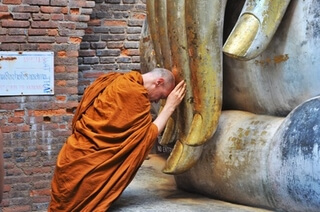
So now I go down to the bottom of the hill where the monastery gate is and I bow up towards the chedi because I found that.
You know,
The near enemy to compassion is sadness.
So you actually feel sad about all these people having such a miserable experience.
Or you see genuine cause for anxiety,
Like your life is becoming more difficult and may become much more difficult.
So it's like there's a validity.
The mind can really pick these things up because it's,
You know,
On a conventional level,
It's real.
Things got scarier.
Things got harder.
So what do you do with that?
So even for myself,
I found that like a full body practice,
Which requires a lot of energy for a period of hours,
It really shifts.
It can really shift a more heavy,
More sticky mind state.
So that by the time I've done that bowing for an hour.
The mind is bright and happy because I've taken the Buddha's enlightenment and my aspiration for liberation as my object in a very dynamic and fully engaging way.
So it shifts the mind state.
And it's like all of the terrible things are still occurring.
But the mind was able to put it down and not give it its interest or focus for a period of time.
Other people,
It might be a particular chant that they like.
So I was recently recommending the Jinnabandra guitar,
Visualizing the 28 footers on top of your head and suitors and arahants all around your body and doing it nine times.
It's okay.
In the past,
We might have done 15 minutes of chant and half an hour sit,
And it was enough because life wasn't too painful.
When life gets much more difficult and much more complicated and much more scary,
We need to really invest more into our spiritual practice so that it can be a real refuge.
We need to have a more dynamic and more energetic practice.
So even for myself,
I find myself doing that.
I'm doing more.
Devotional chanting and I'm doing more devotional practices which engage the whole body for a period of time to just shift these mind states so that it's more likely to experience peacefulness after that.
Thank you.
That's very helpful.
And the other thing is it produces good karma as well and the thing that's ultimately going to help us.
Is the merit that we produce.
Yes.
So these things produce more good karma,
Which hopefully will bless and protect you.
Lead you to a safer situation if you need it.
And perhaps if people would like to say goodnight,
That would be.
Thank you.
Thank you.
Happy to spend time with you.
Thank you.
Bon appétit.
Good night,
Ajahn.
Have a good meal.
Oh,
Hi,
Joyce.
Hello,
Ajahn.
Thank you everyone for organizing this talk.
Good night.