You see something in the world.
That feels very unjust.
It could be something in politics.
It could be something to do with a world leader.
It could be something closer to home.
When you see it,
Your chest tightens.
This is wrong.
This is not okay.
But what can I do about it?
There's really not much I can actually do to change this.
So maybe you talk to a friend and they say,
You know what the Stoics would say to you?
Focus only on what you can control.
And when you hear that,
You feel terrible.
You want to flip a table because you don't want to be told to just focus on what you can control when all of this injustice is going on in the world.
Well,
Let me tell you,
That advice is not stoic.
I want to start here with one of the biggest misconceptions in Stoicism,
And that is the dichotomy of control.
People think that the dichotomy of control means don't care about things outside of your control.
That's not what it means.
The dichotomy of control is not an invitation to detach from the world,
To stop caring,
To stop trying.
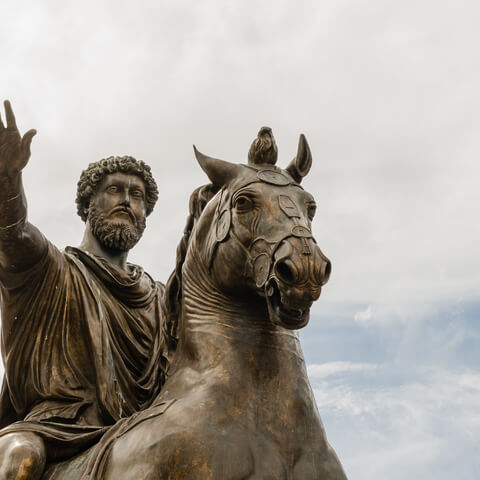
Marcus Aurelius wrote in Meditations.
The line,
You can commit injustice by doing nothing.
Think about that.
The most powerful person in the world,
The emperor of Rome,
Reminding himself that he can be unjust by doing nothing.
He is telling himself that he can be a bad person.
He can do a moral wrong by not doing anything at all.
Justice is one of the core four cardinal virtues.
Fair kindness,
Fair dealing.
Walking with others.
So if Stoicism is not telling you to not care,
What is it actually saying?
Okay,
Let's start with a very important basic Stoic idea.
Cosmopolitanism is the technical word.
The Stoics believe that we are all connected,
That we are social creatures fundamentally.
And so when you see people suffering over there,
They are yours.
They are mine.
You don't just draw a nice,
Neat circle around your little family and then say that everything and everyone outside of that is irrelevant.
It doesn't matter.
That's not how the Stoics thought.
There's a Stoic philosopher called Hercules,
Who you've probably never heard of,
But he drew these concentric circles,
Starting with ourselves,
Then our family,
Then our friends,
Then our wider community,
Outward and outward and outward until we get to the universe as a whole.
If we want to live a stoic life,
The goal is to keep bringing those outer circles inward.
So it's a complete misunderstanding,
This idea that I have my little group.
And anything outside of that,
I don't care about.
Therefore,
I can stay calm as long as my people are okay.
It's more like I have a duty to help everyone and to respond well.
It's more like life affects all of us and I have a duty to respond.
But.
.
.
I have a duty to respond well.
Now,
Let's be honest with ourselves.
When we see an injustice in the world,
We typically react with anger,
Rage,
Or maybe some despair or sadness mixed in.
We want to attack and shout and speak loudly.
We feel that a boundary has been violated and we want to fix it with rage.
Seneca was a tutor to Emperor Nero,
The psychopathic Emperor Nero.
And Seneca saw a lot of his.
.
.
Loved ones get murdered.
By this emperor and he himself was sentenced to death by Emperor Nero.
So he saw a lot of suffering.
And he had every reason to be anger.
And he still wrote an extensive book.
Or essay on anger called The Era.
And he said that anger is a temporary madness.
Now this doesn't mean that it's wrong to feel angry.
It just means that anger is probably not the most reliable guide for making choices.
I think we've all had that experience of being really angry,
Having an argument,
Posting something online,
Getting into a debate.
The question is,
Does it work?
Do we actually feel better?
Maybe we succeed,
Right?
And we get angry and we win an argument.
Are we not just a bit more arrogant?
And let's just say that we get angry and we lose and we fail.
Do we not just ruminate more and become more obsessed?
Marcus Aurelius believed that anger.
.
.
Hurts the individual more than the thing that provoked the anger in the first place.
So the idea here is not to never feel angry.
Just don't let anger be the person in the driver's seat.
Don't let anger call the shots.
Instead,
There's a little gap between that initial frustration or anger you feel and then the space to respond wisely.
Anger is like a fire that keeps needing more fuel to feed itself a lot of people when they they're angry they're not looking to not be angry they're looking for more reasons to be angry And that's kind of a problem.
Because when you're angry,
You're In this rage cycle,
Your nervous system is hijacked.
Are you really able to make the best,
Most practical decisions that will actually help the situation you're trying to improve?
Okay,
So let's talk about some things that actually help.
I have three stoic approaches that could be useful when dealing with injustice in the world.
The first thing is pre-meditation or pre-rehearsal of.
Misfortune,
You could say.
Marcus Aurelius in meditations would remind himself that he was going to be dealing with difficult people.
Unjust individuals,
Arrogant individuals.
It's actually quite useful to premeditate on this idea of human failure.
Seneca thought that one of the biggest reasons for our anger is when our expectations don't meet reality.
Nobody is made angry by things they expect,
He would claim.
So when we acknowledge that,
Yes,
In life there are.
.
.
Injustices.
There are unjust individuals.
There are people that do morally questionable things.
Then we prepare our nervous system to deal with it.
It doesn't make it acceptable.
It just takes away the extra shock.
We don't want to go through life thinking reality shouldn't be this way.
I can't believe that someone would act this way.
Yes,
They can act that way.
They've always been able to act that way.
And it actually helps us to be able to deal with the problem with a rational,
Clear head when we premeditate beforehand on the fact that these things are just part of life.
The second thing we can do.
Is redirect our anger.
This is quite interesting.
So the Stoics thought that the antidote to anger is kindness or care.
So if we start to feel ourselves getting angry,
We can take one direct action for others.
We can show up,
We can donate,
We can act kindly,
We just do one concrete thing to express kindness or care.
This is great because then it reduces the emotional turmoil you experience,
Which will potentially cloud your judgment,
Make you make bad decisions.
And by focusing on kindness and care,
It will help you actually start to solve the issue or the injustice you see in the world.
This also psychologically feels great because now you've moved from being a victim,
Being someone passive,
Watching the world burn,
To now someone who's participating,
Doesn't mean you've solved everything of course but now you're engaged you're not spectating you are now in the arena even in a small way And then the third thing we can do is just ask ourselves this question every day.
What is within my power right now?
So every day you ask yourself,
What can I do?
Instead of ruminating on all the things you can't do,
You just remind yourself that there are always going to be things you can do today to make a difference.
The question is,
How can I fix all of this?
Or why is the world like this?
Why can't I do more?
It's not any of that.
It's what can I do today?
Simple,
Practical.
The Stoics would not be put off by the size of a problem.
They wouldn't say to themselves,
There's a rigged system,
Everything is unjust,
Why bother?
They'd say,
Well,
Of course I can't fix this by the time I go to bed tonight.
So well.
Does that mean I shouldn't try?
No,
Of course.
I can still take action within my area of control.
In fact,
They often talked about the power of small steps.
Start small.
Get in the reps,
And over time,
Those things accumulate.
I want to make a quick note for the parents as well that are watching this.
Children observe what we do more than take in what we say.
We are,
Whether we like it or not,
Role models.
So we don't want to tell our children,
Hey,
Everything's fine.
There's nothing to worry about.
That's potentially dishonest.
Instead,
We can acknowledge,
Hey,
I know this is scary.
I know this is frightening.
I know this is difficult.
And here's what we are going to do about it.
I think the best thing we can give our children most of the time is to show through our actions and our presence the kind of person that we think would benefit them.
Being when they're older and there's a quote that i want to leave you with now i think and this is the most important part of this video Marcus Heretius wrote.
The best revenge is to be unlike the one who performed the injustice.
This is not a call for you to become passive.
This is a call for you to not become a person that you hate.
Not be anything like them.
Think of the irony.
We see someone dehumanizing someone and then we dehumanize them.
We see someone being cruel,
And we are cruel back to them.
We see someone bending the truth and then we bend the truth.
So that we can argue about the situation more effectively.
We are becoming infected by the same values that they hold.
The Stoics were clear that injustice.
.
.
Should be opposed.
Courage.
Was one of their moral virtues as well.
Standing up to bullies and tyrants.
The question is,
How do you oppose it?
Because while the world may or may not be going the way you want it to go,
Because while the.
.
.
Storylines in the world may be unfolding in ways you don't like.
One thing that is always yours is your character.
So don't lose that amidst the carnage external to you.
You can be furious and then remind yourself to be fair.
You can see injustice.
In the world and still decide not to lose your integrity in opposing it.
You can be heartbroken and still commit to the path of honesty.
So Stoicism is not asking for detachment.
Or indifference.
It's asking for something harder and something worth doing.
The Stoics lived through tyranny,
Wars,
Plague,
Executions,
Exiles.
They weren't comfortable.
Writing from the sidelines.
They were in the thick of it.
Using philosophy as their weapon,
As their shield,
As their armor.
And the central message that the Stoics taught was,
You may not be able to change the world.
But you can try.
And more importantly,
You can decide.
The type of person you want to be,
While you try.