The world’s largest free audio library for everyday wellbeing
Sound-Based
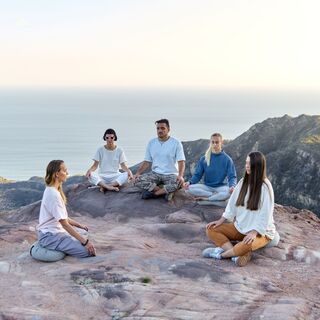
Silence retreat practice is the sustained holding of external silence, no speech and minimal environmental noise, most often within a multi-day residential meditation retreat.
Last Updated
4 Jul 2026
We are still reviewing this page. Our research team checks every technique page for accuracy and evidence quality before final release. Details may change as that review completes. The evidence badge shows our current reading of the published research.
RECOMMENDED DOSE
No direct dose evidence; editorial synthesis. A short, protected period of intentional silence a few times a week is a gentle, achievable entry point for someone new to silence retreat practice.
No direct dose evidence; editorial synthesis. Once shorter sittings feel comfortable, extending into a one- to two-hour silent block builds the capacity that a longer retreat requires.
No direct dose evidence; editorial synthesis. A dedicated half- or full-day of silence, undertaken periodically, reflects the traditional retreat format and is best approached only after shorter practice feels sustainable.
Session length
Session length: 15–30 minutes
15
MIN
How long each individual practice session should last from start to finish.
Frequency
Frequency: 3–4 days
3
DAYS
The number of days per week to fit a session into your routine.
Session length
Session length: 60–120 minutes
60
MIN
How long each individual practice session should last from start to finish.
Frequency
Frequency: 2–3 days
2
DAYS
The number of days per week to fit a session into your routine.
Session length
Session length: Half-day to full-day silence (4–8 hours)
60
MIN
How long each individual practice session should last from start to finish.
Frequency
Frequency: 1 days
1
DAY
The number of days per week to fit a session into your routine.
About this card. These recommendations are not a substitute for personalised guidance from a qualified practitioner. No direct dose-response literature exists for this technique; the guidance below is based on general practice conventions for silence and meditation retreats and should be treated as starting points only.
Quick answers to what people most often ask. Each card links to the deeper section below.
evidence
A meta-analysis of 21 retreat studies covering 2,912 people found moderate improvements in stress, anxiety, and low mood, with the average participant ending up better off than roughly two-thirds of non-attenders. The key limit: studies measure whole meditation retreats, not silence alone, and samples are often small.
Read moregood for
Adults wanting a deeper reset than short daily meditation offers may benefit most, especially those whose busy mind and keyed-up body need a longer runway to settle. Research covers general-population retreat attendees and experienced meditators. Silence retreat practice is not a substitute for care during trauma, acute anxiety, depression, or a fragile life stretch.
Read moresafety
Most healthy adults can practise a silence retreat with low risk. Take extra care with trauma, acute anxiety or depression, a psychosis-spectrum condition, or a raw life transition, since extended silence turns attention inward and can amplify difficult emotion. People with low blood pressure should stand slowly after long sitting to avoid brief light-headedness.
Read morehow it works
Removing the constant pull of conversation frees attention to steady itself instead of tracking the next thing to say. In intensive retreats, sustained practice strengthened response inhibition — the capacity to hold back a reflexive reaction — and blood pressure fell slightly, roughly 2 to 3 mmHg, felt as the body growing heavier and warmer.
Read moreSilence retreat practice is the sustained holding of external silence, no speech and minimal noise, usually within a multi-day residential meditation retreat, turning attention toward the inner soundscape that emerges.
Practitioners set aside speech and minimize environmental noise for a sustained period, from several hours to many days, usually within a residential retreat that follows a structured daily schedule of sitting practice under teacher guidance, often in community. The silence is held continuously rather than in short intervals, allowing progressively deeper layers of auditory and mental quiet to emerge. The practice is an active turning toward the inner acoustic and somatic environment, not merely the absence of external sound.
Silence retreat practice is external silence held within a contemplative retreat container; it is distinct from selective mutism, a childhood anxiety disorder involving an involuntary inability to speak in certain settings. It is also broader than any single meditation technique: silence is the shared condition across Vipassana, monastic, and Quaker forms rather than one specific method. Because it usually sits inside a full meditation retreat, its documented benefits reflect the whole retreat rather than silence studied on its own.
Not to be confused with
Selective mutism
Selective mutism is a childhood anxiety disorder in which a person is unable to speak in specific situations despite wanting to, an involuntary symptom that needs clinical care. Silence retreat practice is a freely chosen, time-limited turning toward quiet, not a disorder or a treatment for one.
A permanent vow of silence
A lifelong or open-ended religious vow of silence is a sustained way of life, whereas silence retreat practice is a bounded period of hours or days that practitioners enter and then return from to ordinary speech.
Sensory deprivation or float-tank isolation
Sensory deprivation removes external input to reduce stimulation, while silence retreat practice keeps the senses open and actively turns attention toward the inner acoustic and body environment that emerges once speech falls away. The aim is heightened attention, not withdrawal of sensation.
The silent treatment
Withholding speech to punish or control another person is an interpersonal behavior, unrelated to the inward, self-directed quiet of a silence retreat, which involves no one else and carries no relational intent.
Silence retreat practice appears to work by removing the constant pull of conversation, which frees attention to steady itself instead of tracking the next thing to say. In studies of intensive retreats broadly rather than silence measured alone, this kind of sustained practice strengthened response inhibition, the capacity to hold back a reflexive reaction, and those gains tracked with steadier emotional functioning (Sahdra et al., 2011). Early brain-imaging in a small group of experienced meditators points to retreat practice engaging attention-related regions, though with only five participants this remains a preliminary hint rather than firm proof (Kozasa et al., 2008).
Attention that usually scatters gets a chance to hold. With no conversation to track during extended silence, the mind has fewer places to jump, and intensive retreat practice has been linked to stronger sustained attention, the capacity to keep focus on one thing over time, which in turn relates to steadier emotional well-being (Sahdra et al., 2011). Early brain-imaging work also points to retreat practice engaging attention-related regions (Kozasa et al., 2008).
With talk set aside for hours or days, attention has fewer places to travel and tends to turn toward the body's quieter signals: breath moving, tension in the shoulders, the faint sense of a heartbeat. This inward turn sharpens interoceptive awareness, the felt sense of your own internal state, and early imaging work hints that intensive retreat practice engages attention-related brain regions (Kozasa et al., 2008), though this stays a small, preliminary finding rather than settled proof.
Extended silence leaves room to notice your own attention, to watch a thought take shape instead of being carried off by it. This capacity to observe the mind, called meta-awareness, tends to strengthen with intensive practice and is linked to steadier attention control and better emotional balance (Sahdra et al., 2011).
During retreat meditation, blood pressure has been measured to fall by a small amount, roughly 2 to 3 mmHg, which many practitioners feel as the body growing heavier and warmer as internal pressure quietly eases (Steinhubl et al., 2015). Longer residential retreats have also been linked to shifts in stress-related biology, including higher telomerase activity, an enzyme that helps protect the ends of chromosomes and tends to drop under chronic strain (Jacobs et al., 2010), alongside mixed changes in stress-linked markers such as BDNF (Cahn et al., 2017). These findings come from whole meditation retreats rather than silence by itself, the samples are small, and not every marker moved in a calming direction, so the body's response is best read as a gentle, variable settling rather than a certain change.
After a long stretch of deep rest, some people describe stress loosening its grip, and one study found a matching change deep in the body's cells. Telomerase, an enzyme that maintains and protects the ends of chromosomes, measured higher in people after a three-month residential meditation retreat than in those still waiting to attend (Jacobs et al., 2010). You can't feel telomerase directly, but the change tracked with feeling more in control and less internal pressure.
After the body has been keyed up, extended stillness lets it finally settle, and that shift shows up in the cardiovascular system. During retreat meditation, blood pressure, the force of blood pushing against artery walls, has been measured to drop by a small amount, roughly 2-3 mmHg, though the change varied widely from one person to the next (Steinhubl et al., 2015).
In the later days of a long retreat, many people describe the body feeling less braced and tender, more settled and able to recover. Extended silence within these residential retreats has been linked to shifts in inflammation signals, among them interleukin-10, an anti-inflammatory messenger the immune system uses to calm overactive responses, though changes across markers were mixed rather than uniform (Cahn et al., 2017).
When speech falls away for days, attention has far fewer things to track, and early brain-imaging during meditation retreats points to stronger engagement of the networks that steer and hold focus (Kozasa et al., 2008). Practitioners often describe this as attention feeling steadier and easier to place, with less pull toward mental chatter.
Heartbeat, breath, and subtle tension that usually go unnoticed start to stand out once speech falls away and attention settles inward on the body. That inward turn is thought to raise activity in the insula and anterior cingulate, the brain regions that read internal body signals; because direct imaging during silence retreats is scarce, this increase is inferred from the practice's interoceptive focus and broader meditation research rather than measured in silence practice itself.
Moderate but indirect evidence supports silence retreat practice for stress, anxiety, and low mood, with the caveat that studies measure whole meditation retreats rather than silence by itself. A meta-analysis of 21 traditional retreat studies (N=2,912) found a moderate improvement across combined psychological outcomes, Hedges' g = 0.49 versus control groups (95% CI 0.36 to 0.61), meaning the average retreat participant ended up better off than roughly two-thirds of people who did not attend, with a similar pre-post effect of g = 0.45 (95% CI 0.35 to 0.54) (Bassam et al., 2017). A systematic review of Vipassana and a controlled month-long silent retreat add convergent reports of reduced stress and greater well-being (Giridharan et al., 2025), (Montero-Marín et al., 2016). What is not yet supported: any claim that silence alone drives these effects, large high-quality trials, or use as a replacement for treatment of a diagnosed condition.
Low mood can sit heavy and feel hard to shift on your own. Across pooled studies of multi-day residential meditation retreats, which usually include long stretches of silence, participants showed moderate improvements in depression symptoms, though these trials measured whole retreat programs in general-population volunteers, not silence by itself (Bassam et al., 2017).
Stress can start to feel less gripping after time spent in extended silence. Reviews of Vipassana, the insight practice usually held in silent retreats, find that participants report lower stress and anxiety, which many describe as the mind feeling less crowded and the body less braced (Giridharan et al., 2025).
Pooled research on meditation retreats finds moderate improvements in anxiety, depression, and stress, and reviews of Vipassana together with a controlled month-long silent retreat point the same way, with participants also reporting greater mindfulness and well-being (Bassam et al., 2017), (Giridharan et al., 2025), (Montero-Marín et al., 2016). The physiological picture is more variable, with some stress-related markers shifting and others staying put (Cahn et al., 2017). The central limit is that these studies measure complete retreats rather than silence isolated, samples are often small, and overall certainty is low, so silence reads as a credible support for settling rather than a proven treatment.
1
Meta-analyses
1
RCTs
1
Systematic reviews
1
Observational
7
Pilot
Studied populations
Changes in peripheral oxytocin and vasopressin during a silent month-long Insight meditation retreat.
2024
Finding: In a month-long silent Insight meditation retreat, participants ended up with a small but real drop in oxytocin, the hormone often tied to bonding and closeness, compared with a control group, and that drop had no connection to changes in their attachment style or anxiety. So if you are drawn to a silent retreat, it is best not to expect it to work by raising "bonding hormones" or by calming anxiety through them; the biology here is early and mixed. This was a single, preliminary study with measurement limits, and a related hormone fell in both groups, which points away from any effect unique to the retreat itself.
See full citation in referencesYoga, Meditation and Mind-Body Health: Increased BDNF, Cortisol Awakening Response, and Altered Inflammatory Marker Expression after a 3-Month Yoga and Meditation Retreat.
n = 38
Finding: In this study, 38 adults (average age about 35) had their mood and blood markers checked before and after a 3-month residential yoga and meditation retreat, and afterward they reported less anxiety and depression alongside higher levels of BDNF, a protein tied to brain health and resilience. Their cortisol awakening response also rose, while inflammation-related markers moved in mixed directions, so the biological picture is not a simple story of "calmer chemistry." Because everyone attended the same retreat with no comparison group, and the retreat bundled meditation, physical practice, and diet together, these changes can't be pinned on silence itself. For someone considering a long retreat, this hints that an immersive, multi-part experience may shift both mood and body chemistry, but it doesn't isolate what silence alone contributes.
reported narratively
Extended silence has long been practised as mauna within Vipassana insight retreats, as contemplative enclosure in Christian monastic life, and as gathered, expectant waiting in Quaker meetings. Across these lineages, silence is treated not as empty absence but as an active turning toward the inner life that surfaces when speech stops. These roots help explain the practice's form, the residential container and the staged deepening of quiet over days, rather than proving any clinical effect.
For most healthy adults, a silence retreat is low-risk, and pooled research on meditation retreats broadly, not silence on its own, points to moderate gains in mood and stress rather than harm (Bassam et al., 2017). Two situations still call for care. Extended silence removes the everyday distractions that usually keep difficult thoughts and feelings at arm's length, so the first days of a long retreat can surface strong emotion, grief, or restlessness before anything settles; this caution comes from retreat experience rather than from safety-specific trials. People with low blood pressure may also feel briefly light-headed on standing after long, still sitting, an effect in keeping with the small blood-pressure drop measured during retreat meditation, the kind of settling you feel as the body growing heavier and warmer (Steinhubl et al., 2015).
Take extra care if you live with trauma, acute anxiety or depression, a psychosis-spectrum condition, or are moving through a raw life transition. Long stretches of silence turn attention inward and can amplify whatever feelings are already present, so support matters more in these situations; this caution reflects how the practice works and what retreat teachers report, rather than a measured finding in the cited studies. If you are new to meditation, start with a shorter, well-supported retreat, since most of the research involved experienced meditators and generalizes poorly to first-timers. And if your blood pressure runs low, stand slowly after long sitting periods so a brief wave of dizziness has time to pass.
Extended silence removes the everyday distractions that usually keep hard feelings at arm's length, so the first days of a long retreat can surface strong emotion, grief, or restlessness before anything settles. Take extra care if you live with trauma, acute anxiety or depression, a psychosis-spectrum condition, or a raw life transition, and choose a supported retreat with teacher check-ins. This caution comes from retreat experience and how the practice works rather than from safety-specific trials (Bassam et al., 2017), (Montero-Marín et al., 2016).
| Technique | Best for | Use with care | Evidence strength | Distinction |
|---|---|---|---|---|
| Vipassana / insight meditation retreat | Building sustained, structured insight practice with a defined technique and teacher guidance across a multi-day residential container. | Intensive insight practice can surface strong emotional material; those with trauma or acute distress should choose a supported setting. | moderate EVIDENCE | Vipassana is a specific insight technique built around non-judgmental observation of sensations and thoughts, and silence is one of its core supports rather than the whole practice. A silence retreat can hold Vipassana, but it can equally hold Christian contemplative sitting or Quaker waiting; the shared thread is extended external quiet, not a particular observation method. Most of the research that touches silence retreat practice was actually conducted inside Vipassana or mixed retreat settings. |
| Mindfulness-Based Stress Reduction (MBSR) | People who want a structured, secular, evidence-familiar program they can fit around work and family without leaving daily life. |
Mostly, but not as an absolute rule. Silence is the core structure of the retreat, held for scheduled hours or days, yet most retreats build in daily check-ins with a teacher, and you can always break silence to ask for support or step out.
+
Mostly, but not as an absolute rule. A silence retreat means holding extended external silence within a structured residential container, so speech is set aside across the scheduled sitting practice rather than policed as a strict vow. Many retreats still allow brief spoken check-ins with a teacher, and choosing to break silence to reach support or leave the room stays your decision throughout. This describes how the practice is arranged across traditions like Vipassana, Christian monastic, and Quaker settings, not a claim that stricter silence produces any particular effect.
There's more to it. A silence retreat is not simply the absence of noise but an active turning inward: sustained external silence (mauna) held within a residential retreat, where attention shifts toward the inner soundscape and body sensations that surface once conversation falls away.
+
There's more to it. Silence retreat practice means holding extended external silence, no speech and minimal environmental noise, most often within a multi-day residential meditation retreat with a structured daily schedule. The point is not empty quiet but an active engagement with the inner world, mental chatter, subtle body sounds, and layers of stillness that emerge in stages the longer you stay. This form has long been part of Vipassana insight, Christian monastic, and Quaker traditions, which treat silence as a doorway toward inner attention rather than mere absence.
The practice of holding sustained external silence, setting speech aside for a set period, as observed in many contemplative traditions and central to a silence retreat.
An insight meditation, usually practiced in multi-day silent retreats, that trains non-judgmental observation of sensations and thoughts as they arise and pass.
The felt sense of your own internal state, such as breath moving, a heartbeat, warmth, or tension. Sharpening it helps you notice early stress signals and steady yourself before feelings escalate.
The perception and interpretation of visceral afferent signals; greater interoceptive awareness improves detection and tolerance of internal bodily states.
Attention directed outward to the environment through the senses, which shows up as sound, texture, and detail becoming vivid once conversation falls away.
The perception and interpretation of external sensory stimuli received through the five senses and other outward-facing modalities.
The ability to notice your own thoughts and attention as they happen, watching a thought take shape instead of being carried along by it.
A shift into the body's rest-and-recovery mode, felt as being more settled, less tense, and better able to relax after a stretch of feeling keyed up.
Increased activity in the parasympathetic branch of the autonomic nervous system, largely via vagal pathways, shifting physiology away from fight-or-flight toward recovery.
The capacity to hold back a reflexive reaction, giving a small gap of choice before acting. In retreat studies, gains in this ability tracked with steadier emotional and social functioning.
Conklin Quinn A, Zanesco Anthony P, King Brandon G, Epel Elissa S, Saron Clifford D (2024). Changes in peripheral oxytocin and vasopressin during a silent month-long Insight meditation retreat.. https://doi.org/10.3389/fendo.2024.1345527
Cited in: Research
B. R. Cahn, Matthew S. Goodman, C. Peterson, R. Maturi, P. Mills, Cahn B Rael (2017). Yoga, Meditation and Mind-Body Health: Increased BDNF, Cortisol Awakening Response, and Altered Inflammatory Marker Expression after a 3-Month Yoga and Meditation Retreat.. https://doi.org/10.3389/fnhum.2017.00315
Outcomes measured
| Outcome | Effect size | 95% CI | N | Comparator | Source |
|---|---|---|---|---|---|
| combined psychological outcomes (pre-post) | Hedges' g = 0.45 | 95% CI 0.35 to 0.54 | 2,912 | — | Bassam et al., 2017 |
| combined psychological outcomes vs controls | Hedges' g = 0.49 | 95% CI 0.36 to 0.61 | — | controls | Bassam et al., 2017 |
| telomerase activity vs controls | reported significant; p<0.05 (1-tailed) | — | 60 | wait-list control | Jacobs et al., 2010 |
| mean arterial blood pressure during meditation | reported significant; p<0.0001 | — | — | — | Steinhubl et al., 2015 |
The research is useful for setting expectations, but study methods and participant groups vary. Treat the findings as general guidance rather than a promise about any single session, and not a replacement for clinical care.
Psychological Effects of a 1-Month Meditation Retreat on Experienced Meditators: The Role of Non-attachment.
n = 19
Finding: In a month-long silent Vipassana retreat with 8 to 9 hours of daily practice, 19 experienced meditators showed rising mindfulness, well-being, non-attachment, and positive mood compared with 19 similar people who did not attend. For someone drawn to a silent retreat, this hints that extended, quiet immersion can lift how present and content you feel, though the gains here belong to people who already had a steady practice. Keep in mind this was a small study without random assignment, and silence was only one part of a full retreat that also involved intensive meditation and a structured daily routine, so we can't credit the silence alone or assume the same results for beginners.
reported narratively
Enhanced response inhibition during intensive meditation training predicts improvements in self-reported adaptive socioemotional functioning.
2011
Finding: Over three months of intensive retreat training, participants got noticeably better at holding back automatic responses, a core marker of self-control, and this group was compared against others who waited and later did the same training. Tracking people over time, those early gains in self-control tended to come before improvements in how well participants said they were handling emotions and relationships, which points to sharpened attention as one plausible way retreat practice supports well-being. For someone considering a retreat, this hints that the steadier focus you build may be part of what carries over into calmer, more adaptive daily functioning. Keep in mind this looked at long, immersive retreat conditions rather than silence on its own, so it suggests a pathway rather than proving that any single ingredient causes the change.
See full citation in referencesPreliminary functional magnetic resonance imaging Stroop task results before and after a Zen meditation retreat
n = 5
Finding: In this early brain-imaging study, five experienced meditators were scanned before and after an 8-day Zen retreat while doing a focus task, and afterward their brains showed stronger activity in regions tied to paying attention and filtering distractions. For someone considering extended silent practice, this hints that time on retreat may exercise the same circuits we lean on to stay focused. That said, with only five participants and no statistical testing, this is a very preliminary look rather than proof, so treat it as an intriguing early signal rather than settled evidence.
reported narratively
Mindfulness meditation, well-being, and heart rate variability: a preliminary investigation into the impact of intensive Vipassana meditation.
n = 36
Finding: In this preliminary study, 36 people had their heart-rate variability measured before and after a 10-day intensive Vipassana retreat, and afterward their meditation shifted this marker of nervous-system flexibility in a distinctive way. Rather than a simple slide into deep relaxation, the pattern looked more like the focused, absorbed state of "flow" that comes with sustained attention. So while silence retreats do appear to change how the body responds during practice, this doesn't neatly translate into "silence calms your nervous system." Because the study was small and compared each person only to their own earlier readings, treat it as an early clue rather than settled proof.
reported narratively
The Impact of Vipassana Meditation on Health and Well-Being: A Systematic Review of Current Evidence
2025
Finding: This review gathered 11 studies of Vipassana meditation, the insight practice often taught in silent retreats, and found that participants reported less stress and anxiety along with gains in mindfulness and overall well-being, with the clearest improvements among people in intensive retreats and those with more experience. For someone considering a silent retreat, that points to a real potential upside, especially if you commit to a deeper, longer format rather than a brief taster. Keep in mind the studies were mostly small, and only three were randomized trials, so the certainty here is modest. The research also looked at full meditation retreats as a package, not silence on its own, so we can't say silence itself is the active ingredient.
See full citation in referencesEffectiveness of traditional meditation retreats: A systematic review and meta-analysis.
n = 2,912
Finding: This review pooled 21 studies of traditional meditation retreats covering 2,912 people and found a moderate improvement in depression, anxiety, stress, and quality of life, both from before to after a retreat and compared against people who didn't attend one, with the gains still holding at follow-up. For someone considering time away on retreat, that points to a real, lasting lift in mood and calm rather than just a short-lived holiday effect. One important caveat: these retreats bundle silence together with meditation, simpler routines, and time away from daily life, so the results reflect the whole experience, not silence on its own, and the studies varied widely in design and quality.
Hedges' g = 0.45
Cardiovascular and nervous system changes during meditation.
2015
Finding: During a week-long silence retreat, researchers used wearable sensors to track 40 people (20 seasoned meditators and 20 newcomers) as they practised, and found that blood pressure dipped by a small but reliable 2 to 3 mmHg during meditation, alongside distinct changes in brain-wave activity. That points to a modest, real settling of the body while you sit, though the effect on heart-rate variability (a marker of nervous-system flexibility) was unclear and differed a lot from person to person. Because responses were so individual, it is worth treating your own experience as the guide rather than expecting a fixed physical result, and the study only captured what happens in the moment of practice, not lasting change.
reported significant; p<0.0001
Self-reported mindfulness and cortisol during a Shamatha meditation retreat.
n = 57
Finding: Over a three-month silent Shamatha retreat, 57 participants reported clear gains in mindfulness, but their resting evening cortisol, a stress hormone, showed no reliable drop across the retreat. There was one nuance: the people whose mindfulness rose the most did tend to show lower cortisol, hinting at a link between the two rather than a guaranteed effect for everyone. For anyone drawn to extended silent practice, this suggests you may notice a stronger sense of present-moment awareness, but you shouldn't count on a retreat alone to lower your baseline stress-hormone levels. Because this was a single observational study without a comparison group, its findings point to a possible connection worth watching rather than proof of cause and effect.
reported narratively
Intensive meditation training, immune cell telomerase activity, and psychological mediators.
n = 60
Finding: In this trial, 30 people who completed a 3-month intensive residential meditation retreat showed higher activity of telomerase, an enzyme that helps maintain and repair cells, than 30 similar people waiting to attend. The difference tracked closely with two mental shifts the retreatants reported: a stronger sense of being in control of their lives and lower levels of anxiety-prone temperament, which suggests the biological change went hand in hand with feeling calmer and more grounded. Keep the scope in mind: this was a demanding full-time retreat built around concentrated meditation rather than silence alone, the group was small, and the researchers did not measure telomerase before the retreat began, so it points to a promising link rather than proof that retreat practice slows cellular ageing or extends lifespan.
reported significant; p<0.05 (1-tailed)
People with low blood pressure may feel briefly light-headed when standing after long, still sitting, in keeping with the small 2 to 3 mmHg blood-pressure drop measured during retreat meditation. Rise slowly and pause for a breath so any wave of dizziness has time to pass (Steinhubl et al., 2015).
Most of the research involved experienced meditators and generalizes poorly to first-timers, so if silence is new to you, start with a shorter, well-supported retreat before committing to a longer container. Begin with a half-day or single day of quiet to let your system get used to the way attention turns inward once conversation falls away.
A silence retreat is best entered through a supported residential setting led by trained teachers, so you are never sitting with intense inner material alone. If silence is new to you, a gentle way in is a half-day or single day of quiet before you commit to anything longer, giving your system time to adjust as conversation falls away and attention turns inward. It also helps to know in advance how to reach a teacher, since continuing always stays your choice.
Pick a residential retreat run by trained teachers who hold daily check-ins, so you are never managing intense inner material alone in extended silence.
Tell the teachers about any trauma, mental-health diagnosis, or recent instability ahead of time, so support is ready if difficult emotion surfaces during the quieter, more inward days.
If silence is new to you, begin with a half-day or single day of quiet before committing to a multi-day retreat, letting your system get used to the way attention turns inward once conversation falls away.
If you are in treatment for a mental-health condition, treat the retreat as a wellbeing practice alongside that care, not a replacement for it, and keep your clinician informed.
When you stand after an extended still period, come up gradually and pause for a breath, so any light-headedness from the settled, lowered blood pressure has time to pass.
Agree in advance how to reach a teacher or step out if you feel overwhelmed, so continuing the practice always stays your choice.
This information is educational and is not medical advice. This practice is not a substitute for professional care and should not replace prescribed medication or treatment for any medical or mental-health condition. If you are managing a health condition or taking medication, talk with a qualified health professional before changing your practice. If you are in distress or crisis, seek professional support.
| moderate EVIDENCE |
| MBSR is a secular, manualized eight-week course of guided mindfulness practice done in ordinary daily life, whereas silence retreat practice removes speech and daily demands entirely for hours or days at a stretch. MBSR trains attention in short home sessions with weekly group teaching; a silence retreat compresses practice into a continuous immersive stretch. The two overlap in cultivating present-moment attention but differ sharply in dose, format, and how much they interrupt normal routine. |
| Concentrative / Shamatha meditation | Developing steady, single-pointed focus through a repeatable technique that can be practiced in short daily sittings. | emerging EVIDENCE | Concentrative practice trains attention by anchoring it on a single object such as the breath, an active focusing effort that can happen in a short daily sitting. Silence retreat practice instead removes external speech and stimulation so attention naturally turns inward over an extended period, without necessarily fixing on one anchor. Several of the physiological findings linked to silence retreats actually come from intensive Shamatha retreat cohorts, since the two often share the same residential container. |
| Secular quiet retreat or digital detox | People wanting rest and relief from constant noise and connectivity without a religious or formal meditation framework. | emerging EVIDENCE | A secular quiet retreat or digital detox reframes extended silence as rest and disconnection from noise and screens, without the contemplative worldview or structured sitting practice that anchors a traditional silence retreat. The felt relief of stepping away from chatter overlaps, but the traditional form treats silence as an active turning inward under teacher guidance rather than simply a break from stimulation. Research support here is thinner and mostly borrowed from broader retreat and meditation studies. |

Moderately, based on indirect evidence. Pooled research on meditation retreats links these multi-day containers to modest easing of stress and anxiety, but studies measure whole retreats rather than silence on its own (Bassam et al., 2017).
+
Moderately, with an important caveat about what the evidence covers. A meta-analysis of traditional meditation retreats found a moderate improvement across psychological outcomes versus controls, and reviews of Vipassana, commonly practised in silence, point the same way toward reduced stress and anxiety (Bassam et al., 2017), (Giridharan et al., 2025); a month-long silent retreat also reported greater mindfulness and well-being (Montero-Marín et al., 2016). The picture is promising but not settled: studies measure complete retreats, not silence in isolation, samples are often small, and this is a support for settling rather than a treatment or replacement for care for a diagnosed condition (Bassam et al., 2017).
Moderate but indirect. The available studies measure whole multi-day meditation retreats, not silence on its own, so silence reads as a credible support for settling rather than a proven standalone treatment (Bassam et al., 2017).
+
Moderate but indirect. A meta-analysis of traditional retreats found moderate improvements in stress, anxiety, and mood (Bassam et al., 2017), and a Vipassana review plus a controlled month-long silent retreat converge on the same finding (Giridharan et al., 2025), (Montero-Marín et al., 2016). The key limit is that these studies measure complete retreats rather than silence isolated, samples are often small, and overall certainty is low, so no evidence yet shows silence alone drives the effects (Bassam et al., 2017), (Giridharan et al., 2025), (Montero-Marín et al., 2016).
Slightly, and temporarily. Blood pressure has been measured to fall by a small amount, roughly 2 to 3 mmHg, during retreat meditation, with wide individual variation (Steinhubl et al., 2015). It is a modest settling, not a treatment for high blood pressure.
+
Slightly. During retreat meditation, researchers measured a small drop in mean arterial pressure, the average pressure in the arteries across a heartbeat, of roughly 2 to 3 mmHg, which many people feel as the body growing heavier and warmer (Steinhubl et al., 2015). These readings came from whole meditation retreats rather than silence on its own, in small samples of experienced and novice meditators, and responses varied from person to person. The signal is suggestive rather than settled, so a silence retreat is best seen as a gentle, variable physiological settling and not a reliable way to manage high blood pressure or a substitute for medical care.
Likely because removing conversation frees attention to steady itself instead of tracking the next thing to say. In intensive retreat research this steadier attention control tracked with calmer emotional functioning, though this is an indirect hypothesis from whole retreats, not proof that silence alone calms the mind (Sahdra et al., 2011).
+
The leading explanation is that extended silence lifts the constant demand of speech, so attention can settle rather than stay primed for the next exchange. In studies of intensive meditation retreats broadly, not silence in isolation, this kind of sustained practice strengthened response inhibition, the capacity to hold back a reflexive reaction, and those gains tracked with steadier emotional functioning (Sahdra et al., 2011). Early brain-imaging in just five experienced meditators points to retreat practice engaging attention-related regions, but this remains a preliminary hint rather than firm proof (Kozasa et al., 2008). Read this as a plausible mechanism, suggestive but not yet confirmed, since no study isolates silence itself as the cause of the calming.
Yes, it can, especially early on. Extended silence removes the everyday distractions that usually hold difficult feelings at arm's length, so the first days can surface strong emotion, grief, or heightened anxiety before anything settles. This caution is drawn from retreat experience rather than safety-specific trials, so take extra care if trauma or acute distress is present.
+
Yes, it can. Because silence strips away the ordinary busyness that keeps hard feelings in the background, attention turns inward and whatever was being held at a distance can rise to the surface, often as restlessness, grief, or sharper anxiety in the opening days before a deeper quiet arrives. This is a practice-informed, mechanism-inferred caution: the cited research studies whole meditation retreats rather than silence alone and was not designed to measure adverse effects, so certainty here is limited (Bassam et al., 2017), (Montero-Marín et al., 2016). Take extra care if you live with trauma, acute anxiety or depression, a psychosis-spectrum condition, or a raw life transition, choose a supported retreat with teacher check-ins, and treat the practice as a support alongside professional care, not a replacement for it.
Start small. If silence is new to you, begin with a half-day or single day of quiet before committing to a multi-day retreat, letting your system adjust to how attention turns inward when conversation falls away. This is practice-informed guidance drawn from retreat experience, not a trial-tested dose.
+
Start small. A short first taste, a half-day or a single day, lets you notice how you respond to extended quiet before you take on the longer, more demanding container of a multi-day retreat. This guidance is experience-drawn rather than measured in trials: most of the research involved experienced meditators, so beginner-specific durations have not been tested directly. Choosing a supported retreat with trained teachers and daily check-ins matters more than any fixed length, especially since the first stretch of silence can feel restless before anything settles.
A silence retreat is the broad container of sustained external silence, which can hold many practices, while Vipassana is one specific insight technique for which silence is a core support. Every Vipassana retreat uses silence, but not every silence retreat is Vipassana.
+
The difference is scope: a silence retreat means holding extended external silence, often within a residential meditation retreat, and it can equally hold Christian contemplative sitting or Quaker waiting, whereas Vipassana is a particular technique of non-judgmental observation of sensations and thoughts. Reviews of Vipassana, commonly practiced in silent retreats, suggest reduced stress and anxiety (Giridharan et al., 2025), and in a silent month-long Vipassana retreat participants reported greater mindfulness and well-being (Montero-Marín et al., 2016). One useful caveat: most of this research ran inside Vipassana or mixed retreats, so the evidence does not isolate silence itself and does not show one form as clinically superior.
An enzyme that maintains and protects the caps at the ends of chromosomes; its activity tends to drop under chronic stress and has been measured higher after long meditation retreats.
A protein that supports the growth and health of nerve cells, often studied as a marker of how the brain and body respond to stress and recovery.
A statistic describing the size of an effect, letting researchers compare how much a practice changed an outcome across different studies. A value around 0.4 to 0.5 reflects a moderate effect.
Cited in: Research, What happens in the body
J. Montero-Marín, M. Puebla-Guedea, Paola Herrera-Mercadal, A. Cebolla, J. Soler, M. Demarzo (2016). Psychological Effects of a 1-Month Meditation Retreat on Experienced Meditators: The Role of Non-attachment.. https://doi.org/10.3389/fpsyg.2016.01935
Sahdra Baljinder K, MacLean Katherine A, Ferrer Emilio, Shaver Phillip R, Rosenberg Erika L, Jacobs Tonya L (2011). Enhanced response inhibition during intensive meditation training predicts improvements in self-reported adaptive socioemotional functioning.. https://doi.org/10.1037/a0022764
Cited in: How it works
Elisa Harumi Kozasa, João Radvany, Maria Ângela Maramaldo Barreiros, José Roberto Leite, Edson Amaro (2008). Preliminary functional magnetic resonance imaging Stroop task results before and after a Zen meditation retreat. https://doi.org/10.1111/j.1440-1819.2008.01809.x
Cited in: How it works
Krygier Jonathan R, Heathers James A J, Shahrestani Sara, Abbott Maree, Gross James J, Kemp Andrew H (2013). Mindfulness meditation, well-being, and heart rate variability: a preliminary investigation into the impact of intensive Vipassana meditation.. https://doi.org/10.1016/j.ijpsycho.2013.06.017
Cited in: What happens in the body
Selvaraj Giridharan, Soni Soumian, Nagaraj V Kumar, Mrunmai Godbole (2025). The Impact of Vipassana Meditation on Health and Well-Being: A Systematic Review of Current Evidence. https://doi.org/10.7759/cureus.93355
Khoury Bassam, Knäuper Bärbel, Schlosser Marco, Carrière Kimberly, Chiesa Alberto (2017). Effectiveness of traditional meditation retreats: A systematic review and meta-analysis.. https://doi.org/10.1016/j.jpsychores.2016.11.006
Cited in: Benefits, Research, Use with care
Steinhubl Steven R, Wineinger Nathan E, Patel Sheila, Boeldt Debra L, Mackellar Geoffrey, Porter Valencia (2015). Cardiovascular and nervous system changes during meditation.. https://doi.org/10.3389/fnhum.2015.00145
Cited in: Use with care, What happens in the body
Jacobs Tonya L, Shaver Phillip R, Epel Elissa S, Zanesco Anthony P, Aichele Stephen R, Bridwell David A (2013). Self-reported mindfulness and cortisol during a Shamatha meditation retreat.. https://doi.org/10.1037/a0031362
Cited in: Research
Tonya L. Jacobs, Elissa Epel, Jue Lin, Elizabeth H. Blackburn, Owen M. Wolkowitz, David A. Bridwell (2010). Intensive meditation training, immune cell telomerase activity, and psychological mediators.. https://doi.org/10.1016/j.psyneuen.2010.09.010
Cited in: What happens in the body
Editorially curated. Tracks are not themselves clinically studied; evidence on the page applies to Silence Retreat Practice as a technique.
Explore guided sessions to deepen your Silence Retreat Practice technique.
Beginner content for Silence Retreat Practice

★ 4.8
·
Guided
·
17 min
Cory Cochiolo
How hard is Silence Retreat Practice?
This silence row carries more structure than ordinary receptive listening, so it should upshift slightly within the family.
2
Mental Effort
2 / 4
▾Emotional Depth
2 / 4
▾Physical Intensity
1 / 4
▾Prior Knowledge
2 / 4
▾