The world’s largest free audio library for everyday wellbeing
Movement-Integrated
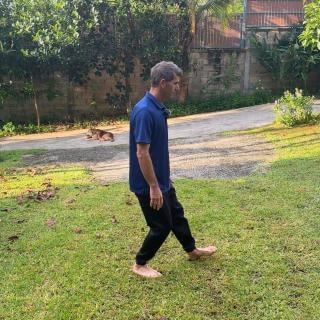
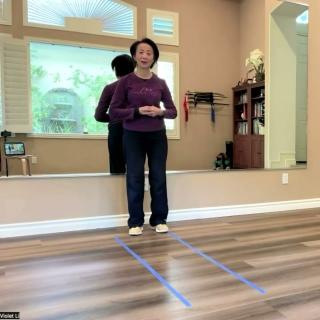
Tai Chi Walking is a foundational Tai Chi exercise that applies rooting, weight separation, and smooth transition to the walking gait, fully loading one leg before the other steps (Wu et al., 2003).
Last Updated
4 Jul 2026
We are still reviewing this page. Our research team checks every technique page for accuracy and evidence quality before final release. Details may change as that review completes. The evidence badge shows our current reading of the published research.
RECOMMENDED DOSE
A short 20-minute Tai Chi–based session was shown to produce immediate reductions in state anxiety and physiological arousal, making it a realistic entry point. A twice-weekly rhythm mirrors established beginner protocols in older adults; the 30-minute upper bound eases newcomers toward the full session length used in most trials.
The most common protocol across randomised trials used 60-minute sessions, delivered twice weekly or three times weekly, sustained over 6–12 weeks. This represents the typical, well-supported working dose for measurable functional and psychosocial benefit.
Higher-commitment programmes used three 60-minute sessions per week, and one protocol supplemented twice-weekly classes with roughly 30 minutes of daily self-practice. The daily upper end reflects that self-practice arm rather than a formally isolated dose, so it is best treated as a maintenance target for established practitioners.
Session length
Session length: 20–30 minutes
20
MIN
How long each individual practice session should last from start to finish.
Frequency
Frequency: 2 days
2
DAYS
The number of days per week to fit a session into your routine.
Session length
Session length: 60 minutes
60
MIN
How long each individual practice session should last from start to finish.
Frequency
Frequency: 2–3 days
2
DAYS
The number of days per week to fit a session into your routine.
Session length
Session length: 60 minutes (plus optional home practice)
60
MIN
How long each individual practice session should last from start to finish.
Frequency
Frequency: 3–7 days
3
DAYS
The number of days per week to fit a session into your routine.
About this card. Dose ranges are drawn from randomised trials of Tai Chi and closely related Tai Chi walking/movement programmes; individual needs vary. These recommendations are not a substitute for personalised guidance from a qualified practitioner.
Quick answers to what people most often ask. Each card links to the deeper section below.
evidence
A meta-analysis of 40 studies and 3,817 people links regular Tai Chi to moderate reductions in stress, anxiety, and low mood, alongside better self-rated sleep and steadier balance in older adults. Almost all of this evidence tests Tai Chi as a whole, not the walking drill alone, and several physiology studies were very small.
Read moregood for
Adults wanting a gentle, low-impact way to steady their balance, settle stress, or ease into sleep may find Tai Chi Walking suits them; it has been studied mostly in older adults and mixed community groups. People with unsteady balance, dizziness, or recent falls should begin near a wall or chair, and it is not a substitute for medical care.
safety
Most healthy adults tolerate Tai Chi Walking well; the main caution is fall risk during the long single-leg balancing that sets it apart from ordinary walking. People with impaired balance, vertigo, recent falls, lightheadedness, or reduced foot sensation should keep a wall, rail, or sturdy chair within reach. This caution is inferred from the practice's mechanics, not safety trials.
Read morehow it works
Fully loading one leg and placing the other foot with control forces the body to track its position moment to moment, tightening the link between movement and the feedback muscles and joints send back. Gait studies show single-leg stance lasts close to two seconds, against a fraction of a second in ordinary walking, demanding tighter control that builds steadier balance.
Read moreTai Chi Walking is a slow, low-impact stepping exercise that fully loads one leg before the other lifts, holding each single-leg stance far longer than ordinary walking.
Practice centres on the gait cycle. You sink your weight fully into the standing leg, a move Tai Chi calls rooting, then lift and place the other foot with slow, deliberate control before transferring weight smoothly across for the next step. Cadence, breath, and weight shift stay coupled in one continuous, low-impact sequence, and single-leg balance lasts much longer than in normal walking. It is taught across Tai Chi lineages as a foundational drill for weight control and balance.
Tai Chi Walking is not ordinary walking, where weight rolls continuously from foot to foot and each foot bears load only briefly; here one leg is fully loaded before the other moves. It is also not a full Tai Chi hand form or a martial sparring practice, but a foundational stepping drill that trains rooting and precise weight transfer. And it is a movement exercise, not a seated meditation or a treatment for any diagnosed condition.
Not to be confused with
Ordinary walking
Everyday walking shifts weight continuously from one leg to the next without pausing. Tai Chi Walking fully loads one leg and holds a much longer single-leg stance, placing the stepping foot with deliberate control before any weight transfers.
Walking meditation (mindful walking)
Buddhist-style walking meditation pairs ordinary slow steps with breath and attention as a contemplative exercise. Tai Chi Walking is a martial-arts-derived movement drill built around specific weight-separation and rooting mechanics, so its focus is on gait technique and balance as much as on presence.
Seated meditation
Seated meditation cultivates calm and attention while the body is still. Tai Chi Walking works toward a similar settled, present state through slow deliberate movement rather than sitting, so the calming effect is carried by the stepping itself.
Tai Chi Walking works mainly by tightening the loop between movement and sensation. Fully loading one leg and placing the other foot with control forces the body to track its own position from moment to moment, which is motor-sensory integration, the coupling of what you intend to do with the feedback your muscles and joints send back. Gait studies show this pattern holds a single-leg stance for close to two seconds, against a fraction of a second in ordinary walking, demanding far tighter proprioceptive control (Wu et al., 2003). Over regular practice, that sharpened sense of where your body is in space tends to register as steadier balance and more precise, grounded stepping, though those balance findings come from research on Tai Chi broadly rather than Tai Chi Walking specifically (Tsang et al., 2003), (Li et al., 2001).
Movements start to feel more deliberate and precise as Tai Chi Walking pairs each slow step with close attention to weight, balance, and foot placement. Gait studies show this pattern holds a single-leg stance far longer than ordinary walking (Wu et al., 2003), asking for tighter coordination between the movement you intend and your body's own sense of where it is in space.
Fully loading one leg before you step asks the body to track its own position moment to moment, sharpening your felt sense of where your weight sits and where the foot will land. Over regular practice this tends to show up as steadier balance and more precise, grounded movement (Tsang et al., 2003), (Li et al., 2001).
Balancing on one leg while the other foot lowers slowly asks the body to knit together signals from the inner ear, joints, and eyes into a single steady sense of upright, the skill that keeps weight shifts controlled rather than wobbly (Wu et al., 2003). Practitioners tend to feel this as a grounded, physically present quality, and studies of Tai Chi link regular practice with better standing balance, especially in older adults (Tsang et al., 2003), (Rini et al., 2016).
Keyed-up, on-alert feelings can ease as the steady pace of Tai Chi Walking shifts the nervous system toward its parasympathetic, rest-and-recovery branch and away from the alert, sympathetic one. In small studies of Tai Chi, heart-rate variability rose and stress-hormone levels fell during practice, changes practitioners often notice as slower breathing and a body that feels less braced (Audette et al., 2006), (Jin & Jin, 1989).
That keyed-up, on-alert feeling can ease during slow, rhythmic Tai Chi stepping, which appears to lower the body's overall state of activation, or arousal. Studies of Tai Chi link it to lower stress and anxiety (Wang et al., 2010) and to a nervous-system shift toward a calmer, more parasympathetic balance (Audette et al., 2006), often felt as the body settling and mental urgency quieting.
The clearest measured changes show up in balance and in the tone of the nervous system rather than in any single organ. In small studies of Tai Chi, heart-rate variability rose during practice, a sign that the parasympathetic, rest-and-recovery branch of the nervous system is gaining ground as breathing slows and the body feels less braced (Audette et al., 2006). The same kind of session has been measured to lower cortisol, the body's main stress hormone; as it falls, tension tends to ease and mood lifts (Jin & Jin, 1989). Reviews of Tai Chi in older adults also report improved balance and steadier posture (Li et al., 2001). These findings come from Tai Chi as a whole, not the walking drill alone, and one early study found heart rate briefly rose during active practice before settling, so the calming shift shows up mainly afterward.
Balance tends to feel steadier with regular Tai Chi Walking, because the slow, fully committed weight shifts give the vestibular system, the inner-ear network that senses head position and motion, repeated practice at reading small changes in orientation. Broad reviews of Tai Chi report improved balance in older adults (Li et al., 2001); the vestibular system's own contribution is expected here rather than measured directly, and practitioners often describe feeling more surefooted and less wobbly as they step.
Movement starts to feel smoother and steadier as the loop between what you intend and what your body senses grows tighter, which is the heart of sensorimotor integration. Regular Tai Chi practice has been measured to improve balance and postural control (Li et al., 2001), and one small trial found the nervous system settling toward a calmer, parasympathetic state after Tai Chi but not brisk walking (Audette et al., 2006).
Movements can start to feel smoother and more sure-footed as balance and postural control improve with regular Tai Chi practice (Li et al., 2001). Sensorimotor coordination, the way the brain times movement to match what your muscles, joints, and sense of balance report, is inferred to strengthen from these measured gains in steadiness, though it has not been measured directly in Tai Chi Walking itself.
Your legs feel like they are actively working to keep you rooted, and standing and stepping start to feel steadier and more grounded. This is postural muscle engagement: because Tai Chi Walking holds each single-leg stance for close to two seconds instead of a fraction of a second, the muscles that keep you upright stay working far longer than in ordinary walking (Wu et al., 2003).
After steady practice, many people feel more sure-footed and clearer about where their body is in space. That points to sharpened proprioception, the body's internal sense of limb position drawn from receptors in muscles, joints, and tendons; reviews of Tai Chi in older adults report better balance and steadier body awareness (Li et al., 2001).
Moderate evidence, all of it from Tai Chi as a whole rather than the walking drill by itself, supports lower stress, anxiety, and depressed mood: a meta-analysis of 40 studies and 3,817 people found a pooled effect size near 0.66 for stress (95% CI 0.23 to 1.09) and anxiety (95% CI 0.29 to 1.03), and 0.56 for depression (95% CI 0.31 to 0.80), moderate reductions that, against the mixed comparison groups used across the trials, put a typical participant ahead of roughly two-thirds of those not practising (Wang et al., 2010). A randomized trial in older adults links Tai Chi to falling asleep sooner and sleeping longer (Li et al., 2004), and cross-sectional and review evidence associates regular practice with steadier balance in older adults (Tsang et al., 2003), (Li et al., 2001). Not yet established: any trial isolating Tai Chi Walking itself, effects in younger or already-active people, and any claim that it treats a diagnosed condition.
Stress tends to ease when attention has one steady thing to hold. The slow, fully committed stepping of Tai Chi Walking gives the mind a simple physical task to track, and across a large body of Tai Chi research this kind of practice is linked to lower stress, less anxiety, and steadier mood (Wang et al., 2010).
If anxiety leaves you restless and on edge, the slow, fully committed steps of Tai Chi Walking give that energy somewhere to go. Research on Tai Chi as a whole, rather than this stepping drill on its own, links the practice to lower anxiety, less stress, and steadier mood, which many people feel as the body settling into a calmer baseline (Wang et al., 2010).
When your mood is low, moving at all can feel like too much, yet regular Tai Chi practice is linked to lower depression scores, and many practitioners describe the slow, absorbing steps as a way to feel steadier and a little lighter once the session ends (Wang et al., 2010).
Standing feels steadier once the body has rehearsed holding its weight on one leg and adjusting to shifting footing. Healthy older adults who practise Tai Chi over the long term tend to show steadier standing balance and posture when vision or the ground underfoot is made uncertain (Tsang et al., 2003), (Rini et al., 2016).
Many people find they feel steadier and more grounded on their feet, with smoother weight shifts from one leg to the other. A review of controlled studies in older adults links this gentle, moderate-intensity practice to better balance and fitness (Li et al., 2001), though the evidence covers Tai Chi as a whole rather than this walking drill on its own.
Regular Tai Chi practice is linked to moderate reductions in stress, anxiety, and low mood, better self-rated sleep, and steadier balance, drawing on a meta-analysis of 40 studies alongside smaller physiological trials (Wang et al., 2010), (Li et al., 2004). Smaller studies have also measured a shift toward calmer, more parasympathetic nervous-system activity during and after practice (Audette et al., 2006). The main limit is scope: almost all of this research tests Tai Chi as a whole, often in older or clinical samples, rather than the Tai Chi Walking exercise on its own, and several physiology findings rest on very small groups.
1
Meta-analyses
6
RCTs
0
Systematic reviews
0
Observational
8
Pilot
Studied populations
Tai Chi on psychological well-being: systematic review and meta-analysis
n = 3,817
Finding: Pooling 40 studies with 3,817 participants, this review found that regular Tai Chi practice was linked to lower stress and anxiety, less depression, and steadier mood, with moderate-sized improvements across all three. The benefits showed up in both healthy community members and people managing chronic health conditions, which suggests the practice may help you feel calmer and more emotionally settled whatever your starting point. Keep in mind that these results come from the broader Tai Chi tradition rather than the walking exercise specifically, and the studies varied widely in how they were run, so the findings point to a general pattern rather than proof that Tai Chi treats clinical anxiety or depression.
reported narratively
Reduced Cognitive-Motor Interference on Voluntary Balance Control in Older Tai Chi Practitioners.
2016
Finding: This study compared 20 older adults who had practised Tai Chi for years against 20 non-practitioners and 20 young adults, and found the long-term practitioners kept steadier balance when a mental task was added to a demanding stepping movement, closing much of the gap with the younger group. In practical terms, regular Tai Chi appears to sharpen the automatic postural control you rely on when walking and thinking at the same time, which is where many stumbles happen. Because this was a one-time snapshot of self-selected, experienced practitioners rather than a trial that trained beginners over time, it can't prove Tai Chi caused the difference, and it looks at Tai Chi broadly rather than the walking exercise alone.
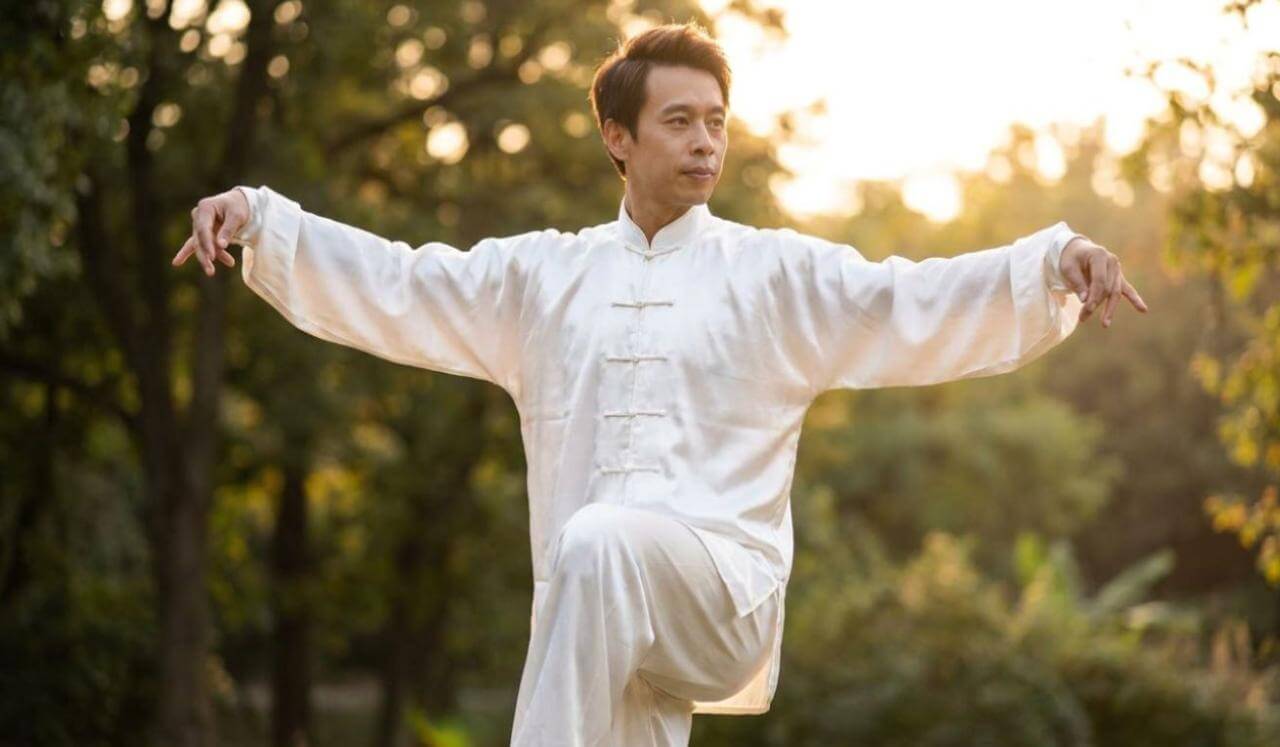
See full citation in referencesTai Chi Walking comes from Tai Chi, a Chinese practice that began as a martial art and has long been practised as a health-promoting movement form, pairing slow motion with breath and focused attention (Wolf et al., 1997), (Lan et al., 2013). It is taught across all Tai Chi lineages as a foundational exercise for rooting and weight control. These roots help explain the practice's form, its slow, deliberate weight-shifting, rather than proving any clinical effect.
For most healthy adults, Tai Chi Walking is a gentle, low-impact practice that is generally well tolerated. The one thing to watch is balance during the long single-leg phase that sets this exercise apart from ordinary walking, when you load one leg fully before the other lifts. That caution comes from how the movement works rather than from safety trials, since the available studies measured balance, mood, and sleep rather than adverse events. If your balance feels shaky, you get dizzy, or you have had a recent fall, keep a wall, rail, or sturdy chair within reach until stepping feels secure, and treat the practice as a complement to medical care, not a replacement for it.
Begin with support nearby or under supervision if you have impaired balance, vertigo or other inner-ear problems, a recent fall, lightheadedness on standing, reduced sensation in the feet, or an unhealed lower-limb injury, because the extended single-leg loading raises the chance of a wobble or fall. This caution is inferred from how the movement loads the body rather than measured directly. Anyone managing a heart, joint, or neurological condition is wise to get clinical clearance before starting: the benefit and safety evidence comes from Tai Chi as a whole in older and clinical groups, not from this stepping drill specifically, so its effects here are extrapolated rather than directly tested.
Begin near a wall, rail, or sturdy chair, or under supervision, if you have unsteady balance, vertigo or other inner-ear problems, lightheadedness on standing, reduced sensation in the feet, or a recent fall. The move that defines Tai Chi Walking, fully loading one leg and holding a long single-leg stance, is exactly what can trigger a wobble when balance is impaired, so keep support within reach until stepping feels secure. This caution is inferred from how the movement loads the body rather than measured in safety trials (Tsang et al., 2003), (Rini et al., 2016).
| Technique | Best for | Use with care | Evidence strength | Distinction |
|---|---|---|---|---|
| Brisk walking | Accessible aerobic conditioning, raising heart rate, and general cardiovascular fitness with no special technique to learn. | If your main goal is steadier balance or a calmer, more attentive body sense, plain brisk walking trains those less directly. | strong EVIDENCE | Brisk walking moves continuously at a steady aerobic pace, shifting weight smoothly between legs for cardiovascular exertion. Tai Chi Walking is slower and low-impact, fully loading one leg and holding a long single-leg balance before the other foot places with control, so it trains balance and body awareness more than aerobic fitness. |
| Full Tai Chi form or routine | Practitioners wanting the full mind-body practice, with its breadth of postures, breathwork, and the stress, mood, and balance benefits studied for Tai Chi as a whole. | The full form takes longer to learn; beginners or those focused purely on steadier stepping may prefer the walking drill first. |
No. Tai Chi Walking isn't just slow walking: you fully load one leg before the other steps, placing the foot with control, so you balance on a single leg far longer than in everyday walking (Wu et al., 2003).
+
No. Speed is only part of it. The defining feature is weight separation and controlled foot placement: you sink your full weight into one leg, a move called rooting, before the other lifts, then transfer across smoothly rather than letting weight roll continuously between feet (Wu & Hitt, 2004). Gait analysis measured this pattern holding a single-leg stance for roughly 1.8 seconds versus about 0.4 seconds in ordinary walking, a documented difference in how the movement is performed (Wu et al., 2003). This describes what the practice is, not a claim about any clinical benefit.
No. Tai Chi Walking is taught as a foundational beginner drill that isolates just the stepping and weight-shifting, so it is simpler to learn than a full Tai Chi form and needs no prior experience (Wu et al., 2003), (Wu & Hitt, 2004).
+
No. Tai Chi Walking distils the core principles of rooting and weight separation into a single low-impact stepping pattern, so it is one of the first exercises taught across Tai Chi lineages and assumes no earlier training (Wu et al., 2003), (Wu & Hitt, 2004). It sits within Tai Chi as a mind-body practice that pairs slow movement with breath and attention, so learning it can also be an accessible way into the wider tradition (Lan et al., 2013). As a beginner, start slowly and keep a wall or sturdy chair nearby until the long single-leg balance feels secure.
The Tai Chi practice of settling your weight down through a fully loaded leg so you feel stable and connected to the ground, like sinking your base before you move.
Fully committing your weight onto one leg before the other lifts, rather than sharing it between both. It is the core mechanic that gives Tai Chi Walking its long single-leg balance.
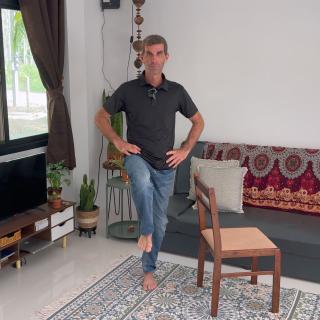
The phase of a step spent balancing on one leg. In Tai Chi Walking this lasts around 1.8 seconds versus roughly 0.4 seconds in normal walking, so the balancing muscles work far longer.
The unilateral support phase of gait; gait analysis measured single-leg stance time of 1.8±0.6 s in Tai Chi gait versus 0.4±0.05 s in normal gait.
Your body's internal sense of where your limbs are and how they are moving, without needing to look. It is what lets you feel your foot land in the right place.
The perception of body position, movement, and force generated by receptors in muscles, joints, and tendons.
The way the brain couples the movements you intend with the position and balance signals coming back from your body, so movement becomes smoother and more accurate.
The tendency for body rhythms such as breath and heartbeat to settle into step with a steady repeating movement, which many people feel as being carried along by the pace.
The rest-and-recovery branch of the nervous system that slows the heart and settles the body. Practices that raise its activity tend to feel calming.
The branch of the autonomic nervous system associated with vagal regulation and restorative physiological states such as reduced heart rate and slowed respiration.
Chenchen Wang, Raveendhara R. Bannuru, Judith Ramel, Bruce Kupelnick, Tammy Scott, Christopher H. Schmid (2010). Tai Chi on psychological well-being: systematic review and meta-analysis. https://doi.org/10.1186/1472-6882-10-23
Cited in: Benefits, Faq, How it works, Research
Varghese Rini, Hui-Chan Christina W Y, Bhatt Tanvi (2016). Reduced Cognitive-Motor Interference on Voluntary Balance Control in Older Tai Chi Practitioners.. https://doi.org/10.1519/jpt.0000000000000066
Movement tends to feel more precise and steady the longer you practise. Across Tai Chi studies, neuromuscular coordination, the timing between nerve signals and muscle response, is measured to improve, which supports better balance and more controlled stepping (Li et al., 2001). Many people describe feeling more surefooted and more physically present in the body.
The slow, deliberate pace often feels less pressured, with breathing easing and the body settling out of a keyed-up state. Over regular practice, Tai Chi is linked to lower resting blood pressure, the force of blood pushing against your artery walls, in older adults and people with high-normal readings (Li et al., 2001). This comes from Tai Chi broadly rather than the walking drill on its own, so read it as a plausible direction rather than a proven effect of stepping (Jin & Jin, 1989).
As slow, deliberate Tai Chi Walking continues, tension tends to ease and a steadier, calmer feeling settles in. Some studies of Tai Chi have measured lower cortisol, the body's main stress hormone, alongside a lift in mood after a session (Jin & Jin, 1989).
The wired, keyed-up feeling that stress brings comes largely from the sympathetic nervous system, the body's accelerator that speeds the heart and raises alertness for action. In studies of Tai Chi, markers of this branch are generally measured lower during and after practice (Audette et al., 2006), (Li et al., 2001), a shift many people feel as the body settling and the sense of urgency easing.
Outcomes measured
| Outcome | Effect size | 95% CI | N | Comparator | Source |
|---|---|---|---|---|---|
| stress | effect size (ES) = 0.66 | 95% CI 0.23 to 1.09 | — | — | Wang et al., 2010 |
| anxiety | effect size (ES) = 0.66 | 95% CI 0.29 to 1.03 | — | — | Wang et al., 2010 |
| depression | effect size (ES) = 0.56 | 95% CI 0.31 to 0.80 | — | — | Wang et al., 2010 |
The biggest gap is direct evidence: no trial isolates Tai Chi Walking, so its benefits are extrapolated from Tai Chi generally. Samples skew toward older adults and clinical groups, several physiology studies included only 19 to 66 participants, and some trials lacked active controls, all of which limit how far the findings generalize to this specific drill or to younger, already-active practitioners.
Tai Chi exercise is more effective than brisk walking in reducing cardiovascular disease risk factors among adults with hypertension: A randomised controlled trial.
n = 246
Finding: In a 9-month trial of 246 adults with high blood pressure, those assigned to Tai Chi ended up with lower blood pressure than those who did brisk walking, with systolic readings running about 12 points lower, alongside better blood-sugar control and lower everyday stress. Participants doing Tai Chi also reported stronger mental well-being and more confidence in sticking with exercise, suggesting the practice can support heart health while feeling manageable to keep up over months. Keep in mind this study tested Tai Chi as a whole practice rather than the specific Tai Chi Walking exercise, and it looked at people already living with hypertension, so it points to a helpful addition to a healthy routine, not a replacement for medical care.
reported narratively
Tai Chi versus brisk walking in elderly women.
n = 19
Finding: In a small trial that randomly assigned 19 sedentary women in their early seventies to either Tai Chi or brisk walking, the Tai Chi group showed a measurable shift in nervous-system balance: more activity in the calming, "rest and digest" branch and less in the stress-driven one, a change the walking group didn't show. In practical terms, this hints that Tai Chi's slow, mindful movement may help tip the nervous system toward a steadier, calmer state in a way that ordinary brisk walking may not. Because the study was so small and involved only older women doing a general style of Tai Chi rather than Tai Chi Walking specifically, treat this as an early, suggestive signal rather than proof that the practice reliably changes heart-rate patterns.
reported narratively
Changes in Brain Volume and Cognition in a Randomized Trial of Exercise and Social Interaction in a Community-Based Sample of Non-Demented Chinese Elders
n = 120
Finding: In a 40-week trial, 120 older adults in Shanghai were randomly assigned to practise Tai Chi, walk, meet for social interaction, or do nothing, and researchers scanned their brains and tested their thinking before and after. The Tai Chi group showed measurable gains in brain volume and better scores on cognitive tests, while the walking group looked no different from those who did nothing, hinting that the mental focus and coordination of Tai Chi may add something that plain walking does not. Keep in mind this was a single study with only about 30 people per group, and it looked at Tai Chi as a whole rather than a specific walking form, so the results point to a promising direction rather than a settled conclusion.
reported narratively
The effect of Tai Chi training on the dual-tasking performance of stroke survivors: a randomized controlled trial.
n = 47
Finding: In this 12-week trial with 47 community-dwelling stroke survivors, twice-weekly Tai Chi training improved dual-task walking (like turning while walking or handling a listening task on the move), but it worked no better than conventional exercise; both groups gained, and neither pulled ahead right after training or at the one-month check-in. For someone recovering from a stroke, this suggests Tai Chi can be a worthwhile way to practise moving and thinking at once, though it doesn't appear to hold a special edge over other structured exercise for that skill. The study was small, so larger and longer trials are needed before drawing firm conclusions.
reported narratively
Spatial, temporal and muscle action patterns of Tai Chi gait
n = 10
Finding: Measuring the walking movements of 10 healthy young adults, this study found that Tai Chi gait differs sharply from ordinary walking: each step cycle stretched to nearly 12 seconds versus about 1 second, and participants balanced on a single leg for roughly 1.8 seconds compared with 0.4 seconds in normal walking. Their ankles, knees, and hips moved through a larger range, they shifted their weight further from side to side, and their leg muscles stayed engaged longer, which captures the slow, rooted, fully-weight-shifted quality that defines the practice. In practical terms, this shows Tai Chi Walking is a distinct, deliberate way of moving rather than simply slow walking. Because the study looked only at movement mechanics in a small group of healthy young people, it describes how the walking works, not any health benefit it may bring.
reported narratively
Subjective perceived impact of Tai Chi training on physical and mental health among community older adults at risk for ischemic stroke: a qualitative study.
2017
Finding: This study asked community-dwelling older adults to describe, in their own words, how a 12-week Tai Chi program affected them, adding a personal perspective to the numbers that usually dominate this kind of research. If you are considering Tai Chi walking later in life, it is a reminder that the value people report often shows up in everyday experience, not just on a chart. Keep in mind that this was a small, focused look at older adults' perceptions over a single 12-week period, so it describes how the practice felt to participants rather than proving specific health outcomes.
See full citation in referencesExploring the basis for Tai Chi Chuan as a therapeutic exercise approach
1997
Finding: This historical review traces Tai Chi back centuries as an East Asian martial art, and notes that for roughly the past 300 years it has been widely practiced as a health-promoting exercise, especially among older adults in China. Over time its 108 classical forms were condensed into simpler sets, making the practice easier for newcomers to learn. For anyone considering Tai Chi Walking, this means you're stepping into a long, well-established movement tradition rather than a modern invention. Keep in mind that this is a historical account of the practice's roots, not a study measuring health effects.
See full citation in referencesTai Chi and Self‐Rated Quality of Sleep and Daytime Sleepiness in Older Adults: A Randomized Controlled Trial
n = 118
Finding: In this six-month trial, 118 older adults aged 60 to 92 with moderate sleep complaints practised Tai Chi three times a week and, compared with a low-impact exercise group, fell asleep about 18 minutes faster and slept roughly 48 minutes longer, alongside better overall sleep quality and less daytime drowsiness. For an older adult struggling to settle at night, that points to Tai Chi as a gentle, drug-free routine that may help you drift off sooner and stay asleep longer. Keep in mind the sleep improvements were self-reported rather than measured in a lab, and the study looked at Tai Chi broadly rather than the walking practice specifically, so treat it as encouraging support for the wider method.
reported narratively
Tai Chi improves standing balance control under reduced or conflicting sensory conditions11No commercial party having a direct financial interest in the results of the research supporting this article has or will confer a benefit upon the author(s) or upon any organization with which the author(s) is/are associated.
n = 60
Finding: This study compared 20 older long-term Tai Chi practitioners with 20 non-practising peers and 20 young adults, testing how well each group kept their balance when the usual cues for staying upright were reduced or made misleading. The older practitioners controlled their standing balance better than their non-practising peers and, on measures of how well they used vision and inner-ear signals, held their own with the young adults, which suggests that steady long-term practice may help preserve the sense of stability we often lose with age. Because this was a one-time snapshot of a small group who chose Tai Chi on their own, it cannot prove the practice caused the difference, and the balance tested here is not the same as the walking exercise specifically. Still, it points to real balance and body-awareness benefits for people who keep the practice up over years.
reported narratively
Ground contact characteristics of Tai Chi gait
n = 10
Finding: Using pressure-sensitive force plates, researchers measured exactly how the foot meets the ground during Tai Chi walking in 10 healthy young adults, and found that each step lands with low impact and a gentle, gradual loading of weight rather than a hard heel-strike. Body weight stayed fairly balanced between the front and back of the foot, while the point of pressure travelled noticeably from side to side, reflecting the deliberate, controlled weight-shifting the practice is known for. For anyone considering it, this helps explain why Tai Chi walking feels easy on the joints compared with ordinary striding. Keep in mind this was a small study of young, healthy walkers, so it describes the movement pattern itself rather than promising any specific health or balance benefit.
reported narratively
Tai Chi Chuan in Medicine and Health Promotion
2013
Finding: This review describes Tai Chi as a traditional Chinese mind-body exercise that pairs deep belly breathing with slow, deliberate body movements to bring the body and mind into balance. It also notes that you don't have to master a full sequence to practice; you can work with selected movements that suit your needs, which is where a foundational piece like Tai Chi Walking fits in. Keep in mind this is a descriptive overview of what Tai Chi is rather than a test of its effects, so it explains the practice without measuring specific health outcomes.
See full citation in referencesChanges in heart rate, noradrenaline, cortisol and mood during Tai Chi.
n = 66
Finding: In this study of 66 people, 33 new to Tai Chi and 33 experienced practitioners, a single session lowered salivary cortisol (a stress hormone) and lifted mood across the board, with people reporting less tension, low mood, anger, fatigue, confusion and anxiety afterward. At the same time the session raised heart rate and noradrenaline, and the researchers described the overall effect as comparable to moderate exercise, so a practice can leave you feeling both physically worked and mentally calmer. Keep in mind this looked at one session rather than long-term change, and because Tai Chi shares these effects with moderate exercise generally, the benefits are not unique to any single walking style.
reported narratively
Tai chi: physiological characteristics and beneficial effects on health
n = 2,216
Finding: Drawing on 31 controlled and clinical studies covering 2,216 people, this review classified Tai Chi as a moderate-intensity activity, one that keeps effort at or below roughly 55% of maximum oxygen use, so most people can sustain it without strain. Across those studies, regular practice was linked to better cardiorespiratory and muscular fitness, steadier posture and balance, greater flexibility, and fewer falls among older adults, which is the same balance-and-stability rationale that underpins the walking version. Keep in mind that these were older, varied studies looking at full Tai Chi rather than the walking exercise specifically, and the results were summarised in general terms rather than as a single precise effect, so treat this as encouraging background rather than proof for one exact routine.
reported narratively
Get clinical clearance before practising on your own if you are managing a heart, joint, or neurological condition or recovering from an unhealed lower-limb injury. The benefit and safety evidence comes from Tai Chi as a whole in older and clinical groups, not from this stepping drill specifically, so its effects here are extrapolated rather than directly tested. Treat the practice as a complement to medical care, not a replacement for it (Tsang et al., 2003), (Rini et al., 2016).
Tai Chi Walking is best approached slowly on a level, non-slip floor with a wall, rail, or sturdy chair within arm's reach, since the extended single-leg phase is where balance matters most. In early sessions it helps to keep light support close and your weight shifts small, easing off only as each transition starts to feel secure. If you are managing a heart, joint, neurological, or balance condition, or recovering from injury, treat clinical clearance as a sensible first step before practising on your own.
Choose a level, non-slip floor and keep a wall, rail, or sturdy chair within arm's reach, especially for your first sessions, so support is always a hand away if a single-leg moment feels unsteady.
In early practice, rest one or two fingers on a rail or chair back while you load one leg fully, then let go only once each weight shift feels secure and controlled.
Take each step deliberately, keeping your knee tracking over your foot and your weight shifts small enough that you never feel pushed past a comfortable, balanced position.
If you notice dizziness, lightheadedness, joint pain, or breathlessness, pause and rest; return to a supported version or stop for the day rather than working through it.
Begin with a few minutes on a supported, even surface, and add time or ease off your reliance on support only as your balance and confidence grow.
If you have a heart, joint, neurological, or balance condition, or you are recovering from injury, check with a clinician or work with a qualified instructor before practising on your own.
This information is educational and is not medical advice. This practice is not a substitute for professional care and should not replace prescribed medication or treatment for any medical or mental-health condition. If you are managing a health condition or taking medication, talk with a qualified health professional before changing your practice. If you are in distress or crisis, seek professional support.
| A complete Tai Chi form is a longer choreographed sequence of many postures, turns, and arm movements. Tai Chi Walking isolates just the stepping and weight-transfer principles as a foundational drill, so it is simpler to learn and focuses on gait, rooting, and balance rather than the whole set. |
| Qigong | Gentle breath-led movement that can be done in place, including for people who prefer minimal travelling or standing balance demands. | moderate EVIDENCE | Qigong shares Tai Chi's Chinese mind-body roots and its emphasis on breath, slow movement, and internal energy, but it centres on repeated, often stationary postures and breathing sets rather than a travelling step pattern. Tai Chi Walking always moves through space, training gait and single-leg balance specifically. |

Both, but unevenly. Gait studies have measured Tai Chi Walking's specific biomechanics, but no trial has isolated the drill for benefits like stress, mood, sleep, or balance; those findings come from research on Tai Chi as a whole (Wu et al., 2003), (Wang et al., 2010).
+
Both, but the two kinds of evidence differ in scope. Biomechanical gait-analysis studies have looked directly at the walking pattern, documenting its long single-leg stance and careful weight shifts (Wu et al., 2003), (Wu & Hitt, 2004). The health outcomes people usually ask about, lower stress and anxiety, steadier balance, and better self-rated sleep, come from Tai Chi practised as a whole rather than the walking drill on its own, so they are extrapolated rather than directly tested (Wang et al., 2010), (Tsang et al., 2003), (Li et al., 2004), (Li et al., 2001). For this specific exercise, then, the outcome evidence is suggestive but not confirmed.
Likely, though the evidence is indirect. A meta-analysis links Tai Chi as a whole to moderately lower stress and anxiety (pooled effect size near 0.66), but no trial has tested the walking drill on its own, so this is extrapolated from Tai Chi generally (Wang et al., 2010).
+
Likely, though the support is indirect for this specific drill. A meta-analysis of 40 studies found Tai Chi practice moderately reduced stress and anxiety, with pooled effect sizes around 0.66, and small studies show calming shifts in the body: a rise in heart-rate variability toward the rest-and-recovery, or parasympathetic, branch of the nervous system, alongside lower cortisol, the body's main stress hormone (Wang et al., 2010), (Audette et al., 2006), (Jin & Jin, 1989). All of this comes from Tai Chi as a whole, studied mostly in older or clinical groups, not the walking exercise by itself. It may help settle stress and anxiety as part of a routine, but it is not a treatment for a diagnosed anxiety disorder.
Because you balance on one leg far longer. Tai Chi Walking fully loads one leg and places the stepping foot with control, so single-leg stance lasts around 1.8 seconds versus roughly 0.4 in ordinary walking, which demands more balance and control (Wu et al., 2003).
+
Because the movement replaces the continuous weight-rolling of ordinary walking with slow, fully committed weight shifts. Gait analysis of Tai Chi stepping recorded a single-leg stance of about 1.8 seconds against roughly 0.4 seconds in normal walking, so your standing leg works far longer to keep you rooted (Wu et al., 2003). That prolonged, carefully controlled single-leg loading calls for tighter coordination between your movement and the position signals your muscles and joints send back, which is why this low-impact drill feels more effortful than everyday steps (Wu & Hitt, 2004). These figures come from small Tai Chi gait studies rather than large trials.
Likely, though the evidence is indirect. Tai Chi Walking holds you on one leg far longer than ordinary walking, which trains the balance and body-position control that steadier standing depends on, and regular Tai Chi is associated with better balance, mostly in older adults (Tsang et al., 2003), (Wu et al., 2003).
+
Likely, but read the evidence carefully. The drill's defining move fully loads one leg before the other steps, so you spend around 1.8 seconds balanced on a single leg versus roughly 0.4 in normal walking, which plausibly trains proprioception, your sense of where your body is in space, and postural control (Wu et al., 2003). Regular Tai Chi is associated with steadier balance, and reviews report gentle balance and fitness gains in older adults (Tsang et al., 2003), (Li et al., 2001). Those findings come from Tai Chi as a whole, mostly in older samples, not from a trial isolating Tai Chi Walking, so any improvement is extrapolated rather than a promised or specific gain.
Use care. Tai Chi Walking's long single-leg balancing can raise fall risk if you feel unsteady or have fallen recently, so begin near a wall, rail, or chair, or with supervision, and progress slowly. This is a mechanism-based caution, not a safety-trial finding, and it does not replace medical care.
+
Use care. The move that defines Tai Chi Walking, fully loading one leg and holding a long single-leg stance, is exactly what can trigger a wobble if your balance is impaired or you have fallen recently. Keep a wall, rail, or sturdy chair within reach, or work with a qualified instructor, until stepping feels secure, and get clinical clearance if you have a balance, neurological, heart, or joint condition. Regular Tai Chi is associated with steadier balance in older adults, but that evidence is extrapolated from Tai Chi as a whole rather than measured for this drill in people at fall risk, so treat the practice as a complement to, not a replacement for, medical care (Tsang et al., 2003), (Rini et al., 2016).
Start with just a few minutes. A short session on a supported, even surface is a sensible beginner starting point; add time only as your balance and confidence grow, and pause if you feel dizzy or unsteady. This is practical guidance, not a tested dose.
+
Start with just a few minutes. Because the defining move is a long single-leg balance, begin briefly on a level, non-slip floor with a wall or chair within reach, then build up gradually as each weight shift feels secure. No trial has established an optimal session length for Tai Chi Walking, so treat any minute-count as a sensible starting point rather than a validated dose, and stop to rest if dizziness or unsteadiness arises.
Match it to your goal. Choose Tai Chi Walking for steadier balance, sharper body awareness, and a calmer, low-impact way of moving; choose brisk walking for aerobic fitness and raising your heart rate. In hypertensive adults, full Tai Chi outperformed brisk walking on several heart-health measures (Kiu et al., 2018).
+
Match it to your goal rather than picking one as better overall. Head-to-head trials of full Tai Chi versus brisk walking favour Tai Chi for some outcomes: it beat brisk walking on several heart-health measures in adults with hypertension (Kiu et al., 2018), one small study saw a shift toward calmer, parasympathetic nervous-system activity after Tai Chi but not walking (Audette et al., 2006), and another trial linked Tai Chi to brain and cognitive gains that plain walking did not show (Mortimer et al., 2012). One caveat: these comparisons tested full Tai Chi in mostly older or clinical groups, not the isolated walking drill, so read the edge as promising rather than settled, and choose brisk walking if straightforward aerobic exertion is your aim.
The small beat-to-beat variation in heart rhythm, often used as a marker of nervous-system balance; higher high-frequency variability generally reflects a calmer, more recovered state.
The variation in time intervals between successive heartbeats; increased high-frequency (vagally mediated) HRV indicates greater parasympathetic activity.
The body's main stress hormone; lower levels generally reflect a calmer, less activated stress response.
A glucocorticoid hormone released by the adrenal glands as part of the hypothalamic-pituitary-adrenal stress response.
In Tai Chi tradition, the internal energy said to flow through the body; cultivating and moving it is a guiding idea of the practice, though it is a cultural concept rather than a clinical measurement.
Cited in: Benefits, Faq, How it works, Research, Use with care
Chan Aileen Wai Kiu, Chair Sek Ying, Lee Diana Tze Fan, Leung Doris Yin Ping, Sit Janet Wing Hung, Cheng Ho Yu (2018). Tai Chi exercise is more effective than brisk walking in reducing cardiovascular disease risk factors among adults with hypertension: A randomised controlled trial.. https://doi.org/10.1016/j.ijnurstu.2018.08.009
Cited in: Comparison, Faq, Research
Joseph Audette, Young Soo Jin, Renee Newcomer, Lauren J. Stein, Gillian Duncan, Walter R. Frontera (2006). Tai Chi versus brisk walking in elderly women.. https://doi.org/10.1093/ageing/afl006
Cited in: Comparison, Faq, How it works, Research, Roots and tradition, What happens in the body
James A. Mortimer, Ding Ding, Amy R. Borenstein, Charles DeCarli, Qihao Guo, Yougui Wu (2012). Changes in Brain Volume and Cognition in a Randomized Trial of Exercise and Social Interaction in a Community-Based Sample of Non-Demented Chinese Elders. https://doi.org/10.3233/jad-2012-120079
Cited in: Comparison, Faq
Chan Wing Nga, Tsang William Wai-Nam (2018). The effect of Tai Chi training on the dual-tasking performance of stroke survivors: a randomized controlled trial.. https://doi.org/10.1177/0269215518777872
Cited in: Research
Ge Wu, Wei Liu, Juvena Hitt, Debra Millon (2003). Spatial, temporal and muscle action patterns of Tai Chi gait. https://doi.org/10.1016/j.jelekin.2003.09.002
Cited in: Faq, How it works, Research, Roots and tradition, What happens in the body, What it is
Zheng Guohua, Xiong Zhenyu, Zheng Xin, Li Junzhe, Duan Tingjin, Qi Dalu (2017). Subjective perceived impact of Tai Chi training on physical and mental health among community older adults at risk for ischemic stroke: a qualitative study.. https://doi.org/10.1186/s12906-017-1694-3
Cited in: Roots and tradition
Steven L. Wolf, Carol Coogler, Tingsen Xu (1997). Exploring the basis for Tai Chi Chuan as a therapeutic exercise approach. https://doi.org/10.1016/s0003-9993(97)90206-9
Cited in: Roots and tradition
Fuzhong Li, K. John Fisher, Peter Harmer, Dainis Irbe, Robert G. Tearse, Cheryl Weimer (2004). Tai Chi and Self‐Rated Quality of Sleep and Daytime Sleepiness in Older Adults: A Randomized Controlled Trial. https://doi.org/10.1111/j.1532-5415.2004.52255.x
William W. N. Tsang, V. Wong, Siu Ngor Fu, C.W.Y. Hui-Chan (2003). Tai Chi improves standing balance control under reduced or conflicting sensory conditions11No commercial party having a direct financial interest in the results of the research supporting this article has or will confer a benefit upon the author(s) or upon any organization with which the author(s) is/are associated.. https://doi.org/10.1016/j.apmr.2003.02.002
Cited in: Benefits, Faq, How it works, Research, Roots and tradition, Use with care
Ge Wu, Juvena Hitt (2004). Ground contact characteristics of Tai Chi gait. https://doi.org/10.1016/j.gaitpost.2004.06.005
Cited in: Faq, How it works, Research, Roots and tradition, What it is
Ching Lan, Ssu‐Yuan Chen, Jin‐Shin Lai, May‐Kuen Wong (2013). Tai Chi Chuan in Medicine and Health Promotion. https://doi.org/10.1155/2013/502131
Cited in: Faq, Roots and tradition, What it is
Putai Jin, Jin P (1989). Changes in heart rate, noradrenaline, cortisol and mood during Tai Chi.. https://doi.org/10.1016/0022-3999(89)90047-0
Cited in: Faq, How it works, Research, Roots and tradition, What happens in the body
J X Li, Yuanyuan Hong, Kai Ming Chan (2001). Tai chi: physiological characteristics and beneficial effects on health. https://doi.org/10.1136/bjsm.35.3.148
Cited in: Benefits, Faq, How it works, Research, What happens in the body
Explore guided sessions to deepen your Tai Chi Walking technique.
Editorially curated. Tracks are not themselves clinically studied; evidence on the page applies to Tai Chi Walking as a technique.
Beginner video for Tai Chi Walking

★ 4.9
·
Talks
·
28 min
Nicola Do
How hard is Tai Chi Walking?
Tai Chi Walking belongs in the mid tier because the walking frame is simple, but the structural discipline is real.
3
Mental Effort
3 / 4
▾Emotional Depth
1 / 4
▾Physical Intensity
2 / 4
▾Prior Knowledge
2 / 4
▾Wellness Academy