The world’s largest free audio library for everyday wellbeing
Movement-Integrated
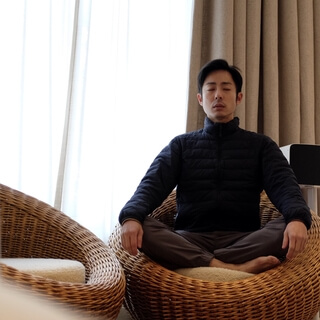
Restorative yoga is a gentle, prop-supported style of yoga in which poses are held passively for several minutes to invite deep relaxation (Danhauer et al., 2008).
Last Updated
4 Jul 2026
We are still reviewing this page. Our research team checks every technique page for accuracy and evidence quality before final release. Details may change as that review completes. The evidence badge shows our current reading of the published research.
RECOMMENDED DOSE
Restorative yoga trials scheduled classes once weekly (a 90-minute weekly program in postmenopausal women; a once-weekly 12-week program) or twice weekly (hour-long classes, and), supporting a 1–2 times per week starting frequency. The shorter 15–30 minute session length is a conservative editorial adaptation for newcomers and was not itself directly trial-tested.
Multiple trials used 60-minute sessions, including twice-weekly hour-long restorative/flow classes for older women with chronic pain and for chronically stressed women, plus 60-minute yoga sessions in a breast cancer trial. This supports a typical established dose of one hour, twice weekly.
Longer protocols used 90-minute weekly sessions and 60-minute sessions practised daily during chemotherapy. Daily practice is directly trial-tested; the 3-times-per-week lower bound of this range is an editorial extrapolation for sustainable maintenance, so the frequency is labelled mixed.
Session length
Session length: 15–30 minutes
15
MIN
How long each individual practice session should last from start to finish.
Frequency
Frequency: 1–2 days
1
DAY
The number of days per week to fit a session into your routine.
Session length
Session length: 60 minutes
60
MIN
How long each individual practice session should last from start to finish.
Frequency
Frequency: 2 days
2
DAYS
The number of days per week to fit a session into your routine.
Session length
Session length: 60–90 minutes
60
MIN
How long each individual practice session should last from start to finish.
Frequency
Frequency: 3–7 days
3
DAYS
The number of days per week to fit a session into your routine.
About this card. These recommendations synthesise dose parameters reported in restorative and related yoga trials; individual studies varied in population and duration. These recommendations are not a substitute for personalised guidance from a qualified practitioner.
Quick answers to what people most often ask. Each card links to the deeper section below.
evidence
Small pilot and feasibility trials link restorative yoga to better emotional well-being, quality of life, and lower depression scores in women with cancer. Broader yoga reviews show small-to-moderate reductions in depression and anxiety, but evidence for the restorative style stays early, and one controlled trial found no drop in cortisol, the body's main stress hormone, beyond gentle stretching.
good for
Restorative yoga suits adults carrying heavy stress or fatigue who need to rest but cannot switch off. It has been studied most in women with breast or ovarian cancer, postmenopausal women, and adults with metabolic syndrome. Because props hold the body, its low-effort format is easier to keep up when energy is depleted.
Read moresafety
Most healthy adults can practise restorative yoga safely, and available trials in cancer patients, postmenopausal women, and adults with metabolic syndrome reported no adverse events. People who are pregnant, or living with uncontrolled high blood pressure, glaucoma, or a recent injury should adapt or skip supported inversions. Those working through recent trauma may prefer shorter, gentler holds.
Read morehow it works
Removing the need for muscular effort is how restorative yoga works: when bolsters and blankets hold the body completely, the nervous system can tip toward its rest-and-recovery branch, slowing the heart and letting held tension drain away. Breath lengthens on its own and the body grows heavy, though this calming mechanism is inferred from broader yoga research rather than measured.
Read moreRestorative yoga is a gentle, prop-supported style of yoga where poses are held passively for several minutes to encourage deep relaxation and rest.
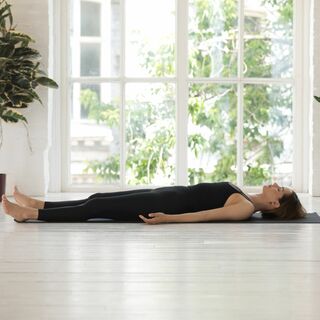
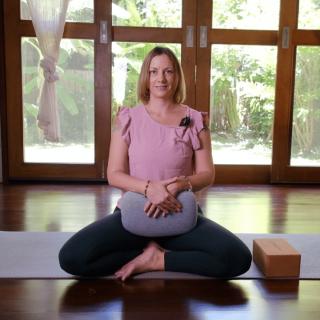
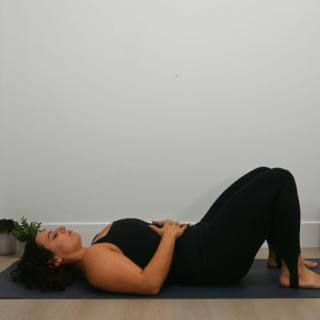
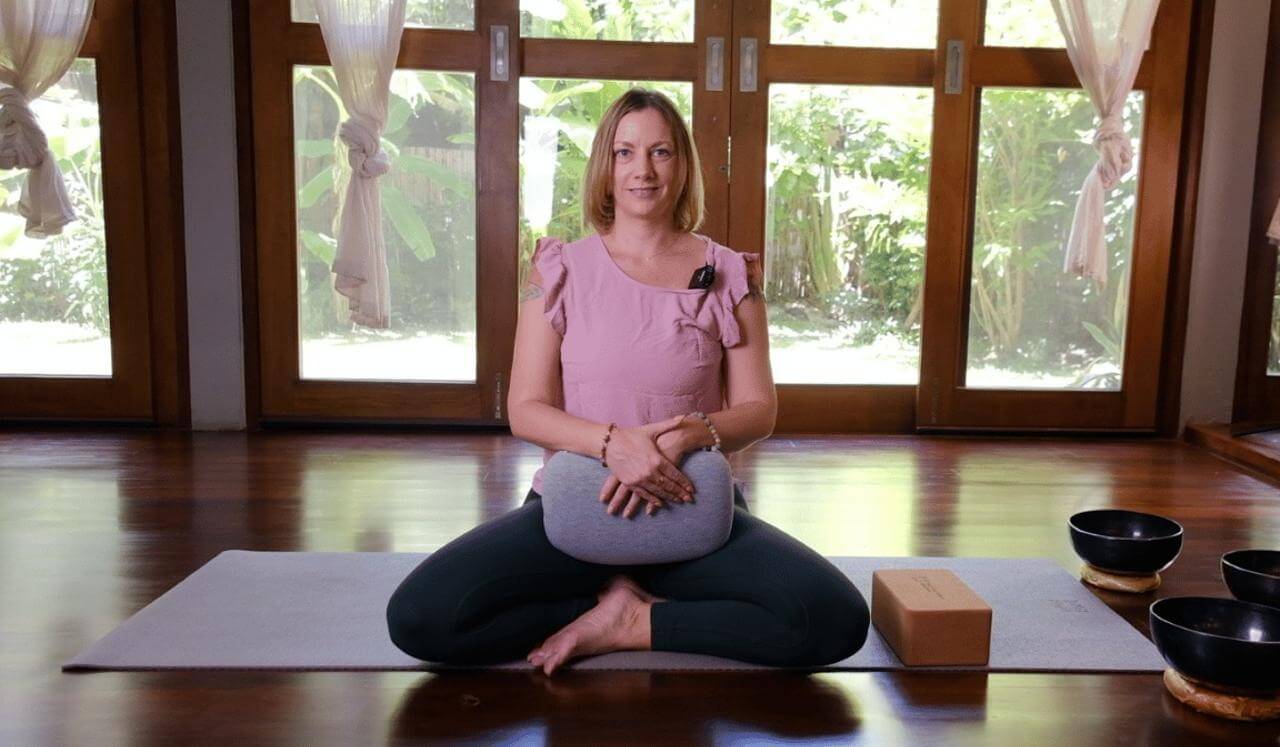
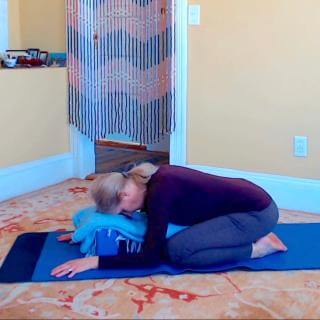
Sessions use bolsters, blankets, blocks, and straps to fully support the body in a small number of passive postures, each held for roughly 5 to 20 minutes. Signature forms include Legs Up the Wall (Viparita Karani), Supported Bridge, Supported Reclined Butterfly, Side-Lying Rest, Supported Child's Pose, and Supported Savasana. A sequence usually moves through gentle supported opening, an inversion or reclined rest, and a long final settling, with slow diaphragmatic breathing carrying attention inward.
Restorative yoga is not the same as active or vigorous yoga; there is little muscular effort, few transitions, and no aim to build strength or flexibility through exertion. It differs from Yoga Nidra, a lying-down guided meditation, in that it centres on physically supported postures rather than a scripted body scan. It is best understood as supportive rest, not a treatment that replaces medical or psychological care.
Not to be confused with
Yin Yoga
Yin yoga also uses long, slow holds, but it deliberately applies mild stress to deep connective tissue to build flexibility, so poses can feel intense. Restorative yoga removes that load entirely, using props so the body is fully supported and nothing is being stretched or strained.
Progressive Muscle Relaxation
Progressive muscle relaxation works by actively tensing and then releasing muscle groups in sequence. Restorative yoga reaches muscular release passively, letting props hold the body so tension drains without any deliberate contraction.
Lying down, napping, or general relaxation
Restorative yoga is not simply lying down or resting; it uses specific prop-supported postures held for set periods with slow breathing and inward attention, which the tradition frames as active relaxation rather than passive downtime.
Restorative yoga appears to work by removing the need for muscular effort: when props hold the body completely, the nervous system can tip toward parasympathetic activity, the rest-and-recovery branch that slows the heart and lets held tension drain away. Practitioners tend to feel this as the breath lengthening on its own and the body growing heavy and quiet. The evidence here is indirect, most of it comes from research on yoga-based relaxation broadly rather than restorative yoga specifically, so the calming mechanism is inferred rather than measured in this style itself (Vempati & Telles, 2002), (Field, 2010).
After a long day of feeling wired and unable to switch off, a few minutes in a fully supported pose can let the breath slow and the body grow heavy on its own. With no muscular effort needed, the nervous system appears to shift toward its rest-and-recovery branch, the parasympathetic system that slows heart rate and lets tension drain away, though most of the supporting evidence comes from related yoga relaxation rather than restorative yoga itself (Vempati & Telles, 2002), (Field, 2010).
That wired, can't-switch-off feeling can begin to ease during restorative yoga, as long, fully supported poses lower the body's overall alertness and let the nervous system drop toward rest. Studies of yoga-based relaxation suggest it quiets sympathetic activity, the fight-or-flight branch that keeps you keyed up (Vempati & Telles, 2002), (Field, 2010), though this has mostly been shown for relaxation practices in general rather than restorative yoga specifically.
After a stressful day, some people find they settle more quickly and slip into calm with less effort. Long, fully supported poses paired with slow breathing appear to strengthen vagal tone, the vagus nerve's calming influence over heart rate and stress reactivity (Vempati & Telles, 2002), (Field, 2010).
Once the props take over the work of holding you, the body often grows heavier, the breath slows on its own, and the urge to stay busy loosens, signs the nervous system is shifting out of its fight-or-flight setting toward the parasympathetic, rest-and-recovery branch (Vempati & Telles, 2002).
When props hold your whole body, the muscles that stay braced even as you try to rest can finally let go, softening in the legs, hips, and back while the breath deepens on its own. This muscular relaxation, a drop in the effort your muscles use to hold you upright, is thought to be one route through which restorative yoga settles the wider nervous system (Vempati & Telles, 2002), (Field, 2010).
The most concretely measured change is in blood pressure. In a small feasibility trial, adults with metabolic syndrome risk factors showed lower systolic blood pressure, the force of blood pushing against artery walls, after a restorative yoga program (Supriya et al., 2025). Alongside this, heart rate and breathing tend to slow as the supported body stops working to hold itself up, which feels like a heavy, settled calm spreading through the limbs. These signals are early rather than settled, and one controlled trial found no drop in cortisol, the body's main stress hormone, beyond what gentle stretching produced (Corey et al., 2014).
After a session, many people describe feeling less pressured and more settled, as if the body has stopped bracing against stress. That matches an early finding: adults with metabolic syndrome risk factors had lower systolic blood pressure, the force of blood pushing against artery walls, after a restorative yoga program (Supriya et al., 2025).
The keyed-up, on-guard feeling can quietly loosen during restorative yoga as the sympathetic nervous system, the body's fight-or-flight branch, settles rather than fires. In one small trial of adults with metabolic risk factors, blood pressure dropped after the program, a downstream sign of easing sympathetic drive (Supriya et al., 2025), and practitioners often notice the pulse slowing and the shoulders dropping.
As the body settles into a fully supported pose, it needs less energy just to keep going. Yoga-based guided relaxation has been measured to lower oxygen consumption during practice, a sign of the body dropping into a calmer, lower-effort resting state (Vempati & Telles, 2002). In restorative yoga specifically this shift is expected rather than directly measured, and it often feels like breathing slowing and the body growing heavier and quieter.
Your pulse tends to quiet and your breath lengthens as the fully supported body stops working to hold itself up, the settling that follows when the nervous system shifts toward parasympathetic activity, its rest-and-recovery branch (Vempati & Telles, 2002). In one small feasibility trial in adults with metabolic syndrome, related markers such as blood pressure dropped, though heart rate itself was not the main measure (Supriya et al., 2025).
That keyed-up, can't-quite-settle feeling reflects the balance between the body's fight-or-flight branch and its rest-and-recovery branch, its sympathovagal balance. In a small feasibility trial, systolic blood pressure was lower after a restorative yoga program (Supriya et al., 2025), a shift toward the rest-and-recovery side that people often feel as the body growing heavier, the breath slowing, and mental urgency easing.
Limited, early evidence supports restorative yoga itself, with the clearest signals in people coping with illness. Small pilot studies link the practice to better emotional well-being and quality of life in women with breast or ovarian cancer (Danhauer et al., 2008), (Danhauer et al., 2009), lower depression scores in African-American breast cancer survivors (Taylor et al., 2018), and early improvements in cognition (Gary et al., 2022). Stronger numbers exist for yoga broadly, not restorative yoga specifically: a meta-analysis in people with cancer found a Hedges' g of -0.42 for depression and -0.35 for anxiety versus control groups, both small-to-moderate reductions, meaning the average participant ended up less depressed or anxious than roughly two-thirds of those who did not practice (Gonzalez et al., 2021). Still missing are large trials of restorative yoga on its own, long-term follow-up, and any claim that it treats a diagnosed condition.
Living with cancer often means carrying fear, fatigue, and emotional strain alongside treatment. In small pilot studies, women with breast or ovarian cancer who practiced restorative yoga reported better emotional well-being and quality of life (Danhauer et al., 2008), (Danhauer et al., 2009), and many describe the fully supported poses as a rare chance to rest without having to hold themselves together.
Most of what we know about restorative yoga comes from small pilot and feasibility studies in people carrying a heavy load, and in those groups it is linked to steadier mood, better quality of life, and less fatigue (Danhauer et al., 2009), (Taylor et al., 2018). Broader reviews of yoga as a whole, not the restorative style specifically, point the same way for depression, anxiety, and sleep (Gonzalez et al., 2021), (Cramer et al., 2017). The real limits are scale and directness: samples are small, the strongest numbers belong to general yoga, and one controlled trial found no advantage over gentle stretching for cortisol or perceived stress (Corey et al., 2014).
1
Meta-analyses
1
RCTs
1
Systematic reviews
0
Observational
11
Pilot
Studied populations
Effects of Yoga Interventions on Health Outcomes in Women With Gynecological Cancers: A Systematic Review of Randomised Controlled Trials.
2025
Finding: This systematic review of randomised trials in women recovering from gynaecological and other cancers found that restorative yoga's gentle, low-effort format kept people practising more consistently than more vigorous styles, with sedentary survivors attending sessions at higher rates. For someone easing back into movement after cancer treatment, that suggests a slow, restful practice may be easier to stay with when energy and motivation are low. The evidence here is still early, drawn largely from small pilot and feasibility studies, so these adherence patterns point to a practical option rather than a proven clinical benefit, and larger trials are needed to confirm what restorative yoga can deliver.
See full citation in referencesRestorative yoga for women with ovarian or breast cancer: findings from a pilot study.
2008
Finding: In this pilot study, women with breast or ovarian cancer who took part in weekly 75-minute restorative yoga classes, gentle prop-supported poses held for deep relaxation, reported improvements in mood, anxiety, mental health, and overall quality of life. For someone facing the emotional weight of a cancer diagnosis, this suggests a low-effort practice may offer a genuine lift in day-to-day well-being alongside standard care. Because this was an early, small-scale study focused on one group of patients, the results are encouraging rather than conclusive, and restorative yoga is best seen as a supportive addition rather than a treatment for depression or the illness itself.
See full citation in referencesRestorative yoga grows out of the broader yoga tradition, where stillness, breath, and surrender are treated as active practices rather than idleness, which is why the style is often described as active relaxation. Some pose choices carry tradition-specific reasoning, such as left side-lying being linked to right-nostril dominance in yogic and Ayurvedic thought. These roots help explain why the postures are shaped and held as they are, not that the lineage proves any particular clinical effect.
Restorative yoga is one of the gentlest movement practices, using bolsters and blankets to hold the body in fully supported positions, and no adverse events were reported across the available trials in cancer patients, postmenopausal women, and adults with metabolic syndrome (Selvaraj et al., 2025), (Danhauer et al., 2008), (Cohen et al., 2007). This is reassuring but practice-informed rather than safety-tested: the studies were small, drawn from specific clinical groups, and noted good tolerability rather than measuring harm as a primary outcome, so an absence of reported problems is not the same as proven safety for everyone. Supported inversions such as legs-up-the-wall, where the pelvis is raised and blood pools toward the upper body, may not suit pregnancy, uncontrolled high blood pressure, glaucoma, or a recent injury, so adapt the pose or check with a clinician first.
Most healthy adults can practise restorative yoga safely, and only a few groups need to modify it. People who are pregnant, living with uncontrolled high blood pressure or glaucoma, or recovering from a recent injury should adapt or skip supported inversions and long supine holds, since raising the pelvis or lying flat for several minutes shifts blood pressure and changes pressure in the head and abdomen. Anyone working through recent trauma may find that extended stillness and quiet inward attention let difficult emotion surface, so a gentler entry, shorter holds, or professional support can help.
Supported inversions such as legs-up-the-wall raise the pelvis so blood pools toward the upper body, and long supine holds keep you flat for several minutes. Both shift blood pressure and the pressure behind the eyes, which can be a problem with uncontrolled high blood pressure or glaucoma. Keep the pelvis low, replace raised-hip poses with a flat, fully supported rest, and check with a clinician before practising.
| Technique | Best for | Use with care | Evidence strength | Distinction |
|---|---|---|---|---|
| Vigorous or flowing yoga (Vinyasa, Hatha flow) | Building strength, flexibility, and cardiovascular fitness when you have the energy for active, effortful movement. | When you are fatigued, recovering, or new to movement, its physical demand can be harder to sustain than a gentle practice. | moderate EVIDENCE | Vigorous and flowing yoga styles build heat, strength, and stamina through continuous, effortful movement, while restorative yoga does the opposite: props hold the body so no muscle has to work, and each pose is held passively for several minutes. One is active exertion; the other is deliberate, fully supported rest. |
| Low-impact stretching | Simple flexibility and gentle, low-effort activity when you want movement without props or a meditative frame. | emerging EVIDENCE | Low-impact stretching and restorative yoga both keep effort low, but stretching actively lengthens muscle through mild tension, whereas restorative postures use props to remove effort entirely and let tissue soften on its own. Restorative practice also folds in slow breathing and inward attention that plain stretching usually leaves out. |
Not quite. Restorative yoga is a distinct prop-supported practice: bolsters and blankets hold you in postures kept passively for several minutes with slow breathing and inward attention, which the tradition frames as active relaxation rather than passive downtime (Danhauer et al., 2008).
+
Not quite. Restorative yoga uses props, bolsters, blankets, blocks, and straps, to fully support the body in shapes such as Legs Up the Wall or Supported Savasana, each held passively for five to twenty minutes with slow breathing and attention turned inward (Danhauer et al., 2008). The yoga tradition treats this deliberate stillness as active relaxation, which describes what makes the practice form distinct rather than a claim that the setup produces an effect beyond ordinary rest.
No. Restorative yoga uses props, bolsters, blankets, and blocks, to hold your body in fully supported poses, so no muscle has to work and nothing is stretched to its limit (Danhauer et al., 2008). It is one of the gentlest, lowest-effort styles, which makes it accessible whatever your flexibility.
+
No. Because props do the work of holding each posture, restorative yoga asks for passive rest rather than reaching or stretching, so flexibility is not required (Danhauer et al., 2008), (Danhauer et al., 2009). Its low-effort, fully supported format tends to be easier to keep up than more vigorous yoga, which is part of why it has been studied as an approachable option for people who are sedentary or depleted (Kaitlyn et al., 2018). That is a point about the practice's form and accessibility, not a claim that the gentle format produces any particular health outcome.
The body's rest-and-recovery branch of the nervous system, which slows heart rate, eases breathing, and lets tension release. When it takes over, people often feel calmer, heavier, and more settled.
The autonomic branch, largely vagally mediated, that promotes rest, digestion, and physiological recovery.
The body's fight-or-flight branch, which speeds heart rate and primes muscles for action. High sympathetic activity feels like being wired, keyed-up, or on guard.
How strongly the vagus nerve applies the parasympathetic brake to the heart and stress response. Stronger vagal tone generally means quicker settling after stress and a steadier emotional baseline.
Cardiac vagal control, often indexed through heart-rate variability, reflecting parasympathetic influence on the heart.
The ability to sense and interpret internal body signals such as breath, heartbeat, tension, or temperature. Building it tends to feel like being more in tune with the body and catching early stress signals sooner.
A restorative posture in which the legs rest up a wall while the rest of the body lies supported on the floor, a gentle inversion used to encourage rest and circulation.
The bolsters, blankets, blocks, and straps that hold the body in a restorative pose, so it can stay in position for several minutes without any muscular effort.
The higher of the two blood-pressure numbers, measuring the force of blood against artery walls as the heart beats. Lower readings usually reflect a body under less cardiovascular strain.
A cluster of risk factors, such as raised blood pressure, blood sugar, and waist size, that together increase the risk of heart disease and type 2 diabetes.
Giridharan Selvaraj, Shanbhag Nandan M, Bin Sumaida Abdulrahman, Balaraj Khalid (2025). Effects of Yoga Interventions on Health Outcomes in Women With Gynecological Cancers: A Systematic Review of Randomised Controlled Trials.. https://doi.org/10.7759/cureus.95017
Cited in: Comparison, Research, Use with care
Outcomes measured
| Outcome | Effect size | 95% CI | N | Comparator | Source |
|---|---|---|---|---|---|
| depression symptoms | Hedges' g = -0.419 | 95% CI -0.558 to -0.281 | 1,486 | controls | Gonzalez et al., 2021 |
| anxiety symptoms | Hedges' g = -0.347 | 95% CI -0.473 to -0.221 | 977 | controls | Gonzalez et al., 2021 |
| fatigue | SMD = -0.48 | 95% CI -0.75 to -0.20 | 883 | no therapy | Cramer et al., 2017 |
| sleep disturbances (short term) | SMD = -0.25 | 95% CI -0.40 to -0.09 | 657 | no therapy | Cramer et al., 2017 |
| systolic blood pressure (within-group) | reported significant; p=0.021 | — | 21 | — | Supriya et al., 2025 |
| perceived stress (stretching vs restorative yoga) | reported significant; p=0.04 at 1 year | — | — | low-impact stretching | Corey et al., 2014 |
The main gaps are scale and specificity: most restorative yoga studies are small pilots or feasibility trials in particular clinical groups, without large samples or long-term follow-up (Cohen et al., 2008), (Supriya et al., 2025). Several of the stronger findings for depression, anxiety, and sleep come from yoga in general rather than the restorative style, and one randomized trial found no cortisol or stress advantage over active stretching (Gonzalez et al., 2021), (Corey et al., 2014).
Yoga for depression and anxiety symptoms in people with cancer: A systematic review and meta‐analysis
2021
Finding: This review pooled randomised trials of yoga-based practices in people with cancer and found moderate reductions in both depression and anxiety compared with people who did not practise, with the drop in low mood being slightly larger. For someone navigating the emotional weight of cancer treatment, that points to yoga as a practice that may genuinely lighten anxiety and low mood alongside medical care. Keep in mind that these results come from yoga broadly rather than restorative yoga on its own, and the authors flag differences in study quality, so the numbers describe the wider family of yoga rather than this specific style.
Hedges' g = -0.419
Effect of restorative yoga vs. stretching on diurnal cortisol dynamics and psychosocial outcomes in individuals with the metabolic syndrome: the PRYSMS randomized controlled trial.
2014
Finding: This year-long trial compared restorative yoga with gentle low-impact stretching in adults living with metabolic syndrome, and the stretching group actually came out ahead: they showed the significant drops in the stress hormone cortisol and in perceived stress at six months, with perceived stress falling about 2 points more than in the yoga group by the one-year mark. In other words, restorative yoga did not lower stress or cortisol any more than an active stretching routine in this group. That doesn't mean restorative yoga isn't calming, only that it didn't beat a simple stretching class here, and the social connection of interactive stretch sessions may have played a role. If your main goal is stress relief, this suggests that keeping any gentle, regular movement practice going matters more than the specific style.
reported significant; p=0.04 at 1 year
Restorative yoga for women with breast cancer: findings from a randomized pilot study.
2009
Finding: In this small pilot with 44 women with breast cancer (average age around 56, a third still in active treatment), a program of gentle, prop-supported restorative yoga proved practical to stick with and was linked to better emotional well-being and quality of life compared with the women who did not take part. For someone navigating cancer or its aftermath, this suggests that a slow, deeply relaxing style of yoga may offer a supportive way to ease low mood and anxiety without demanding physical exertion. Because the study was small and preliminary, the results point in an encouraging direction rather than proving the practice works, and larger trials are still needed to confirm the benefit.
See full citation in referencesA Restorative Yoga Intervention for African-American Breast Cancer Survivors: a Pilot Study.
n = 33
Finding: In a small pilot trial with 33 African-American breast cancer survivors, those assigned to an 8-week restorative yoga program reported lower depression scores afterward than women placed on a wait-list, so the gentle, supported practice may offer a mood lift during recovery. The same study found no clear difference in sleep quality, fatigue, or perceived stress between the two groups, so its benefits here appear specific to mood rather than across the board. Because the group was small and only about 6 in 10 participants attended the classes consistently, these early results are promising but far from settled.
reported narratively
Yoga for improving health-related quality of life, mental health and cancer-related symptoms in women diagnosed with breast cancer
2017
Finding: This Cochrane review of yoga for women with breast cancer found that, compared with no therapy, regular yoga practice improved health-related quality of life and produced a moderate reduction in fatigue (across 11 trials and 883 women) along with a smaller improvement in sleep in the short term. For someone navigating the tiredness and disrupted rest that often follow breast cancer treatment, that points to yoga as a practical way to feel more rested and more like yourself day to day. Worth knowing: this looked at yoga in general rather than restorative yoga specifically, the benefits were measured over the short term, and the same review did not find yoga reduced depression or anxiety versus no therapy.
SMD = -0.48
Restorative yoga in adults with metabolic syndrome: a randomized, controlled pilot trial.
2008
Finding: This small pilot trial enrolled 26 underactive, overweight adults living with metabolic syndrome, a cluster of conditions that raises the risk of diabetes and heart disease, and set out to test whether a restorative yoga programme, gentle, prop-supported poses held passively for deep relaxation, was practical and acceptable for people not used to exercise. The study found the approach was feasible and well received, suggesting it can be a realistic starting point for those who find more vigorous activity daunting. Because the group was small and the trial was designed mainly to check whether people would take to the practice rather than to prove health benefits, treat these results as an early, encouraging signal rather than firm proof that restorative yoga improves metabolic health.
See full citation in referencesExploring the Effects of a Six-Month Restorative Yoga Trial on Metabolic Syndrome Risk Factors and Mental Health in Hong Kong Adults: The Yoga Education Series—Hong Kong 1 (YES-HK1) Feasibility Study
n = 21
Finding: In a small 6-month feasibility trial with 21 adults in Hong Kong who had at least two metabolic syndrome risk factors, weekly restorative yoga lowered systolic blood pressure by roughly 17 points, along with reductions in waist circumference, triglycerides, and fasting blood sugar. The blood pressure and waist measurements improved more in the yoga group than in the comparison group, hinting that gentle, supported poses may help steady the markers linked to heart and metabolic health. Because only 21 people took part, this is an early, exploratory result rather than proof, so it points to a practice worth trying alongside standard care rather than a replacement for it.
reported significant; p=0.021
A Feasibility Study of Restorative Yoga Versus Vigorous Yoga Intervention for Sedentary Breast and Ovarian Cancer Survivors.
n = 35
Finding: In a small pilot trial with 35 sedentary breast and ovarian cancer survivors, the gentle, low-exertion restorative style was easier to keep up with than a more vigorous yoga routine: everyone in the restorative group stuck with it through 12 weeks, and a larger share attended enough sessions to count as consistent. For someone who feels too depleted or out of practice for demanding movement, this suggests restorative yoga may be a more realistic place to start. Because this was an early feasibility study with a small group, it tells us people were more likely to keep showing up, not that one style produces better health results than the other.
reported narratively
Feasibility and acceptability of restorative yoga for treatment of hot flushes: a pilot trial.
2007
Finding: This small pilot trial worked with 14 postmenopausal women who were having frequent, moderate-to-severe hot flushes, and it set out to see whether a structured restorative yoga program was practical and acceptable for them. Participants learned eight restorative poses in an introductory session and then attended eight weekly 90-minute classes, and the study focused on whether women could realistically sign up for and stick with a routine like this. If you are exploring gentle, supported yoga during menopause, this early work suggests the format is feasible and worth trying, though with so few participants and no comparison group, it does not yet tell us how much the practice actually eases hot flushes.
See full citation in referencesEffects of Vigorous Versus Restorative Yoga Practice on Objective Cognition Functions in Sedentary Breast and Ovarian Cancer Survivors: A Randomized Controlled Pilot Trial.
2022
Finding: In this small pilot trial, sedentary breast and ovarian cancer survivors who took up restorative yoga, a gentle, prop-supported style built around passive poses and deep relaxation, showed measurable gains in cognitive function at both 12 and 24 weeks, with signs that this restful approach may help mental sharpness even more than a physically vigorous style by the six-month mark. For survivors coping with the mental fog that often follows cancer treatment, that points to a low-effort practice that may support clearer thinking over time. Keep in mind this was an early study with only about 35 participants, so the results are promising rather than proven, and larger trials are needed before restorative yoga can be considered an established treatment for these cognitive difficulties.
See full citation in referencesYoga-Based Guided Relaxation Reduces Sympathetic Activity Judged from Baseline Levels
2002
Finding: In this study of 35 healthy adult men, a session of yoga-based guided relaxation lowered how much oxygen the body burned and deepened each breath, alongside shifts in autonomic readings toward the body's rest-and-recovery mode rather than its alert, sympathetic state. In practical terms, this points to lying-down guided relaxation settling the nervous system into a calmer gear, the same physiological quieting that restorative postures aim to encourage. Keep in mind this was a small, one-session study in healthy young and middle-aged men, and it tested general yoga relaxation rather than restorative yoga specifically, so it hints at the underlying mechanism more than it proves a lasting benefit.
See full citation in referencesYoga clinical research review
2010
Finding: In healthy adult volunteers, yoga-based guided relaxation slowed the heart rate, lowered oxygen consumption, and calmed the skin's stress response, while shifting the balance of the nervous system away from its "fight-or-flight" gear and toward its rest-and-recovery mode. In practical terms, this is the physical signature of settling down, so a session of restful, supported postures may help your body move into a genuinely calmer state rather than just feeling relaxed. Keep in mind that this was a small study in healthy people and looked at general yoga relaxation rather than restorative yoga specifically, so it points to how the practice may work rather than proving results for any particular health condition.
See full citation in referencesSupported inversions and long supine holds that raise the pelvis or keep you flat may not suit pregnancy. There is no pregnancy-specific safety testing for restorative yoga, so keep the pelvis low, replace raised-hip poses with a flat or side-lying supported rest, shorten holds, and check with your clinician or a prenatal-trained teacher first.
Lifting the lower body or holding a shape for several minutes can load a recovering area. If you are recovering from a recent injury, adapt or skip supported inversions, keep the pelvis low, and add padding until any sense of strain disappears.
Extended stillness and quiet inward attention can let difficult emotion surface for people working through recent trauma. A gentler entry helps: shorten the holds, keep the eyes open, choose a more upright supported position, and seek professional support if strong feelings recur.
Restorative yoga is one of the gentlest movement practices, and no adverse events were reported across the available trials in cancer patients, postmenopausal women, and adults with metabolic syndrome. This is reassuring but practice-informed: the studies were small, drawn from specific clinical groups, and noted good tolerability rather than measuring harm, so an absence of reported problems is not the same as proven safety for everyone.
Restorative yoga is best approached slowly and with plenty of props, letting bolsters, blankets, and blocks hold you so fully that your body can sink rather than work. A sensible starting format is a quiet, unhurried session with a small number of well-supported shapes and gentle transitions in and out of each one. If you are pregnant, managing high blood pressure or glaucoma, recovering from an injury, or working through recent trauma, treat inversions and long still holds with extra care and adapt them to suit you.
Arrange bolsters, blankets, and blocks so the pose holds you completely and no muscle has to work to keep you in place; your weight should sink rather than brace. If any area still feels like it is straining or gripping, add padding until the effort disappears.
Move into a pose gradually and pause at the first point of gentle sensation instead of pushing toward a stretch; restorative yoga works through passive release, the slow softening of tissue over minutes, not through reaching an end range. Sharp or pinching sensation is a signal to back off or re-prop, not to hold on.
If you are pregnant, have uncontrolled high blood pressure or glaucoma, or are recovering from an injury, keep the pelvis low or replace raised-hip poses such as legs-up-the-wall with a flat, fully supported rest, because lifting the lower body changes pressure in the head, chest, and abdomen.
When a pose ends, roll gently to one side and rest before pressing up to sitting; rising slowly gives blood pressure time to adjust and prevents the light-headedness that can follow deep, still rest, particularly if your resting blood pressure runs low.
Long, quiet holds can bring emotion or restlessness to the surface as attention turns inward; if that becomes uncomfortable, shorten the hold, open your eyes, or shift to a more upright supported position, and seek guidance from a teacher or clinician if strong feelings recur.
This information is educational and is not medical advice. This practice is not a substitute for professional care and should not replace prescribed medication or treatment for any medical or mental-health condition. If you are managing a health condition or taking medication, talk with a qualified health professional before changing your practice. If you are in distress or crisis, seek professional support.
| Yoga Nidra | A guided, lying-down route into deep relaxation and sleep, led by a voice rather than by props and postures. | emerging EVIDENCE | Yoga nidra is a guided, lying-down meditation that walks attention through the body toward a state between waking and sleep, usually in a single reclined position. Restorative yoga instead moves through several prop-supported postures held in stillness; the rest comes from how the body is arranged rather than from a spoken script. |
Partly. Small pilot trials link restorative yoga to better mood and quality of life, and broader yoga research points to modest drops in depression and anxiety, but the evidence is early and one trial found it no better than gentle stretching for stress (Danhauer et al., 2009), (Gonzalez et al., 2021), (Corey et al., 2014).
+
It appears to do more than simply feel pleasant, but the evidence is early rather than settled. Small pilot and feasibility studies link restorative yoga to better emotional well-being, quality of life, and cognition in people coping with cancer (Danhauer et al., 2009), (Taylor et al., 2018), (Gary et al., 2022), and broader yoga research points to small-to-moderate reductions in depression and anxiety (Gonzalez et al., 2021). Even so, one controlled trial found it no better than gentle stretching for cortisol, a stress hormone, or for perceived stress (Corey et al., 2014), and most restorative-yoga studies are small pilots without long-term follow-up. It is best read as supportive evidence for well-being and settling, not proof that it treats any diagnosed condition.
Possibly, but the evidence is early. One small feasibility trial of 21 adults with metabolic syndrome risk factors found lower systolic blood pressure after a restorative yoga program, but this was a within-group change with no controlled comparison, so it is a preliminary signal rather than proof (Supriya et al., 2025).
+
Possibly, but treat it as suggestive rather than settled. In a small pilot study of 21 adults with metabolic syndrome risk factors, systolic blood pressure, the force of blood against artery walls as the heart beats, dropped after a restorative yoga program, though the change was measured within the group over time rather than against a control group (Supriya et al., 2025). With no large, controlled between-group trial for restorative yoga specifically, this is an early signal, not evidence that it reliably lowers blood pressure or treats high blood pressure. It may complement, but does not replace, medical care for hypertension.
By removing the need for muscular effort. When props fully hold the body, the nervous system can tip toward parasympathetic, rest-and-recovery activity, which slows heart rate and breathing and lets tension drain away. This mechanism is inferred from yoga-based relaxation broadly, not measured in restorative yoga itself (Vempati & Telles, 2002), (Field, 2010).
+
By taking away the work of holding yourself up. When bolsters and blankets support the body completely, the nervous system can shift toward its parasympathetic branch, the rest-and-recovery side that slows the heart, eases breathing, and lets held tension release, often felt as the body growing heavy and the breath lengthening on its own. This settling mechanism is inferred rather than confirmed for restorative yoga specifically, since the supporting evidence comes from yoga-based relaxation in general (Vempati & Telles, 2002), (Field, 2010). It describes how the practice may calm the body, not a treatment for any condition.
Use care. Restorative yoga itself is gentle, but supported inversions like legs-up-the-wall and long flat holds shift pressure in the head, chest, and abdomen, so they may be unsuitable with uncontrolled high blood pressure or glaucoma. Keep the pelvis low or choose a flat, fully supported rest, and check with your clinician first.
+
Use care. Most restorative postures are low-effort and well tolerated, with no adverse events reported in the small clinical-group trials available so far, reassurance rather than tested proof of safety for everyone. The specific concern is the raised-hip poses: lifting the pelvis or lying flat for several minutes shifts blood pressure and the pressure behind the eyes, which can be a problem with uncontrolled hypertension or glaucoma. The practical, physiology-based approach is to adapt or skip supported inversions, keep the pelvis low, and confirm with a clinician before practising.
Use care. Restorative yoga is generally gentle and well tolerated, but there is no pregnancy-specific safety testing, and supported inversions like legs-up-the-wall or long flat holds may not suit pregnancy. Keep the pelvis low, shorten holds, and check with your clinician first.
+
Use care. Restorative yoga is one of the gentlest movement practices, and no adverse events were reported in the available trials, but those studies were in cancer patients, postmenopausal women, and metabolic-syndrome adults, not pregnancy, so this is practice-informed reassurance and physiology-based caution rather than proven safety. Supported inversions such as legs-up-the-wall raise the pelvis so blood pools toward the upper body, and long supine holds keep you flat, both of which can be unsuitable in pregnancy. The safe approach is practical: keep the pelvis low, replace raised-hip poses with a flat or side-lying supported rest, shorten holds, and check with your clinician or a prenatal-trained teacher first.
Around 5 to 20 minutes each, by convention. Props hold the body fully so no muscle has to work, and the timing is practice-based guidance rather than a clinically tested dose (Danhauer et al., 2008).
+
Around 5 to 20 minutes per pose is the usual range, held passively while bolsters, blankets, and blocks support you completely (Danhauer et al., 2008), (Danhauer et al., 2009). Treat this as conventional practice guidance, not an outcome-tested prescription, since no study links a specific hold length to a particular benefit. Ease into each shape slowly, add props until any sense of effort disappears, and come out gradually; if stillness brings up restlessness or strong emotion, shorten the hold or open your eyes.
Just a few simple props: a bolster, a couple of blankets, one or two blocks, and a strap. You do not need a studio, firm pillows, folded blankets, and thick books work as household stand-ins, since the goal is only to support the body so no muscle has to work (Danhauer et al., 2008).
+
You can start at home with very little. The core kit is a bolster, a firm cushion you drape or elevate the body over; a couple of blankets for padding and weight; one or two blocks that bring the floor closer to you; and a strap to hold a position without effort. Because restorative yoga works by fully supporting the body in passive, several-minute holds, household items can substitute, firm pillows, tightly folded blankets, and thick books in place of blocks (Danhauer et al., 2008). What matters is that the props hold you completely, so you can let your weight sink rather than brace.
The main difference is load. Yin yoga applies mild, sustained stress to deep connective tissue to build flexibility, so poses can feel intense, while restorative yoga uses props to remove effort entirely so the body is fully supported and nothing is being stretched (Danhauer et al., 2008).
+
The main difference is load and intent, not which one is better, no head-to-head research compares their outcomes. Yin yoga uses long holds that deliberately stress deep connective tissue such as fascia and joint capsules, so a pose is meant to feel like a strong, edge-of-tolerance stretch. Restorative yoga instead arranges bolsters, blankets, and blocks so the body is held completely and no muscle works, letting tissue soften passively rather than being loaded (Danhauer et al., 2008). Choose yin when you want to work on flexibility through sensation, and restorative when you want fully supported, low-effort rest.
The moment-to-moment balance between the fight-or-flight and rest-and-recovery branches of the nervous system. Tipping toward the recovery side feels like the body settling and a sense of urgency easing.
The idea, drawn from the yoga tradition, that stillness, breath, and surrender are practised deliberately rather than being mere inactivity, so rest becomes something you actively do.
Maria Gonzalez, Michaela C. Pascoe, Guoyan Yang, Michael de Manincor, Suzanne Grant, Judith Lacey (2021). Yoga for depression and anxiety symptoms in people with cancer: A systematic review and meta‐analysis. https://doi.org/10.1002/pon.5671
Corey Sarah M, Epel Elissa, Schembri Michael, Pawlowsky Sarah B, Cole Roger J, Araneta Maria Rosario G (2014). Effect of restorative yoga vs. stretching on diurnal cortisol dynamics and psychosocial outcomes in individuals with the metabolic syndrome: the PRYSMS randomized controlled trial.. https://doi.org/10.1016/j.psyneuen.2014.07.012
Cited in: Comparison, Faq, Research, What happens in the body
Suzanne C. Danhauer, Shannon L. Mihalko, Gregory B. Russell, C. Campbell, Lynn Felder, Kristin Daley (2009). Restorative yoga for women with breast cancer: findings from a randomized pilot study.. https://doi.org/10.1002/pon.1503
Cited in: Benefits, Faq, Research, What it is
Taylor Teletia R, Barrow Judith, Makambi Kepher, Sheppard Vanessa, Wallington Sherrie Flynt, Martin Chloe (2018). A Restorative Yoga Intervention for African-American Breast Cancer Survivors: a Pilot Study.. https://doi.org/10.1007/s40615-017-0342-4
Holger Cramer, Romy Lauche, Petra Klose, Silke Lange, Jost Langhorst, Gustav Dobos (2017). Yoga for improving health-related quality of life, mental health and cancer-related symptoms in women diagnosed with breast cancer. https://doi.org/10.1002/14651858.cd010802.pub2
Beth E. Cohen, A. Ann Chang, Deborah Grady, Alka M. Kanaya, Cohen Beth E, Chang A Ann (2008). Restorative yoga in adults with metabolic syndrome: a randomized, controlled pilot trial.. https://doi.org/10.1089/met.2008.0016
Cited in: Research, What it is
Rashmi Supriya, Kumar Purnendu Singh, Ayoub Saeidi, Julien S. Baker (2025). Exploring the Effects of a Six-Month Restorative Yoga Trial on Metabolic Syndrome Risk Factors and Mental Health in Hong Kong Adults: The Yoga Education Series—Hong Kong 1 (YES-HK1) Feasibility Study. https://doi.org/10.5334/paah.414
Cited in: Faq, Research, What happens in the body
Lapen Kaitlyn, Benusis Lara, Pearson Stephanie, Search Benjamin, Coleton Marci, Li Q Susan (2018). A Feasibility Study of Restorative Yoga Versus Vigorous Yoga Intervention for Sedentary Breast and Ovarian Cancer Survivors.. https://doi.org/10.17761/2018-00039
Cited in: Comparison, Faq
Cohen Beth E, Kanaya Alka M, Macer Judith L, Shen Hui, Chang A Ann, Grady Deborah (2007). Feasibility and acceptability of restorative yoga for treatment of hot flushes: a pilot trial.. https://doi.org/10.1016/j.maturitas.2006.08.003
Cited in: Research, Use with care
Deng Gary, Bao Ting, Ryan Elizabeth L, Benusis Lara, Hogan Pasha, Li Qing S (2022). Effects of Vigorous Versus Restorative Yoga Practice on Objective Cognition Functions in Sedentary Breast and Ovarian Cancer Survivors: A Randomized Controlled Pilot Trial.. https://doi.org/10.1177/15347354221089221
Cited in: Benefits, Faq, Research, What it is
Rama P. Vempati, Shirley Telles (2002). Yoga-Based Guided Relaxation Reduces Sympathetic Activity Judged from Baseline Levels. https://doi.org/10.2466/pr0.2002.90.2.487
Cited in: Faq, How it works, Research, What happens in the body
Tiffany Field (2010). Yoga clinical research review. https://doi.org/10.1016/j.ctcp.2010.09.007
Cited in: Faq, How it works, Research, What happens in the body
Explore guided sessions to deepen your Restorative Yoga technique.
Beginner video for Restorative Yoga

★ 5.0
·
Talks
·
3 min
Ali Temple
How hard is Restorative Yoga?
Restorative Yoga belongs near the low end of yoga because it is intentionally prop-supported and mostly passive once the pose is set.
2
Mental Effort
2 / 4
▾Emotional Depth
1 / 4
▾Physical Intensity
1 / 4
▾Prior Knowledge
2 / 4
▾Editorially curated. Tracks are not themselves clinically studied; evidence on the page applies to Restorative Yoga as a technique.