Welcome to this guided meditation and practice to support the health and wellness of your pelvic floor.
This is a net of muscles that surrounds your genitals,
And it's not a place we tend to think of too much until we have an issue in this region.
It's very common to have problems with the pelvic floor,
Especially with pregnancy and childbirth.
But even if there isn't a specific issue happening in this area right now,
This kind of work can be preventative and also incredibly soothing.
Having a strong and supple pelvic floor encourages hip stability,
Lower back health,
And a regulated nervous system.
The pelvic floor is one of the first places to react to stress,
And when we can't release the pelvic floor,
We have a much more difficult time releasing the stress as well.
This meditation will focus on how to use the breath to calm and support this vital and often unsung part of your body.
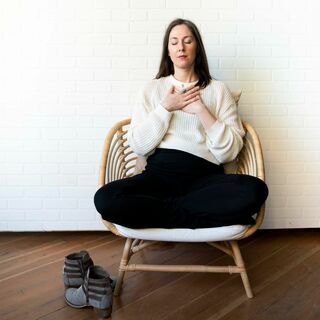
I'll invite you to lie down for this meditation,
But you can absolutely do it seated or lying on your side.
However is most comfortable for you is fine.
Close your eyes or soften your gaze and take a few deep breaths just to settle in.
You might like to put your hands on your belly,
Nice and low down,
Close to your pubic bone.
Deepen your breath a little bit and relax your body.
Notice if you have any tension in your shoulders or your jaw or your belly,
Any tension that you could let go of consciously.
Often when there's tension in the pelvic floor,
There's tension elsewhere too.
There is a specific connection between the pelvic floor and the jaw,
For example.
When one is tense,
The other tends to be as well.
And then when this line activates,
The shoulders and the abdomen will also tend to tighten.
The good news is,
When we can relax one of these areas,
It can help to relax the rest.
So just notice what you can let go of consciously,
And go ahead and do that.
You might want to take a big sigh to help with that letting go.
We'll continue to work on this.
Focus on what you're feeling underneath your hands as you breathe.
As you relax your muscles,
Your belly should rise gently into your hands on your inhale.
And gently release back towards your spine as you exhale.
See if you can relax further,
Allowing this movement to deepen naturally.
There's no muscular work here,
No contractions.
When you relax and breathe naturally,
The belly should simply rise and fall on its own.
Now let's focus the attention a little deeper,
Onto your pelvic floor itself.
This is like a little diaphragm that supports your pelvic organs.
It's about an inch up from the surface of your body around your genitals.
You may or may not have some familiarity here already,
So just see what you can feel when you connect here.
Also,
Do be aware that this is your genital area,
So breathing and feeling into this place could come with some memories,
Images,
Or emotions that have been sitting there for a while.
It's completely normal,
Welcome,
And okay.
Just let those thoughts and feelings be present as we work here together.
I like to imagine the pelvic floor as the bottom of the soft balloon of my belly.
As I inhale,
The balloon inflates,
Pressing itself into my hands,
Which are on my belly.
And as I exhale,
It deflates,
So the balloon gets smaller under my hands.
In the same exact way,
The bottom of the balloon pushes downward towards my feet as I inhale,
And it deflates inward toward my heart on the exhale.
So the pelvic floor expands and stretches towards the feet on the inhale,
And it deflates in and up on the exhale.
Again,
There's no need to contract any muscles here.
We're simply exploring the natural movement of the breath.
Sometimes when exploring the pelvic floor,
I like to think about the image of a jellyfish moving in the water.
They fan open in order to take in more water,
And then squeeze inward towards themselves to move forward.
Perhaps imagine your pelvic floor this way,
Gently opening to take in the water,
And then softly drawing in to move slightly forward.
Imagine the jellyfish swimming gently,
Slowly,
Towards your heart.
If you're comfortable,
Let's expand this metaphor a little bit and add some muscular strength to our work.
We will be consciously engaging the pelvic floor muscles now on the exhale.
Think of a jellyfish when it draws its tentacles in towards its body.
The contraction is in and up towards your heart.
It's not a pushing or a bearing down.
You can also think of it like sucking something up through a straw with your genitals.
A less poetic metaphor perhaps,
But it may help get the image.
So inhale to relax,
Imagining that jellyfish opening to take in more water.
Suck in and up with the muscles this time,
So a contraction,
Like that jellyfish drawing in towards itself to push itself up through the water towards your heart.
Again,
We're not bearing down.
It's really the opposite of that.
It's a drawing in,
As if you could pull your genitals up into your stomach.
So try this a few times,
Relaxing as completely as you can on the inhale,
And then squeezing and drawing in on the exhale.
See how it feels to activate these muscles.
These exercises are excellent for strengthening this area and encouraging healthy blood flow to the genitals as well.
Just doing a little bit of this work can help to raise awareness to this area for your brain,
Which can make it easier to both strengthen and also relax.
So now that we've tried that a few times,
Let's relax again.
For some of us,
This will have brought in some more awareness.
It'll make it a little easier to relax now,
To feel the rise and fall of the pelvic floor naturally.
Return to the image of the jellyfish,
Simply floating in the water,
Not really trying to get anywhere.
Expanding on the inhale,
And on the exhale,
Simply deflating,
Drawing in towards itself naturally.
No specific muscular contraction.
Noticing that this is a natural movement in this part of your body,
Which is actually shaped a little bit like a jellyfish cap.
Stay relaxed.
Notice any other effects in your body.
What do you feel in your belly?
Your shoulders?
Or your jaw?
Soften where you can,
And enjoy the simple release of the pelvic floor breathing.
It might be beneficial for you to return to this meditation somewhat regularly,
Even every day.
Helping to teach these muscles both to relax and also to engage.
Ideally,
They simply engage naturally when you need them in day-to-day life,
And they rest and relax when they're not needed.
It might also be interesting for you to take an awareness of this area into the rest of your life once we close our work together today.
You may notice that tension arises under stress,
Or when you feel unsafe or uncomfortable,
And that this can be a very useful signal for you that something might need to change.
When you feel ready to close our work together,
Let's simply take a deep breath in through the nose and a big sigh out the mouth.
Shake out your hands and feet as you may need to.
If you're laying on your back,
Gently roll to one side and slowly rise up to a seat again.
Thank you for listening,
And have a wonderful rest of your day.