Hello everyone and welcome.
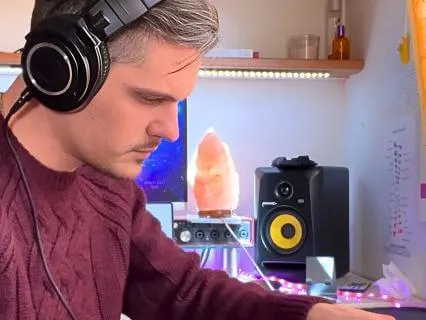
My name is James and I work with sound,
Meditation,
Music and frequencies designed to support relaxation and nervous system regulation.
And today I want to talk about something that many people have heard about before but very few people actually understand it clearly.
And I'm talking about binaural beats.
Now,
You may have seen this term before somewhere while searching for,
I don't know,
Meditation music,
Sleep sounds,
Or relaxation tracks,
You know,
Maybe on an app or in a music title somewhere,
Right?
And naturally,
The question that comes up for most people is pretty simple.
What are binaural beats exactly,
Right?
So today we're just gonna slow things down a little bit and explore this together in a very simple way so nothing complicated nothing you know overly technical just understanding what they are and more importantly how the brain actually responds to them So let's start with the most basic idea.
A binaural beat happens when two slightly different frequencies are played separately in each ear using headphones.
That's it.
In other words,
Your left ear hears one frequency and your right ear hears another frequency.
And when the brain receives those two signals at the same time,
Something interesting happens.
Instead of hearing two completely separate tones,
The brain actually begins to perceive the difference between them as a subtle internal rhythm.
Let me give you a quick example now,
Because this usually makes things a lot more clear,
Okay?
Imagine your left ear receives a tone of let's say 100 Hz and your right ear receives a tone at 106 Hz.
What happens is that your brain detects the difference between those two signals,
Which is in this case 6 Hz.
Now,
Here's the really important part,
Because this is where many people get confused.
You're not actually hearing a 6Hz tone in the air,
Okay?
That frequency isn't coming out of headphones like a normal sound.
The 6Hz rhythm is actually being created inside your brain,
Through the way your auditory system processes those two slightly different signals.
And that's why binaural beats are often described as an auditory illusion.
But the interesting thing is that even though the beat itself isn't heard like a normal tone,
The brain still responds to it,
Right?
And once you understand that,
Things start to become really fascinating because you begin to see how sound can interact with the mind in a much more subtle way than we usually think.
Now,
Another question people often ask me is something like,
Okay James,
But if I'm already listening to frequencies in music,
Isn't that basically the same thing?
And that's actually a really fair question,
Honestly.
But the answer is no.
Because a pure frequency and a binaural beat are not exactly the same thing.
A pure frequency is a real sound,
Okay?
For instance,
If you play a tone through speakers,
You'll hear it clearly in the room around you,
Okay?
Because the sound physically exists in the air.
A binaural beat works differently.
It only appears when each ear receives two slightly different signals separately,
And your brain compares those signals internally.
So without that separation,
The brain doesn't create the same internal rhythm.
And this is exactly why headphones are so important.
People ask me about this all the time,
You know,
Something like,
Can I just listen through speakers?
And the honest answer is that if you want the full binaural beat effect itself,
You know,
Headphones are really necessary.
And the reason is pretty simple.
When sound plays through speakers,
The signals mix together in the air before they reach your ears.
So both ears end up hearing almost the same thing.
But for binaural beats to work,
Each ear needs to receive a slightly different signal so the brain can detect the difference between them.
So,
Headphones aren't just helpful,
But they're actually part of the process itself,
Okay?
Now,
The next question that usually comes up is this.
How does the brain actually respond to binaural beats?
And this is where we get into something called entrainment.
And I'm sure you probably heard this term before.
Now the word might sound a little technical,
But honestly,
The idea behind it is very simple.
Entrainment is basically the brain's natural ability to synchronize with an external rhythm.
And this is something that happens to us all the time in everyday life,
Okay?
For instance,
If you listen to slow music for a while,
You might notice that your breathing begins to slow down as well,
Right?
And your body starts relaxing without you consciously deciding to relax.
You know,
Your nervous system simply begins to follow that rhythm.
And it's all natural.
With binaural beats,
Something similar can happen.
So the brain perceives that internal frequency difference and over time it can begin responding to that rhythm in a natural way but i want to be very clear about something here okay because this is often misunderstood Binaural beats do not force the brain into a specific state,
Okay?
And they definitely don't control your mind.
What they do is much simpler than that.
They create a gentle signal and your brain responds to that signal naturally.
Now,
In my work,
I rarely use binaural beats on their own,
Right?
And instead,
I integrate them into slow meditation music man,
Four.
Because I just want the listener.
.
.
You know,
To have like the most natural experience ever.
So yeah,
If you'd like to just explore this topic in much greater depth,
I explain all of this,
You know,
The full process step-by-step inside my courses here on Insight Timer.
Especially the one called the power of frequency,
Where I go deeper into how sound brainwaves and,
You know,
Different frequencies interact with the nervous system.
But at the same time,
I also know that many people prefer to go straight into the experience itself,
You know,
Without studying too much theory first.
So if that's you,
You'll also find many tracks here on Inside Timer in my teacher profile,
Point of Attraction Sound.
Explore different kinds of sound experiences.
Some tracks focus on binaural beats,
Others on pure frequencies,
And in many cases I combine those elements together with solfeggio frequencies and relaxing ambient music.
And the idea behind that combination is actually very simple.
Instead of working with just one element,
Your experience is multiple layers at the same time.
So,
The binaural beat supports the brain's rhythms,
Right?
The frequency works more subtly on another level.
And the music creates a calm and comfortable environment for your nervous system.
And together,
Those elements create a very gentle but powerful listening experience.
So if you're curious,
Feel free to just explore the tracks in my profile and simply try them for yourself.
And if you do listen,
I'd generally love to hear how the experience felt for you.
So you can always leave a comment or a review and share what you notice while listening.
Because ultimately,
Sound is something that's meant to be experienced,
Right?
Not just understood.
And in the next video,
We'll explore something even more practical.
A very simple and effective way.