Hello,
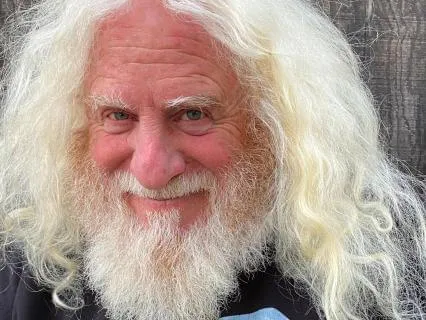
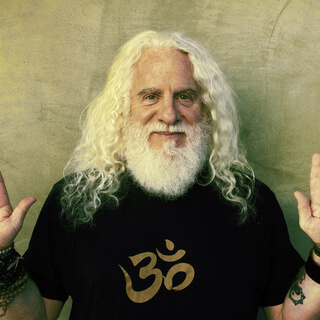
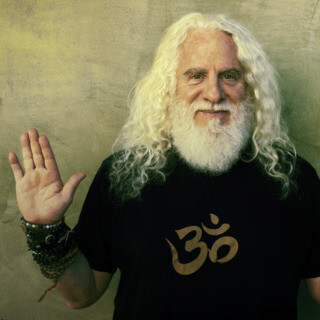
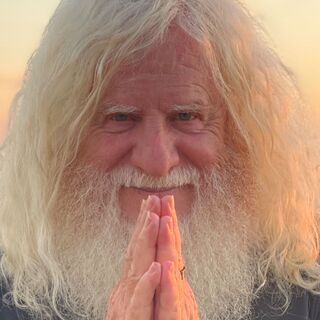
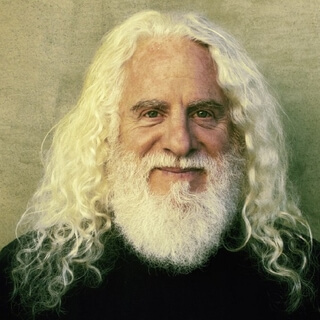
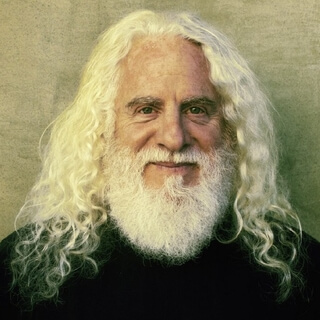
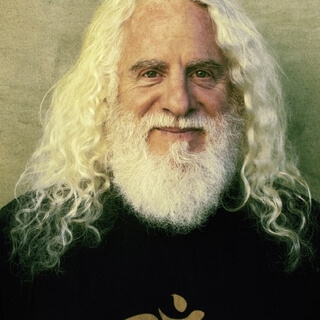
This is davidji.
And I'm so excited today to share a few powerful breathing techniques with you on video.
I have been researching and studying and practicing.
Teaching the science of breath,
The mechanics of breathing,
Mindfulness,
Meditation,
Stress management for over 20 years.
And there really is some great evidence-based science regarding using our breath to lower our heart rate.
To calm ourselves down,
To move through anxiety and stressful moments.
And most importantly,
To help us connect to the stillness and silence that rests within.
Many of you have taken my Insight Timer course,
Breathe With Me,
Heal With Me.
That's an audio course right here on Insight Timer,
But today I get to guide you in video,
In real time.
And that might inspire you even a little bit more to use these breathing techniques to help you slow down the world around you and nourish yourself.
At the same time.
So before we begin,
A few gentle invitations.
I want to offer a few simple guidelines so you can move through this experience with ease and with safety.
First,
Give yourself some support.
If you're standing or if you're sitting at a high top,
I invite you to find a seat or a place where your body can relax.
If you're driving,
Pull over and park.
You don't want to do these types of techniques while you're driving because these breaths can soften you deeply and we want your body to feel steady and supported as you practice.
Second,
You know I always say,
Comfort is queen,
So let comfort lead the way here.
If you're pregnant,
If you're navigating a medical condition,
Or if you're simply feeling sensitive in your body today.
Allow yourself to keep the breath natural and easy.
Don't force anything.
That's the beauty of these techniques and pretty much everything that I teach.
It's gentle.
It's intuitive.
Comfortable.
It's organic.
Remember,
Comfort is queen.
There's nothing to push,
Nothing to hold.
Your body already knows the right rhythm for you.
And third,
Honor your body's wisdom.
If at any point you feel lightheaded or strained or uncomfortable,
Simply return to your normal breath.
This is not about effort.
This is not the breathing Olympics.
It's about relationship and embodiment.
And your body will always guide you toward.
What feels right.
So with that.
Let's settle in.
Let's take a long,
Slow,
Deep breath in right here.
Reach up to the sky.
And as you exhale,
Just allow your shoulders to drop.
Let them soften.
Feel free to move them around a little bit.
Move your neck around a little bit.
And let's begin to explore the quiet power.
Of your breath.
There is this magnificent intelligence within your body that has been keeping you alive since your very first breath.
A gentle pulse.
Sacred rhythm.
Ritam.
There's a tiny cluster of cells in your heart.
Known as the sinoatrial node.
Sinoatrial node.
It's your heart's natural pacemaker.
You don't have to remember its name.
It's been showing up for you since you were in the womb.
And every beat of your heart since.
So remembering the word sinoatrial node is not core to this practice.
They will not be a quiz.
You just have to learn how to befriend it.
Because every breath you take is a message to your heart.
Every inhale whispers,
Let's rise.
In every Excel.
Hums.
Let's soften.
And in that dance.
Your nervous system listens.
And when the breath is rushed,
The heart responds in kind.
And when your breath slows,
The heart begins to trust again.
So today.
We're going to learn how to communicate with the deepest rhythm.
Of our being.
Let me share a simple truth about breath and heart.
When you breathe in,
Your heart naturally speeds up a little bit.
When you breathe back out,
Your heart slows down.
Your exhale is like this loving hand on your heart saying,
All is well.
You're safe.
You can ease up a little bit now.
So if you remember nothing else from today,
Hopefully you remember all of this,
But if you remember nothing else,
Remember this.
Longer.
Slower.
Exhales,
Invite calm.
Longer,
Slower,
Excels.
Invite calm.
Before we move into these practices,
Let's take a moment to arrive.
Your breath is already flowing.
Quietly.
Faithfully.
Without asking anything of you.
And what we're about to explore is simply a way of becoming a little bit more intentional with something that has pretty much always been there.
These are techniques that.
Will help you.
Invite you.
To just listen a little more closely.
Each breath you take is a conversation with your heart.
Each breath you take is a conversation with your nervous system.
Each breath you take.
Is a conversation.
With the deeper intelligence within your body.
And when your breath becomes shallow,
And sometimes it does,
And we notice it.
Your system prepares for a challenge.
And when your breath becomes long.
And slow.
Steady.
Your system prepares to restore.
To repair.
To settle.
So in the next few moments,
We'll explore three simple rhythms of breathing.
Each one has its own purpose.
The first one will help you release tension very,
Very quickly.
And it'll actually knock your heart rate down.
The second one will steady and ground you.
And the third one will bring your entire system into harmony.
So move at your own pace.
Let this be gentle.
Let this be easy.
And most importantly.
Let this be a moment where you begin to trust the wisdom that is already alive within you.
So let's take a long,
Slow,
Deep breath in.
And a soft breath out.
And let's begin.
The first of these breathing practices I like to call filler up.
Top it off.
This is your reset breath.
When stress in your life spikes,
When emotions rise,
When you feel tight or overwhelmed,
You don't have to push it away.
You can breathe through it.
And this technique will slow your heart rate down very,
Very quickly.
Very,
Very real.
It'll relax you very,
Very quickly.
So it works like this.
We'll breathe in about three quarters,
Filling our lungs about three quarters.
Through our nose.
All of these,
We're gonna breathe in through our nose and out through our mouth.
That's how I like to teach.
Breath awareness.
So we're going to breathe in about three quarters.
And then instead of exhaling,
We're going to top it off.
So we fill her up to three quarters.
And then we top it off.
And then we do what's known as a physiological sigh as we exhale.
Hmm.
.
.
That's essentially it.
So we'll do it three times together.
Fill her up,
Top it off.
Sigh it out.
Right.
So do this with me again.
Listen to your body.
It'll feel really good though.
And if you want to,
You can even,
If you're using like a device or a tracker,
You could see what's your heart rate right now.
After we do this just three times,
Your heart rate's going to drop.
Your whole body's going to relax.
So check it out.
Let's do it.
Fill her up.
Top it off.
And sigh it out.
I didn't really sigh there.
So let's do three where I do actually sigh.
Do the thing I'm trying to teach you right now,
Okay?
Fill her up.
Top it off.
Sigh it out.
That's it.
That's better.
Again,
Fill her up.
Tap it off.
Signing out.
One more time.
Fill her up.
Tap it off.
Sigh it out.
Sigh and it just float right here.
Just allow it.
Feel yourself slowing down.
Your heart rate is dropping right now.
Your body's relaxing,
Your mind is calming.
Pretty amazing.
Pretty awesome.
Your sinoatrial node.
Thanks you for this one.
So I'm going to share.
A physiological and emotional and a lifestyle benefit.
With each of these practices so you can really understand them at those three levels.
So physiologically,
This breath quickly releases any built up carbon dioxide that we have inside of us.
And we have a whole bunch of it.
Well,
A lot less right now.
And it resets our breathing rhythm.
And it allows our heart to really settle in.
And that allows your nervous system to downshift.
The emotional benefit is that it softens the intensity of overwhelm in any moment.
Like giving your emotions a little more space to move and settle,
Which is always a good thing.
And lifestyle-wise,
You can use this in real time before a difficult conversation,
After receiving stressful news,
Or anytime you feel activated.
To come back to clarity within seconds.
I do this all the time before I go on a podcast.
I do it before I record a meditation.
I do it.
I did it right before I clicked start on this video.
So it really works.
The second technique I want to share with you,
I refer to as your steady anchor.
But you can think of it as four,
Six breath.
This is your everyday companion.
It's simple,
It's grounding,
It's reliable.
And essentially what we do with this technique is inhale to the count of four through our nose and exhale to the count of six through our mouth.
Through our mouth.
And let that exhale be smooth,
Unforced,
Generous.
So let's try it with me right now.
Inhale.
And Excel.
Let's do it again.
Inhale.
And Excel.
Let's do it one more time.
Inhale.
And Excel.
With each longer exhale,
You're gently telling your heart,
You could slow down now,
All is well.
And this rhythm begins to ease anxiety.
You're feeling a little better now,
Right?
Softens any mental noise that we have,
Brings your body back into balance.
So if your mind is busy,
This will become your anchor.
If your emotions feel loud,
This really can become your stabilizer.
You're digging it,
Right?
So the four,
Six breath.
Physiological benefit,
The longer exhale gently activates the vagus nerve.
The vagus nerve.
The longest nerve in our entire body,
Not Las Vegas,
But Vegas,
V-A-G-U-S.
This is the longest nerve and it comes from the Latin,
Which means wandering.
This is a nerve that starts at the base of your brain and then weaves its way down past your ears.
Down your carotid channels here,
Your carotid arteries,
Down into your heart and lungs,
Down deeper into your digestive system.
That's a long nerve.
And it's the largest one in your body.
And so it gets activated just by that longer exhale.
It signals our heart to slow.
And it guides our body into a calm,
Regulated state.
Your vagus nerve is speaking to your brain,
Your heart,
Your lungs,
And all the organs in your body,
Telling them,
It's safe.
Or it's dangerous.
And we just sent a powerful message.
It's safe.
Emotionally,
It steadies your inner world.
It reduces anxiety.
I know you're feeling a little less anxious right now.
It helps you quickly feel more grounded,
More centered,
And more present.
Lifestyle benefit.
This becomes your daily anchor,
Something you can return to throughout the day to stay balanced and focused.
And ideally responsive rather than reactive.
So you can do it once.
We did it three times,
But you could do it once.
Uh,
I like to do this typically 10 times.
I like to do all these techniques 10 times,
But you could build up to this.
You don't have to start.
The third technique that I want to share with you,
I refer to as coherence breath.
Very,
Very cool.
Very,
Very powerful.
And,
Um.
.
.
Most of us breathe between around 12 breaths per minute.
Most of us.
Some of us a lot more,
Some of us a lot less.
But this coherence breath is going to guide us into breathing six breaths per minute.
This is where everything begins to synchronize our heart,
Our breath,
Our nervous system,
All start to move together.
We start to breathe slowly enough that our entire system starts to harmonize.
Now you're probably feeling pretty chill right now,
But we're going to breathe into five through our nose.
We're going to breathe out to five through our mouth.
We'll do that for a minute.
That'll be about,
Six breaths for that minute.
I'll time us right here.
And I'll guide us with my breath and my hand signals.
Okay,
So again,
Into five through the nose.
Out to five through the mouth.
And again,
Always keep moving towards comfort in this process.
So no strain,
No effort.
Just a smooth,
Continuous wave of breath.
So let's begin.
You're allowed to smile while you breathe.
Or even laugh.
In.
And out.
Yourself slowing down in.
And out.
Let's go one last time here in.
And out.
And now just float.
Now just float.
This pace here.
Heart rhythm is becoming more coherent.
Your nervous system is shifting.
Into healing mode.
Your body is beginning to restore itself.
This is the breath of regulation.
This is the breath of resilience.
This is the breath of coming home to yourself.
Pretty amazing,
Right?
So what are the benefits of coherence breath?
Physiological benefit is that this rhythm optimizes our heart rate variability.
This allows your heart and your breath and your nervous system to synchronize.
This supports healing,
Supports recovery.
And overall resilience.
The emotional benefit is quick and profound.
This creates a deep sense of inner harmony.
We're feeling that right now.
This is where our thoughts,
Our emotions.
And our body.
Begin to feel aligned and more at ease.
And the lifestyle benefit,
When we practice this regularly,
And I would suggest you practice it regularly,
It builds long-term resilience.
And what is resilience?
It's your ability to get back up after life has dealt you any kind of setback.
Large or small.
It's our ability to.
Get back up.
So this technique will also help us navigate stress.
It'll help you make clearer decisions.
And it's gonna move you through life with greater steadiness and flow.
All of these.
You can use them right now.
And these will change your life over time.
So we've learned three life-changing techniques.
These land in three different layers.
Fill her up,
Tap it off,
Provides immediate relief.
4-6 delivers elegant emotional regulation.
And coherence breath brings us longer term.
Transformation.
Pretty powerful,
Pretty amazing.
So as you move through your day,
Notice your breath.
Not necessarily to control it,
But just notice it.
To connect with it.
Because your breath is always listening.
Your heart is always responding.
And this beautiful conversation between breath and heartbeat is always available to guide you back to steadiness.
Always to guide you back to that stillness and silence that rests within.
So you can be the calm amidst the chaos,
The stillness inside the storm.
So perhaps today you begin a new friendship with your breath.
With your heart,
With that quiet rhythm,
Ritam,
Within you that has never left your side.
And anytime life feels loud,
You already know the way back.
Just breathe.
And let your Excel lead you home.
From the sweet spot of the universe.
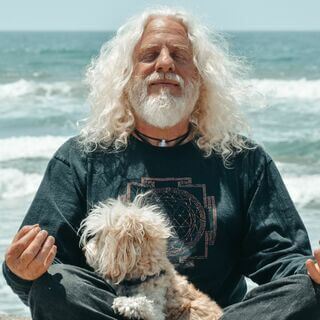
This is David G and I'm always guided by one of the great breathers and meditators of our time.
Peaches,
The Buddha princess who teaches us in every moment.
Resist nothing.
And you will receive unconditional love.
We send you love.
Keep meditating and keep breathing,
And I'll see you in the gap.