Hi,
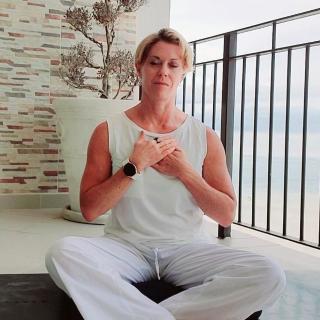
I'm Sherry.
If your nervous system has been feeling overwhelmed,
Frozen,
Are simply tired from holding too much for too long.
This Yin Yoga practice.
Is here to help you reset gently from the inside out.
Will be moving slowly through long-held postures designed to support vagus nerve stimulation and nervous system regulation.
Most poses will be held for a few minutes to give your body space to unwind at its own pace.
You might want to have a blanket,
A couple of blocks,
A bolster,
Or pillows,
And possibly even a chair to put your legs up during our final rest.
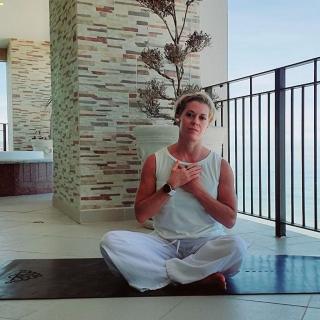
Will begin upright in a seated posture.
Whatever is comfortable for you.
Allow your ear to drop gently toward your shoulder.
Keep your chest lifted and direct your eyes up into the opposite corner without moving your head.
If it feels good.
You can invite calm through ujjayi breathing.
Slightly constricting the back of your throat to create a saw steady ocean sound.
This position.
Activates the cervical branch of the vagus nerve.
And surrounding cranial nerves.
Eye movement stimulates oculomotor and facial pathways.
One Ujjayi breath adds internal vibration.
That tones the vagus through the throat and diaphragm.
Both shown to support sleep quality.
Allow your eyes Return to center.
Gently lift your head back to neutral.
And allow your other ear to drop toward your shoulder.
Stretching the second side.
Keep the rest of the body relaxed.
Eyes move to gaze up to the top corner Possibly continuing your ujjayi breath smooth and steady through the nose.
Notice how this side feels compared to the first.
Is there any difference in your jaw,
Throat,
Or behind your eyes?
Allow yourself to be with sensation.
Without needing to change or explain it.
Gently,
Bring your head back to neutral.
Eyes return to center.
Allow the breath to return to its natural rhythm.
Take a moment here.
To notice the overall tone of your body,
Your face,
Your neck.
Your breath.
As the neck unwinds and the inner gaze softens.
A quiet invitation.
Opens through the spine.
Allow your legs to extend wide.
On your mat.
You can support yourself.
By placing a bolster cushion our stacked blankets under your chest.
Arms or forehead.
Allow your spine to round as you fold forward and soften.
The weight of your head.
Holding forward in this shape compresses the lower abdominal cavity,
Stimulating visceral afferents.
Nerves that carry information from the gut to the brain.
Since the vagus nerve is mostly afferent,
This passive stimulation can increase vagal tone.
And signal that it's safe to downshift toward rest.
This kind of feedback loop is essential for sleep preparation.
Bring your awareness to the inside of your thighs,
The base of your spine,
And your lower belly.
Is there a tug,
A stretch,
A warmth?
What does grounded openness feel like in this moment?
Slowly begin to walk your hands back toward your body Open your spine upright.
Draw your legs in.
From here Shift your weight forward and come onto hands and knees.
And lower down onto your belly Stand one knee and let that leg open out to the side,
Taking half frog shape.
Adjust your arms in any way that supports you.
Turn your head in whichever direction feels comfortable and easeful for your neck.
In this shape,
Gentle pressure on the lower belly and inner thigh.
Stimulants,
Vagal pathways.
Related to digestion.
Healthic awareness.
And immune signaling.
The prong position.
Also activates the ventral side of the body.
Calming the dorsal vagal circuit.
And helping the system downshift.
From bracing into rest.
Notice the contact between your body and the ground.
Is their breath moving into your back ribs?
Belly or side waist.
What feels grounded?
And what's still holding?
When you're ready.
Slowly straighten the bent leg.
Passing through center.
As we move into half frog on the opposite side.
Make any adjustments.
What do you need here?
Head.
Arms.
Anything that's needed for this pose to feel natural and supportive.
This side may feel different.
And that's useful information.
The vagus nerve plays a role in how we process asymmetry.
Helping the body recognize contrast.
And shift from guardedness into adaptability.
Supporting both sides evenly.
Can build resilience.
Through safe,
Sustained contact.
Is there a different sensation of stretch?
Pressure.
Our release compared to the first sight.
Can you track any pulsing?
Warm.
Our internal movement.
Especially around the hip belly.
Our side body.
Bringing in a bit of movement now.
Begin.
Draw the leg back in and return to a neutral position on your belly.
From here.
Gently roll onto your back.
And bring your feet to the floor about hips width apart Place your hands behind your head.
Interlacing your fingers Allow the elbows to rest on the mat.
As you exhale.
Invite both knees to drop to one side.
Moving your eyes in the same direction.
The head Remain centered and neutral.
Inhale.
To return the knees and eyes to center.
Exhale.
Drop your knees to the opposite side.
Eyes following.
Continue side to side with your breath.
Adding a soft hum on each exhale The simple repetition engages The Vegas Nerd.
Through motion.
Eye tracking and vocal vibration.
When these elements combine with your breath They help regulate both the brain stem and spinal branches of the vagus.
Balancing the nervous system and downshifting out of overdrive.
As you move,
Notice how the eyes and pelvis feel connected.
What changes when your attention follows the motion.
Rather than controls it.
Can you feel the vibration of the hum?
Anywhere inside your body you After your final round Allow your knees and eyes to return to center.
We might.
Bring your feet a little wider.
And allow your knees to fall inward.
Until they rest against each other.
Keeping your head in neutral Gently.
Shift your gaze to one side.
Will be holding this gaze point.
For about a minute This technique activates a reflux loop.
Between the muscles behind the eyes.
And the cranial nerves connected to the vagus.
When the eyes hold still in one direction,
It can cue a spontaneous vagal response.
Like a sigh,
Swallow,
Or yawn.
Signaling the nervous system that it's safe.
To share.
Into deeper parasympathetic states.
Gently,
Bring your eyes back to center.
Pause for a moment.
Then allow your gaze to move to the opposite side and rest there.
Notice what's happening beneath the surface.
Is there a subtle drop in energy?
A shift in your bra our sense of release.
Through your chalester belly.
What signals,
If any?
Tell you that your system is settling.
You Bring your eyes and arms back to center.
Release your hands and allow your arms to rest wherever they feel most comfortable.
You Gently,
Draw your knees up toward your chest and allow them to fall to one side.
Whichever side feels most natural today.
If it's helpful,
You can slide a blanket or bolster between the thighs or under the knees for support.
Keep your shoulders relaxed.
In your head centered.
Or turn the gaze gently in the opposite direction.
Whatever feels most supportive.
There's no need.
To force any rotation.
We're simply here.
To soften.
And listen.
In the supine twist We're encouraging the connective tissues of the abdomen to hydrate.
And glide more freely.
The gentle ringing motion.
Helps hydrate the fascia.
Around the digestive organs.
And stimulates visceral glide important for healthy digestion,
Detoxification and vagal tone.
Unlike deep muscular stretches this kind of twist.
Works through time Breath.
And safety.
Inviting the body to soften layer by layer Notice if one side of your belly feels more protected or held.
Can you allow just a little more weight to drop into the floor?
Notice the quality of your breath here.
Not changing it.
Simply sensing.
Doesn't move up into the chest Or is it settling low and steady?
Allow your breath to be a companion.
Not a task.
Begin to soften the shape.
Bring your gaze back to center.
Gently.
Light your knees.
Through the middle and allow them to draw to the opposite side.
Quest don't just benefit.
The digestive organs This rotation.
Also affects the thorocumcular fascia.
Tissue rich with nerve endings.
That communicates directly with the Vegas Learn.
Moving through this spiral gives your nervous system a chance to settle,
Recalibrate,
And feel held.
Feel into how this side receives the twist.
Allow the breath widen across your ribs Notice the contact your body makes with the floor how you're being supported without needing to do anything at all.
Start to ease your way out slowly,
Allowing the twist to unwind itself.
From center,
Plant your feet on the mat,
Knees pointing up.
Cross into the soles of your feet to lift your hips.
Just enough.
A slide,
A folded blanket,
A cushion,
Or a bolster.
Underneath your tailbone or sacrum.
Allow your pelvis to settle heavily into the support.
From here.
Your legs can stay bent.
Or you can extend them long if that feels supportive.
Arms may rest long by your side.
Bent in the cactus or you might choose.
To place your hands on your chest or abdomen.
Whatever feels most grounding for your system.
Supported bridge.
Helps to soften accumulated tension in the low back and hips.
Areas that tend to constrict when the body is under stress.
Gently elevating the pelvis.
And signals safety to the nervous system.
By reorienting your body's sense of gravity.
And allowing the spine to decompress without effort.
This can be a powerful yet subtle way.
To nourish,
Vagal tone and down regulate.
As you settle allow your awareness to land in your lower body.
Notice the contact points.
Your sacrum on the support.
The weight of your heels or legs.
The back of your arms.
Is there anywhere you feel a little more hell?
A little more willing to soften.
There's no need to name or define.
Simply noticing what's here a sensation Tone temperature,
Weight.
Stay with this.
For a few quiet moments from here.
Will begin to transition.
Your final rest.
You might bring your map to the wall.
Slide a chair beneath your calves.
Or lift your legs into the air with no support at all.
Choose.
What feels most accessible and nourishing to your body.
If you'd like.
Place a light weight on your lower belly.
Such as a folded blanket,
A small cushion.
Or even your hands.
First Sense of Gentle Containment Feel the contact.
The pressure.
The ground beneath you.
We'll begin with just a couple rounds of a breath that helps to release tension.
And bring the body into a state of calm.
The physiological side.
I invite you Take a slow breath in through the nose.
And a sip Second little breath on top And exhale,
Long and slow,
Back out the nose with a self-sign.
Do one more round Inhale Sit down.
Hill.
Allow the breath to settle into a steady rhythm.
Inhaling for a count of five.
And exhaling for a count of five.
In and out through the nose.
This is sometimes called coherent breathing.
Known to support vagal tone.
And heart-brain balance Preparing.
To inhale together now.
For two,
Three,
Four,
Five.
Exhale,
Two,
Three,
Four,
Five.
There's no need to be exact.
Simply find A gentle even flow.
Whatever count of five.
Feels best in your body.
I'm gonna stay here for the next minute or so.
Simply noticing how the body responds to rhythm,
Stillness.
Support.
When you feel ready,
Allow the breath return.
Its natural rhythm.
Simply give it back to the brainstem.
No control.
No counting.
Only breath and presence.
And remain in this shape if it continues.
To feel good in your body.
I just.
.
.
Your system is asking for something different.
Letting go here.
Allowing.
The ground to hold you.
Bringing awareness.
Back to the body.
The weight of your limbs your contact points of the ground.
Shape of breath Moving,
Chat me through you.
Snow Rush.
Your legs are elevated.
Slowly guide them down.
And roll onto your side.
You might choose to pause here,
Curled inward.
Or easing your way up to a seated position.
Allow your eyes to stay soft.
Notice.
What feels different?
But shifted even subtly.
Yourself.
Moment here to simply be.
With yourself.
If something in today's practice resonated with you.
I'd love to hear what landed.
Your body is always communicating with you.
All we need to do.
Is pause and listen.