Joe didn't make it.
When I first saw the tall,
Pimple-faced teenager,
I thought that he looked out of place.
He had the long,
Blonde locks of a surfer,
Or more likely like an urban skateboarder,
And a distant,
Hungry look in his eyes that made you think he wanted to be somewhere else.
He was there as usual for breakfast and lunch on the fourth day into the course,
But when the rest of us were having a tea break at three p.
M.
,
I noticed that his bags had gone.
He seemed to have left in a hurry,
As his futon was left unfolded with the bed linen strewn in a mess on top in seeming protest.
Retreats are not for everyone.
When I first arrived in Japan many years ago,
I had been expecting to find a plethora of Buddhist temples offering Zen meditation.
Having been introduced to the practice of meditation through martial arts,
I was looking forward to weekend retreats in the mountains under the watchful eye of an experienced and enlightened oroshi.
However,
I quickly discovered that most temples around Tokyo were graveyards or tourist attractions that acted as cash cows for generationally rich Japanese families.
I learned,
For example,
That the famous bronze statue of Buddha and Kamakura is owned by a family and that they have their residence on the grounds,
But out of sight from the tourists,
As is their luxury fleet of vehicles.
In Kyoto,
There are some temples that advertise classes to give tourists a taste of Zen.
It means a quick tour of the temple,
Sitting down for twenty minutes of guided meditation,
And then finishing up with a cup of bitter green tea.
I met one monk who said that Zen was one of Japan's best-known exports,
But there wasn't much interest in Japan.
People and cities just did not seem to have the time to commit to regular practice.
He himself had travelled to the United States for his training,
And when he returned to Japan,
He had hoped to start regular weekly Zen meetings.
But on the night that I was there,
There were only the two of us.
More recently,
A weekly advertisement indicating Friday night Zazen kept catching my eye in the local Tokyo newspaper.
Finally,
After months of dithering,
I mustered enough energy afterward to head out to Ueno on the Yamanote Line.
I found the temple in amongst office buildings about ten minutes' walk from the station,
And when I walked up the stairs to the fourth floor,
I was surprised that the meditations were led and organised by a long-time Tokyo resident from the US.
Again,
The spacious hall was filled by only the two of us.
So too,
An annual weekend retreat in a temple in Shizuoka,
Held over the Golden Week,
Is organised and run by a British monk living in Tokyo.
When I attended,
I found the temple staff were Japanese,
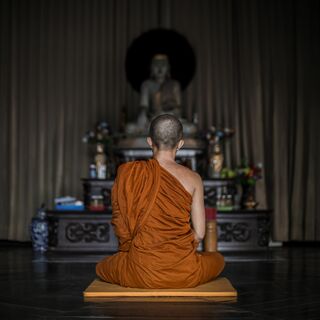
And apparently ordained monks,
With the full robe outfits and shaven heads,
But they seemed more interested in listening to Enka,
Watching the horse races on the kitchen TV,
And drinking beer.
Very little,
If any,
Sitting in the dusty adjacent meditation hall.
To them,
We were probably just a bunch of Japophile foreigners intent on an authentic Japanese experience.
At one time,
We persuaded the head monk to chant a sutra for us and bang-a-bong,
But then that really did have the effect of making me feel like a stupid tourist.
I had given up on the idea of finding a place to meditate in Japan,
When one day a Facebook friend of mine announced that she had just been on a ten-day Vipassana course in Chiba,
Which was only two hours from my home.
I looked online at the course webpage,
And was surprised when I saw what people were going to do.
Ten hours of meditation,
Getting up at four o'clock in the morning and going through to nine o'clock at night.
There were some breaks for lunch and rest,
But it still meant ten hours of intensive meditation a day.
I was shocked and wondered if I had the mental strength needed,
But I decided to enrol in a course in the heat of summer and waited for the time to come.
I've never had much need to get beyond the city fringes.
The large sprawl of Tokyo takes some time to get out of,
Whether that means going west towards the mountains or east towards the coast.
I did have an idea of the rice fields and forests that lay beyond the city,
Due to our numerous trips out to Narita Airport,
But the other parts of Chiba had remained a mystery until this time.
Once beyond the city of Chiba itself,
The land becomes an intense summer green that is not often associated with Japan.
Extensive stands of bamboo,
Manicured rice fields in which herons stepped through on stilted legs,
Small towns and one-hut train stations.
Perhaps it was my imagination,
But the train itself seemed to slow down and take on a more spaced out and casual approach to the earlier frenetic clickety-clacking within the city.
Here there seemed an extra noise or two.
Clickety-clackety-click.
Clickety-clackety-click.
Clickety-clackety-click.
There was space to sit down on the seats.
There was time to look out of the windows.
The Vipassana Centre in Chiba is out in the countryside,
Close to the town of Mobara.
Established in 2006,
The land on which the buildings sit is an old baseball diamond,
With netting and run-down disused clubhouses.
The Centre members renovated the buildings as much as possible,
Turned the largest building into a kitchen-dining-room facility,
And added temporary toilets and shower facilities.
When the first residential courses were held,
The participants slept in single-pup tents raised off the ground on wooden platforms.
All rather makeshift,
But it worked.
As word got out that there was an active Vipassana Centre in Tokyo,
More people became interested,
And the courses became increasingly popular.
Eventually,
With volunteer help and donations,
A large meditation hall,
Two dormitories and bathroom were added.
When I arrived toward early evening,
I surrendered my phone,
Tablet and any other distractions for safekeeping,
Sat through the orientation and enjoyed a wholesome vegetarian dinner with my fellows.
After this,
We were taken to separate male-female dormitories,
And I was shown my space on the floor,
Given a futon,
Some sheets,
A pillow,
And made myself ready for the early start the next morning.
To an outsider looking through the windows,
Meditation must seem like a very relaxed and peaceful thing to do.
The reality is that it is very hard work.
When sitting on a cushion with legs crossed and eyes closed,
The body is held very still and stopped from moving.
Over time,
The breath becomes slower,
But the mind and our thoughts are just first things we have to fight with.
Usually in our lives,
We let our minds run free,
Jumping from one thought to the next and back again.
It really is like a wild animal that needs to be tamed.
In meditation,
The attention is focused simply on the breath going in and then the breath going out.
Every time a thought comes up,
It is ignored and the mind is refocused on the spot between the nose and the upper lip,
And the attention returns to respiration.
It sounds easy,
But it isn't.
Most beginners find that the mind will focus for about one or two breaths before going off on some tangential daydream.
Slowly and with practice,
The thoughts begin to slow down and a mental peace begins to appear.
There even seem to be moments when there is no thought at all,
Just a quiet awareness.
It is very much like throwing out all the junk and furniture from your room and just living simply on a tatami mat floor.
The mind gets cleared of all clutter and learns to rest.
Getting up every day at 4am wasn't really a problem.
In fact,
It was one of the best memories from the time I spent there.
The cool,
Early morning air felt refreshing in contrast to the oppressive heat of the day,
And the full moon that hung on the morning horizon like a white pearl also provided natural light on the path to the meditation hall.
Once everyone was seated,
The hall filled with silence as minds turned to meditation.
The early morning bird song and the call of insects became louder as the sky lightened.
It was the best part of the day.
The physical side of sitting absolutely still during the four-hour intensive long sections of the day is an enormous challenge.
Again,
We are not used to sitting still for a long time,
And the body will tell you that it needs to move.
Your nose will begin to itch,
And you will want to scratch it.
You will hear mosquito whine around your ears,
And you will want to slap at it.
You will feel that your shirt or pants are too tight,
And you will want to wriggle to make yourself more comfortable.
But no,
You can't move.
Most of all,
You cannot uncross your legs during intensive practice,
And this becomes very painful.
Try sitting with your legs crossed and back straight and see how long it takes before the pain starts,
Usually about 20 minutes.
Imagine what it feels like then to sit for an hour,
And then to do this repeatedly every day for 10 days.
Sometimes the pain is so bad that you want to give up,
Stand up and go home like Joe did.
It seems endless,
And it takes over the mind.
There's no escaping the pain,
And it becomes central and foremost to your existence until a point is reached where there's simple surrender.
The body will not take any more pain and lets it go.
In my case,
I felt as if I'd been immersed in a cold waterfall,
And the pain was washed out of me in a tingling current of released tension and energy.
By day five of the course,
There's still some pain from time to time,
But you know that it's not an insurmountable problem as before.
At the end of the retreat,
There's a strong sense of accomplishment,
Knowing that sitting motionless for an hour is possible.
Another interesting challenge during the 10 days was the vow of noble silence.
Before starting the retreat,
A solemn promise is made not to talk or have any contact with any other person.
It meant that even though there were 60 people on the course,
It would feel like you were there by yourself and in your own world.
This is important because often people talk without thinking and just chat because they feel uncomfortable with silence.
Silence also helps the mind to become still and quiet.
Noble silence means that the whole day becomes a meditation,
Even going to the bathroom and eating because you have to control the wish to speak.
In an emergency,
It is possible to speak with course leaders,
But mostly people spend the days in a quiet way.
No music,
No television,
No internet,
No reading,
No writing,
No talking,
No cell phones.
At the end of the 10-day course where noble silence was lifted,
People had the chance to speak and relax.
It was a rather strange experience because we had been closely together for the duration of the course,
And yet this was the first opportunity we had to speak with one another.
I discovered that some people had come from as far north as Hokkaido and one or two from Shikoku.
There was even a young man from Bhutan and a couple of foreigners like myself who had made Japan home.
Mostly though,
The participants were young Japanese students or new graduates in their mid-twenties.
I was surprised at the total number of people in the course,
And once again thought back to what the young monk in Kyoto had told me a couple of years before.
He had said there wasn't much interest in the practice of meditation in Japan,
But maybe this course was a sign that there still is.
Since the first course I've attended for the four,
I'm aware that there's a small corps of volunteers who give their time in the upkeep of the centre,
Prepare and cook the meals,
Act as administrators and maintain the buildings.
There's none of the pomp and ceremony found at working temples,
No monks in robes,
No fancy raked pebble gardens to contemplate,
Nor statues of Buddha to bow down to.
The centre provides many with their first intensive retreat experience,
And those who return for more develop an inner peace that stays and is carried within them between times.
I have booked myself in again for the summer.