Lesson 1
Session 1A. Why work with the mind and how to begin to do this?
42 Session Challenge Session 1A – Awareness
Quote for the day: ‘reality is a function of what we pay attention to’
What will you learn?
• Our reality is determined not from external objects but our internal mindset.
• We need to start with awareness of this to enable working with our minds.
• Doing that requires calming the mind and creating focus, attention & observance of our minds.
• To transform our minds we need to connect with our mental reality in a calm space.
• Meditation is the best method to achieve all the above.
• We begin with simple breathing meditation in 3 parts.
Day 1 & 2 Challenge:
1. Do the meditation following the audio session 2 and at try to do at least once again each day. Try to begin each day from now on with a calm abiding meditation, ideally mornings, not necessarily first thing but before screens and conversations.
2. Contemplate during the day the expression; ‘reality is a function of what we pay attention to’
3. Try to let the calm sense of awareness that comes during meditation to pervade your day
read more
Lesson 2
Session 1B. How to begin meditation.
42 Session Challenge Session 1B – Awareness
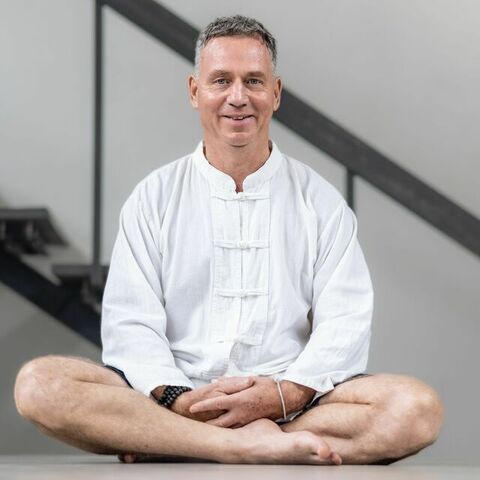
MEDITATION POSTURE:
• CROSSED LEGGED; Ideally full or half lotus, if this is not possible sit on the knees with a cushion between the legs or otherwise legs apart on a chair is also fine. The essence is comfort but to be upright.
• STRAIGHT BACK; Not awkward but comfortable & upright
• SHOULDERS STRAIGHT; comfortable but upright.
• HEAD SLIGHTLY FORWARD; looking at the ground in front 1-2 meters.
• EYES ALMOST CLOSED; allow just a small amount of light to enter. Closed or open are also OK but avoid sleepiness or distraction.
• TONGUE AGAINST THE ROOF OF MOUTH; stops too much saliva forming.
• HANDS RIGHT ON LEFT THUMBS TOUCHING; gently in the lap, one can also have the hands on the knees facing upwards or downwards if you prefer.
First technique mindfulness of breathing:
In this practice one is simply becoming aware of the breath in a gentle way. Do not breath differently simply breathing normally become aware of the breath.
Watch the breath as it enters all the way down to the chest and then leaves again, let the breath be what it is deep or shallow, long or short.
We divide the practise into three parts: a. Begin by using counting to help keep one’s attention., breath in and out then count one, then in and out and two and so forth up until ten and then start at one again. B. continue without counting just observing the breath. C. Observe the breath just at the tip of the nostrils as the breath enters and leaves the nose.
One’s attention will inevitably wander this is normal. When it does, very gently become aware that one has lost the object of attention and bring it back to the breath. Do not return to count one but continue where you were.
Don’t become involved in thoughts nor become upset with them. Be aware that they have arisen and allow them to simply move on. Let them pass by like a cloud through the sky.
RELAX let yourself gently be attentive to the object without any tension or force. Be GENTLE with yourself and your practise.
THANK YOU FOR YOUR PRACTICE
read more
Lesson 3
Session 2A. How to begin to develop our meditation practise
42 Session Challenge Session 2A. – Awareness
Quote for the day: ‘Between stimulus and response there is a space. In that space is our power to choose our response. In our response lies our growth and our freedom’ Viktor Frankl
What will you learn?
• Despite not ‘doing’ when we meditate we do want to improve our practise.
• Finding balance between excitement & laxity is key like the strings of a guitar.
• Mindfulness & introspection are the mental factors/muscles we need for this.
Day 3 & 4 Challenge:
1. Do the meditation following the audio and at try to do at least once again today, focus on cultivating the two qualities of mindfulness and introspection.
2. Build up these mental muscles by; During the day practise a. Mindfulness; stop and be mindful 4 or 5 times a day, just stop and breathe for a minute or ten breaths. Also do a mindful action once a day, slowly and intentionally being aware of every part of the action. B. Introspection; once a day stop and look at where your mind is follow the dialogue of your thoughts and get in touch with your mental state.
3. Try to let the calm sense of awareness that comes during meditation to pervade your day.
read more
Lesson 4
Session 2B. Practising with the right factors
42 Session Challenge Session 2B – Awareness
What to focus on:
One’s attention will inevitably wander this is normal. When it does, very gently become aware that one has lost the object of attention and bring it back to the breath. Do not return to count one but continue where you were.
Don’t become involved in thoughts nor become upset with them. Be aware that they have arisen and allow them to simply move on. Let them pass by like a cloud through the sky.
Don’t expect thoughts to stop completely this is not the idea, it is to learn to not follow and not become involved in thoughts. Learn to see you are not your thoughts.
RELAX let yourself gently be attentive to the object without any tension or force. Be GENTLE with yourself and your practise.
There is a balance to achieve since though being relaxed is essential being alert is also vital. We are trying to combine two mental factors normally not seen together; clarity and stability.
As Roshi states ‘ the mind must be unhurried, yet at the same time firmly planted or massively composed…But it must also be alert , stretched, like a taut bowstring….this is a heightened state of concentrated awareness wherein one is neither tense nor hurried and certainly never slack. It is the mind of somebody facing death’
Daily practice:
Meditation like most things is only really beneficial with regular practise. Ideally this breathing meditation should be done every morning soon after waking. Ideally before screens or conversations begin but some drink or stretching beforehand is fine. Aim to slowly move up to 20-30 minutes a day.
THANK YOU FOR YOUR PRACTICE
read more
Lesson 5
Session 3A. Dealing with our thoughts Lecture
42 Session Challenge Session 3A. – Awareness
Quote for the day: ‘Awareness takes over from thinking. Instead of being in charge of your life, thinking becomes the servant of awareness’ Eckhart Tolle
What will you learn?
• We need to learn to let go of our attachment to thinking and thoughts.
• Once we get familiar with this concept we can literally choose which thoughts to stay with and which not.
• Think through the dog and lion example and learn to be like the lion with your thoughts in meditation not running after the thoughts like the dog!
Day 5 & 6 Challenge:
1. Do the slightly longer meditation following the next session's audio and at try to do at least once again today, focus on letting go of the thoughts and be lion like in dealing with your thoughts.
2. Try to let the calm sense of awareness that comes during meditation to pervade your day.
3. Look for the mindfulness bell app from Thich Nat Han to assist with mindful moments during the day.
read more
Lesson 6
Session 3B. Meditation working with our thoughts
42 Session Challenge Session 3B. – Awareness
What to focus on:
Learning through practise how to deal with thoughts in meditation. Follow the audio and focus particulary on letting the thougths go like the lion rather than the dog, like a cloud passing through the sky or a fish through water. The sky & water remain unaffected likewise dont let the mind be affected by thougths by following them or identifying with them.
Thank you for your practise.
read more
Lesson 7
Session 4A Working with the obstacles which harm our meditation practice. Lecture
42 Session Challenge Session 4A – Awareness
Quote for the day: When conditions show the mind is tight, we learn to soften and relax, to open the attention. When the mind is sleepy or flabby, we learn to sit up and focus with more energy. The Buddha compared this with the tuning of a lute, sensing when we are out of tune and gently strengthening or loosening our energy to come into balance. In — Jack Kornfield
What will you learn?
• Clarity & stability are the 2 mind states we need to combine in meditation.
• To achieve this we need to work with the imbalances of excitement & dullness
• Learn the antidotes to these distracting states of mind.
Day 7 & 8 Challenge:
1. Do the slightly longer meditation following the audio and at try to do at least once again today, focus on working with your balance noticing when agitated or dull and try to bring yourself back to clarity and stability.
2. Keep up mindful moments, a mindful action and introspective moments during the day.
3. Build up your ability to do this by trying to notice during the day when your mind is agitated or dull.
4. Try to let the calm sense of awareness that comes during meditation to pervade your day.
read more
Lesson 8
Session 4B Practise working with the obstacle to good practise
42 Session Challenge Sesion 4B – Awareness
What to focus on:
Finding the balance between excitment and dullness and establishing clarity & stability. Follow the audio meditation and particulary focus on finding the balance within your meditation. Notice when falling into one of the extremes of excitment or dullness. Use the techniques to adjust the mind when it does. be aware with introspection of where and how your mind is. Aim for a balance combining clarity & stability.
read more
Lesson 9
Session 5A Developing awareness both within and outside formal meditation. Lecture
42 Session Challenge Session 5A – Awareness
Quote for the day: The man who is aware of himself is henceforward independent; and he is never bored, and life is only too short, and he is steeped through and through with a profound yet temperate happiness. Virginia Woolf
What will you learn?
• Our meditation practise should not be left on the cushion.
• Our daily life reflects in our practise and a minimum of morality is essential.
• At least not harming others with body, speech or mind.
• The 9 round breathing exercise brings us more quickly into focused meditation.
Day 9 & 10 Challenge:
1. Do the slightly longer meditation following the next session's audio and at try to do at least once again today, begin with the nine round breathing.
2. Gently start to extend your meditation practise as you feel comfortable. When the time passes comfortably then extend little by little, a minute at time. Work up to ideally 25-30 minutes or if comfortable even longer up to an hour.
3. Think about your actions during the day, physical, verbal and mental and try to avoid intentionally harming others in any of these three ways.
4. Keep up with the mindful moments, a mindful action and cultivating introspection during the day.
read more
Lesson 10
Session 5B Developing awareness both within and outside formal meditation: Meditation
42 Session Challenge Session 5B – Awareness
What to focus on:
Begin the meditation with the nine round breathing:
Nine round breathing:
Very useful if you are finding that the mind is very busy right from the start of one’s practise this will enable you to bring calm much more quickly into the mind.
• Start with the hands on the knees, face down
• Bring the right index finger up to the left nostril, sealing it and breathe in with the right nostril, at the same time clench the left fist. Move the finger to the right nostril seal and breathe out through the left while simultaneously letting the fist go.
• Bring the left index finger to the right nostril, seal it and breathe in through the left nostril while clenching the right fist. Move the finger to the left nostril seal and breathe out through the right while letting the fist go.
• Keep both hands on the knees, breath in through both nostrils while clenching the fists. Breathe out through both nostrils while letting both fists go.
• Repeat the above 3 times.
Thank you for your practise.
read more
Lesson 11
Session 6A Learning how to be choicelessly aware; lecture
42 Session Challenge Session 6A – Awareness
Quote for the day: 'Choiceless awareness - at every moment and in all the circumstances of life - is the only effective meditation.' — Aldous Huxley
What will you learn?
• We often hear about positive psychology and the benefits of choosing the positive but we can both transcend this positive/negative dichotomy and also learn to work with our obsessive thinking though simple observance of our thoughts.
• The ability to let go of thoughts depends on, not just intellectually but from the heart, being able to understand that we are not our thoughts. Simple observance without judgement in an open spacious state of mind is paramount.
• An important point is to recognise that thoughts are simply thoughts not some sort of external reality.
• The majority of thoughts are unnecessary, not only do they drain our energy needlessly but often cause stress, anxiety, worry etc.
Day 11 & 12 challenge:
1. Do the choiceless awareness meditation with the audio and try to become familiar with this practice.
2. Do the breathing meditation ideally in the morning one time today and try to allow your meditation time to gradually extend minute by minute per day.
3. Take a moment during your day to be choicelessly aware of your surroundings, just observe without judgement with an open accepting mind. Let your calm mind from meditation pervade into the day.
4. Keep going with mindful moments, a mindful action and culitivate introspection of your mind throughout the day.
read more
Lesson 12
Session 6B Learning how to be choicelessly aware; Meditation
42 Session Challenge Session 6B – Awareness
What to focus on:
The practice:
We begin with some moments of breathing and then move our attention to the mind. Like a clear dawn sky or clear lake, we try to stay with this subtle level of our minds. If nothing else arises we stay with this but very soon something will come up. This may be a sound, a sensation within the body, a taste, smell or tactile object. Mostly, however it will be thoughts in the mind. When they arise, we should label them as what they are; a sound of a bird, an itch or pain within the body or a thought about yesterday, our friend etc. This will enable us to not be involved in or identifying with them. Rather we should keep ourselves as an observer merely watching, just as if we were watching a movie, tv or a show. When we lose our perspective and become involved in a thought or sensation etc., we notice we’ve lost our attention, step back from the distraction return ourselves to being the observer and allow the disturbance to arise be there and naturally go on its way. While practising learn to notice each time you become involved and follow the thoughts or other distractions and bring your mind back by labelling and allowing the thought to naturally be there and naturally go on its way.
Thank you for your practise.
read more
Lesson 13
Session 7A What is mind, awareness or consciousness and how does it function; Lecture
42 Session Challenge Session 7A – Awareness
Quote for the day: “We are shaped by our thoughts; we become what we think. When the mind is pure, joy follows like a shadow that never leaves.” – Buddha
What will you learn?
• The mind’s functions: main mind and mental factors.
• Our mind can be defined as a non-physical phenomenon which has clarity and knowing as its main features.
• Our mind has different levels; 1.a superficial level exemplified by the surface of an ocean, very rough agitated etc. On this level of our mind we constantly creating our reality and lost in conceptions which are by definition representations of reality not reality itself. 2. A subtle level of our mind which is exemplified by the depths of the ocean. Something we all experience at times when gardening, dancing etc. A much healthier part of our mind it is mere awareness without conceptualization.
• We reach this level of mind not by trying to force ourselves there but by letting go of the superficial thinking level of our mind, then naturally we are left in this subtle level of mind.
Day 13 & 14 Challenge:
1. Do the slightly longer meditation following the audio and at try to do at least once again today, focus on letting yourself rest in the subtle level of the mind by letting the thoughts go again and again.
2. Continue with the breathing meditation to start the day.
3. Particularly focus on introspection ‘knowing the state of your mind’ during the day.
4. Try to recall and contemplate when in your life you are in this more natural state of the mind. It might be dancing, gardening, running, other sports etc. Those times when we lose the self into what we are doing and it is not me doing something we are just doing.
5. Try to let the calm sense of awareness that comes during meditation to pervade your day.
6. Keep up with mindful moments, a mindful action and introspective moments.
read more
Lesson 14
Session 7B What is mind, awareness or consciousness and how does it function; meditation
42 Session Challenge Session 7B – Awareness
What to focus on:
Choiceless Awareness Meditation
Our consciousness can be understood from the viewpoint of varying levels. There is a superficial level where we create most of our problems through constant fabrication of our reality. Much like the waves of an ocean this is a very agitated, uncomfortable level of our minds. We establish our identity, our ‘world’, how we should and could react, what happened in the past, what we aspire for in the future etc. all here.
There is however a deeper subtle level to our consciousness, which is a much healthier place to be. Much like the depths of an ocean here there is calm, peace and absence of obsessive fabrication.
One of our most pervasive and self-created problem areas is identifying with and living within the superficial level of our minds. The reality is we are not our thoughts and emotions. Only when we identify with them do we create a sense that this is who we are and hence suffer from them.
If we can learn to not identify especially with negative thoughts, feelings, sensations and emotions but observe them dispassionately then we can learn to let them, and also the suffering they create, go.
So, this meditation is a technique to learn to observe rather than identify with our thoughts. It is also a very useful method to train ourselves to deal with excessive thinking during meditation. Thoughts are not something that we can easily stop when meditating and indeed the purpose of meditation is not to stop the thoughts as is commonly mis-conceived. Rather we are working with the thoughts and learning not to follow them. As such like a radio going on in the background while we do something else they can be there but do not detract from our meditation.
read more
Lesson 15
Session 8A Learning other aspects of our mind and how they relate to our wellbeing; lecture
42 Session Challenge Session 8A – Awareness
Quote for the day: 'In the way that a gardener knows how to transform compost into flowers,
we can learn the art of transforming anger, depression, and racial discrimination into love and understanding. This is the work of meditation.'
Thich Nhat Hanh
What will you learn?
• The mind can be divided into sense consciousness and mental consciousness and the way they engage with objects is quite different. Also when we look at where our happiness or not is coming from it is clearly much more a function of our mental consciousness.
• Our conceptions are representations of the world not a realistic image of it. These images are almost always very distorted by our own mental states. We therefore can be seen to create our own emotional issues from these images not from actual external realities, just like a dream. So our anxiety, fear, worry etc. are arsing due to a distorted image of what we are engaging. The positive side of this is that by changing these images we can change the ‘reality’ we are experiencing and therefore the emotional reactions that arise due to this.
Day 15 & 16 Challenge:
1. Do the slightly longer meditation following the audio and at try to do at least once again today, focus again on this foundation of our practise being with the non-conceptual mere awareness within the mind.
2. Continue with the breathing meditation to start the day.
3. Try to recall and be aware of where we are creating images about our life and how these images are very often poor representatives of our actual reality. Our memory of places, events, people etc.
4. Try to let the calm sense of awareness that comes during meditation to pervade your day.
5. Keep up with mindful and introspective moments.
read more
Lesson 16
Session 8B Learning other aspects of our mind and how they relate to our wellbeing; meditation
42 Session Challenge Session 8B – Awareness
What to focus on:
How our mind works and what is the relevance of this to our life and wellbeing, how does our mind create either our suffering or our happiness. Possibly the most important piece of advice given as personal instruction from my own teacher: Meditate from the heart not the head!
This practically means to come from the chest area of the body rather than the head when meditating. Feel what you are doing do not think it!
Thank you for your practise.
read more
Lesson 17
Session 9A Opening our meditation into the world; Lecture
21 Day Challenge Session 9A – Awareness
Quote for the day: ‘Ultimately, we are either in fear, generated by the resistance of the sense of separateness, or we are in love, the state of complete openness and at one ness with what is’ Kathleen Singh
What will you learn?
• One of the most essential aspects to working with our mind is to be able to bring our meditation off the cushion and into our daily lives. This is particularly important for those of us who have busy working, family lives etc.
• Remember this choiceless awareness practise in essence is a non-judgemental open minded awareness of everything and the more we can bring that same mindset into our daily life, business, personal, family whatever the better we will deal with those situations.
• While almost closing our eyes in meditation is very useful for many types of practise as we are turning inwards to work with our consciousness it can also be helpful for certain types of meditation to keep our eyes open.
• One of the problems with not opening the eyes is that it creates a feeling of separation between ourselves and the outside world. This becomes an artificial duality which contradicts reality.
• Keeping our eyes open during meditation may seem awkward at first but becomes a natural way to practise especially with certain meditations objects such as the mind which we will move onto next.
• So this session we will do the choiceless awareness meditation one more time but with our eyes open
Day 17 & 18 Challenge:
1. Do the choiceless awareness as per the audio one more time but this time keep your eyes open.
2. Continue with the breathing meditation to start the day.
3. Start to see during the day, that just as you can be in the present moment and focus even with your eyes open, you can let that meditative mindset be there throughout the day.
4. Keep up with mindful moments, a mindful action and introspective moments.
THANK YOU FOR YOUR PRACTICE
read more
Lesson 18
Session 9B Opening our meditation into the world; Meditation
21 Day Challenge day Session 9B – Awareness
What to focus on:
Learning to meditate with our eyes open allowing an opening of our practise into the world. When doing this blink as much as you need and don't focus on anything within your visual field just let it be a blur in front of you. Remember you are cultivating a non-judgemental spacious awareness.
read more
Lesson 19
Session 10A Using the mind itself as our meditation object: Lecture
21 Day Challenge day Session 10A – Awareness
Quote for the day: ‘When your mind doesn’t stir inside, the world doesn’t arise outside.
When the world and the mind are both transparent, this is true vision.
And such understanding is true understanding’ Bodhidharma
What will you learn?
• Today we will continue with our calm abiding meditation generating the capacity of awareness but we will use a different object; the mind itself. Here we are not referring to the thinking level of our mind, the superficial level but the awareness below our thinking, feeling, and emotional levels.
• There are many benefits to using the mind as an object, it brings us directly in touch with the very foundation of our mental health, and it is something we are with all the time, though we don’t notice it mostly. Learning to come from this deeper level of our minds in all we do, work, play relationships etc. is a far healthier place to approach things.
• The tricky part of this practise is to identify the mind. This can be achieved through long intense meditation or there are meditation masters who can show us this part of the mind. However without these two options the best way to identify this level of mind is through examples; a clear dawn sky, a clear lake or the sense at the level of our eyes especially when in meditation are all examples of what we are taking as our object. These are only examples though which are pointing towards our faculty of being aware, of being alive sitting in the place where we are etc.
• Once we have managed to identify this part of the mind as best we can, we then take this as our object and try to focus single pointedly on the mind. Don’t confuse this with choiceless awareness where we are observing and labelling whatever objects appear within the space of our awareness, here we are only focusing and abiding on the clear nature of awareness.
Day 19 & 20 Challenge:
1. Do the meditation as in the audio at least one more time today.
2. Continue with the breathing meditation to start the day.
3. During the day try to be with this subtle level of mind as much as possible.
4. Try to let the calm sense of awareness that comes during meditation to pervade your day.
5. Keep up with mindful moments, a mindful action and introspective moments.
read more
Lesson 20
Session 10B Using the mind itself as our meditation object; Meditation
21 Day Challenge day Session 10B – Awareness
What to focus on:
To do this practise we must first identify the mind or awareness and then take it as our object of concentration. This is the most difficult part to identify the mind. To do this the easiest method is through examples. The mind is exemplified by a clear dawn sky, a clear lake or the clear sense at the level of our eyes when in meditation. In other words, not the thoughts, feelings, emotions etc., but the awareness that underlies these. We try to get a sense of this awareness the clear nature of it and then take that as our object of focus.
For this practise it is advised to actually keep your eyes open, this may feel odd at first but will bring benefits if you keep going with it. Don’t focus on anything in the visual field just let it be a blurred image and blink as much as you need. Remember you are paying attention to the ‘subjective’ awareness not to anything ‘externally’.
We then turn our attention to the breathing and stay focused on the breath for at least a few minutes or an even greater part of the meditation until we feel settled. Then we turn the attention to the mind or awareness using the examples we gave to try to get a sense/image of the mind. Once we have to the best of our ability identified the mind, we then allowing everything else to pass by stay focused on this sense of awareness. When we lose our attention and get lost in thoughts etc., we become aware we have wandered, step back from the thought or whatever and gently come back to the mind.
We finish with a dedication that our practise may be beneficial to all living beings.
THANK YOU FOR YOUR PRACTICE
read more
Lesson 21
Session 11A Deepening the mind as a meditation object; Lecture
21 Day Challenge Session 11A – Awareness
Quote for the day: “Meditation is not about stopping thoughts, but recognizing that we are more than our thoughts and our feelings.” — Arianna Huffington
What will you learn?
• If you have been keeping up with the previous 10 sessions you will be feeling the effect by now; less stress, worry, more focus and control in your life in general. These results are not just possible but the law of cause and effect makes this inevitable.
• We should understand that just as we see clearly cause and effect relationships in our external environment, physically; e.g. we understand that to grow a plant we need the seed, sunlight, rain etc. That this same dynamic is true of our minds. What we expose ourselves to, what we read, think about, our anger etc. are all likewise causes that will lead to future mental states.
• Today the particular method to work with staying with this deeper level of our mind below the thoughts is to try to understand that the thoughts, while appearing to be separate objects from the mind with some sort of concrete reality, are in fact simply part of the mind. In such a way the thoughts instead of disturbing the meditation bring us back to the place we are meant to be focusing on; the mind itself.
Day 21 & 22 Challenge:
1. Do the slightly longer meditation following the audio and at try to do at least once again today, focus on working with the thoughts and by seeing that they are merely part of the mind, allow them to bring you back to your awareness, your object of attention.
2. Try to do the breathing (or mind) meditation at the start of your day.
3. Build up your ability to do this by trying to notice during the day when your mind is agitated or dull.
4. Try to let the calm sense of awareness that comes during meditation to pervade your day.
5. Keep up with the mindful moments, a mindful action and introspective moments during the day.
THANK YOU FOR YOUR PRACTICE
read more
Lesson 22
Session 11B Deepening the mind as a meditation object; Meditation
21 Day Challenge day Session 11B – Awareness
What to focus on:
Our mind is more than simply thoughts, feelings and emotions, there is a deeper healthier level from which we should be meditating.
How to use the thoughts to come home to our awareness: recognise that your thoughts are not seperate from the awareness they are part of it like waves are part of the ocean. By seeing this use the thoughts to bring yourself back to your meditation rather than leading you away from it.
read more
Lesson 23
Session 12A Further cultivating awareness of our mind & extending our practise: Lecture
21 Day Challenge day Session 12A – Awareness
Quote for the day: “As my awareness increases, my control over my own being increases.” William Schutz
What will you learn?
• The key to meditating on the mind, the awareness, is to identify that level of our mind first. The pure awareness which lies below the thoughts, feelings, emotions etc.
• The essence of achieving this is to let go of the thoughts. Our pure level of awareness is always there and once we disconnect with the superficial conceptual level of our mind, once we stop chasing the thoughts, the purer level will automatically be there.
• Only with a focused mind can we see things the way they are rather than the way we project them to be. Just like a candle that is blowing in the wind and cannot illuminate a picture, or an axe hitting tree at different points. It is the root of being able to really transform our minds. Especially learning to connect with the deeper level of the mind allows real change to develop otherwise at the superficial level of the mind we are simply moving furniture.
Day 23 & 24 Challenge:
1. Do the slightly longer meditation following the audio and at try to do at least once again today, focus on letting yourself rest in the subtle level of the mind by letting the thoughts go again and again.
2. Continue with the breathing meditation to start the day.
3. Particularly focus on introspection ‘knowing the state of your mind’ during the day.
4. Try to recall and contemplate when in your life you are in this more natural state of the mind. It might be dancing, gardening, running, other sports etc. Those times when we lose the self into what we are doing and it is not me doing something we are just doing.
5. Try to let the calm sense of awareness that comes during meditation to pervade your day.
6. Keep up with mindful moments, a mindful action and introspective moments.
read more
Lesson 24
Session 12B Lengthening our practise: Meditation
21 Day Challenge day Session 12B – Awareness
What to focus on:
Extending our meditation practise should be done only when we feel comfortable with what we are already doing. Do not try to extend the time you are meditating while still feeling uncomfortable or waiting for it to finish. When the time goes quickly only then begin to add one minute at a time becoming again comfortable with that before moving on to longer periods. Ideally work up to about 25-30 minutes of calm abiding meditation on a daily basis.
read more
Lesson 25
Session 13A Settling our practice into a regular routine: Lecture
21 Day Challenge day Session 13A – Awareness
Quote for the day: “Where there is peace and meditation, there is neither anxiety nor doubt.” Sr. Francis de Sales
What will you learn?
• The benefits of working with our mind have been extensively researched and are nothing to do with superstition but have logical and predictable results. The effects are observable within the mind and the body in terms of our health both mentally & physically.
• Give yourself these 42 sessions and determine to maintain regular practise for this time in such a way the habit begins to develop and the chances of keeping with the practise increase.
• Establish a place if you can within your home which is your meditation or ‘happy spot’ and try to keep to this place. If you move around a lot then maybe have a particular meditation cushion!
• Don’t overdo your meditation stop when you start to feel uncomfortable the key to keeping with this wonderful habit is to stop when you are still feeling comfortable not push further. Even it is only a few minutes at first regularly sitting is the key. Just as drops fill a bucket regular practise will lead to results.
• Remember the key to sustained and beneficial practise is to not leave the meditative mind on the cushion but to let it permeate the rest of your day. Keeping up with the mindful moments is an excellent way to help this but the essence is to let the simple ‘non-conceptual’ awareness be there throughout the day with whatever you are doing. You will find this is a much better place to come from in all activities.
Day 25 & 26 Challenge:
1. Do the slightly longer meditation following the audio and at try to do at least once again today, focus on letting yourself rest in the subtle level of the mind by letting the thoughts go again and again.
2. Gradually extend your meditation times as you feel comfortable with the amount you are doing
3. Continue with the breathing meditation to start the day.
3. Try to let the calm sense of awareness that comes during meditation to pervade your day.
4. Keep up with mindful moments, a mindful action and introspective moments.
read more
Lesson 26
Session 13B Building the practise into our life: Meditation
21 Day Challenge day Session 13B – Awareness
What to focus on:
Like anything else habits need to be cultivated. Meditation does not exist in a bubble what you do in the rest of your life directly impacts your meditation. This is the case as we are not a fixed autonomous entity but we are much more a dynamic process which is a combination of what we do, experience, read, listen to, watch, the people we mix with etc. If we want our mind to improve and thereby our happiness to improve we need to bring the right conditions into our life which enable this.
Read, listen & follow the teachings of great masters within all traditions who have achieved higher happier states of being through contemplation
read more
Lesson 27
Session 14A Creating the mind body connection: Lecture
21 Session Challenge Session 14A – Awareness – Body Scan
Quote for the day: “Mr. Duffy lived a short distance from his body.” ― James Joyce, Dubliners
• There is an intimate connection between our mind and body but it is one that many of us don’t feel due to living in our ‘heads’ too much.
• It has been clearly shown that our minds can and do have a tremendous effect upon our bodies. This can range from curing chronic even terminal illness to simply being able to relax each part of the body.
• The effectiveness of this ability relies upon a number of factors; the strength of the concentration or focus within the mind, the joy or energy the mind has and going into the body in as deep a way as possible. If we can get down to the molecular level of the body the effects can bring the deepest changes. Research has extensively shown that even chronic life-threatening diseases can be reversed through talking to the body in this deep level.
• The key to this meditation is that we are not trying to work with the body or change it but simply to observe and bring that connection between mind and body back into our consciousness. Usually we tend to react to the body rather than observe it. Especially when there is pain or discomfort we generate aversion to that and the body with it. Here we are learning not to react but simply observe the body being with whatever the body exhibits.
Day 27 & 28 Challenge:
1. Do the meditation as per the audio.
2. Continue with the breathing or the combined mind & breathing meditation to start the day.
3. Take moments during the day to connect with the body. Not to react to it as we normally do by complaining when it hurts etc. but to simply be there with whatever the body is feeling.
5. Try to let the calm sense of awareness that comes during meditation to pervade your day.
6. Keep up with the mindful moments, a mindful action and introspective moments.
read more
Lesson 28
Session 14B Learning the connect with the body: Meditation
21 Day Challenge day Session 14B – Awareness
What to focus on:
Dividing the body into 2 or 3 parts we begin to scan each part with our minds. We take the middle of the body down to the feet as the first part and slowly going through each part of that section of the body we examine and describe to ourselves whatever is there. We may feel tension or calm, relaxed or agitated. We should notice where the body is in contact with another object and where it is not. There may be a heaviness or lightness there, heat or cold. Or one may be able to sense a colour or shape in that part of the body. Whatever is there without judging or trying to change it in any way we just observe and feel whatever is there. Having gone through that part of the body we then, using the breathing, breathe into ourselves white light which is the essence of healing, energy, life and joy and we are left feeling relaxed and full of joy. On the out breath we dispel black smoke or dirt which is all the suffering, pain, discomfort or disease we have so that it completely disappears leaving us free from any problems. We then move to the lower stomach and back and gradually up the body through the whole upper body simply noticing whatever is there. As before whether tense or relaxed, hot or cold etc., we simply observe whatever is there. Having gone all the way through right into each of the fingers and thumbs we then do as before breathing in white light to that part of the body filling it with health, energy, life and joy. We then breathe out black smoke or dirt which symbolizes all our sufferings, pains etc. The body is left free from all these and blissfully relaxed and happy. If we wish to divide the body into more than 2 sections to do this practice we can add the neck and head as another area or any other way we wish to separate the body up. We may even want to focus on areas which have more issues as well which is perfectly OK to do. The important thing it to observe the body as carefully as one can and simply describe what we see there.
THANK YOU FOR YOUR PRACTISE
read more
Lesson 29
Session 15A Enhancing body awareness: Lecture
21 Day Challenge day Session 15A – Awareness – Body scan 2
Quote for the day: ‘Awareness is like the sun. When it shines on things, they are transformed.’ Thich Nhat Hanh
What will you learn?
• Body scan is a very useful on a need to do basis – If you are tired, tense, have sickness pain etc. or to help sleep is very useful. We are often unaware of the issues in our body until they turn into serious painful ones.
• We fail to see that so many of our physical issues arise from emotional mental states; body scan helps us to recognise this.
• We are nonetheless still cultivating awareness during this meditation. If we don’t have time to do the full body scan it is also useful to simply pay attention to the parts of the body that are feeling tense or uncomfortable.
• Body scan increases our sense of grounding, mindfulness, self-awareness and self-compassion. It can also be a useful tool to help sleep, when unable to sleep don’t lie there trying to sleep sit up do a brief body scan and this can enable sleep to come very easily. It also helps with managing pain, which in reality is heat and movement within the body interpreted by the brain as pain.
Day 29 & 30 Challenge:
1. Do the meditation as per the audio.
2. Continue with the breathing or the combined mind & breathing meditation to start the day. Choose the one that suits you best.
3. Take moments during the day to connect with the body. Not to react to it as we normally do by complaining when it hurts etc. but to simply be there with whatever the body is feeling.
5. Try to let the calm sense of awareness that comes during meditation to pervade your day.
6. Keep up with the mindful moments, a mindful action and introspective moments.
read more
Lesson 30
Session 15B Deeepening our body awareness: Meditation
21 Day Challenge day Session 15B – Awareness
What to focus on:
Not living always in our heads and thoughts but bringing our attention into the body has numerous benefits. We are a connected intergrated system not seperate entities of body and mind. The one has a huge influence on the other. Leaving this connection to chance usually creates artificial division between the two which is not good for the health of either.
read more
Lesson 31
Session 16A Working with the obstacles to meditation practice 1. laziness: Lecture
21 Session Challenge Session 16A – Awareness
Quote for the day: ‘Mindfulness is the key to meditation, as well as continuous effort. Do not expect results right away. Just keep practicing’ Dalai Lama
What will you learn?
• Despite meditation not being something that we are trying to ‘achieve’ we do want to work on improving our practice as we continue.
• The faults which hinder our practice have been traditionally listed as 5 today we will look at the first of these; Laziness:
1. Laziness: this is more an issue of intention rather than mere laziness. There are various types of laziness;
a. The usual connotation of lazy; no energy or wishing to rest or sleep. Overcome through learning and appreciating the benefits of meditation. Creating reasoned faith in what we are doing.
b. Secondly the laziness of feeling unworthy that I can’t do this etc. This is overcome through again reasoned understanding that no one cannot meditate, anyone who has a mind can meditate and gain the benefits.
c. Lastly the laziness of distraction, preferring the coffee or T.V. watching rather than working on our minds.
Use the research which is now extensive on the huge benefits of meditation on both our mental and physical health. These benefits should be noted and appreciated when they occur, in such a way we reinforce this positive habit. Also use the inspiration and example of others yogis, masters etc. who have been meditating for longer.
Day 31 & 32 Challenge:
1. Do the meditation as per the audio and once again if you can.
2. Notice and rejoice when you feel the benefits of your practice in your day. Be conscious of the positive benefits you are feeling.
3. Be aware of the tendency to be lazy in the above 3 ways, notice and work with this. Again awareness is the key.
4. Keep up the introspection, mindful moments and a mindful action during the day.
5. Particularly try to let the calm and focus gained when meditating come over into the rest of the day.
read more
Lesson 32
Session 16B How to work with reducing the obstacle of laziness: Meditation
21 Day Challenge day Session 16B – Awareness
Begin with a few minutes of breathing meditation. Then begin to contemplate the antidotes to laziness:
• Importance of happiness; how pretty much everything we do down to the tiny actions involve looking for more happiness and less suffering.
• Where does this happiness actually come from; the main cause is within our minds. Think how when something good has happened how even difficult things become easy and vice versa when we are in a bad mood sick etc.
• Consider how the mind is changeable not fixed and what we do now effects are future experience. Therefore it matters what we do with our mind now and working with our minds becomes the most important place to work.
• How changing the mind and therefore our experience depends on going deeper below the obsessive thinking level of the mind and that requires calming the mind to enable working with it.
• The time required for meditation is very small especially when compared with other activities we spend so much of our day on, TV, phones, etc.
• Look at examples of people you know or well-known people who through deep contemplation have achieved calm, happiness, compassion, love etc.
• Be aware that this practise will not only improve our own lives but the lives of those around us and indeed the world in general.
• Finish by resting with the strong intention to keep going and make meditation a regular habit.
THANK YOU FOR YOUR PRACTICE
read more
Lesson 33
Session 17A How to generate the essential emotion of gratitude: Lecture
21 Day Challenge day Session 17A – Awareness (working with the obstacles to concentration) - Gratitude
Quote for the day: “Piglet noticed that even though he had a Very Small Heart, it could hold a rather large amount of Gratitude.” ― A.A. Milne, Winnie-the-Pooh
What will you learn?
• This session we will practise an analytical meditation rather than a calm abiding meditation
• This gratitude practise is extremely useful to counteract the obstacle of laziness. The direct term used for this antidote is faith but the meaning here is a confidence or belief in the benefits of what we are doing i.e. here meditation.
• This comes about through a realistic understanding of what actually makes us happy.
• Confidence then is a major antidote to laziness and is exemplified in the beautiful emotion of gratitude.
• There are therefore 3 main benefits from gratitude
i. It focuses our mind on the positive aspects to our life. What we pay attention to thereby becomes positive and the reality created likewise.
ii. It takes us away from overly focusing on ourselves. Most if not all the things we can find to be grateful for come from other living beings; our home, food, clothes, medicine etc. all depend on others.
iii. As an antidote to laziness towards working with our minds.
Day 33 & 34 challenge:
1. Do the meditation as per the audio, get familiar with the practice until it becomes something you can start each day with, ideally at the end of your morning calm abiding meditation add a few minutes of gratitude.
2. Keep up with at least one session of the breathing/mind meditation, to begin your day ideally.
3. Make a list of all the things in your life you have to be grateful for. Include general things but particularly things personal to you.
4. Keep up the introspection, a mindful action and mindful moments during the day.
5. Particularly try to let the calm and focus gained when meditating come over into the rest of the day.
read more
Lesson 34
Session 17B Practising the amazing emotion of gratitude: Meditation
21 Day Challenge day Session 17B – Awareness
What to focus on:
We try to as realistically as possible imagine being in a state of existence worse than our own. Imagine being a person whose life is constant pain physically or emotionally. Someone, who has uncontrollable cravings or addictions, which is all that can occupy their minds, someone in a place of famine or a war zone. An animal in constant fear of being killed, eaten, at the mercy of the elements and having very limited intelligence to be able to understand the concepts we can. Then bring your mind back to yourself and see how fortunate to be as we are. Then imagine being physically and mentally less able than you are, or being born in a place where freedoms are severely curtailed. Or imagine being like the majority of people who have no interest or faith in the possibility of self-development or being happier within one's life. Then again return to your own life and feel how fortunate. Let this be a feeling not stuck as a thought.
Then consider the qualities that your life does have; being human, educated, intelligent, having time and resources to be able to experiment with new and better ways to be, physically and mentally. There being places and teachers that we can learn new ways from and having the wish within oneself to try new methods. Add what you personally feel grateful for your family, friends, career etc. Again, rejoice and appreciate these things.
Then contemplate what you can do with this life, improving yourself, living truly in your life being there, and the greatest potential of being useful to others and the world in general.
Finish by remembering that our lives are very rare, almost no living beings have quite the life we have or the opportunities we have.
Conclude with dedication/prayer that our practise may be beneficial to all living beings.
THANK YOU FOR YOUR PRACTICE
read more
Lesson 35
Session 18A Extending gratitude into meaning & purpose: Lecture
21 Day Challenge Session 18A – Awareness (working with the obstacles to concentration) - Gratitude
Quote for the day: “He is a wise man who does not grieve for the things which he has not, but rejoices for those which he has.” – Epictetus
What will you learn?
• Our first obstacle to meditation is laziness of the 3 types; sloth, lack of confidence & distraction.
• The antidotes to laziness are 4; faith, aspiration, exertion and pliancy.
• Focusing on gratitude is an extremely powerful way to teach the mind to realign to what it really worthwhile and beneficial in life.
• Especially today we add to the meditation the thought considering what we can do with this life, what opportunities do we have with this blessed life; in general there are 3 levels of meaning:
1. We can spend our lives on meaningless activities; drink, TV, drugs, shopping etc. we have the choice to do this if that is what we want.
2. Superior to this is to begin to actually work on ourselves become better people, improve our mental state, happiness, wisdom etc.
3. The greatest opportunity is however to not only focus on ourselves but to extend our thinking out to others as well and become truly beneficial to others and the world in general. This also deals with the fundamental root of our emotional issues which is disconnection.
Day 35 & 36 Challenge:
1. Do the slightly longer meditation following the audio adding the concept of opportunity to what we are grateful before. Get familiar with this way of thinking.
2. Let this concept of faith and deep interest on making life meaningful pervade your day also and as such allow the aspiration to want to practise to arise. This leads to natural effort.
3. Continue with the calm abiding meditation (breathing or the mind) to start the day.
5. Try to let the calm sense of awareness that comes during meditation to pervade your day.
6. Keep up with mindful moments, a mindful action and introspective moments.
read more
Lesson 36
Session 18B How to develop meaning & purpose in our lives: Meditation
21 Day Challenge day Session 18B – Awareness
What to focus on:
Meditation on the purpose or opportunity of being alive:
As before begin with the gratitude meditation to reach a feeling of deep gratitude towards what you have in this life. Follow that by recognising the potential that this life has. We can waste our days in distraction if we choose but clearly something more meaningful far more healthy.
Consider the various levels of meaning; our family, friends, career, home etc. identify what for you is the purpose in being alive. Go further and think of the potential we have to become better, kinder, wiser people for our own and others benefit. The greatest meaning is widely understood to be love and compassion, opening ones heart to others, to the suffering in the world and being here for the benefit of others. Bring this strong purpose into the mind through reasoning and then once you have the conclusion let it become a strong feeling and focus on that feeling.
THANK YOU FOR YOUR PRACTISE
read more
Lesson 37
Session 19A Adding awareness of our own mortality to our gratitude reflection: Lecture
21 Day Challenge Session 19A – Awareness (working with the obstacles to concentration) - Gratitude
• Quote for the day: “Gratitude is an antidote to negative emotions, a neutralizer of envy, hostility, worry, and irritation. It is savoring; it is not taking things for granted; it is present-oriented.” – Sonja Lyubomirsky
What will you learn?
• The first obstacle to meditation or working with our minds is laziness and this is principally overcome through faith, ideally reasoned faith which leads to aspiration or a desire to want to work with ourselves. This then leads to exertion, or simply making an effort to practise.
• The final antidote to laziness is pliancy; this is a workability of both body and mind. Both will settle down as you continue to practise naturally as the mind calms down so many of our physical discomforts calm down also and we find we can sit for longer be less distracted etc. This pliancy is not something we actively need to work on it will begin to arise naturally as you keep going. It is the final and in many ways the supreme antidote to laziness as it allows sustained and focused practise.
• Adding the contemplation of our inevitable death is also helpful to encourage ourselves. Thinking we will live forever (even though we might understand this intellectually it is not the way we live)
• So we bring to our minds the certainty of death that we are inevitably going to die. Then we recognise how quickly life goes by and indeed the older we get the quicker it goes and that the time we have left is a lot less than we imagine. This contemplation brings us into our lives in a positive worthwhile way. ‘If we were going to die tomorrow how would we live this day? ’ this is how we should try to think every day.
Day 37 & 38 Challenge:
1. Do the meditation as per the audio at least once per day.
2. Do the calm abiding meditation on the breath or mind
3. Keep up the mindful moments, a mindful action and being introspective
4. In particular bring the topic of death into your mind let its reality sink in as much as possible.
read more
Lesson 38
Session 19B Developing an awareness of death: Meditation
21 Day Challenge Session 19B – Awareness (working with the obstacles to concentration) - Gratitude
What to focus on:
We begin as before with gratitude.
Then contemplate what you can do with this life, improving yourself, living truly in your life being there, and the greatest potential of being useful to others and the world in general.
Finish by remembering that our lives are very rare, almost no living beings have quite the life we have or the opportunities we have.
On the basis of this contemplation add the thought of death:
a. That death, my death, is completely certain. No one escapes this reality and it will inevitably happen to me.
b. That life goes past very quickly and goes quicker and quicker the older we get.
c. The time we have left is much less than we feel; when taking away sleeping, working, washing etc. all the meaningless activities we need to do there is little time left.
Conclude that having this blessed life is very special and as it will not last we should use this life while we have the opportunity.
Finish with dedication/prayer that our practise may be beneficial to all living beings.
THANK YOU FOR YOUR PRACTICE
read more
Lesson 39
Session 20A Other obstacles to our meditation practice: Lecture
21 Day Challenge day Session 20A – Awareness
Quote for the day: “Meditation is like giving a hug to ourselves, getting in touch with that awesome reality in us. While meditating we feel a deep sense of intimacy with God, a love that is inexplicable.” Paramhamsa Yogananda
What will you learn?
• The 4 antidotes to laziness we mentioned last session culminate in the antidote of pliancy. This pliancy creates a strong sense of joy which makes meditation very easy and comfortable to do.
• The 2nd obstacle is losing your object of focus, losing your attention and wandering to other things. This will of course improve as practise develops though it may not disappear completely when meditating within a busy life. The antidote to this losing the object is mindfulness and this quality is hugely beneficial not just when working with our meditation but throughout our day.
• The 3rd obstacle is laxity and excitement, 2 extremes which we need to be aware of and find the balance between. We should consciously be aware and work on this imbalance within our practise and apply the antidotes when we become aware. Principally calming the mind down when excited and raising the mind up when dull.
• The 4th obstacle is not applying antidotes when imbalance arises. Falling especially into dullness may feel like calm focused meditation but is not at all and in fact quite dangerous leading to a dull state of mind not just when meditating but throughout the rest of our lives.
• The 5th obstacle is over-application of antidotes when they are not required. When you’re balanced and have a calm vivid attention to the object then rest with that don’t keep applying antidotes. Equanimity is the antidote to this.
Day 39 & 40 Challenge:
1. Do the meditation as per the audio at least once preferably 2x today
2. Try to start your day with gratitude using the meditation we did before or at least a summary of it.
3. Use the contemplations we have been through the last few days to invigorate your meditation.
4. Especially work on the mindful moments & a mindful action during the day to strengthen this mental capacity and also be introspective consciously noting where and in what state your mind is.
5. In general work on being aware throughout your day, awareness is the topic of these 21 sessions for the important reason that mental health, sanity depends completely on this awareness.
read more
Lesson 40
Session 20B Working with the other obstacles to meditation: Meditation
21 Day Challenge Session 20B – Awareness (working with the obstacles to concentration) - Gratitude
Like anything else in life we need to work on improving the conditions for effective meditation. These consist of primarily mindfulness & introspection, finding the right balance in our practise and creating the supporting conditions in our life. As within this whole challenge the real key to this is awareness.
Like the string of a guitar we need just the right balance and to combine clarity and stability.
read more
Lesson 41
Session 21A How to keep up this beautiful practice throughout of lives: Lecture
21 Day Challenge Session 21A – Awareness
Quote for the day: ‘If every 8 year old in the world is taught meditation, we will eliminate violence from the world within one generation.’ – Dalai Lama
What will you learn?
• Ideally what you have experienced in these 21 sessions will not be a one off adventure but something that you will continue with hopefully throughout your life.
• So how do we enable that continuation? Let’s think about firstly an ideal day from the point of view of working with our minds:
1. Start from the moment you open your eyes. Our day can often be determined by the way we begin and if that is negative then clearly not so useful. So try to begin the day with positive thoughts. Appreciation and gratitude are perfect for this. Even simple appreciation of being alive and having a precious life and what we can achieve for ourselves and others.
2. Then do some stretching yoga etc. to open the body up and have a drink wash etc. but try most importantly to avoid screens until AFTER your first meditation.
3. Then sit and do your first meditation of the day; always a calm abiding one on the breath or mind as we have learnt. To enable this try to find a spot/cushion which is your meditation place and aim to keep to that place as the energy will build up around that. At the end of your morning meditation spend a few moments again on gratitude and recognition of death and impermanence hence motivating yourself for the day ahead.
4. During the day keep up with mindful moments and introspective moments. The essence is that long term benefit is difficult if we leave our practise on the meditation. We must bring it into the day, our awareness our mindfulness should continue during the day.
5. Ideally 4 times per day of some sort of meditation or practise stopping being mindful etc.
6. At the end of the day have a small review of the day, have regret (NOT guilt) for anything that didn’t go well and rejoice be happy in what went well during the day. In such a way our days become better day by day and consequently more and more happiness comes into our lives.
7. In some ways happiness is very simple; the kinder, better person we are the more happiness we experience. Do good as much as possible!
8. If you can find a teacher and like-minded people to share your practise with this is a huge help. A teacher for meditation is said to be essential as this is the most important learning we can do in this life.
9. Finally if you can take longer time out to go somewhere and doing a week or 10 day retreat focusing on your meditation this is a huge boost to your practise.
• Be aware meditation does not exist in a bubble. The rest of your life should be in harmony with the peace and calm your meditation is achieving. It matters what you watch, read and listen to as this is the cause of what you become.
read more
Lesson 42
Session 21B Maintaining this path to happiness: Meditation
21 Day Challenge Session 21B – Awareness
Be aware meditation does not exist in a bubble. The rest of your life should be in harmony with the peace and calm your meditation is achieving. As such we hear of a threefold process to enable meditation; a. Morality: simply stated to at least avoid harming others and if possible to help others as much as possible. b. Concentration: developing our ability to focus as we are doing in this cultivation of awareness challenge. c. Wisdom: this has many levels but here study, reading, listening to qualified people around this subject of awareness. The theory behind this lies in the fact that we are not fixed as a person, many traditions not just spiritual ones understand that the sense of a separate autonomous self is an illusion which therefore implies that we are dynamic changing processes. As such what we do, think, read, listen to etc. determine the way we are. It matters what you watch, read and listen to as this is the cause of what you become.
To conclude with the words of HH Dalai Lama “just keep going”!
THANK YOU FOR YOUR PRACTICE
Note: this is the first of a number of 21 session challenges; in following ones we will look at dealing with negative emotions, cultivating positive emotions and boosting our immune system through meditative practises. There is also a 21 session challenge designed specifically for cancer and other chronic disease recovery. Thank you again.
read more