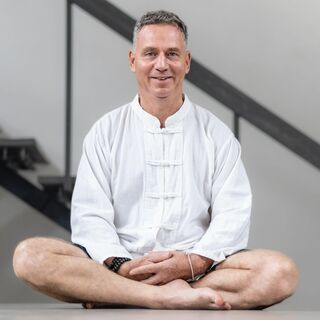
Welcome everybody.
It's Tenzin here.
In this session I'd like to do a little bit of discussion and then we'll follow it with a video of some practical meditative practice to enable what we're talking about into our minds.
One of the things which meditation immediately brings up when you start to do it,
And one of the things which also comes over into the rest of our life as well,
Is our addiction to thinking,
Our addiction to thoughts,
Our inability to let the thoughts go,
To not be involved in the thoughts,
To not become the thoughts.
Now of course this becomes very obvious in meditation when we're trying to stay on an object whether it's the breath or whether it's any other sort of object and we're being distracted again and again,
Taken away from the object by our thoughts.
Generally in meditation when we're doing that we should understand very clearly the principle that our thoughts are not something we can stop.
The ability to stop the thoughts is not something we're trying actually to do in meditation,
Although it may be one of the things that come much later in our meditative practice,
The ability to stay without thinking.
Certainly in the initial time however in meditation that's not what we're doing.
Actually what we're doing is trying to allow the thoughts to be there in the background without being involved in them.
If we take a simple example,
If you're up in the morning and you go and make your breakfast and you put the radio or you put the TV on in the background,
You can have those things going on in the background but while you're focusing on making the breakfast or doing what you're doing,
Then your focus is on that,
Your focus is on making the food and the radio or the TV or whatever it is in the background and much of the time it would be making no impression upon you at all.
It's simply there in the background.
In a similar way to that in our meditative practice what we're trying to do is allow ourselves,
Allow the thoughts to be there,
We're not trying to stop them,
We're not trying to push them away,
But we let them be there in the background without being involved.
So that's what we're trying to do in meditation.
But also in our daily lives one of the biggest mental issues which we have on the cause of so much of our mental disturbance and unhappiness is becoming involved in thoughts,
Is identifying with thoughts.
Rather than seeing that there is a level of our mind below the thoughts which is much more peaceful and joyful and healthy,
We identify and we follow these thoughts and emotions.
So we wake up in the morning and we have a depressed thought going through our head.
Well that's just a thought.
But when we identify with it,
When we follow it and we become a depressed person then that little thought becomes our reality for maybe one or more days.
We become a depressed person.
The point is here there is no need to become a depressed or a worried or an anxious person.
The only reason we do that is because we identify with those thoughts,
We follow those thoughts.
So learning this technique to be able to separate,
To be able to be uninvolved,
To let the thoughts go and carry on through without being involved in them is a very,
Very important thing to be able to do.
And on the level of our mental health,
On the level of our stability,
Our health,
Our joy,
Our happiness within our minds,
The more we are able to distinguish thoughts which we do want to be involved with,
Healthy,
Strong,
Positive thoughts,
Love,
Compassion,
Connection and so forth,
The more we can distinguish those from the harmful negative thoughts which are disturbing our minds,
Making us unhappy,
Causing all the issues that we find in our lives.
The more we can do that the better.
And the more we can then learn to let those negative thoughts go,
To be uninvolved in them.
We can't stop them,
Certainly not overnight anyway.
Eventually it may be possible to be able to reduce and even eliminate negative emotions.
But in the beginning of our practice that's not going to happen.
So what we want to learn to do is to become uninvolved,
To be able to let them go,
To very easily let these thoughts go.
Now,
There are various techniques we can use to do that.
But one of the most effective ways to work with our thinking and the ability to stay away from it and be uninvolved in it is to practice a meditation called choiceless awareness.
Choiceless awareness is,
As the name suggests,
A technique whereby we're staying with our mind,
We're staying with our consciousness,
But not the consciousness of the thoughts,
Not the being involved in our thoughts and emotions and feelings,
But the slightly deeper level,
What we call the subtle level of our minds,
Which is below the thoughts,
Below the emotions,
Etc.
We're trying to stay with that.
And as long as there are no thoughts and emotions or sounds or feelings or whatever arising,
Then we can just stay with that.
But as soon as something arises in this meditation,
What we're trying to do is observe it,
Look at it,
But not be involved in it.
So in other words,
We're taking the position of an observer of everything which is happening.
So whether that's a sound,
Whether that's a sensation in the body,
Whether it's a smell or a taste or a touch,
Or whether,
As it will mostly be,
It's thoughts going around the mind,
Whatever arises within the sphere of our awareness,
We're trying to stay uninvolved in it,
We're trying to observe it,
We're taking the position of someone looking rather than someone who is involved.
In a very similar way in which we watch TV or we watch movies or we watch a show,
We're observing the phenomena without being involved in it,
Without being a part of it,
Without identifying with it.
Now,
To enable this to be more easy,
What we do during the meditation is label things.
And certainly when we first do this practice,
This is very useful,
Not necessarily always,
But certainly in the beginning,
To label things.
So when we feel an itch in the body,
We label that as an itch in the body.
When we feel pain in the body,
We label it as pain.
When we hear a sound,
We label it as a sound of bird or sound of someone talking or sound of whatever it may be.
When we have a smell,
We identify that or taste or whatever.
But of course,
Again the most predominant interference or arises within our meditation are going to be thoughts.
So we label those thoughts.
That's a thought about yesterday,
That's a thought about my friend,
That's a thought about my family,
That's a thought about tomorrow or next week.
Label the thought and by labeling it,
Whether it's a thought or anything else,
You'll find that you can keep yourself as the observer,
Not be involved because it's something you're looking at rather than something you're identifying with.
And this is a very useful technique to be able to let the thought arise or whatever it is,
Identify it,
Become the observer of the thought and thereby let it arise,
Let it be there and let it naturally go in its way without being involved.
And this technique enables us,
The more we practice this type of meditation,
The more you'll find that you'll be able to let go of things very easily.
So I find myself that in my own practice I can wake up in certain moods,
Whether depression or unhappiness or anxiety,
Whatever it may be,
And I have two choices.
I can follow that and become that and identify it and spoil my whole day or even my whole week or I can let it go.
And just through the very limited amount of practice I've been able to do,
I can do that quite quickly.
Within seconds,
I would say,
I can let go of a negative thought.
That's something you will be able to do very quickly.
If you practice this meditation,
If you practice,
Keep going with this on a regular basis,
Very quickly you'll get to the point whereby you can wake up in a terrible mood but you can let it go in seconds.
You can be affected by someone criticizing you or someone attacking you or some issue in your life,
Some sickness or problem with somebody in your life and you can let that go very quickly.
It's just a thought.
It's just a passing of thought through your mind.
And by identifying it,
Labelling it,
Observing it rather than being involved in it,
Then you'll be able to let it go very quickly.
So in the next video we will do the actual meditation on this practice.
Thank you.