Hello friends and welcome back.
Before we begin today's practice,
Let's set ourselves up by grabbing a couple of blocks if you have them and if you don't have any yoga blocks it's perfectly okay.
You can use a couple of towels or blankets folded up or rolled up.
Whatever you have around the house is great.
Pillows can also work.
Since today's practice is all about grounding through transitions,
We want to help ourselves feel supported through whatever props we can use in today's practice.
So if you're ready,
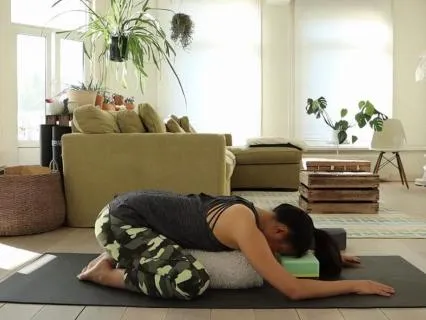
Let's begin in child's pose.
With knees wide apart,
Big toes touching.
And let's start today's child pose.
Feeling supported.
And you might like to place the block,
Blanket,
Or rolled up towel.
Underneath you.
Against your chest.
For some of us,
Against the rib cage might feel nice.
And then for some of us,
We might like to place maybe a block underneath the forehead as well.
And as you start to open into child's pose,
Let's give ourselves.
.
.
A nice,
Big,
Deep inhale through the nose and exhale through the mouth.
And let it go.
Beautiful.
One more time.
Inhale through the nose.
And exhale through the mouth and just let go of everything that doesn't need to be here now.
Beautiful.
Starting to find that quiet space inside of yourself.
For some of us,
That might be the heart space.
That energetic heart space within the ribcage.
Or for some of us that might be lower down in the belly.
Wherever feels.
Good for you to open into this.
Quiet space inside of you.
With every big,
Deep inhale,
Feel the belly rising in all directions.
Traveling through the ribcage in all directions all the way up into the chest.
And with every exhale,
Feel the release in the chest,
The ribcage,
And the belly.
Taking a few moments.
Watching the breath moving through the body.
Feeling the body rising and falling with each inhale and exhale.
And then from this quiet space inside,
Let's open with the intention today.
Of leaning into this quiet grounded space from within.
If it's helpful.
You might like to think of a place that you know of.
This could be.
In real life or in your imagination,
But somewhere.
.
.
Where you feel safe.
Secure.
Perhaps as a feeling of warmth.
When you are in this place.
It could be somewhere in nature.
Or it could be your favorite room.
In a place that you know of.
Wherever you are.
Really step into this place and bring it to life.
What are you seeing around you?
What are the sounds around you that you can hear?
As you look around this space.
Are there any smells?
That continue to nurture this warmth.
And openness.
From this grounded space inside of yourself.
And then really bring yourself into these physical sensations that are opening up as you.
See you soon.
Smell and hear this space around you.
And then continue feeling into these physical sensations and slowly.
Let the visuals fade away.
But staying with those physical sensations.
This openness.
Expansion.
Continuing to nurture this openness and this groundedness from within you.
At any time during your practice or at any time during this changing season or this changing transition in your life,
You can always bring yourself back.
To this grounded.
Open space from within you.
Feeling nurtured and supported.
One more breath here.
Now very slowly,
Gently,
If you have any blocks or towels or blankets underneath you,
Removing them to the side of you.
And then bringing yourself up to all fours.
And just a very gentle cat-cow.
As you inhale,
Let's arch the spine looking up towards the sky.
Dropping the belly down to the floor.
And as you exhale,
Round the spine,
Pulling the shoulder blades away from each other.
Drawing the belly button into the spine.
Beautiful,
Few more rounds as you inhale,
Arching the spine,
Dropping the belly,
Looking up to the sky.
And as you exhale,
Rounding the spine,
Tucking the chin into the chest.
And then coming back to all fours on a tabletop and any other movements your body might be feeling like it needs,
Maybe swaying the hips from side to side.
Or stretching out the side bodies from side to side.
Beautiful and let's come into our next pose,
Sphinx.
So coming onto the forearms into a very gentle back bend.
And your version of Sphinx.
If your lower back hurts,
For some of us we might like to place two blocks against each other or perhaps a rolled up towel or blanket and place that underneath the hips just at the top of the thighs.
To ease a bit of the pressure away.
From the lower back.
And then you might like to place another blanket or two blocks underneath the forearms.
Otherwise simply coming into Sphinx.
Feeling a slight Stretch through the thighs and the hip flexors,
Very slightly.
Back bend through the lower back all the way up through the spine.
And it's up to you whether you want to look up to the sky,
Getting an opening in the neck.
Or perhaps for some of us,
We might like to tuck the chin into the chest,
Looking down.
And feeling the back of the neck lengthen.
And perhaps for some of us,
We might like to maybe place a block underneath the forehead as well,
Giving ourselves some support.
It might feel nice to interlace the hands underneath the chin.
Like a chin rest too.
Many variations because every body is different.
And every day is different too.
So if you come back to this practice tomorrow and the next,
Feel free to try different variations.
And whatever feels comfortable for you.
Continuing to breathe.
Deeply from the belly.
Notice.
If there might be any passing thoughts.
Or emotions moving through the body and the mind.
Everything just.
As it is.
Continuing to stay here in sphinx if this feels good.
Or if you'd like to take it one step further.
Perhaps some of us might like to move into seal,
Straightening the arms,
Coming onto the hands.
The closer we bring the hands to ourselves,
The deeper a backbend we go into.
Or the further away we bring our hands from ourselves.
The less intense it is on the back.
Now as we begin to bring more of a yin approach to this,
Be very careful.
Or watch.
Where your body might be wanting to.
Strive to go deeper in this pose.
Where can we observe this in ourselves,
In our ego,
And how can we back away from this?
Perhaps the hardest thing to do.
Is simply stay in sphinx on our forearms.
And just allow the pose to be exactly as it is.
If we are in seal with straight arms,
At any point in time it starts to feel a little bit too intense,
You are very welcome to come down on the forearms.
One more breath here.
Now if you have any blocks or props underneath you,
Very slowly remove them away from you.
And then bringing the forehead down onto the floor,
You might like to place your forehead on your hands like a pillow.
And give yourself a couple of moments in this rebound pose to feel into the sensations that that last couple of poses might have brought up inside of you.
If it feels good,
You might like to bend your knees and sway the feet from side to side.
A very gentle windshield wipers.
Just easing up in the lower back a little bit.
But then coming to a place of stillness.
And then feeling into.
Where in the body might feel a little bit tender right now.
Or perhaps there might be an opening inside of the body.
Or contraction.
Simply laying here and feeling into all of these changing physical sensations and there's no need to fix or change anything.
Simply noticing what is here is enough.
Now coming back onto all fours.
And coming to a seated position,
Let's move into half saddle on the right side.
So with the legs outstretched in front of you,
Let's bend our right knee and place the right heel as close to our hip as possible.
Much as we can.
And for some of us,
This might be as far as we go today.
If we have Sensitive knees.
You might want to be very careful in this pose.
You might like to sit up on a block or on a blanket that's rolled up.
And for some of us who are a little bit more open or flexible,
We might like to.
.
.
Walk the hands back,
Maybe coming onto the elbows.
Feeling a nice long stretch all the way down that right thigh,
Up through the right hip flexors.
The first few breaths,
Just really giving yourself that time and space to ease into this pose.
Perhaps maybe even using the breath.
Just like we did at the beginning,
Inhale through the nose.
And exhale through the mouth and just release and surrender.
To all of the sensations that might be opening up in the body right now.
If you feel like your body might be ready to go a little deeper in this,
Feel free to come down all the way with your spine on the floor.
But this might be too intense for the majority of us.
At any point you feel like your knee,
Your right knee might be popping up.
From the floor.
You could also place a block underneath that knee.
So lots of variations we can do in this pose as well.
And at any point this feels too intense You might like to bend that straight leg,
Placing the sole of the left foot on the floor.
With a bent knee.
But wherever you are.
.
.
Finding stillness in this pose.
And noticing where the discomfort lies.
Challenging sensations is okay.
We use our yin practice.
To learn to work.
With these challenging sensations.
Discomfort is okay.
But sharp pain is not.
So if at any point you feel any sharp,
Stabbing pain,
Back away from the pose and come into a child's pose.
But as you are in this pose Starting to notice where you might be holding on to tension.
Anywhere in the face.
Or the jaw.
Or perhaps.
.
.
In the glutes.
Where can you soften into this pose?
Which muscles can you soften into?
And simply allow the body to open up where it wants to take you.
One more breath here.
Now if you are laying down on the floor,
Roll away from the bent knee.
As elegantly as you can.
And come back up to a seated position.
Now let's straighten both legs.
Amen.
Give ourselves a little wriggle.
Some movements with the legs and the knees.
And perhaps you might like to bend our knees,
Placing both soles of the feet on the floor as wide as your mat.
And a very gentle windshield wiper.
Dropping the knees from side to side.
And just releasing some of the tension that might have built up in the hips or the knees.
Giving some movement back to some of the creep that might have happened in all of those deeper connective tissue layers.
And then let's come into half saddle on the other side.
So straightening out the legs again,
This time bending the left knee,
Placing the left heel as close to the hip as we can.
Keep that right leg straight.
And then walking our hands back.
Perhaps coming onto the elbows.
And maybe that's as far as we go today.
If you had a block,
If you were sitting on a block on the other side Go ahead and continue to sit on a block on this side as well.
So whatever variation you did on the other side follow that on this side whether that's a block underneath your bent knee Or perhaps instead of having a straight right leg,
You're bending the right knee with the right sole of the foot on the floor.
And then for some of us who are a little more bendy,
We might like to lie all the way down onto the floor,
Coming into a deeper back bend as well.
So working with wherever we are at today.
Noticing the physical sensations that are showing up right now in your body.
Where might there be some tightness?
Where might you be striving perhaps a little bit too hard in this pose?
It's a practice.
To constantly remind ourselves that in yin There is no need to push yourself deeper in this pose.
We hold these poses for longer.
Applying static stress.
While keeping relaxed muscles.
This way time and gravity are going to take you deeper into the pose.
So we simply allow our bodies to show us where they want us to go.
Rather than us trying to muscle our way into the pose.
Working very deeply into the hips and into the lower back.
So notice if there might be some emotions that might be surfacing.
Like frustration.
Or anxiety.
And there's no need to fix or change,
But simply witnessing.
And observing.
All of these emotions and naming them.
That is enough.
One more breath here.
Now if you want the floor rolling over and away from the bent knee side as elegantly as you can.
Removing the blocks away from you.
And then bringing yourself to a seated position.
Shaking out the legs.
Very gently.
And let's do another windshield wiper.
So bending the knees,
Both soles of the feet on the floor as wide as your mat.
And then dropping the knees from side to side very slowly,
Feeling into all of the sensations.
Just allow the body Work through the tenderness.
Now coming into butterfly pose.
Soles of the feet together.
Legs forming a long and loose diamond shape.
It might feel nice to place a block underneath each knee or Roll the towel or blanket underneath each knee.
And then very slowly allow yourself to drape over.
And feel like your shoulders are draping over your spine.
The head is heavy and hanging.
It might feel nice to maybe place a block underneath the forehead as well.
But take the first few breaths.
To really inhale into any of the tightness you might be feeling in the hips.
Or anywhere all the way up the spine.
And then as you exhale,
Surrender just a little bit more into the pose.
Allow the spine to round and fold over.
Opening up the back.
Creating space between each vertebra.
If you have blocks underneath your knees or underneath the forehead,
Simply allowing your body to lean into these blocks or towels or blankets and allow the body to be supported.
As much support as you can give.
Your bones.
As much support as you can allow the body to open up.
With time.
And space through every breath.
You might start to feel that.
The body starts to open up in different ways.
So starting to really tap into these.
Subtle shifts that might be happening not just physically but also perhaps mentally and emotionally.
Bringing your awareness back into this.
Grounded,
Quiet space inside of yourself.
Once again feeling into those physical sensations that brought about that feeling of safety,
Security.
And an openness.
And notice even how through some of the discomfort you might be feeling in this pose.
There is still this.
.
.
A quiet space inside of you.
Where you can feel this groundedness.
Openness and warmth.
And notice how both of these sensations can exist at the same time.
This discomfort within the body through these physical poses.
But also.
.
.
This openness.
Is groundedness.
As you allow yourself to be supported in this pose.
One more breath here.
Now very slowly remove any of the blocks away from the forehead,
From beneath the knees.
And very slowly bring yourself back up to a seated position again.
Any movement in the body.
That you feel you might need.
And then let's find our way down to Savasana.
Final resting pose.
As you lay here it might feel nice to pull a blanket over you.
Or maybe even placing one or two blocks on your belly.
Feeling a bit of weight against you.
Allow yourself to feel supported and cocooned.
Feeling into the surface beneath you.
The surface beneath you holding and supporting you back.
And allowing yourself to sink and open up.
Into deeper layers of consciousness.
As you lay here in deep relaxation.
Recalling the intention you set for this practice.
Staying grounded from within.
Tapping back.
Into that grounded.
Open it And if it's helpful,
Bring yourself back to the beginning.
That physical space.
Whether it was in nature or somewhere indoors.
Feeling those physical sensations of safety and security.
And then once again allowing those images to fade away but simply.
Feeling into those physical sensations.
Opening.
Into timelessness.
Spaciousness.
Even through all of these changing physical sensations,
Emotions and thoughts.
Noticing.
That there is an ever unchanging awareness that is always here.
This unchanging awareness.
That feels grounded.
Centered.
In balance.
Know that you can always bring yourself back to this space.
Of groundedness from within.
Even through all of these changing seasons and transitions that life might throw your way.
I hope this practice continues to nurture you throughout your days.
See you back on the mat.
Very soon.
Namaste.