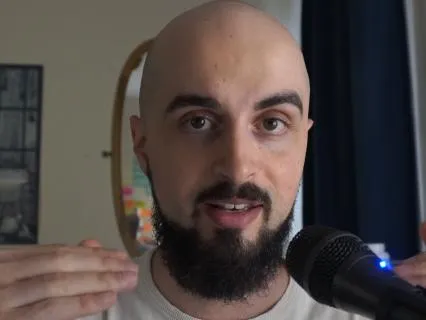
The Letting Go Technique Masterclass: Life-Changing Benefits
In this Letting Go Technique masterclass, we'll break down the common mistakes people make when using the technique to process energy and emotions. We will explore the nuances and details that help you build consistency in emotional regulation, inner peace, and overall well-being. Please note that this content is for educational purposes and does not replace professional mental health care. You can find 'The Letting Go Technique' playlist under the 'Tracks' tab on my Insight Timer profile for multiple guided versions of the practice.
Transcript
This book is essentially magic and the letting go technique on page 19 is future technology.
Everyone who does this technique consistently says it changed their life.
But some people don't get to that point because they don't practice it correctly.
So in this video we're going to break down the nuances of how to do it correctly so you can use this technique and massively benefit from it for the rest of your life.
So first off when people start practicing the letting go technique they're drawn to it because they're like,
Wow I can let go of my triggers.
I can feel so good.
I can be happy all the time.
But they're like,
Wait a second.
Why?
I felt my negative emotion.
Why am I still feeling it?
Why is it coming back?
I thought this was supposed to be the fix all.
But you want to think of it like you have a tank of suppressed energy and emotion in your body that's stuck there from a lifetime of fear and difficult experiences that you've had as human being.
And by practicing the letting go technique you're taking a chunk of that energy out of your body permanently out of that tank of suppressed energy.
And that tank will get smaller and smaller and lighter and lighter over time.
But every time you practice letting go technique maybe you take out 0.
1% or 0.
5% or maybe if you have a big upheaval of energy it's like 3% of that tank.
But if you're consistent with it over time that tank will get smaller and smaller.
And you'll notice that on a scale of 1 to 10 instead of something triggering you consistently at an 8 out of 10 after maybe six months of doing it it'll be like a 3 out of 10.
You'll be like oh my gosh this thing that used to trigger me like crazy just doesn't anymore.
So you want to have that long-term mentality so that when you're practicing it you don't get caught up in why am I still feeling this.
Another thing worth noting is like he mentions in the book some emotions are very intense or like grief.
It comes in waves and you've got to ride those waves as they keep coming back over and over so that they don't get stuck in your system.
It takes patience.
You want to respond with your best judgment.
Go at your own pace.
But then other emotions are small and you feel them one time fully and they're gone completely.
So it just depends.
Now if an emotion gets stuck you want to surrender to the stuckness.
A lot of the time people are like oh my emotion's stuck it's just there and they start freaking out and going back into resistance.
So just release resistance to the fact that it's stuck and that's when it will tend to move.
Other times it will stay stuck but you just allow it to be there.
Maybe you have to distract yourself go and do something for a few hours or a day and then it'll tend to pass once you've really gotten back in that rhythm of not resisting it.
Another hidden factor is sometimes when an emotion keeps coming back there's an underlying hidden memory or belief or part of you that wants to speak and be heard and fully processed on a conscious and psychological level.
So once you've done that a few times you've done the letting go technique you felt it through and it's still there or it still keeps coming back do some journaling or some therapy or some parts work to process that on a conscious level so that you can dissolve it fully and break that pattern.
Okay so a lot of the time we're judging our emotions and that's why we can't feel them because we're like I'm a big strong adult I can't be feeling that stupid emotion that's weak.
But we want to understand that a lot of our emotional responses are stemming from our inner child response.
The emotions that we felt when we were kids that we didn't fully process and they're coming back they're triggering us because we never got a chance to safely hold space for them.
So if we can start to conceptualize them as an inner child response as just a part of us then when it comes up we can treat it like a crying child or an angry child that part of us that needs to fully feel that and have it be processed so we can stop and nurture and feel that let it flow through the system see it as just a part of us so that that part of us that never got to fully do that finally can and it doesn't have to stay stuck in our system anymore and then that part of us and us in turn our bodies will feel lighter and better in the process because we're not judging or suppressing based on what we think is in conflict with our adult identity.
If something feels too intense or too big to deal with yourself then honor that.
Work with a coach or a therapist or a guide or someone who can help you go into that safely but if something feels like it could be manageable but it's just a little bit too intense use EFT tapping some guided videos or use yoga use breath work something to settle the nervous system down from like an eight out of ten down to five or six so that you can use that momentum from those other practices to dive into the letting go technique with the energy that remains from there so that you can gradually allow the remainder to dissolve and bring it down to a level where you feel that peacefulness but err on the side of caution with this don't dive into anything that's too intense make sure that you start small with smaller energies and emotions so that you build safety and confidence with the letting go technique so that when you do build up to more medium and bigger emotions you have that safety on a deep subconscious level with the technique so this is really the key distinction to the technique is ignoring the thoughts and that might sound like suppression but it's not because you're not suppressing the energy you're just ignoring the thoughts you're not even trying to suppress them you can just imagine like you're shuffling them to the background they're not important for the sake of this technique and that's super important to be clear on before you begin because otherwise when you sit with your emotions some really distracting or fearful thoughts will come up and you'll start to be like oh do i need to be thinking about this right now instead you want to be super clear it doesn't matter what the thoughts are it doesn't matter how scary they are they're just expressions of the emotion you're feeling in that moment and you keep dropping past them again and again and this is a time thing it's like meditation bringing your attention back to the breath over and over eventually you start to find a rhythm it's the same with the sensations in your body and your emotion your thoughts distract you but you keep ignoring them keep shuffling them to the background however you want to think of it no pun intended and keep coming back to the sensations over and over until you start to feel that groundedness and safety and connection with what you're feeling even if it's uncomfortable and then you're in that energy the thoughts are no longer important you have a rhythm of attention on that energy so often people get tripped up by this because they say i can't ignore my thoughts or they keep distracting me they will at first that's okay just keep bringing the attention back to the sensations dropping into that and you'll find that rhythm that momentum and you'll be able to use this technique successfully so the second key to mastering this technique and getting all the benefits to it besides ignoring the thoughts or shuffling them to the background is to master non-resistance to what you're feeling and the key here is to understand that resistance comes in layers it's like layers of an onion you want to drop down to the center which is the surrender but on the top layer you have resistance to even letting the feeling come up you're feeling some sticky emotion and you try to sit with it but there's part of you that's trying to just keep it stuffed down so you want to start with just not resisting the resistance like hawkins says in the book just allow that energy of resistance to be there for a moment and eventually after a few moments it'll start to usually melt away and the feeling will start to rise up and then you'll notice some resistance to that feeling and you just want to relax and let that initial layer start to melt away and then after a few moments you'll notice there's still some part of you that's trying to control what you're feeling or some thought that's trying to distract you because it doesn't think the energy's safe or it fears that you're going to get stuck in it and then you reassure yourself either by relaxing or speaking to your mind and saying it's okay to relax that resistance it's okay to let this feeling be there and then that layer melts away and then you drop a little bit deeper but then you'll still notice as you start getting closer to that center that there's still part of you that's like i kind of want this feeling to be gone and that's where the letting go technique is kind of a misnomer it's more of starting with letting it be you want to that final bottom layer where you're just okay with letting it be there and you'll know when you're there it's a very distinct sensation you want to get familiar with how that feels to truly let go of resistance that place of surrender is where you're okay with it being there and you're okay with it leaving there's a sense of detachment like oh there's a sensation there it's kind of uncomfortable but it's fine i'm just with it i'm holding space for it and that's where you're holding space for the crying child and you're just loving the crying child while it's crying instead of trying to get it to change or stop crying that's usually when the child stops crying is when it really feels like you've held space for them and you've loved them even when they were sad or feeling whatever they were feeling and so you're treating yourself the same way that's when the energy really starts to lift and dissolve and evaporate when you've befriended it when you're not resisting it even a little bit so remember those resistance layers are layers you want to drop through them over the course of time and conscious intention and that's where you'll really start to notice progress and consistency with this technique so what most people do is they only practice it when they feel a negative emotion they only process their emotions to try to regulate their nervous system when they feel crappy but that's a reactive strategy if you want to be consistent if you really want to feel good if you really want to empty the tank you want to take a proactive strategy as well do it reactively when it makes sense to do it when you feel some type of way that you want to process absolutely do it reactively but also do it proactively and my opinion is there's no better time than right now to just practice it while all these distinctions are fresh on your mind and you're embracing that nuance of the process and then when you're done that my suggestion is right now write down how frequently you want to do it whether it's every day or multiple times a week maybe two or three times a week whatever you decide set a minimum goal for that emotional work specifically the letting go technique is what i would suggest as a foundation put that into your calendar as a recurring reminder put it into your alarms as a recurring alarm so that you have accountability and you're consistent and you're proactive because like hawkins says in the book one of the best times to dip down into that well of suppressed crap is when you're feeling good because it's easier to handle it as opposed to when you're down in the dumps you're less inclined to do it but if you do it and you're in a rhythm when you're feeling good you'll stay in the habit consistently even in tough moments so you'll have that consistency in your balance in your mood in your frame of mind overall because the letting go technique goes straight to the heart of all the mind stuff you're going straight to the energy behind that shifting the energy so your mind follows suit that's why it's future technology because it's way more efficient than the paradigms that we're currently operating from around mental health and wellness so practice that schedule it in hold yourself accountable get all the benefits
Meet your Teacher
More from The Mental Level
Related Meditations
Related Teachers
Trusted by 36 million people. It's free.

Get the app