Hi there,
Welcome to episode 78,
Catch yourself mind bending and the places we go.
Gather some tools and info to help you be here.
Understand,
Be the observer of how we're thinking.
Where is our mind?
Are we in a loop?
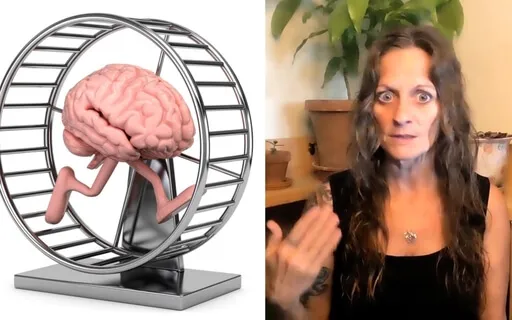
So that is the hamster wheel where we might be thinking the same thing over and over the same topic,
The same catastrophe.
The what ifs,
Lots of things can go in the hamster wheel,
But it's often things that aren't really positive based,
But we can be in there.
So that might be an area that your thoughts are running.
If you would,
The hamster wheel sometimes I'll explain it like running races and how when we're in these loops and we're in the circles,
We might be running multiple 5Ks in a row or 10Ks or triathlons.
Go wherever you want when you're thinking of this analogy.
And then we wonder why we're exhausted and we're tapped out.
Well,
Think of what's going on here in the mind.
Where are you running?
What's going on?
How many wheels are you on?
Even though you're on only one at a time,
Because we can only have one thought and have only one action at a time,
Even if we are trying to splice ourselves into many pieces.
So are you on a wheel?
Are you jumping wheels?
Are you running multiple marathons back to back?
In your mind or in your thoughts,
You might also be in storytelling.
That's where we might keep picking off the same book off the bookshelf over and over.
It might be the anxiety book.
Let me read all about anxiety and all the reasons in my life why I should feel anxious or the book on suppression.
Why are all of the reasons in my life that I should be feeling sad?
And we forget that there's a whole bookcase there that we can look at all the books and have compassion and respect for all the books.
The ones with anxiety,
The ones with sadness,
The ones with joy.
We have lots of books inside self.
And where are your thoughts?
Are you picking off the same book off the bookshelf and feeling stuck in that story?
Another area that the mind might be in thoughts is related to worry or judgment.
We can have lots of worried thoughts and that might be similar to the loops or to the races or to the book off the bookshelf or it might be something different.
But judgments and worry thoughts,
The judgments,
Those labels we place on ourselves and how it comes with emotional impact then.
If we're going through our day telling ourselves that we are worthless or we don't have value or we're so stupid or we're too sensitive or lots of things that we can tell ourselves.
We're a whole system.
So emotionally we'll go there.
It's not like we can go through the whole day beating ourselves up,
Getting in the boxing ring,
Punching ourselves in the face and then truly authentically feeling grounded and connected.
It's not like we can't present that way,
Right?
That's where we could put on a mask.
Maybe we're in this place of beating ourselves up and then we can step out the door in costume and put on the face that all is fine.
You know,
Sometimes we can be really good at that disassociation,
The disconnection from our true nature and where we're at and put on the costume or put on the mask as though things are fine.
But underneath,
Where are you?
You know where you are sometimes,
Sometimes we don't because the autopilot,
We're not catching ourselves.
We're not paying attention until we do.
Another area of the mind might be in comparison.
You might be looped in that thought loop of comparing yourself to others or comparing others to others and just being mindfully aware that when you do that,
Number one,
It oftentimes is not of positive value,
But also just remember that you are judging that other person.
Anytime you're comparing,
Even if you're comparing as a way to put yourself down,
You are still judging the other person.
So maybe if you are having a hard time moving away from judgment towards yourself,
But you're more in alignment with,
I really don't want to judge others,
Maybe that will help you to move out of comparison mind a little bit to notice that it's not just about you.
You're judging the other person as well.
The other area that we want to think about in mind,
So we have the thought area of mind and then we have the spoken word of where our mind is at and what we're doing.
When we want to maybe catch yourself in areas here is when things are maybe a little off balance in our spoken word and off balance can be in terms of healthy,
Positive interaction relationship,
And it also could be on the speed dial or the gas pedal and how fast we're going.
So with our communication,
Again,
This is still about the mind.
Our spoken word is often what's here and what we end up allowing through spoken word.
When you're trying to slow down and catch yourself in spoken word,
You want to maybe have some mindful awareness around areas of judgment.
So still about the labeling comparison,
Because this would still be a way that we are outwardly speaking this.
And if you're doing that,
Think about how you feel after.
If you even give yourself the opportunity to slow down and feel the after,
Again,
We'll buzz through life and disconnect,
So you might have to first slow down there to even give yourself an opportunity to think about and feel in the somatic body,
What does that feel like after or in the moment when I was just judging,
Comparing or gossiping.
Gossiping is another big one.
How do you feel after you're speaking,
So thought,
Spoken,
Gossiping about other people?
What's the agenda there?
What's the purpose?
It's usually about balancing,
Right?
Why do we gossip?
There is this song,
This is going to totally age me,
But I have no whatever you'd want to call it,
Ill feelings about my age.
But there was a song that I was in my teenage years at some point,
It was How Do Rumors Get Started?
But it was like,
How do rumors get started,
Started by the jealous people.
I could hear it in my head.
It's this idea of why do we gossip?
What's the purpose?
And it's often about balance,
Hierarchy,
Trying to fit in in some way,
Easing social anxiety.
Oh,
If I drop a name and talk a little bit about this person,
Maybe that will make me feel comfortable in this situation.
But what's the outcome?
And sometimes it's much more ill-willed and tension behind that gossiping nature,
Judgment and comparison,
Putting someone down to make ourselves feel better,
Ego blasting,
Right?
I mean,
You want to talk about ego dynamic there,
Gossiping and comparison would be in that loop.
So where's the mind?
Where's the spoken word in what you're saying that is going on in your mind?
Getting down,
Catching yourself,
Noticing how you feel after those types of things.
If you're judging,
Comparing or gossiping.
Another area with communication and how we're speaking,
You want to be maybe mindful around the areas related to what's your agenda in communication.
So that's where we turn up that knob sometimes of control expectation,
And then it will create a reaction cycle on the back end if it doesn't align with our agenda that we're moving in with.
And then thinking about kind of speed,
I guess would be trying to think of like categories that would pop up in your mind when I talk about this stuff.
I think maybe speed might be a way to look at it.
Where sometimes mind and communication or speed can be shut down,
We shut the door.
We numb out,
That would be like a numbing out almost,
Silent treatment,
Maybe even,
Or feeling trapped in how to speak,
What our emotions or what our thoughts are feeling.
There may be multiple reasons why the dial gets turned way down in the communication,
But we also might turn it way up in the communication.
And this is where we could interrupt,
Talk over people.
And it could even be because we have something that is exciting to share.
Not necessarily like sometimes when we're talking over someone,
It could be that passive-aggressive energy and communication like dominance,
Domineering,
Intimidation dynamics when we're talking over.
But it can also be when we're just really excited.
There's something really exciting to share.
And maybe it's like a back and forth conversation with someone and we have shared excitement about what we're talking about.
But are we being mindful in the flow of that dynamic?
And it's a way that we can catch ourselves in communication.
So where are we at in our thoughts?
Where are we at in spoken word?
How are we speaking or what are we speaking?
And then speed.
What's the speed and how do we get in the middle ground?
And the middle ground is often safety areas too,
Safety and communication.
Safety is certainly in terms of abusive dynamics,
But sometimes safety is really also about safety and vulnerability.
And maybe the individual is not abusive that you're talking with,
But maybe you just don't feel safe in that vulnerability.
And that's going to kind of determine that volume too.
Are we closing down all the way over here?
Are we all the way over here?
And how do we get into the middle?
By catching yourself,
Right?
Our mind,
Our spoken word.
The third area of the mind is what I call the mind lapse.
The mind lapse is associated a lot with habits and addictions that we are attempting to break away from.
As a reminder,
Addictions can be anything.
Everything that we notice is pulling away our time that is creating an intense desire towards even though we have awareness around understanding it creates harmful effects.
A little summary there that I could give you to know that anything can fall into that category.
Substances,
Shopping,
Food.
Food is a huge one.
Eat our emotions,
Food addiction and food is everywhere.
So it's really challenging for many people to get into a healthy relationship with food.
Gambling,
Gaming,
Gaming is a huge one as well.
Gaming addiction that people don't oftentimes notice the interchange there of when it falls over into something that's fun versus something that becomes more of an addiction.
And then all the different ways that that can happen in addiction cycles.
When the mind lapse comes in,
We get into a little bit of the habit and addiction mindsets that lead us into the relapse or continual habit creation.
When we slow it down,
Think about what makes it easier for us to create bad habits and addictions and I don't even really like to use the word bad to be honest.
I'm going to change that language.
What makes it easier for us to move into unhealthy habits versus more healthy habits?
Things that we truly value that are in alignment with our true birth and things that we notice are self-sabotaging and creating more destructive patterns for us.
Slowing down and catching our self will help us notice where is our resistance there.
It could be about maybe feeling like we don't have the support system.
It could be about our own internal cycles,
Those the mind loops,
The mind cycles that get us into things like shame and guilt or unworthiness,
Devaluing ourselves,
Telling ourselves we don't have the strength or ability.
So demoralizing what's really within us in terms of our own morals and our own values even and convincing ourselves to move in to unhealthy patterns and habits and addictions.
And it's often again,
Everything's tied together.
So when you think about it,
You can notice how mindset,
Spoken word can create action behavior and the mind laps as well.
A common spoken word that is in thought as well,
But spoken word that leads to relapse cycles is just one won't harm me.
Just one time I'll be fine.
So for example,
I'll use two different examples.
One will be with alcohol and one will be with sugar.
If someone has stopped an unhealthy relationship with alcohol,
And maybe they've gone an extended period of time without drinking or consuming alcohol.
For purposes of this,
I'm just going to use a six month timeframe.
I'm going to use the six month timeframe because often it takes about six months from breaking in addiction,
Especially a substance for the brain networking,
The neural network pathways,
As well as all the hormonal changes that have to happen in the body and psychological changes that occur to really start to notice the system changing with addiction.
So someone is in six months of sobriety from alcohol,
And then they are at a function,
A gathering,
Maybe a work function,
Maybe a family gathering,
Maybe a friend's cookout.
I don't know,
Lots of examples,
Just use what works for you.
And they're there.
And maybe first it's just self.
Maybe first they just tell themselves,
I'll just have a drink.
You'll be fine.
I have six months sober.
And then it opens the portal.
And it usually doesn't stop at just one.
Sometimes it's external pressure,
So for self,
You can think of how your spoken word might impact others.
Sometimes it's spoken things from others around that will help also move someone back into a relapse cycle.
Things like,
Are you sure you don't want to drink?
Are you okay?
You're not drinking?
Oh,
Come on,
Just have one.
You'll be fine.
What's the big deal?
I drink every day.
You haven't drank in six months.
One drink's not going to hurt you.
It will assure you as a therapist who has specialized in mental health and addiction for quite a long time,
That will never assist someone who is working through contemplation of staying sober.
And oftentimes those types of statements,
To be perfectly upfront and honest,
Are about you,
If you are making those statements.
And if you are receiving those statements,
Know that it is about the individual who's holding that drink.
It's not about you.
It's about their own discomfort with their own drinking behavior.
And for them,
It can feel uncomfortable,
Or for you,
If you're the speaker of such things,
To notice that someone else can have a great time without alcohol or another substance.
So don't let someone else's spoken word get you off track with yourself,
Okay?
The mind,
It can take us lots of places.
When we catch ourself,
We open a whole doorway for change.
With that,
I would like to move into the tools today.
For the first one,
You're going to need a piece of paper of some sort and a pencil and whatever writing device you'd like.
And I'm going to pull up my timer here.
So for this first experience,
You might have done this with me in another format,
But it's going to tie into some of the other tools today.
So it's an important refresh,
Or it might be new for you today.
This is called the dot-dot.
This technique can be used in a vast array of different situations or events that you may find yourself in and how it can be helpful.
It is a great tool for emotion regulation.
It's also very much an assistance for staying in the now,
In the present moment.
The more we are in the present moment,
The more it helps us regulate our whole system.
All we have is the now.
So the more we're in the now,
The more we're regulated.
This also can be a huge assistance in impulse control with habit and addiction breaking.
The first 90 seconds is an opportune time for making choices that are more in alignment with self.
The first 90 seconds,
We're on fire sometimes with our desire to get into a bad habit or relapse cycle.
So using this tool and technique helps us slow down and connect back to the present moment,
Which will allow us a 90 second lapse of time to get more into clear decision making moving forward.
And again,
It will also help you to understand or apply some of the other tools I'm going to share with you today.
So to begin,
For round one,
I'll be keeping the time for one minute,
And then I'll let you know when the one minute is over.
What you'll do is just grab your pen,
Piece of paper,
Whatever writing instrument you have.
When I say begin,
For the first minute,
What you're going to do is you're going to simply start by any time after I say begin,
You have a change in your awareness.
So maybe a thought is changing,
A perception is changing,
Or an emotion is changing.
So you can have a thought change where you're thinking,
Is this almost over?
And then you're thinking,
I went over to have for dinner,
Or I forgot to do something or a change of perception might be you're connecting to yourself,
And then you hear a noise in your space and your focus changes to there.
And then maybe you hear another noise or light comes through your own window and your perception or your vision changes to that direction.
Or you might have a change in emotion.
You might start feeling calm at ease,
And then you might start feeling uncomfortable or anxious wondering if this is over,
Or when I'm going to say stop.
Anytime any of those things come through,
Whether it is thought,
Perception or emotion,
Simply place a dot on your paper.
So that's it,
But each and every time.
So it might be a thought and then it might be a switch change over to perception,
A back to a thought,
And then an emotion.
I remember how many things I just listed,
I think that was five,
But I wasn't really paying attention.
So I think that was five,
So it'll be five dots,
But just an example,
Anything that goes by place a dot on your paper and you can begin now.
And you can stop there.
Take a moment to count your dots.
And then just separate those off,
Maybe put a line under it,
Square around it,
Circle,
Whatever you want to do,
But just so that you have them in their own little space there before we start round two.
So for the next round,
Same exact thing that you're going to do.
The slight difference is when I say begin,
You're going to start by connecting with your breath in whatever way feels right for you.
This isn't about thinking about connecting with your breath,
Because that's going to get your thoughts involved.
It's simply connecting with your breath.
So it might be connecting with how your body is rising or falling.
It might be connecting with the air as it goes out through and in your nostrils or your mouth.
It can be anything related to just the sensation of breathing.
The thinking about breathing would be,
How am I breathing?
Am I breathing right?
What am I doing?
Where am I breathing?
Am I breathing up here?
Am I breathing down here?
That's getting the mind involved.
So all of those things that you're thinking about now related to your breath versus the feeling of breathing is just going to be a feeling of breathing.
And that would not require a dot.
But any of the other things,
You're going to place a dot.
When you place a dot,
Then you're going to connect back to the feeling of your breath,
Whatever way that you choose to do that.
Another thought,
Perception,
Emotion change might come in.
You place a dot and then come back to breath.
So same thing as the first round.
The difference is you start,
When I say begin,
With connecting to breath.
Any change in thought,
Perception,
Or emotion,
You place a dot and then you return back to breath.
I will be the timekeeper again,
So I will let you know when the minute is over and you can begin now.
And you can stop now.
And then you will again count up your dots.
For your own self-reflection,
Take a moment to notice the difference in how many dots you had the first round versus how many dots you had the second round.
You may notice that you had a decrease in the second round,
Which is very common for people.
It's very less common that that increases.
It might stay the same,
But it's common that it either stays the same or the number decreases.
And all we did was connect to the breath.
Your breath is with you all the time,
So it is an anchor and a tool that can pull you back to the present moment whenever you would like it to.
An important reminder so that we can stay present in our self and we can use our breath to do so.
How you would incorporate this into your daily life.
You obviously probably will not have a pen and paper with you at all times to do the dotting and you do not need to count your dots.
In the future,
This was just an experience so that you could see the value of breath and reconnection cycle and realize the impact it has on where your mind goes.
What you could do though to incorporate this technique into daily living is anytime you're noticing your mind is going in one of those places,
The wheel,
The storytelling,
All the things we've been talking about,
You can do like a tap.
So this isn't tapping EFT if you're familiar with that sort of therapy,
That is not this,
But you can tap like you can just tap your fingers,
You could tap your leg,
You could tap your steering wheel,
You could tap your desk,
You could tap your pen,
Tap.
That's what you would be doing instead of the dot.
The tapping itself or the dotting is not only a pause cycle in the brain,
But it's actually an energy release.
It lets us get out a little bit of the fidgety energy or anxious energy or whatever energy is going on there.
It could be frustration,
Anger,
Lots of different things,
But the tapping or the dotting lets us release a little bit of that,
Which is helping with that 90 second pause window to help us slow down and come more full circle to have clarity in decision making.
So you can incorporate it in any way in your everyday life just by whenever you become aware that you're up here using breath connection to come to the now,
Which leads me into the other tools for today.
All the tools for today are about daily mindfulness and that's why I wanted to start with the dot dot.
The second part of this is the noticing and awareness.
When we increase that volume of awareness of where our mind's going,
How we're having spoken word or the mind lapse that can occur,
The self-sabotaging cycles,
We want to try to turn up our awareness about where our mind goes.
So in the dot dot,
You had a slice of awareness of where did your mind go in the first round.
You might have even noticed a difference in emotion,
Ease,
And comfort in round two versus round one.
So when we do these things,
It lets us notice our self.
Where does your mind go?
Where is it taking you?
And don't judge that.
Have a curious lens around that.
You can say things to yourself like,
Isn't that interesting?
Where did I go there?
What was that about for me?
I wonder what took me that direction.
What am I trying to show myself or teach myself in that moment that I'm wanting to escape the now?
What is it about the now that makes me want to escape it?
So those are things that you can bring in.
Curious awareness,
Non-judgment.
Because when we become aware,
We want to try our best to figure things out instead of just stuff them back down.
And if we judge ourselves,
We're going to stuff them.
They go down.
Curiosity lets us be open to ourself.
And curiosity is another aspect that's a great tool in overall daily mindfulness,
Which I'll talk about in just a moment.
But I first want to share another tool,
And that is where we can take our mind in the moment or our senses in the moment when we're catching ourself.
It's all about not being present.
This idea of catching ourself is when we're on autopilot,
When we're in self-sabotage,
In any of the categories that I'm going to be covering with you.
Today's just about mental.
We'll talk about the other ones as we move through this.
Curiosity is the lens to use as we're going through this.
And you'll hear in just a moment how it lands in these other areas as well.
But with the awareness that we have,
Whenever we notice that we're not here,
We're in the mind,
We're wrapping around,
We're avoiding all those kind of things,
You can do a few things.
One is just a mind,
Awareness,
And or you can even say it out loud to yourself,
Where are my feet right now?
Where are you in this moment?
Because often in this moment,
We're much safer and much more balanced than when we're up here.
It's all the extra that we bring in up here that can really make our emotions deregulate,
Get us into even crisis mode and have us feeling all kind of fuzzy in lots of ways.
So you can simply say to yourself,
Where are my feet now?
And then notice where you're at now.
Are you feeling comfortable and safe in your current space?
Another one is using a trinket or something to ground yourself and pull you back into your own experience.
When we're thinking about things like numbing out,
Avoidance,
Self-sabotage even,
And certainly addiction cycles,
There are varying degrees of disassociation that can be hard to hear or digest for some people,
But they are varying degrees of disassociation and taking us away from the now.
Higher degrees are certainly like out of body disassociation that we can even train ourselves to do,
Especially those of us who have trauma.
But any of these cycles are about not being present in the now.
So we can have a trinket of some sort that pulls us back into where am I in this moment?
So where are my feet now or where am I right now?
Let me experience something on self to help me reconnect with self.
So I will often have my necklace.
It's a little personal thing about what this is.
My daughter's name starts with a C.
So I have a C.
My name obviously starts with an N.
So I have an N.
And this heart,
Double heart in the middle was my mother's who I lost during the September 11th situation of 2001.
So I often will wear this and it just keeps me in a connection with her,
The energy of her embracing and being with my daughter and I.
But it's a super quick anchoring tool for me.
If I'm feeling up here,
Let me reconnect for a moment.
Or if I have a ring on right now,
I'm wearing my favorite ring.
And this would be another thing for me that I would just maybe twirl my ring a few times.
I wouldn't want to get myself into a fidgeting type of energy with this though.
So I wouldn't want to be fidgeting a whole lot with this or I wouldn't want to be constantly fidgeting with my ring because that's going to for myself increase my anxious energy.
I'm wanting it to just connect to self.
It is an anchoring.
Let me hold it.
Let me feel it.
Let me experience it for just a moment and get back into body.
And then you can also use five senses in any way.
You can do the five sense countdown.
So five things see,
Hear,
Et cetera.
Or you can just pick a sense and use that one sense.
So feeling,
I have a cushy kind of thing under me.
Can't even pull it up right now to show you,
But I could feel that and feel the texture of it and maybe spend one to two minutes grounding and connecting with that texture.
So those are things that you can use in your experience using five senses,
Using something here or in the mind.
Where are my feet now or where am I at this moment?
Let me connect to my now experience.
The last section here I want to cover with you is about daily mindfulness.
So for the next week,
Allowing yourself to have a dedicated commitment to any opportunity you notice to be able to move yourself back into a mindfulness practice.
When we're thinking of daily mindfulness,
We want to think of two strong components here.
The one is to be one mindful.
We have been taught and inundated in our brain space that we should move in multiple directions and multitask as a strength.
It's actually detrimental to the brain,
Causes many more mistakes,
Causes even maybe some internal brain injury if you look at it that way and slows us down in many different ways,
Causes all kinds of stuff within our internal system.
One mindful is about doing one thing with focused attention at a time in your present moment using all senses.
Being one mindful.
Because this is a video,
I can't do this as an interactive experience,
But I will share a thing that you can do on your own and in your own time that will allow you to notice what this is like.
Most of us know our ABCs and 123s.
If you are watching me as English as your second language,
Then do this in your primary language or you can do it in English if you feel comfortable doing that,
But you might feel most comfortable trying this out in your primary first language.
If you are doing this,
You would set a timer and the first round you would set the timer,
Hit go and say your ABCs out loud and then stop.
Note your time.
Round two,
You're going to count from one to 26.
Set a timer,
Count out loud,
Note your time.
For the variation there,
If you're using a different language,
You would select whatever number is the number of alphabetic characters.
I think they said that right word.
In your alphabet or in your,
Yeah,
In your alphabet.
Anyway,
Round three then you would multitask.
So you're going to do both at the same time.
So you would say 1A,
2B,
3C,
4D as fast as you can out loud.
Setting timer.
If you notice a mistake,
You have to start at the beginning and then you're accountable for self,
So you have to self notice.
So you might not even get to the end that you notice,
But you still have to start at work and then you note your time and notice the difference.
Something that you know how to do quite easily and what happens when you multitask.
So that's a way to give yourself some cognitive understanding of the concepts I'm talking about with one mindfulness.
The other aspect of daily mindfulness is non-judgment.
It's not about catching yourself in somewhere away from now to then judge yourself.
It's non-judgment.
It's increasing awareness so that we move into something different.
Judging ourselves takes us into participation and out of the observer role,
Which is the third part.
Being the observer,
Noticing and experiencing our now with our senses and observing without participating up here in the mind through judgment.
Some ways that you can practice daily mindfulness are basically anything that you're doing,
But I will give you some examples.
I have been doing quite a bit of gardening.
It is that time of year and it is an amazing mindfulness experience.
I can connect with the experience of pulling out the weeds or planting the seeds or taking the fruit off or I'm not growing vegetables this year because I have a male dog living with me right now and no matter what I do,
He's marking stuff up out there.
So now I have just a bunch of wildflowers.
Whatever it is,
When I'm doing my gardening experience,
I am connecting with the experience of connecting with the earth in the experience of gardening,
Especially when I'm not wearing gloves because that's where I'm really exchanging my energy with earth energy.
It's a mindfulness experience.
I'm using all of my senses.
I'm all in and sometimes I'll even take it to a different part where in that experience when I'm weeding,
I will take it to the energy of weeding out things in my own life,
Things that I am working on releasing,
Letting go of.
Sometimes it can even be a really emotional thing that I allow it to be.
If I'm feeling like I need to really release sadness or frustration,
I can let that emotion out in the experience,
Mindful in the experience of the gardening.
I know that many people have a dishwasher,
But maybe you can do this for a dish or two and that is washing the dishes in a mindful way.
Just as if a child were to walk up and wash the dishes,
Washing it that way,
Listening to the sound of the water,
The suds in your hands,
The smells,
The act of washing the dishes,
You can have a conversation in a mindful way where maybe you're dip dodging around sometimes back and forth in your mind.
Now I'm listening,
Now I'm not.
I'm half listening.
I'm thinking about something else.
I'm thinking about what I want to say,
That interruption cycle,
Right?
Having a mindful conversation.
If we notice that our mind's going somewhere else,
Coming back to person,
Honing in,
Watching maybe their mouth as they speak for a moment,
Repeating back a word they just said in your mind to hone in,
Reflecting back to them something they just said,
Allows you to pull back in and be mindful in the conversation.
Listening to a song that maybe you've heard a million times,
But listening to it in a mindful way,
Listening to the notes,
The harmony,
The tunes,
Or the words in a way that maybe you haven't before.
Taking a walk is a beautiful way to practice mindfulness.
When we're taking a walk,
We can be all up here in our mind.
We can be in the mind and arrive at our destination or just go on a leisure walk and not have any leisure.
Because we're all up here,
We're thinking,
Thinking,
Thinking.
We miss all the beauty around us.
So you can take a mindful walk and feel the breeze,
Smell the air,
Hear the birds,
Notice the squirrels or whatever animals you have living in your space.
Take it all in.
And I assure you,
You will have much more joy during that walk than the other walks we take when we're all up here.
And often they up their thoughts aren't really tranquil and soothing.
You can also increase that a bit by walking mindfully.
In a walking mindful meditation,
You're making slow,
Intentional,
Rhythmic movement with your feet's connection to the earth.
You are connecting slowly as you take each step forward and the slow,
Intentional movement connecting as the heel,
As the arch,
As the toes hit and lift off the earth as the next foot touches down the heel,
Sole and toes.
And maybe you don't do this for a 30 minute walk if that seems too much for you.
But even just taking a few minutes to walk this way will make a big difference.
Taking a hike and hiking in a mindful way.
All the things we're doing,
We could do mindfully.
And when we're doing that,
It regulates and trains the whole system.
We're training ourselves to be in the now.
We're training ourselves to be present.
The whole system is involved when we're doing that.
So allow yourself to have a dedication,
A commitment to whenever you notice you're not here,
Come on back to here.
With that,
That's everything for this week.
Thank you so much.
And I hope you enjoy your practice.
Talk to you again soon,
My friends.