Greetings,
O Sleepless Ones,
And welcome to another edition of Quirky Bedtime Stories.
It is early spring in Tokyo,
And along with the beauty of the ephemeral cherry blossoms that spring forth,
Comes the ubiquitous season of,
How can we put it nicely,
Coughing and sneezes.
Kafun,
It is called in Japan.
It's essentially allergies to pollen.
So my apologies if my voice is squeaky from time to time.
It may be due to excitement,
Of course,
Of having the opportunity to read to you another quirky story.
However,
In this case,
It's probably more to do with the allergy.
So be it.
This story this evening is a little bit of history.
Tokyo is an interesting place once you start digging around a little bit,
And full of surprises,
As we shall see.
Let's begin.
The story is called Edo.
Looking at the vast sprawl that 17 million people call home from the vantage point of the sky tree,
It is hard to imagine that Tokyo started off as a humble fishing village not all that long ago.
Other cities around the globe have more long-standing histories when compared to the east capital,
Tokyo.
London,
Amsterdam,
Beijing,
The list goes on,
All beat Tokyo in terms of age.
Tokyo,
Or Edo,
As it used to be called,
Was the brainchild of Tokugawa Ieyasu in 1603,
When he decided that it was a good idea to leave all pomp and courtly ceremony behind in Kyoto,
The capital city of Japan at the time,
And require all his supporters and conquered warlords to move kit and caboodle to Edo,
A humble tidal fishing village prone to flooding.
Families of the rich and powerful were in essence held hostage for a three-year rotation,
So that the formerly warring samurai lords were forced into peace on threat of having name and wiped off the face of the earth for all eternity.
It worked.
The heaving throng of people that scurry about below me are perhaps not aware of the history beneath their feet.
It would be accurate,
For instance,
To refer to Edo as the Venice of the East,
As it was built around a series of both natural and constructed waterways and swamps.
These acted as main routes for trade and commerce,
As,
For example,
The Hiro Main Street was,
As well as firebreaks that would help save sectors of the city from the frequent firestorms that ravaged its largely wooden structures from time to time.
As the city grew into modern times,
The waterways were piped underground to be replaced by streets and tollways as motorised transport took hold.
The current Inner Loop Highway was added relatively recently,
When Tokyo first hosted the Olympic Games in 1964.
Rather than wait for the land to be vacated to build the motorway,
Designers opted to elevate the entire structure above the canals and waterways that still existed.
So these days we have the strangely juxtaposed structures of trestled highways over water.
There is talk recently of returning to the old ways,
Opening the waterways once more and tunnelling under the city to detour the traffic.
A major task,
To be sure,
And one in which other countries would take decades of planning,
Further decades to fund,
And more decades thereafter to bring to fruition.
In Tokyo,
Though,
Given the rate of development and construction skill,
I'm predicting that the above-mentioned plan to reroute the highways underground will be completed by Christmas.
If you have the time when visiting Tokyo,
A visit to the Tokyo Edo Museum next to the Sumo Stadium is well worth the time.
The building itself is a marvel of 60s architecture as it is perched on stilts and sits,
Appearing to dangle off the ground in a triffid-like stance.
For us,
Not much remains of the original Edo as it was constructed mostly of wood and was thoroughly blitzed by the American firebombings of World War II.
Tokyo has essentially been rebuilt from the ground up from 1945 onwards.
What has survived,
Though,
Are accurate records and paintings that have allowed miniaturists of the museum to rebuild Edo in wood so that visitors can walk amongst the old city like giants.
We enter the museum over a partially reconstructed Nihonbashi,
Into the display area and are introduced to the palaces of the wealthy,
Along with the wooden row houses that housed the artisans,
Merchants and common folk of the era.
We see displayed before us the common life.
No such thing as running water,
Toilets or kitchens for most people,
But night soil workers,
Water carriers,
And a thriving takeaway food industry that sprung up to keep Edo's streets poop-free and its inhabitants well hydrated and fed.
The takeaway food culture still exists and thrives these days,
Making Tokyo well worth a visit if you wish to sample the menus of a bygone age.
Takoyaki,
Ramen,
Soba,
Onigiri,
Sushi,
Sashimi,
And McDonald's.
The lives of the common folk in Edo are,
To me,
Much more interesting than the well-to-do samurai and lordly folk ensconced in their walled-off domains.
We see,
For instance,
That families crammed themselves into one-room wooden houses that gave rise to the utilitarian use of space these days.
Folding furniture,
Futons that roll up,
Spaces that function as family space as well as workspace.
There are also depicted attempts to enliven the spaces with popular prints,
Colourful textiles and homely decorations,
Right next to a rope dangled from a ceiling to help women and childbirth.
Rock tends not to burn too well,
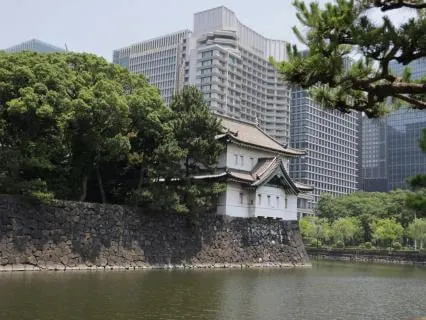
So thankfully the remnants of castle walls,
Embankments and moats remain around the city in plain sight.
Apparently,
Looking back to see where these walls came from,
Construction races used to be held between various samurai clans who sought to channel their warrior spirits into building better,
Faster,
Longer and deeper than their rivals.
Apparently also,
Prizes were handed out to the winning clans,
Thus giving an air of festivity to proceedings.
One rather impressive of such public works is the Tamagawa Josui,
Which runs from the Tamagawa River at Osaku all the way to central Yotsuya,
Bringing fresh drinking water to the populace.
Impressively,
This 43-kilometre channel was dug by hand over a period of eight months and has a difference in elevation of 92 centimetres.
That's incredible.
It recently celebrated 350 years since construction and is regarded as a National Historic Landmark.
These days it is still in use,
Providing a nice cycle route into Tokyo and a slice of green that bisects the west of the city.
All good.
I redirect my attention to the current structure I'm privileged to be spending an afternoon in,
Tokyo Skytree.
It is massive,
And it has already withstood a 9.
0 magnitude quake that hit eastern Japan on March 11th,
2011.
The roots of this tower are literally three-metre thick steel girders that can be seen disappearing four storeys into the ground below,
Through conveniently placed observation windows built into the pavement at ground level.
The tower then twists and spirals elegantly into the sky to a height of 634 metres,
Making it the tallest free-standing broadcasting tower in the world.
The previously famous Tokyo Tower whimpers off by itself in a central location in Tokyo and now only serves as a historic bookmark,
Occasionally pointed at and even less frequently visited,
Rusting away as it deserves to do.
I guess that's what you get for unimaginatively copying the Eiffel Tower in the first place.
So,
What happened to the great Ieyasu Toguawa,
The founder of Edo Tokyo?
Well,
After his death in 1616,
It was popular to think that his remains were interned at the family shrine in Nikko,
That we shall visit later on.
However,
Even cunning after death and fearing that his remains would be somehow interfered with,
He changed his name to the Great Gongen,
Light of the East,
Was deified as god and is buried,
Apparently,
Atop of Mount Kunozan in Shizuoka Prefecture,
Another place well worth a pickle-wich.
So,
Pay him a visit and ask for his power.
Thank you for listening.