Hello,
My name is Leah Sugarman.
Welcome to your Ujjayi Pranayama practice.
Ujjayi breath is a really common breath practice in yoga.
But it's a really,
Really powerful practice in and of itself,
So it can be really helpful to use in a yoga practice to link movement with breath.
But it's also really powerful to just use as a standalone pranayama practice to help to calm and soothe the nervous system.
But it can also be used to energize and heat the body.
So you get to kind of choose what you want from this practice.
Ujjayi literally translates to victorious.
So this is victorious breath.
It's often called oceanic breath because it makes the kind of ebb and flow sound of the waves in an ocean.
It's really a simple breath practice,
But it takes a little bit of finessing to kind of really get to it.
Begin in a comfortable seated position and you can sit anywhere.
If you want to sit in a chair,
Feel free.
If you want to sit on your bed or in a couch.
Or on the floor,
Find whatever you like.
Grab any props that you want.
So you might want to sit on pillows or cushions or blankets.
Just do whatever you need to to let your body become really,
Really comfortable.
And then root down into your sitting bones so that your pelvis becomes heavy.
And then feel the counter of this as you lift up through the crown of your head and elongate your whole spine.
Let your shoulders soften.
Let your face soften.
So relax all the muscles within your face.
And you can choose to keep your eyes open for this if you'd like to.
You could soften your gaze if you'd prefer.
You could close your eyes completely.
So just play around with whatever you like.
So just take a moment to tune in to your natural breath.
Just notice how your breath flows on its own without any interference from you.
Is it fast?
Is it slow?
Is it shallow?
Is it deep?
Try not to judge anything right now.
Try not to affect or change the breath.
But just take notice.
Of how it is naturally in this moment.
And then when you're ready,
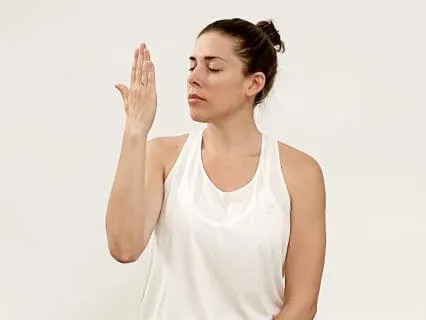
Lift one hand and place it in front of your face.
So just imagine that this hand is a mirror.
And your goal is to fog up this mirror with your bra.
So keep it right in front of your mouth and your nose.
And then inhale deeply through your nose.
And exhale,
Open your mouth and release a sigh.
Inhale through your nose exhale open your mouth and release a sigh Now continue to breathe like this.
And again,
Imagine that your hand is a mirror and you're trying to fog up this mirror with your breath.
So really focus on that exhalation,
Releasing a sighing sound.
So you can really hear it as you breathe out and feel the sensation of warmth against your hand.
Now as you do this,
Continue to breathe in this way,
Just notice what's happening in the back of your throat.
What kind of sensation happens to create this sighing sound?
What sort of constriction do you need to make there so that the air passes through in such a way that it creates that sound?
And notice how the breath has a sense of warmth to it when you have this subtle constriction in the back of your throat as you breathe out that sighing sound.
You can feel the warmth of your breath against your hand.
It's almost as if you're whispering that same sort of constriction that you create in the back of your throat to create this sigh.
So do this three more times.
Now this time.
.
.
Inhale deeply through your nose.
And keep your mouth closed,
But release a sighing sound through your nose.
Inhale through your nose.
Exhale,
Release that sighing sound through your nose.
Continue to breathe like this.
And continue to imagine that your hand is a mirror and you're fogging up that mirror with your breath.
Continue to feel that warming sensation against your hand with every exhalation.
Notice the constriction in the back of your throat as you create this sound to your breath.
Do this three more times.
Really focusing on your exhalation.
Now this time,
Strive to maintain that same subtle constriction in the back of your throat,
That same whisper-like quality as you also inhale.
And then keep it for the exhale as well through the nose.
Inhale through your nose,
Constrict the back of your throat.
Exhale through your nose constrict the back of your throat Do this three more times.
Continue to feel the warming sensation against your hand.
Imagine that you're fogging up this mirror with your breath.
Now once you really get the hang of this,
You can relax your hand down and continue to breathe in the same way.
In and out through your nose.
All while creating a very subtle constriction in the back of your throat so that your breath has sound.
Visualize wave.
Ebbing and flowing.
At the shore.
And let your breath become The soundtrack to these waves.
So once you've found this really strong,
Victorious Ujjayi breath.
Now the magic lies in the subtlety.
So you found the volume,
You found the sound to the breath,
But can you finesse it just a little bit so that it doesn't become this really powerful,
Like hurt your throat kind of breath,
But there's a softness to it.
There's a gentleness as it just ebbs and flows naturally.
Can you equalize the length of your inhale?
And the length of your exhale And continue to breathe in this way.
Let this breath become your metronome.
So wherever your thoughts may go to,
You always have this steady,
Consistent beat to return back to.
Take three more breaths like this.
And then once you've finished.
Just allow your breath to return to its natural rhythm.
So release your control over it.
Just let it flow effortlessly through your body.
And take notice of any small changes.
Any differences in how you're breathing now than when you began your practice.
When you feel ready.
Refocus your gaze or flutter your eyes open.
And just know that you can use this breath,
Victorious breath,
Ujjayi breath.
Any time that you'd like to throughout your day.
Again,
This practice is really calming and soothing to the nervous system.
Anytime that you really focus on your breath,
It will help to soothe and relax your nervous system and help to shift you into the rest and digest response so that you really take some parasympathetic nervous system dominance.
It can be used to help relieve stress or anxiety anytime throughout the day.
But again,
It can also be used to energize you.
This breath practice is one of the few pranayama practices that really can be used for either calming or invigorating.
So you can really kind of choose how you want to use this practice.
Of course,
If you want to be more calming,
You might take longer,
Fuller,
Deeper breaths.
If you want to be more energizing,
You might shorten your breaths a little bit strong stable breath but however you like to practice it this breath is really helpful and effective for relieving stress and reconnecting you to your own body and through the breath.
So I hope that this practice has been helpful for you today.
Thank you for joining and I will see you next time.