The world’s largest free audio library for everyday wellbeing
Somatic & Body Based
Authentic Movement is a somatic and depth-psychological practice in which a mover follows the body's spontaneous impulses with eyes closed while a witness observes, then the two reflect together on what arose (García-Díaz & García-Díaz, 2018).
Last Updated
4 Jul 2026
We are still reviewing this page. Our research team checks every technique page for accuracy and evidence quality before final release. Details may change as that review completes. The evidence badge shows our current reading of the published research.
RECOMMENDED DOSE
No direct dose-response literature exists for this technique. These recommendations are based on general practice conventions for movement-based, witnessed embodiment practices and should be treated as starting points only. A short introductory session with a witness or facilitator helps build comfort with self-directed movement. No direct dose evidence; editorial synthesis.
No direct dose-response literature exists for this technique. These recommendations are based on general practice conventions for movement-based, witnessed embodiment practices and should be treated as starting points only. Once comfortable, a longer mover-and-witness cycle allows deeper exploration. No direct dose evidence; editorial synthesis.
No direct dose-response literature exists for this technique. These recommendations are based on general practice conventions for movement-based, witnessed embodiment practices and should be treated as starting points only. Extended sessions typically suit established practitioners working within a facilitated group or ongoing personal practice. No direct dose evidence; editorial synthesis.
Session length
Session length: 15–20 minutes
15
MIN
How long each individual practice session should last from start to finish.
Frequency
Frequency: 1–2 days
1
DAY
The number of days per week to fit a session into your routine.
Session length
Session length: 30–45 minutes
30
MIN
How long each individual practice session should last from start to finish.
Frequency
Frequency: 2–3 days
2
DAYS
The number of days per week to fit a session into your routine.
Session length
Session length: 60 minutes
45
MIN
How long each individual practice session should last from start to finish.
Frequency
Frequency: 3–4 days
3
DAYS
The number of days per week to fit a session into your routine.
About this card. No direct dose-response literature exists for Authentic Movement; all guidance here is editorial synthesis based on general conventions for movement-based embodiment practices and should be treated as a starting point only. These recommendations are not a substitute for personalised guidance from a qualified practitioner.
Quick answers to what people most often ask. Each card links to the deeper section below.
evidence
Only small, early studies exist, with no randomized trials yet. A single uncontrolled study of 57 adults found Authentic Movement increased contact with inhibited emotions, though the shift was mixed: anxiety eased while sadness and anger rose. Pilot and case work explore attachment trauma and clinician self-awareness, but samples stay tiny.
Read moregood for
Authentic Movement suits adults who want more contact with their body and emotions, especially when feelings feel stuck or hard to name. Early work explores it with trainee clinicians building self and other awareness, and, in small pilots, adults carrying developmental trauma. It supports emotional awareness rather than treating any diagnosed condition.
Read moresafety
Most healthy adults can practise Authentic Movement with low physical risk, the main hazard being moving with eyes closed, so clear an open space. The larger caution is emotional: following the body's impulses can surface difficult feelings like sadness or anger. Those working with trauma or attachment wounds should practise alongside a trained facilitator.
Read morehow it works
Closing the eyes and following the body's impulses turns attention inward, heightening interoceptive awareness, the felt sense of internal signals like breath and tension. As sensation links with feeling, wordless experiences take shape and become something to notice and name, while the witness's steady presence helps them feel containable. These pathways remain early and theoretical.
Read moreAuthentic Movement is a somatic practice in which a mover closes their eyes and follows the body's spontaneous impulses while a witness observes, then reflects with them afterward (García-Díaz & García-Díaz, 2018).
A session pairs two roles: the mover and the witness. The mover works with eyes closed for a set period, letting movement arise from inner impulse rather than conscious choreography. The witness watches with attentive, non-judging presence, tracking the mover's experience without directing it. Afterward the two usually speak, with the mover putting words to what arose and the witness reflecting on what they saw. This mover-witness relationship, together with the sequence of inward impulse, sustained body attention, and shared reflection, is what sets Authentic Movement apart from ecstatic dance or open improvisation.
Authentic Movement is not choreography, performance, or dance in the usual sense; the movement is meant to arise on its own rather than be planned. It differs from Continuum Movement in its emphasis on psychological content and witnessing, and from ecstatic dance in its inward focus and therapeutic framing. It is also not a self-guided free-for-all, because the witnessing relationship is central. Developed within Jungian depth psychology and dance/movement therapy, it is a reflective, relational practice rather than a fitness or exercise routine.
Not to be confused with
Active Imagination (Jungian)
Active imagination is the Jungian practice of engaging unconscious images through dialogue, writing, or art. Authentic Movement is often described as active imagination carried out through the moving body, giving the same impulse-led, image-attentive process a somatic, witnessed form rather than a purely mental or visual one.
5Rhythms
5Rhythms guides dancers through a set sequence of rhythmic states in a group, with music shaping the arc of the session. Authentic Movement has no imposed rhythm, music, or sequence: movement arises from the body's own impulse with eyes closed while a witness observes.
Free improvisation / contact improvisation
Improvisational dance forms generate spontaneous movement for performance, creativity, or partnering, with attention typically outward toward form, space, or another dancer. Authentic Movement removes the performance frame entirely; the eyes-closed inward focus and the containing witness relationship are what set it apart.
Authentic Movement is thought to work by turning attention inward: closing the eyes and following the body's impulses heightens interoceptive awareness, the felt sense of internal signals like breath, tension, and the first stirrings of an emotion. That link comes from movement research broadly, not from Authentic Movement specifically (Vaisvaser, 2025). As bodily sensation begins to connect with feeling, experiences that were wordless can take shape and become something you notice, name, and reflect on, with the witness's steady presence helping them feel containable rather than overwhelming (Wyman‐McGinty, 1998). Researchers frame these as plausible pathways drawn from related movement studies rather than effects measured in Authentic Movement itself, so they remain early and theoretical (Shafir et al., 2013).
Moving with your eyes closed and following the body's own impulses turns attention inward, toward the quiet signals of breath, tension, and shifting sensation. That capacity is interoceptive awareness, the felt sense of what is happening inside the body, and in Authentic Movement it is theorised from related movement research rather than measured directly (Vaisvaser, 2025), (Shafir et al., 2013).
Following the body's own movement impulses can let feelings held below words begin to surface, while a witness's steady, non-judging attention helps them feel containable rather than overwhelming (Wyman‐McGinty, 1998). This is the idea behind affective release: physical sensation becomes emotion you can notice and reflect on, though it rests so far on clinical description and related movement studies rather than controlled trials (Vaisvaser, 2025).
A vague, hard-to-name feeling in the body can slowly take on shape and meaning during Authentic Movement. Closing the eyes and attending to sensations, images, and impulses as they arise gives that wordless experience a route into something you can notice, name, and reflect on (Wyman‐McGinty, 1998).
A sensation or gesture you can't quite name can settle into an image or a word during Authentic Movement, and describing it to a witness afterward gives that wordless experience a form you can actually reflect on (Wyman‐McGinty, 1998). Early accounts describe this as one way the practice may help feelings held in the body become thinkable.
Moving with your eyes closed can bring a clearer, more grounded sense of where your body is and how it is shifting. That inward attention draws on proprioception, the body's sense of its own position and motion signalled by receptors in muscles, joints, and tendons, and early, indirect evidence suggests it is part of what gives the practice its physically present, settled quality (Vaisvaser, 2025).
Trembling, shaking, or small involuntary movements can surface once you stop steering and follow the body's own impulses. The proposed idea is that this spontaneous activity lets the nervous system finish stress responses it never completed and settle back toward baseline (Begin et al., 2022). This is an early, largely theoretical account rather than something measured directly in Authentic Movement.
Being witnessed by an attentive, non-judging observer can make it feel safer to let the body move and let held feelings surface. In Authentic Movement this relational attunement, the sense of being tracked and held by another person's steady presence, is thought to help link bodily sensation with emotion (Wyman‐McGinty, 1998), (Vaisvaser, 2025).
What happens in the body during Authentic Movement has not been measured directly, so the physical picture comes from broader dance and movement therapy research rather than from studies of this practice (Homann, 2010). That work suggests self-directed movement may increase sensitivity to internal signals and ease sustained muscular tension, which practitioners tend to feel as the shoulders and jaw softening, a heavier and more settled body, and sensations they would usually overlook becoming clearer. Some people also notice spontaneous trembling or shaking as held activation discharges, a change described in the wider literature on spontaneous movement rather than confirmed in Authentic Movement, and often followed by a sense of the body letting go (Begin et al., 2022).
Following the body's own movement impulses can leave you feeling more physically 'here,' with sensations you would usually move straight past becoming clearer and easier to stay with. This is thought to reflect heightened interoception, the felt sense of internal signals like tension, breath, and subtle sensation, though it is inferred from broader dance and movement therapy research rather than measured in Authentic Movement itself (Homann, 2010).
With the eyes closed, many people feel more clearly located in their body, with steadier balance and a grounded sense of being physically present. That draws on proprioception, the sense of where your limbs are that comes from receptors in muscles, joints, and tendons. Research in dance and movement therapy suggests this internal position-sense becomes more active during embodied movement (Homann, 2010), though it has not been measured directly in Authentic Movement.
The body can soften and stop bracing when movement is allowed to follow its own impulse: the shoulders and jaw let go and a settled heaviness sets in. This eases muscular tension patterns, the habitual ways muscles stay contracted, though the shift is inferred from the wider dance/movement therapy literature rather than measured directly in Authentic Movement (Homann, 2010).
When a witness watches you move, you may feel seen and attuned to, as though someone is tracking your experience from the inside. That felt sense is linked to mirror-neuron activity, the brain response that fires both when you make a movement and when you watch someone else make one. It is expected to rise during Authentic Movement based on related dance/movement therapy research rather than measurement of this practice itself (Homann, 2010).
Moving with your eyes closed while a witness watches can feel like being quietly understood without a word spoken. That sense may involve the mirror-neuron system, brain cells that fire both when you move and when you watch someone else move, though it is inferred from broader dance and movement therapy neurobiology rather than measured in Authentic Movement itself (Homann, 2010).
Emerging evidence, all from small studies, points to Authentic Movement mainly for emotional awareness: a single uncontrolled study of 57 adults found it increased contact with emotions people had been holding back, though the shift was mixed, with anxiety easing while sadness and anger rose (García-Díaz & García-Díaz, 2018). Limited pilot and case work has also explored it for processing attachment-related trauma in three adults (Li et al., 2025) and for helping trainee clinicians develop a clearer sense of self and other (Lucchi, 2018), and some practitioners describe emotional and spiritual meaning arising through the practice (Torgersen, 2026). What is not yet supported: large or randomized trials, long-term follow-up, and any claim that it treats a diagnosed condition or replaces clinical care.
As the body moves on its own impulse, feelings you've been holding out of awareness can rise into view, sometimes as ease and sometimes as anger or sadness. One small study found the practice heightened contact with these held-back emotions, so the value lies in noticing what surfaces rather than in feeling better right away (García-Díaz & García-Díaz, 2018).
Feelings you have been holding back can rise to the surface when you close your eyes and let your body move without steering it. In one small study, people became more aware of inhibited emotions after Authentic Movement, though the shift was not simply feel-good: anxiety eased while sadness and anger became more present (García-Díaz & García-Díaz, 2018).
The main direct study, a single-group before-and-after design in 57 community adults, found that Authentic Movement increased awareness of inhibited emotions, with anxiety decreasing but happiness dropping and melancholy and anger rising (García-Díaz & García-Díaz, 2018). Around it sit small pilots and case studies on attachment-related trauma (Li et al., 2025) and on self and other differentiation in trainee clinicians (Lucchi, 2018), plus indirect mechanism research from dance and movement therapy. The limits matter, though: samples are tiny, most studies have no comparison group and so cannot show the practice caused the change, and a review of improvisational movement reports inconsistent results (Horváth et al., 2025).
0
Meta-analyses
0
RCTs
0
Systematic reviews
0
Observational
10
Pilot
Studied populations
The effect of the practice of Authentic Movement on the emotional state
n = 57
Finding: In a pre/post study of 57 adults, García-Díaz and García-Díaz found that a session of Authentic Movement, moving with eyes closed while a witness held attention, shifted emotions in a mixed direction: anxiety dropped, but so did happiness, while feelings of melancholy and anger rose. The researchers read this not as a mood lift but as people making contact with emotions they had been holding back or avoiding. For anyone considering the practice, this suggests it can surface hidden or uncomfortable feelings rather than reliably leaving you cheerful. Keep in mind the scope was narrow: a single session, a small non-random group, no comparison group, and everything measured by self-report, so these early signals are far from the last word.
reported narratively
The body in analysis: authentic movement and witnessing in analytic practice
1998
Finding: This paper describes Authentic Movement as a form of active imagination, where a person moves with eyes closed, following their own spontaneous impulses while a silent witness holds attention to the experience. Turning attention inward to bodily sensations, images and feelings, the author suggests, lets experiences that are hard to put into words become something a person can reflect on, with the witness providing a sense of being held and seen. This is a clinical and theoretical account drawn from dance/movement therapy and analytic practice rather than a controlled trial, so it explains how the practice is meant to work rather than measuring specific outcomes. If you are curious about it, treat it as a description of the practice and its intended experience, not as proof of particular effects.
Authentic Movement was developed by Mary Starks Whitehouse in the 1950s and 1960s and later refined by Janet Adler and Joan Chodorow, growing out of Jungian depth psychology and dance/movement therapy. Whitehouse's idea of 'being moved,' letting movement arise from the body's own intelligence rather than conscious choreography, and the Jungian notion of a 'somatic unconscious' shape the practice's form: eyes closed, impulse-led, and witnessed. These roots help explain how and why the practice is done, not that its lineage proves a clinical effect.
For most healthy adults, Authentic Movement is a low-risk practice you can explore gently, there is no physical hazard beyond moving with your eyes closed. What to expect is emotional rather than bodily. Following the body's spontaneous impulses can bring feelings you have been holding back into awareness, and that shift is not always pleasant. In a pre/post study of 57 community adults, anxiety eased for some people while sadness and anger rose and self-reported happiness dropped for others (García-Díaz & García-Díaz, 2018). That points to emotions surfacing, not to any harm to the body. If you are working with trauma or attachment wounds, early pilot work suggests exploring the practice alongside a trained facilitator or therapist rather than alone, a caution drawn from clinical practice rather than from safety testing (Li et al., 2025).
People working through trauma or attachment wounds should approach Authentic Movement with a trained facilitator or therapist. The small pilot work in this area was carried out inside a structured, supported protocol rather than solo practice, so the caution is informed by how the practice was studied (Li et al., 2025). Anyone who knows that rising sadness or anger can feel destabilizing may want support on hand, because the practice can surface difficult emotions before it settles them, a caution grounded in the mixed-affect findings of the 57-adult study (García-Díaz & García-Díaz, 2018). These recommendations rest on small studies, and the wider research on improvisational movement is still inconsistent, so treat them as precautionary rather than firm exclusions (Horváth et al., 2025).
Following the body's spontaneous impulses can bring held feelings into awareness, and for people carrying trauma or attachment wounds that surfacing can feel destabilizing. The only trauma-focused evidence is a small three-person pilot run inside a structured, professionally supported protocol, so the supported guidance is to explore the practice alongside a qualified facilitator or therapist rather than alone. This is a practice-informed caution drawn from how the practice was studied, not a safety-tested rule, and Authentic Movement does not treat trauma or replace clinical care.
| Technique | Best for | Use with care | Evidence strength | Distinction |
|---|---|---|---|---|
| Ecstatic Dance | Energetic, communal emotional release and uplift through free dancing to music in a social setting. | The stimulating, outward-facing format offers little of the inward witnessing that surfaces and contains deeper material. | EVIDENCE | Ecstatic dance is expressive, music-driven movement in a group, usually with eyes open and attention flowing outward into the room and the beat. Authentic Movement turns the opposite way: eyes close, there is no music to follow, and attention drops inward to the body's own spontaneous impulse while a witness holds quiet, non-judging presence. The difference is direction of attention and the therapeutic, witnessed framing rather than communal release. |
| Continuum Movement | Slow, fluid somatic exploration through breath and sound, with less emphasis on psychological narrative. | EVIDENCE |
Traditionally, yes. In classic Authentic Movement a witness holds steady, non-judging attention while you move with eyes closed, and that role is a defining feature of the practice rather than an optional extra (Wyman‐McGinty, 1998). You can move alone, but the witnessed form is what distinguishes it, and a facilitator is recommended for trauma or attachment work.
+
Traditionally, yes. The mover-witness pairing defines Authentic Movement: one person closes their eyes and follows the body's spontaneous impulses while a witness attends without judging, and the two reflect together afterward (García-Díaz & García-Díaz, 2018). Descriptive sources frame the witness as a containing presence that can make it feel safer to let held feelings surface (Wyman‐McGinty, 1998). This is source-context, not efficacy-tested, so solo practice is not invalid, but a witness or trained facilitator is especially advisable for trauma- or attachment-related work.
No. Authentic Movement is a specific witnessed practice in which you close your eyes and follow the body's spontaneous impulses, what its founder called 'being moved', rather than dancing freely to music. A witness holds quiet, non-judging attention, and afterward you reflect together on what arose (García-Díaz & García-Díaz, 2018).
+
No. Unlike free-form or ecstatic dance, Authentic Movement has no music, no performance, and no choreography; attention turns inward as you let movement arise on its own impulse with eyes closed (García-Díaz & García-Díaz, 2018). What sets it apart is the mover-witness relationship, in which sensations, images, and feelings are treated as material to notice and reflect on rather than as expression for its own sake (Wyman‐McGinty, 1998). It grew from Jungian depth psychology and dance/movement therapy through Mary Starks Whitehouse and her successors, a lineage that shapes the form rather than proving any clinical effect.
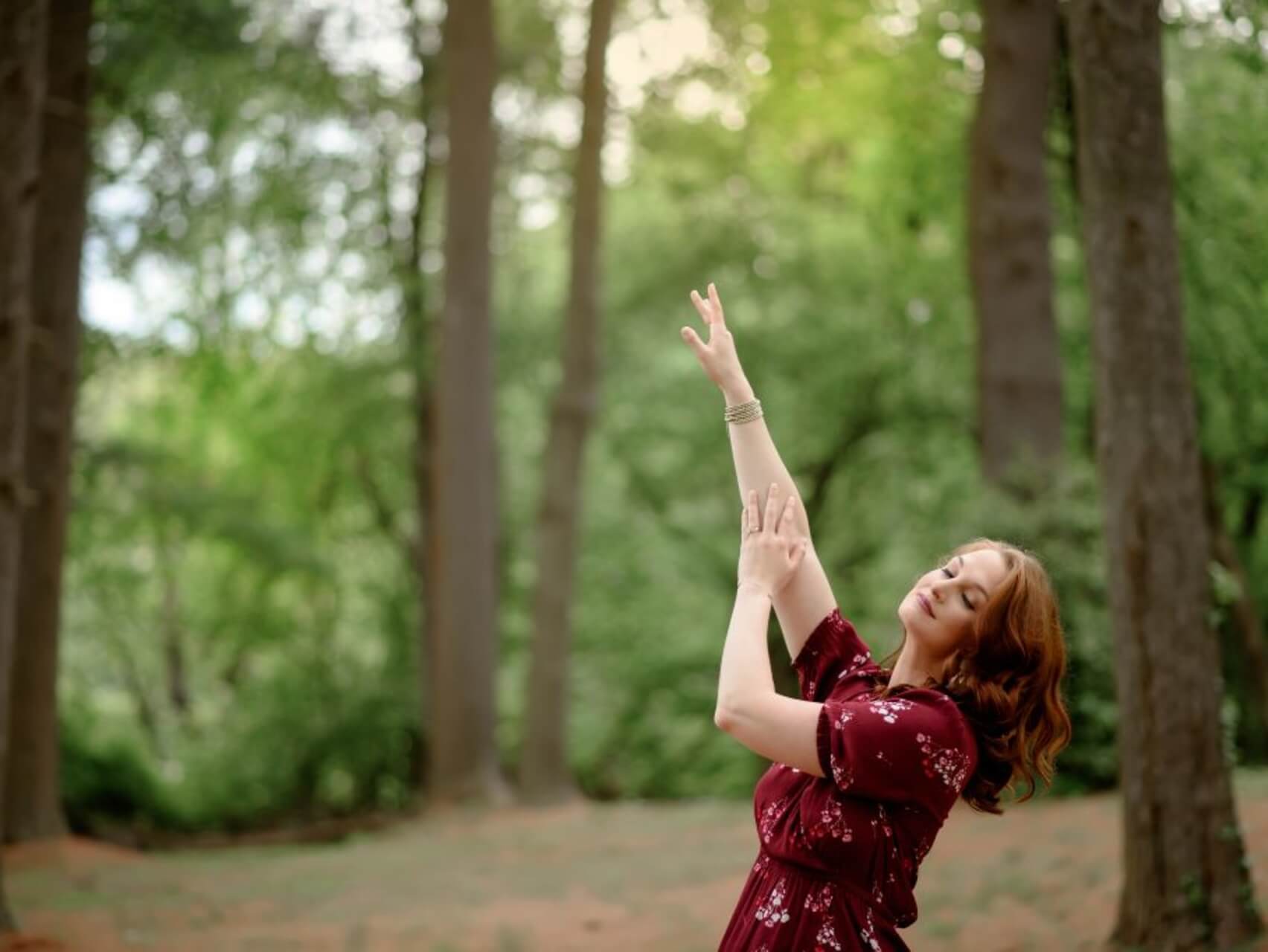
The two roles at the heart of Authentic Movement: the mover closes their eyes and follows spontaneous movement impulses, while the witness holds attentive, non-judging presence and later helps reflect on what arose. The witness's steady attention is what can make it feel safe to let held feelings surface.
Mary Starks Whitehouse's phrase for letting movement arise from the body's own impulse rather than consciously choreographing it, as though the body is moving you rather than you moving it.
The ability to sense and read internal body signals such as breath, tension, heartbeat, and the first cues of an emotion. Strengthening it often feels like being more embodied and able to catch a feeling early, before it takes over.
Perception of visceral and internal bodily states via afferent processing; linked to affect detection and emotion regulation.
The body's felt sense of its own position and movement in space, built from receptors in muscles, joints, and tendons. It shows up as steadier balance and a clearer, grounded sense of being physically present.
Kinesthetic awareness arising from proprioceptors, supporting sensorimotor integration and spatial orientation.
The release of stored stress activation through spontaneous trembling, shaking, or involuntary movement, thought to let interrupted fight, flight, or freeze responses finish so the body can settle. It often feels like vibration or trembling followed by a deeper letting-go.
Neurogenic discharge / autonomic release; proposed completion of incomplete defensive responses. Evidence in Authentic Movement is indirect and emerging.
The Jungian idea that sensations, images, and movement impulses in the body carry meaning that has not yet reached words. Authentic Movement treats these as material worth noticing and giving form to.
S. García-Díaz, Sergio García-Díaz (2018). The effect of the practice of Authentic Movement on the emotional state. https://doi.org/10.1016/j.aip.2018.03.004
Cited in: Benefits, How to practice safely, Research, Use with care, What it is, Who should use care
Wendy Wyman‐McGinty (1998). The body in analysis: authentic movement and witnessing in analytic practice. https://doi.org/10.1111/1465-5922.00023
Explore guided sessions to deepen your Authentic Movement technique.
Outcomes measured
The research is useful for setting expectations, but study methods and participant groups vary. Treat the findings as general guidance rather than a promise about any single session, and not a replacement for clinical care.
Healing developmental trauma: a pilot study on the discipline of Authentic Movement and attachment in adulthood
n = 3
Finding: This small pilot study in China followed three adults whose early experiences of controlling parenting had left them with a habit of keeping people at arm's length. Pairing Authentic Movement with a structured interview about their attachment history, the study found that all three reconnected with and released long-suppressed emotions tied to those early memories, and afterward described feeling a greater sense of security in how they relate to others. Because this rests on just three detailed case stories with no comparison group, it points to early promise rather than proof; it suggests Authentic Movement may help some people surface and work through emotions linked to attachment, and this kind of deeper trauma work is best undertaken with professional support.
reported narratively
Minding the moving self: the centrality of body movement in the neurodynamics of the self and psychotherapeutic implications
2025
Finding: This neuroscience review makes the case that movement and body awareness are woven into how we sense ourselves, describing how tracking our body in the space around us feeds a felt map of self and a finer awareness of internal signals that shape emotion and thought. It also points to shared brain systems for mirroring and synchronizing with others as a likely route by which movement-based practices build empathy and a more integrated sense of self. For someone exploring Authentic Movement, this offers a plausible reason why moving with attention might deepen self-connection and attunement to others. Keep in mind this is a theoretical model drawn from broader brain research, not a direct test of Authentic Movement itself, so it explains a possible pathway rather than proving the practice delivers these effects.
See full citation in referencesAuthentic Movement as a Training Modality for Private Practice Clinicians
2018
Finding: In this study, therapists in training used Authentic Movement as part of their professional development and reported a clearer sense of where they ended and their clients began, a stronger ability to work with images and symbols, and less tendency to over-identify with the people they were treating. For someone drawn to this practice, that points to its usefulness as a tool for building self-awareness and emotional boundaries rather than treating a specific condition. Keep in mind this was a small qualitative study based on the practitioners' own accounts, all of whom were clinicians in training, so the findings describe personal and professional growth rather than measured symptom change, and they may not carry over to other groups.
See full citation in referencesMy Dance Is My Prayer
2026
Finding: Over six years, this qualitative study followed people practising intentional dance prayer, a form derived from Authentic Movement, and their first-person accounts described emotional, spiritual and bodily insights that shifted how they understood themselves. For someone drawn to this practice, that suggests it can open a felt sense of meaning and personal transformation that goes beyond simple movement or exercise. Because the findings rest entirely on participants' own descriptions, with no measurements or comparison group, they capture lived experience rather than proof of a specific effect, so treat them as an honest window into how the practice feels rather than a guaranteed outcome.
See full citation in referencesCharacterizing a Common Class of Spontaneous Movements
2022
Finding: This descriptive paper maps out a kind of spontaneous, self-directed movement that shows up across many settings, from therapy rooms to religious gatherings to people moving alone, and that isn't tied to any medical condition. The authors propose that this kind of movement may be a natural, inherited way the body regulates itself, which offers early, hypothesis-level backing for the idea that letting movement arise on its own can serve a calming, self-balancing purpose. This is an observational, idea-generating piece rather than a trial, so it describes and interprets rather than measures outcomes; the authors themselves call for future research to test whether these movements actually help.
See full citation in referencesEmotion regulation through execution, observation, and imagery of emotional movements
2013
Finding: In this experiment, people who performed, imagined, or simply watched whole-body movements linked to a particular emotion felt more of that emotion afterward, showing that how we move can actively shape how we feel through the body's own sensory feedback. For anyone drawn to a practice like Authentic Movement, this hints at why letting the body move can genuinely shift your emotional state rather than just expressing it. Keep in mind, though, that this study looked at movement and emotion in general, not Authentic Movement specifically, so it offers background support for the idea rather than direct proof that this particular practice works.
See full citation in referencesMove freely! – A theoretical overview of the mechanism of movement improvisation
2025
Finding: This review took a broad look at the research on improvisational movement practices, including forms like Authentic Movement, and found the evidence so far is patchy and often contradictory, with no shared way of measuring results across studies. The authors mapped out 18 different ways movement might influence mental health, but concluded the field still needs standardized methods before anyone can say for sure which effects are real. For someone considering this practice, that means the potential is genuinely interesting, but the specific mental-health benefits are not yet firmly established, so it's best approached as a promising exploration rather than a proven treatment.
See full citation in referencesEmbodied Concepts of Neurobiology in Dance/Movement Therapy Practice
2010
Finding: This is a review of the dance and movement therapy field rather than a study of Authentic Movement itself, and it gathers ideas from brain and body science to explain why moving with awareness might help the nervous system settle. Drawing on how the body reads its own internal states, stores experience below conscious awareness, and mirrors the movement of others, the authors sketch a plausible picture of how body-based practices could support the mind-body connection. For someone considering this practice, it offers a reasonable rationale for why gentle, self-directed movement may feel regulating, but it is worth knowing that this paper measured no heart rate, hormone, or other physical markers, so it explains a possible "why" without proving what happens in the body during Authentic Movement.
See full citation in referencesLetting the body move without steering it can bring feelings you have been holding back into awareness, and that shift is not always pleasant. In a pre/post study of 57 community adults, anxiety eased for some people while sadness and anger rose and self-reported happiness dropped for others. This points to emotions surfacing rather than any harm to the body. If you know that rising sadness or anger can feel destabilizing, have support on hand, and remember you can slow down, pause, or open your eyes at any point.
These cautions rest on small studies, and the wider research on improvisational movement is still inconsistent. Read the recommendations here as precautionary directions rather than firm exclusions, and adjust to your own experience and support.
Authentic Movement is gentlest when you give yourself an open, uncluttered space where moving with your eyes closed feels safe, ideally with a steady, non-judging witness or trained facilitator nearby. For most healthy adults it is a low-risk practice to explore slowly, letting spontaneous impulses arise while knowing you can pause or open your eyes at any moment. Because what surfaces may be relief as readily as sadness or anger, meet whatever comes with curiosity, and if you are working through trauma or attachment wounds, arrange to practise alongside a qualified therapist rather than alone.
Because you will move with your eyes closed, set up in an open, uncluttered area free of sharp corners, cords, or anything you could knock into. A clear floor lets your attention stay inward without risk of bumping or tripping.
Authentic Movement is built around a witness who holds steady, non-judging attention while you move. Having that presence, or a trained facilitator, can make it feel safer to let held feelings surface and easier to settle afterward.
Let movement arise on its own impulse, and remember you can always slow down, pause, or open your eyes if sensation becomes too much. Knowing you can stop at any point protects against feeling overwhelmed.
What surfaces may be relief as readily as sadness or anger, so meet whatever arises with curiosity rather than forcing it toward calm. The value is in noticing what comes up, not in feeling better right away.
Give yourself time at the end to notice what came up, feel your feet on the floor, and return to ordinary awareness slowly. Reorienting gently helps difficult material settle rather than trail into the rest of your day.
If you are processing trauma or attachment-related material, arrange to practise alongside a qualified therapist or facilitator rather than alone, since the available trauma-focused evidence comes only from small, professionally supported pilots.
This information is educational and is not medical advice. This practice is not a substitute for professional care and should not replace prescribed medication or treatment for any medical or mental-health condition. If you are managing a health condition or taking medication, talk with a qualified health professional before changing your practice. If you are in distress or crisis, seek professional support.
| Continuum Movement explores fluid, wave-like motion guided by breath, sound, and subtle internal sensation, emphasising the body as a fluid system. Authentic Movement shares the inward, slow, impulse-led quality but centres on psychological content and the mover-witness relationship, treating sensations and images as material to notice, symbolise, and reflect on rather than as fluid exploration for its own sake. |
| Dance/Movement Therapy | Structured, clinician-led therapeutic work where a trained therapist actively shapes and guides the movement process. | moderate EVIDENCE | Dance/movement therapy is the broader clinical field within which Authentic Movement developed; it uses movement toward psychological and physical integration across many structured methods and populations. Authentic Movement is one specific discipline inside that field, defined by eyes-closed, impulse-led moving and the mover-witness relationship rather than by therapist-led or choreographed intervention. |
| Tension & Trauma Releasing Exercises (TRE) | A structured, repeatable way to invite tremoring and physical tension discharge without a psychological or relational frame. | EVIDENCE | TRE deliberately evokes neurogenic tremoring through a fixed sequence of physical exercises, aiming to discharge stored tension through shaking. Authentic Movement can produce similar spontaneous trembling, but it arises unpredictably from following inner impulse rather than from a prescribed protocol, and it is held within a witnessing relationship and a psychological, meaning-making frame rather than pursued as a standalone tension-release technique. |
Some, but it is early and thin. One uncontrolled study of 57 adults found Authentic Movement increased contact with held-back emotions, with mixed mood effects, plus tiny pilots on attachment trauma and clinician self-awareness, and no randomized trials yet (García-Díaz & García-Díaz, 2018).
+
Some, but treat it as suggestive rather than settled. The main direct study was a single before-and-after design in 57 adults that found greater awareness of inhibited emotions, though the affect shift was mixed: anxiety eased while sadness and anger rose (García-Díaz & García-Díaz, 2018). Around it sit only small pilots and case studies on attachment-related trauma (Li et al., 2025) and on self and other awareness in trainee clinicians (Lucchi, 2018). Samples are tiny, most have no comparison group so they cannot show the practice caused the change, there are no randomized trials, and a review of improvisational movement reports inconsistent results (Horváth et al., 2025). None of this proves the practice treats a diagnosed condition or replaces clinical care.
Not necessarily. Authentic Movement is not reliably calming; the single before-and-after study of 57 community adults found mixed emotional effects, with anxiety easing for some while sadness and anger rose and reported happiness dropped (García-Díaz & García-Díaz, 2018).
+
Not necessarily. The one direct study of 57 community adults found that Authentic Movement mainly increased awareness of emotions people had been holding back, and that shift went in different directions: anxiety eased for some, while melancholy and anger rose and self-reported happiness dropped for others (García-Díaz & García-Díaz, 2018). It is best understood as a practice that surfaces held feelings, which can be uncomfortable as readily as relieving, rather than a certain mood lift. This comes from a single small study with no comparison group, so read it as an early signal rather than settled proof.
To turn attention inward. Closing your eyes removes external visual reference so you can follow the body's own impulses rather than watch or steer them; this is thought to heighten interoceptive awareness, your felt sense of internal signals, though that link is drawn from broader movement research rather than measured in Authentic Movement itself (Vaisvaser, 2025).
+
To turn attention inward. Closing the eyes is central to the practice's design: with a witness holding steady, non-judging attention, the mover follows spontaneous movement impulses instead of choreographing or observing them (García-Díaz & García-Díaz, 2018). Removing the visual field is thought to sharpen interoceptive and proprioceptive awareness, the felt sense of internal signals and of the body in space, and to let wordless bodily experience take shape as something you can notice and reflect on (Wyman‐McGinty, 1998). This mechanism is early rather than confirmed, since it comes from wider movement research and has not been measured within Authentic Movement itself (Vaisvaser, 2025).
It is thought to be nervous system discharge, the body releasing stored stress activation through spontaneous trembling so interrupted fight, flight, or freeze responses can finish and settle. This is a proposed mechanism drawn from broader spontaneous-movement research, not measured in Authentic Movement itself, and it is a normal but optional experience, not a sign of harm (Begin et al., 2022).
+
Trembling or shaking is described as nervous system discharge: as attention turns inward and movement arises on its own, the body may release held autonomic activation through vibration or trembling, often followed by a sense of settling. This explanation is theoretical, borrowed from the wider literature on spontaneous, self-directed movement rather than confirmed within Authentic Movement itself (Begin et al., 2022). Shaking is not required for the practice to work, it varies from person to person, and it is not a sign that anything is wrong. If it feels like too much, you can slow down, pause, or open your eyes.
For most healthy adults, yes. Solo practice is low-risk beyond moving with eyes closed, but the main caution is emotional, not physical: following the body's impulses can surface held feelings, and one small study found anxiety eased for some while sadness and anger rose (García-Díaz & García-Díaz, 2018).
+
For most healthy adults, practising alone is low-risk, with no bodily hazard beyond moving with your eyes closed in a clear space. The main thing to expect is emotional: surfacing held feelings can be uncomfortable as readily as calming, so keeping an exit within reach and reorienting slowly at the end helps difficult material settle (García-Díaz & García-Díaz, 2018). If you are working with trauma or attachment wounds, early pilot work points toward exploring the practice alongside a trained facilitator or therapist rather than alone, though this is a practice-informed suggestion from small supported pilots rather than a safety-tested rule (Li et al., 2025).
Use care. If you are working through trauma, practise Authentic Movement alongside a trained facilitator or therapist rather than alone, since it can surface difficult emotions and the only trauma pilot used a supported protocol (Li et al., 2025).
+
Use care. For most healthy adults Authentic Movement carries little physical risk beyond moving with your eyes closed, but following the body's spontaneous impulses can bring held feelings into awareness, and that shift is not always calming: one study found anxiety eased for some while sadness and anger rose for others (García-Díaz & García-Díaz, 2018). The only trauma-focused evidence is a small three-person pilot conducted inside a structured, professionally supported protocol, so the supported guidance is to work with a qualified facilitator or therapist rather than alone (Li et al., 2025). This is a practice-informed caution, not a safety promise: no controlled trials have tested Authentic Movement for trauma, and it does not treat trauma or replace clinical care.
Start simply: clear an open, uncluttered space so you can move with your eyes closed without bumping into anything, and, when you can, have a witness or trained facilitator present. Let movement arise on its own, keep the option to slow down or open your eyes, and expect mixed feelings, relief as readily as sadness or anger (García-Díaz & García-Díaz, 2018).
+
Start simply and gently, treating your first sessions as setup rather than performance. Clear an open space free of sharp corners or cords so moving with eyes closed feels safe, and move with a witness or trained facilitator when possible, since that steady presence can make it easier to let held feelings surface and settle. Keep an exit within reach, you can always pause or open your eyes, and expect emotions that may be uncomfortable, meeting whatever arises with curiosity; one small study found the practice surfaced anxiety, sadness, and anger as well as relief (García-Díaz & García-Díaz, 2018). If you are working with trauma or attachment-related material, early pilot work suggests exploring it alongside a qualified therapist rather than alone (Li et al., 2025).
The main difference is where attention goes. Authentic Movement is eyes-closed, impulse-led, and inward, done while a witness watches within a therapeutic frame; ecstatic dance is expressive, music-driven, eyes-open, and communal, with attention flowing outward (García-Díaz & García-Díaz, 2018).
+
The main difference is where attention goes and how it is framed. In Authentic Movement you close your eyes and follow the body's own impulses while a witness holds quiet, non-judging attention, then reflect together on what arose (García-Díaz & García-Díaz, 2018), (Wyman‐McGinty, 1998). Ecstatic dance turns the opposite way: eyes open, music-driven, and communal, with attention flowing outward into the room and the beat. This is a descriptive difference in focus and framing, not a claim that one practice works better than the other; no direct head-to-head comparison exists.
The process of turning a vague, wordless body sensation into an image or word you can name, hold in mind, and reflect on, often by articulating it to a witness after moving.
The steady, tracking presence of a witness who attends to your experience without judging it. Feeling safely seen in this way can make it easier to let movement and held feelings surface and then settle.
Intersubjective witnessing proposed to provide a containment function; supported by descriptive and indirect evidence.
Cited in: How it works, What it is
Peng Li, Helen Payne, Ben Grey (2025). Healing developmental trauma: a pilot study on the discipline of Authentic Movement and attachment in adulthood. https://doi.org/10.1080/17432979.2025.2528823
Cited in: Benefits, How to practice safely, Research, Use with care, Who should use care
Sharon Vaisvaser (2025). Minding the moving self: the centrality of body movement in the neurodynamics of the self and psychotherapeutic implications. https://doi.org/10.3389/fpsyt.2025.1726099
Cited in: How it works
Beth Lucchi (2018). Authentic Movement as a Training Modality for Private Practice Clinicians. https://doi.org/10.1007/s10465-018-9287-3
Anette Torgersen (2026). My Dance Is My Prayer. https://doi.org/10.1007/s10465-025-09426-2
Cited in: Benefits
Joel Begin, Luiz Bertolucci, MD, Dorothea Blostein, Budiman Minasny (2022). Characterizing a Common Class of Spontaneous Movements. https://doi.org/10.3822/ijtmb.v15i3.719
Cited in: How it works, What happens in the body
Tal Shafir, Stephan F. Taylor, Anthony P. Atkinson, Scott A. Langenecker, Jon‐Kar Zubieta (2013). Emotion regulation through execution, observation, and imagery of emotional movements. https://doi.org/10.1016/j.bandc.2013.03.001
Cited in: How it works
Milla Horváth, Frida Zuber, Boglárka Kitti Vécsey, Fanni Varga, Mihály Gáspár, Beáta Magda Nagy (2025). Move freely! – A theoretical overview of the mechanism of movement improvisation. https://doi.org/10.1016/j.aip.2025.102259
Cited in: Research, Who should use care
Kalila B. Homann (2010). Embodied Concepts of Neurobiology in Dance/Movement Therapy Practice. https://doi.org/10.1007/s10465-010-9099-6
Cited in: What happens in the body
Editorially curated. Tracks are not themselves clinically studied; evidence on the page applies to Authentic Movement as a technique.
Beginner content for Authentic Movement

★ 4.8
·
Music
·
16 min
Niamh O'Shea
How hard is Authentic Movement?
Authentic Movement belongs in the mid tier because it is not physically extreme, but the emotional openness and spontaneous following are real from the start.
3
Mental Effort
2 / 4
▾Emotional Depth
3 / 4
▾Physical Intensity
2 / 4
▾Prior Knowledge
2 / 4
▾