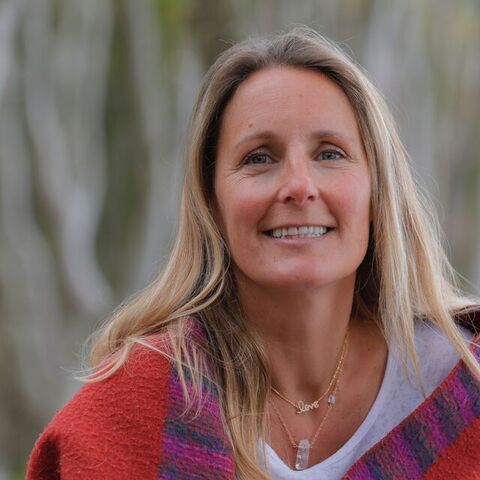
The following practice is led by Sonia Lockyer,
Host of the Wellbeing Ritual Club.
We'll begin by sitting comfortably.
We want to have your spine straight,
So however that means that you sit.
It can be in a chair,
It can be on the floor,
No pressure.
And you can move any time.
If you start to get a dead leg,
I usually do,
Then move your dead leg.
Don't sort of suffer.
There's nothing to suffer at all today.
And just notice as you breathe in and out through your nose how that feels this morning.
Unless you've got a cold or you can't breathe through your nose,
In which case,
Gently breathe through your mouth.
You can have your teeth slightly apart,
Your lips slightly apart if you're breathing through your mouth.
And gently press your tongue up into the roof of your mouth.
And as soon as the tongue moves up to the roof of the mouth,
There's a settling of these bones in the skull that aren't,
They aren't solidly connected.
The skull has its own movement and pulse.
If you've ever had a brace like as you know I did last year,
Then you really get the idea of how much movement there is going on in your mouth and around your jaw and all around your head.
And so this gentle pressing of the tongue up into the roof of the mouth,
It just helps everything to kind of yawn almost.
Let the shoulders drop away from the ears.
And have a little wriggle.
It can be quite surprising where the pockets of tension lie.
We're just curious and exploring.
And perhaps your hands are resting on your knees.
Let's have our palms turned down so that we are in that earthing,
Grounding energy.
And feel the sitting bones pressing down so that they also are in that earthing,
Grounding energy.
You could almost imagine a downward pointing triangle at the back of the small of your back,
The sacrum,
Sending this almost like a tail of energy down into the ground.
You feel very connected and solid.
And then this strong foundation allows the inner upward energy of the lift that comes up through the spine.
So from the tailbone up through the spine,
Up through the back of the neck,
Up through the crown of the head,
Creating space between each of the vertebrae,
Space for each of the organs,
Space for a deeper breath.
And of course the largest organ of the body is the skin,
Very active.
So much information coming and going through the skin,
Digestion happening,
Nutrition,
Hydration happening,
Information about texture,
Temperature,
Sensation,
Temperature,
Sensation.
Allowing even our space,
Even our skin to feel a sense of spaciousness.
So the footprint of our body in the space that we're sitting at actually becomes just a bit larger,
A bit more expanded.
You can maybe picture yourself in relationship with the furniture and the walls.
Allow yourself to take up a bit more room.
We're going to do our breath practice,
Which is very like a meditation practice.
In the yoga teachings,
Breath practice comes just before stillness and then stillness comes into meditation.
It's not linear.
Nothing to do with spirit is linear.
But they are quite a helpful combination of awareness.
So the breath calms the mind,
It actively calms and soothes the mind and the nervous system.
The stillness creates a container and then the meditation is the experience within the container.
They really work as a family together.
Let's bring some gentle movement into the body by taking right ear to right shoulder.
Dropping chin to chest,
Noticing what your breath does as you circle left ear to left shoulder.
Coming up and over.
And then changing direction.
Back to stillness.
Shoulders circling.
Maybe the elbows,
Maybe the arms.
Resting hands on knees and settling the heart.
Moving forwards and back if that feels easier.
Changing direction.
You can move at any time during the practice so feel free to keep wriggling and adjusting.
Come back to centre and gently rock the pelvis so as you exhale the tailbone goes back.
As you inhale the pubic bone moves forwards.
There will be a ripple effect through your spine.
It's impossible to move your pelvis in isolation.
It's such a pivotal point for the whole body.
And your legs really adapt and adjust as you do this as well.
And even your shoulders and your chest and your neck.
And your head will adapt too as you probably look down a little more as you rock back and probably look up a little more as you rock forwards.
And then settling into stillness.
Laying your hands in your lap.
Right hand resting on top of left.
Palms turned upwards.
So the hands are almost like a little cup to hold the practice.
Breathing through the nose.
Let's start by noticing how that feels.
How the nostrils feel as you bring an intake of breath.
Cool air.
Entering your body and then.
As you allow the out breath.
It's slightly warmer air.
Getting to know the landscape of your breath this morning.
How does the inhale feel?
And how does the exhale feel?
Where is the comfort?
The ease?
Do you naturally find the little space between the breaths?
That place where the lungs are full.
You can just rest in that suspended moment.
And the space at the end of the exhale where the lungs are empty.
Can you rest in that suspended moment?
For me that feels like a really nourishing moment of stillness.
But there are times when that feels uncomfortable and panicky.
It's never the same practice twice.
Observing the breath like this gives you a really honest assessment of how you're feeling inside today.
We're going to bring some movement into starting with your hands at your heart as you inhale hands are going to rise up overhead.
As long as your shoulders are happy with this as you exhale take your arms wide.
It's like you're swimming through the ether.
Returning to your heart.
The inhale is going to be approximately a count of four.
And your exhale is going to be anything from six to eight.
You find what works for you.
It's slowing it right down.
Hanging out in that exhale for longer.
If your shoulders are uncomfortable just play with the ratio instead.
Inhaling for four.
Playing with it just a little bit to find the best version for you.
Sometimes your spine really wants to keep moving.
If that is an impulse you're feeling then just let that continue to move.
You don't need to control it.
It's not a choreographed movement.
And then resting your hands in your lap.
A moment to notice.
And we'll bring in a different movement.
So this time starting with your elbows bent.
Your hands in a gentle fist.
Maybe turn the palms down actually.
As you inhale the fist comes back in towards you.
And that opens up the front of your chest as your elbows draw back behind you.
And as you exhale you're going to open up the hands and press the hands forwards.
And you might find that your heart dips back behind you so that you really open up between the shoulder blades.
And then inhale.
Bringing the palms in.
Actually the palms facing up feels better for me.
You can adapt it according to what feels good.
And again we'll start to lean into the exhale so it's just a little bit longer.
And as the whole body adapts to this movement.
It's not just the arms that are moving.
The whole torso responds.
The legs respond to keep you stable.
The neck,
The face responds.
There's not a sense of isolation.
It's very much a dance through the whole of your body.
Coming back to centre bringing your hands down.
And then visualising a circle in front of you.
You might have seen the Marvel movies with Doctor Strange and these Tibetan monks that create these incredible circles that become portals.
That they can step through into other worlds other times.
So sometimes I visualise that circle as one of those portals.
It might be a neater,
Tidier circle.
Just settle into what your circle looks like.
And we're going to use light as we breathe.
Starting at the base of the circle as you inhale you're going to come over to the side and all the way up to the top.
And as you exhale you're going to go over to the other side and all the way down.
Finishing right at the bottom.
So now we've got even breath.
Even inhale.
Even exhale.
And I'm moving my finger but you don't need to move your finger because you're just visualising this circle.
A beautiful circular breath.
And now we're going to go over to the top.
And we're going to go over to the top.
And we're going to go over to the top.
And then letting the visualisation go.
Allowing your breath to move into its natural cadence and just watch that with a smile.
Where does it want to go today?
And sometimes if the inhale is dominant it's because you're getting that lovely surge of hormones that the morning brings to get you going and get you started for the day and the week ahead.
But sometimes if the exhale is dominant then that's just a little indication that maybe you could schedule some rest time today if possible.
Definitely not always possible.
But sometimes it can be.
And even if some rest time isn't available we can apply a mindset of restfulness,
Of quietening whilst we partake in the busyness of a day.
Our mindset isn't the choice.
We stay present instead of rushing ahead to what is coming or dwelling in what just happened.
And inviting our hearts to express an intention for the week ahead.
So really tuning in and listening to the body.
What does she need this week?
And even if what she needs this week is quite inconvenient,
Sometimes it is.
Are we prepared to honour that?
To prioritise it?
Or are we going to hustle with our body and kind of explain that,
Yeah that's great but I can't this week.
I can give it to you next week.
Cultivating a relationship,
A dialogue.
And tipping off the hamster wheel and coming into presence.
And bringing your hands up to your heart centre.
Dropping your forehead to your fingertips.
Namaste.