Hi,
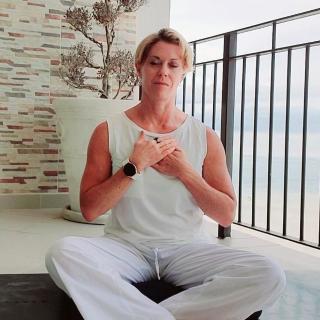
I'm Sherry.
If you've been carrying weight in your neck or shoulders,
Attention.
That doesn't ease no matter how much you stretch.
This practice is for you.
Sometimes that holding isn't muscular,
It's nervous system based.
A kind of bracing your body has learned to do on its own.
Today,
We'll gently unwind those patterns through slow,
Mindful movement.
Will begin by allowing your eyes to lead your head.
Slowly.
Side to side.
And at the end of each turn,
Pause.
And allow a full breath.
You might try matching the movement with your breath.
So on the exhale.
Turn the eyes,
Turn the head.
We pause for a breath.
And then on the inhale,
Come back to center.
Exhale we move to the other side Cross for a round of breath.
On the inhale we return to center.
Orienting is an instinctive part.
Of how our nervous system finds safety.
It evolved to help us scan our surroundings and decide.
Am I safe enough to soften?
When we're stuck in bracing This natural reset can go quiet.
Bringing it back online gently helps the body remember it's not under threat.
As you pause on each side,
Notice Does your body allow you to stay?
Or is there a pull to return to center?
Simply observe the impulse.
Without needing to fix or follow it.
Allow the movement to fade and come back to a neutral gaze.
Letting your head rest at Sumter.
Feel the weight of your body where it meets the ground.
Notice what,
If anything,
I shifted.
When you're ready will begin to work with the shoulder.
Not by forcing them open.
But by showing the brain how to release them from within.
Seated are lying down.
Draw one shoulder blade slowly toward the spine.
Then allow it to release even slower.
This isn't a stretch.
It's a glide in and out of effort.
You can alternate sides I repeat on one side a few times before switching.
Contracting back on the inhale.
Returning on the exhale.
The slow contraction and release.
Works directly with the muscles.
That brace through the upper back.
Especially the rhomboids and traps It's not about forcing them to let go.
It's about showing the brain a new pattern.
One where effort isn't always needed.
If you've been repeating one side,
Begin to explore the other now.
Allow the pace to stay slow enough.
To register sensation fully as the shoulder glides and returns Notice.
If there's a difference between initiating movement and allowing release.
Where does the control live?
And is there any part of the movement that skips ahead?
Allow both shoulders to return to neutral.
And the breath to flow without needing to guide it now.
Sense in to the back of your ribs your spine your breath.
Notice any new space or sensation.
Now we'll meet the familiar pattern of lifting the shoulder and tilting the head.
Something many of us do without even realizing.
And begin to rewire that reflex with breath and awareness.
Gently tilt your head.
To one side on the same side Lift your shoulder slightly.
Just enough.
Feel contact.
Then allow both to lower together with your exhale.
Repeat a few times,
Then switch sides.
This pattern mimics the startle or red light reflex.
A protective response that pulls us inward and upward.
Over time it can get stuck in the system.
Slow,
Paired movements like this Teach the brain that it's safe to soften that shield.
If you've stayed on one side,
Begin to explore the other now.
Allow each round to feel like a quiet conversation.
Not a correction.
Notice the relationship between the head and shoulder.
Do they move as partners?
Art is one lead the other.
Is there ease our effort in letting them drop?
And back to center Allow your head to balance naturally.
Shoulders resting away from the ears Sense into the length of your neck.
The space beneath your jaw the base of your school.
What's present now?
From here,
We'll shift inward into self contact.
Bringing in the quiet strength of containment.
Before continuing on.
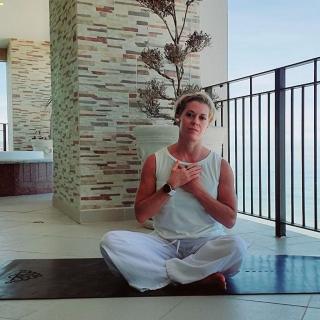
Bring one hand to the opposite shoulder or collarbone.
And cross the other over it.
Allow your arms to cross your chest in a way that feels natural.
Begin a slow,
Gentle rocking.
Forward and back,
Are side to side.
Following your breath Inhale.
We rock away from center.
Exhale.
Allows us to return.
Cross body self-contact can signal safety to the nervous system.
Especially when paired with rhythm.
This kind of gentle containment.
Supports midline integration.
And softens the drive to brace outward or push through.
Feel the contact of your hands.
Is there warmth?
Tension our sense of holding.
Does the bra Move more freely in one part of your body than another.
Allow the rocking to fade.
Stay in the shade.
Release your arms.
Rusting them wherever they feel most at ease.
Feel the imprints.
Of where your hands were.
Sands.
The center line of your body.
Breath.
The chest.
The quiet.
Will shift into the heart space.
Exploring.
The gentle movement of the sternum.
As it lifts and softens.
Carving room for breath where the body may have been holding tight.
From Seated.
Inhale.
As you gently lift.
Press your sternum forward.
Just slightly.
Exhale to round and allow the chest to soften.
Think of it as a quiet ripple,
Not a stretch.
This subtle wave.
Invites movement.
Into the thoracic spine and diaphragm.
Two areas that often goes still in free states.
When the chest can move freely,
It helps the nervous system re-enter.
Flow and connection.
As your sternum lifts and softens.
Where does the movement begin?
Can you sand?
Whether it starts from breath,
From spine,
Or from effort.
What shifts when you allow it to begin somewhere new?
Allow the shape to fade.
Spine neutral.
Breath natural.
Feel into the space behind your chest.
Notice.
The tone of your brow.
The quality of presence across your front body.
We'll close with the final shape.
To cradle the neck and hood.
Inviting your system.
To feel fully supported.
As if the weight you've been carrying can finally be received.
Bring both hands behind your head.
I'll go CC.
Allow your head to rust into your palms.
From here,
Explore gentle nodding motion.
Or slow figure eight.
Lead from your ribs or pelvis.
Not the neck.
Fratling the head Invites the nervous system.
Out of vigilance when we support the head from underneath.
Rather than holding it up.
We share.
From defense into trust.
This movement three patterns chronic upper body tension by including the whole spine.
Not isolating the nut.
Feel the weight of your head in your hands.
Is it easy to allow it to be held?
Is there a part of you?
Still doing the holding.
Allow the movement to grow smaller until it fades.
Hands can stay.
Are come down to rest wherever they feel most supported.
Sense the back of your skull.
Your spine,
Your breath.
Notice.
What's quieter?
What's clear?
There's no need to move quickly.
Allow your system to settle into the space you've created.
The space that's always been underneath the holding.
Allow yourself to stay here a little longer if it feels nourishing.
Absolutely no rush.