We're going to begin the practice in child's pose.
So come onto your hands and knees.
Bring your big toes together and open the knees out towards the sides of the mat.
Sit back onto your heels.
And bring your forehead to the mat,
Taking the arms out in front of you.
Make sure that you're comfortable here.
You can sit onto a block or a cushion if that feels best for you.
And if it feels best to support your head,
Take a block under your forehead.
Or stack your forearms and rest your forehead onto the forearms.
And relax into the posture here.
Take some breaths to feel into your body.
And notice how your body is feeling today.
Notice any places that are communicating that they're ready for some opening and release.
And notice any places that feel comfortable and at ease.
There's no right or wrong way for your body to feel.
And no need to think about why anything feels the way that it does.
Just observe whatever it is that you feel inside your body right now.
Give yourself this time to feel into your body.
And welcome exactly what is.
If you are feeling any areas that feel a little more tense or uncomfortable.
Begin to breathe into those places.
Inhale into the discomfort.
And allow the exhalation to encourage that tension to release.
Send each breath to wherever it needs to go.
Every exhalation encouraging the tension to unwind and release a little bit more.
The intention of this practice is to make space for grief.
Grief is a very unique process that each of us experiences in our own way.
Following a significant loss or change.
The postures that we're moving through today target the lung and large intestine meridian.
Which in traditional Chinese medicine are connected to grief and letting go.
But more importantly,
Your practice is your space to be with whatever you are feeling.
To connect with your body and your process.
And to allow the postures to support you through your experience.
As you move through the postures today,
You may find that you feel movements of energy.
Movements of emotions and thoughts.
And that is all very natural.
There's no need to analyse anything that you feel or to try and change anything.
Allow the process to happen for you.
As you move yourself through the postures and just observe.
Now from here walk your hands in until you come to your hands and knees.
Take any support to the side.
And come down to lying on your front for Sphinx Pose.
Bring your elbows under your shoulders and your forearms parallel to the sides of the mat.
So that your chest is lifted.
And if this is too intense for your back,
Walking the forearms forwards will reduce that intensity.
Or you can rest your forehead onto your forearms and still get that backbending shape.
If your lower back feels sensitive here,
Opening the legs wider can help to relieve some of that pressure.
And if your chest is lifted,
Drop your chin to your chest to open the back of the neck.
Check over your body to see if there are any places that you can relax.
Can you relax the thighs?
The shoulders The feet and the toe.
Our postures today are focusing on the lung and large intestine meridians,
Which are in the arms,
Shoulders and around the collarbones.
But in all of the yin yoga postures,
We feel what we need to feel and release whatever needs to be released.
The fascia connects around the whole body,
So we can even feel the effects of a posture in surprising places.
Notice what your body's feeling in this position.
Just observe.
And observe what happens as you rest here for a few minutes.
Remember to send the breath into any areas that feel tight or uncomfortable.
To come out,
Bring your hands under your shoulders and press up onto your hands and knees.
Bring your hands under your shoulders and your knees under your head.
And next we're going to come in to thread the needle.
Thread your right arm behind your left arm with the palm of the hand facing upwards.
And keeping the right arm straight.
And bring your right ear and shoulder to the mat.
You can keep your left hand on the mat here or bring the arm out to a diagonal angle.
If it doesn't feel comfortable to have your head on the mat like this.
Or if your head doesn't come all the way down.
Rest the side of your head onto a block.
Check over your body again to see what you can relax here.
And notice the sensations that come up in this position.
As your body gets used to being here,
If you feel like you would like some more opening through the left shoulder,
Bring your left arm behind your back.
To rest at your lower back.
Relax the shoulder.
Keep breathing into any tension.
Take your time to come out of the posture.
Bring your left hand back under the left shoulder and press yourself back up onto your hands and knees.
And we'll take some cat cows here.
So inhale to drop the belly,
Bring the chest forwards and look up.
Exhale to bring the chin in towards the chest.
And round the back.
Do a few more of these.
Inhale to come forwards and look up.
Exhale to round inwards.
And we'll come in to thread the needle on the other side.
Bring your left arm behind the right.
Keeping the arms straight and with the palm facing upwards.
And take your left ear and shoulder to the mat.
Or use a block for support if that feels best.
Take the right arm out to a diagonal angle.
And relax into the posture.
Notice the new sensations that come up in your body on this side.
And if you want to open the shoulder a little more,
Take the right hand behind your back.
Keep breathing.
And slowly make your way back out.
Bring the right hand under the right shoulder.
And we'll do some more cat cows here.
Inhale the chest forwards and look up.
Exhale,
Bring the chin to the chest and round the back.
Next we're coming into half frog.
So from here bring your big toes together and open your knees to the sides of the mat.
As if you were coming into child's pose,
But keeping your knees above your hips.
Walk your hands forwards with your arms straight.
And bring your chin or forehead to the mat or you can take a block for support if that feels better for you.
Keep your hips aligned above your knees.
And relax into the posture.
Let your chest sink towards the mat.
Feel into the new sensations that come up in your body here.
Thank you Keep breathing into any tight or uncomfortable places.
As we begin to stretch more deeply into the connective tissues,
It's normal for feelings,
Thoughts and memories to come up.
As our bodies release what they've been storing.
And our energy starts to flow more freely.
If anything does come up for you,
That's okay.
It's just a sign that something is moving.
Observe the thought.
Feelings and memories.
In the same way that you observe the physical sensations.
And continue to allow the process to happen.
From here,
We're going to move into child's pose.
So move your hips back now and sit onto your heels.
Or put some support on your heels to sit back onto if that feels better for you.
Keep your arms extended out in front of you.
Rest your forehead onto the mat or onto a block.
Relax into the posture.
In traditional Chinese medicine,
The large intestine and the lung are the organs connected with letting go and a healthy flow of qi or life force energy around the body.
And yogic philosophy gives us the principle of aparagraha.
Or non-grasping,
Or non-attachment.
As one of the fundamental principles that leads us to suffer less.
And experience more freedom in life.
When we hold on to too much,
The free flow of our energy can become stagnant and lead to physical and emotional blockages.
But this doesn't mean that we have to be completely detached from life.
More that we can learn to understand the transient nature of all things.
And make peace with the constant change of life.
And grief is a process that shows us just how much we loved or cared about something.
And isn't something to push away in an attempt to feel unattached.
When we welcome the very natural experience of grief.
And allow ourselves to be with the process.
We open ourselves to receive the real wisdom of the impermanence of everything.
And what it means to both love.
And let's go.
When we take this time to practice and be with the processes that are happening in our bodies and our feelings.
We can receive a lived understanding of the teaching.
Rather than having them as ideas and principles to compare ourselves to.
And we can begin to experience real transformation in our relationship with life.
Slowly walk your hands in to bring yourself back up.
And make your way down to lying on your back.
Bring your legs to a little wider than hip distance apart.
And we're going to come into Banana Aslanow.
So bring your right foot to meet the left.
You can bring the feet together.
Or cross the right ankle over the left ankle for a deeper stretch.
Bring your upper body towards the left to make a curved banana shape.
And bring your arms over your head.
Taking the right wrist into the left hand.
Relax into the posture.
Relax the arms.
Relax the hips.
Relax the legs and the feet.
We're going to stay in these last few postures for a little bit longer.
And I'll give you some time in silence to be with your experience.
Slowly make your way back out.
Bring the right foot back to the right side of the mat.
Bring the upper body back to the centre.
Release the arms to the side.
And take some breaths to observe.
To feel any after effects from the posture.
And we will go to the other side.
Bring the left foot to meet the right.
Either bringing the feet together or crossing the left ankle over the right ankle.
Bring the upper body to the right.
Take the left wrist into the right hand and relax the arms over your head.
Relax into the posture.
Feel into the new sensations that arise for you on this site.
Bring the left foot back to the left side of the mat.
Bring the upper body back to straight.
Release the arms and take some breaths here to observe.
And we'll finish with a twist.
From here,
Bend the knees and bring the knees into the chest.
Keeping the knees and the ankles together.
Shift the hips slightly towards the right.
And drop the knees to the left side,
Taking the left hand to rest onto the right thigh.
Bring the right arm up to a diagonal angle.
And you can turn your head to look over the right shoulder.
Or keep looking straight up.
Relax into the posture.
Slowly make your way back out.
Take the left hand to the outside of the legs.
And bring the legs back to the centre.
Bring the right hand back to the right side.
And make sure that your body's back in alignment.
Keeping the knees at the chest,
Bring your hands onto your knees and make some circles with the knees.
Feeling the lower back massaging into the mat.
And circle in the opposite direction.
And we'll twist to the opposite side,
So shift your hips slightly to the left this time.
And bring your knees down to the right.
Taking the right hand to rest onto the left thigh.
Bring the left arm up to a diagonal angle.
Either looking over the left shoulder or keeping the head looking up.
Relax into the posture.
This is your final posture before the relaxation.
And slowly come back out.
Bring the legs back to the centre.
Release the left arm.
Restraighten your hips and make some more circles with the knees,
Circling in one direction.
And circling the opposite way.
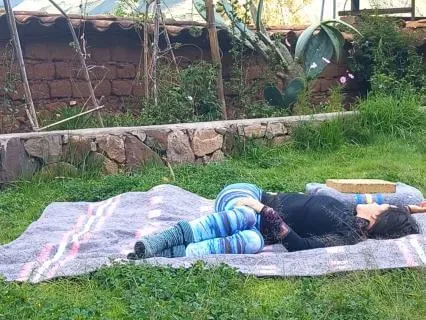
And it's time for your relaxation.
So make sure that you're going to be warm enough.
And bring yourself into a comfortable position to rest.
You can come into Shavasana with your legs a little wider than hip distance apart.
And your arms a little away from your body with the palms of the hands facing upwards.
Or if it feels better for your back,
Bring your feet to the mat at hip distance apart.
And drop the knees in together.
Take any support that you need for your comfort.
Perhaps a block or a cushion under your head.
Or a rolled up blanket under your knees or feet.
And feel your body completely letting go.
As you begin to relax.
Notice how every exhalation guides your body more deeply into relaxation.
With every exhalation,
Any remaining tension releases from the muscles.
With every exhalation,
You become more relaxed.
More at peace.
These next few minutes are yours.
To do nothing but be here.
And enjoy the effects of your practice.
You Very slowly begin to reawaken your body.
Start to make some small movements with the fingers and the toes.
With the wrists and the ankles.
And take your arms up over your head for a long stretch down the side.
Ben Johnny.
Bring the knees into the chest and hug the knees.
Rock from side to side here.
To ease out any remaining tension from the lower back.
And when you feel ready,
Keeping your eyes closed.
Roll over onto one side.
And make your way back up to sitting.
Come to sitting with the eyes closed.
And just take a moment here to feel back into your body.
To notice any effects from your practice.
To notice how your body is feeling.
And to notice how you are feeling.
And when you're ready,
Slowly open your eyes.
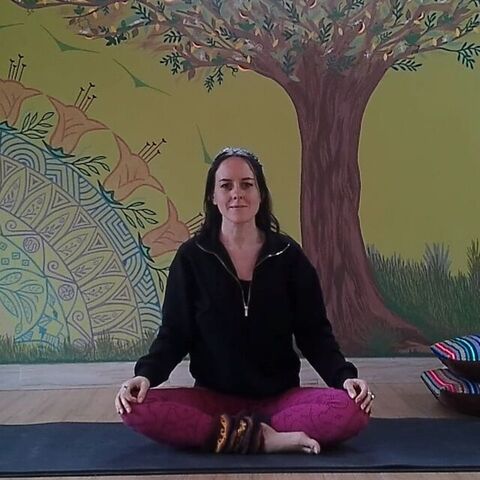
This brings us to the end of the practice.
Thank you for joining me today.