Welcome to this guided meditation for listening to your chronic pain.
Please be aware that this is a meditation that requires that you focus in on your pain.
We'll do this very gently and in a way that may help calm the pain.
But if what you need right now is distraction,
That's completely okay,
But this will not be the meditation for you today.
With that in mind,
You may like to begin with a little escape route before we start.
If it begins to feel too intense to focus on your pain,
And you begin to feel not only uncomfortable but unsafe,
And need to move out of this meditation,
What can you do to bring yourself back to safety?
You may already have several strategies to take care of yourself in this moment,
Especially if you've been living with chronic pain for a while.
You may also like to do something to break your focus.
I'd like to start our meditation today with a little clearing breath,
And you could use this as your escape route if you need to shift your attention and move out of this meditation at any time.
First,
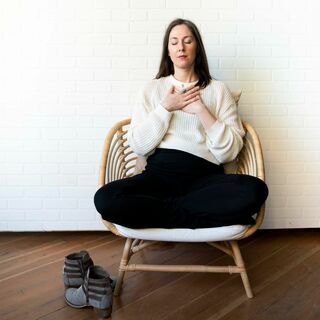
Please come to a comfortable position for your meditation.
Seated is fine,
Or lying down if that works better for you.
Especially with chronic pain,
Make sure that you're as comfortable as is reasonable.
Then,
As you inhale,
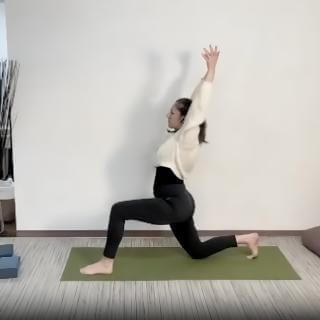
Reach your arms up over your head to any degree.
Exhale out your mouth as you bring your hands together in front of your heart.
Do that twice more,
Inhaling fully,
And then clearing out of your mouth whatever may be on your mind,
Allowing yourself to become present.
This simple movement with breath tends to be calming for the nervous system,
And it helps us to get out of our head,
Whatever may be going on in that moment,
So feel free to come back to this anytime you need it.
When you're ready,
Settle into your meditative shape.
Allow your body to become heavy and soft.
Notice if there is any tension in your body that you could let go of.
With an exhale,
Perhaps,
Gently release whatever tension you can,
And feel free to do that a few times.
Now we will locate the area of your chronic pain.
It may just be in one place,
Or it might be kind of all over.
So if you can,
Just pick one spot in your body.
It doesn't have to be that specific,
Just one area where the chronic pain tends to be most present,
Or is most present just right now.
You may be feeling that pain right now,
Or it may be kind of quiet here.
Perhaps it's a bit of an echo of the last time you felt the pain really strongly,
Tender,
But not flaring.
Perhaps it feels like it's on fire.
All of these sensations are okay.
We tend to associate pain with the idea that something is wrong in the body.
With chronic pain,
That's not necessarily the case.
You're not in danger right now.
The body is not injured right now.
But there is a pain signal,
And pain is often telling us to pay attention.
Again,
Not necessarily because something is wrong,
But because the body is trying to communicate something.
Whatever the sensations are that you're feeling,
They are exactly that,
Sensations.
They may be intense,
Gentle,
Throbbing,
Even itchy.
Simply let them be what they are.
It's totally okay to move and shift your body if you need to,
But try to stay with the sensations that you feel.
See if you can breathe directly into this part of your body.
Allow yourself to feel these sensations.
Use language in your mind to describe the sensations if you can.
Is it hot,
Cold,
Thick,
Pulsing?
Does it feel like a fire,
A shard of ice,
Like a black block with no movement or light?
There is no right or wrong here.
Take a little time to get curious about what exactly this sensation feels like to you.
Imagine it almost like an item or even a character.
An angry little man with a bone to pick.
A soft,
Sad animal curled up in a ball trying to hide.
What does this sensation look and feel like to you?
Once you have an image in your mind,
We can begin to talk with the pain.
Silently or out loud,
I invite you to ask this character or this item in your body the following question.
What do you do for me?
Notice if you get an answer.
It might be in words or it might be an image or a change in the sensation.
It might be nothing.
Really notice,
Again there is no right or wrong.
What do you do for me?
Let's ask another question.
What do you need from me?
Notice what happens when you ask this question.
Stay with it.
Keep breathing.
What do you need from me?
At any point in this exercise you may notice emotions arising.
Sadness,
Fear,
Frustration,
Anger,
Even joy or gratitude.
Welcome those emotions.
Keep breathing with them just like you're breathing with the pain.
Chronic pain often does have an emotional element and that's totally welcome here.
Now,
Imagine yourself as your kindest,
Most compassionate,
Most aware version of yourself.
Imagine yourself as the caretaker of this painful part of you.
From this perspective,
What would you like to say to your pain?
Is there anything you'd like to offer or promise,
Especially if there is something the pain asked you for?
What would you like to say to this item or this character of your pain?
When you're ready,
If it's accessible and appropriate,
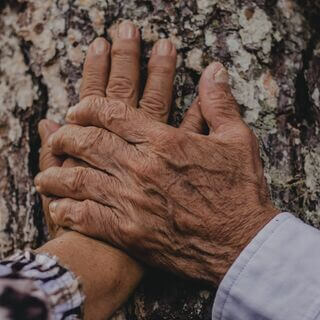
Place your hands on the part of your body where you feel your pain.
Take another deep breath and simply hold this tender part of you with kindness and gentleness.
Let it know that you are here and right now you are listening.
Perhaps you cannot listen all the time,
But you're carving out some space right now to pay attention to your body,
To listen to your pain.
Thank your pain for being with you in these precious moments.
Thank yourself for your bravery in choosing to sit with your pain and listen to what it may need.
When you're ready,
We can gently arouse ourselves from this meditation.
It might feel nice to take three more breaths,
Reaching your arms up over your head on the inhale and exhaling your hands together at your heart.
Cleansing this experience,
Gently letting go of this work and returning to your day.
You may also like to take a few minutes to journal about this experience and especially to write down any answers you may have gotten from your pain.
Thank you for listening and your willingness to explore the wisdom of your body and the wisdom of your pain.