The first one we're going to do is a downward dog.
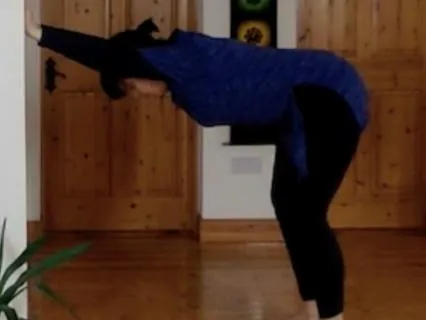
So in our downward dog we come to the wall and we're going to place our hands just where our shoulders are.
And then begin to walk out.
And as you walk out,
Bring a little bend in the knees and come to bring the head in between the arms.
So you might feel you want to walk out a little bit more,
Keep the legs hip distance,
Maybe depending as well on how your blood pressure is.
Remember,
Never let the head come lower than the heart,
But maybe bringing the arms down then again so that they come in that same angle or in that same scope as wrists,
Elbows and shoulders.
In line with each other and then you come to your downward dog.
Over time,
Maybe the legs begin to straighten a little.
But I always like to keep a little bend in my knees.
To protect my back,
Let the legs do a little bit of work.
So this is my downward dog.
Drawing the belly button back,
Maybe about 10,
20%.
Staying here for a few breaths.
And then from here coming again.
Towards the wall and you can see how far my hands have moved they've come from.
Here,
Then to here.
The next one we're going to do.
Is from the wall,
Bringing one foot behind.
Let the front knee bend.
So now we find ourselves in what would be a warrior one variation.
And here.
Sometimes I like to play with bringing the hands.
So I make those little cupcake hands,
Bringing the hands up the wall.
This can be quite good if you're playing around with balance as well.
Or maybe let the hands come out.
I'm going to let mine creep around the wall.
Or come out to something like that.
So again,
You're working a little bit with balance,
Maybe one hand,
One arm comes up.
So you can play around with that.
And all the foil.
Just making sure that the knee doesn't go too far forward.
Keep it stacked if you can.
Over that ankle joint.
If you have a little bit more space,
You can always bring the front foot.
Ahead if you feel you want to make your stance a little bit.
Wider as well.
And then coming out from this.
Maybe come up onto the ball of the back foot.
And press and come forward.
Then we could do the other side,
Bring the leg behind.
Bring a bend into that front knee.
Again,
Play around a little bit with us.
And there's a nice little action where,
You know,
Elbow soft that you can maybe press a tiny bit into the wall.
And maybe by pressing into the wall,
This is going to allow you to move the torso.
Back a little at the same time.
Keep a bend into that front knee.
Three to five breaths.
Coming out of this then again,
If you want to come up on the ball of the foot of the back leg.
And come forward.
So the next one we're going to do is.
.
.
Variation of cobra.
Cobra,
We tend to do it on the ground.
Lying on our front so in this cobra coming close to the wall.
Hands again.
Just in line with the shoulders.
And rather than pressing the hips,
Engage the thigh muscles.
So almost as if you wanted to press the thighs forward,
The glute muscles or the bum muscles might engage.
And we're lifting the chest up.
I have the advantage of my tummy pressing or like I can feel my tummy against the wall.
I would say if neck is OK and you're all right to maybe look up a little bit to the wall,
You may choose to do that or look straight ahead at the wall,
Release the shoulders and maybe a little press.
Just to know,
Just to remind you that the wall is there.
So here we have a variation of our cobra.
And you can always work in and out of that.
So as you breathe in,
Lift up into your Cobra.
As you breathe out,
Coming back down,
As we would normally do.
If we were doing it on the ground.
Inhale and lift.
And then exhale,
Come back.
Remembering to stay within your comfort zone at all times.
And then finally,
We're going to come to one for a little bit of strength.
This is going to be our plank at the wall.
So we begin to walk back as we would with.
Our downward dog,
But we're not going to bring a bend into the hips.
So coming back a little bit.
From the wall,
You can see the amount of space that I have there,
My hands.
And my wrists again in line with the shoulders.
And I'm going to gently press in towards the wall.
So I have a little bit of my weight in towards the wall.
Make sure that your shoulder blades I sometimes like to use the cue that your shoulder blades are glued into your back or maybe coming down your back.
We don't tend to give the instructions,
Squeeze the shoulder blades together,
Because that causes a little bit of instability around the arms and the shoulders.
Kind of drawing the shoulder blades.
Down.
And maybe imagining that you have some sort of sticky glue on the inside.
So they stick against your rib cage.
So this is one of the variations of plank.
You can always come back a little bit more.
My arms tend to straighten out a little.
And again,
The action isn't pressing the hips forward.
You can see a difference there.
The action comes from the thighs.
So the thighs are strong.
If you want,
You either can lift the kneecaps or squeeze the thigh muscles.
In towards the bones.
We're getting those to keep.
And strong and steady.
So this for me,
I'm happy enough with this as my plank.
I can feel it into my legs.
I can feel it maybe towards those back muscles and into my arms.
And hands as well.
If you want to take a little bit out of it,
You just walk forward.
If you find the bend in the elbows happens,
Just keep the elbows close in as opposed to you're not doing a press up.
So they're not.
They're not sticking out.
There's a little bit of a softness in them And then keep on.
The shoulder blades again.
So it could be that variation as well.
When you've done all of that,
If you want,
Last time,
Come into your downward dog.
Take a breath or two there.
When you're ready,
Slowly walk towards the wall.
And that's four poses against the wall.
No mat involved,
No chair involved,
And a little bit of stretching,
Alignment,
And body strength as well.