This practice is inspired by Buddha's teachings in the Satipatthana Sutta,
His guidance on establishing mindfulness.
In this practice we're exploring the fourth foundation of mindfulness,
Mindfulness of dharmas or mind objects.
The mind objects for this practice are a particular group of mental states that Buddha called the hindrances.
These are patterns of mind that can obscure clarity and make it difficult to see experience as it really is.
And these five hindrances are sensual desire,
Ill will,
Sloth and torpor,
Restlessness and worry,
And doubt.
The Buddha compared these hindrances to disturbances in a bowl of water.
When the water is colored,
Boiling,
Covered with algae,
Stirred by the wind,
Or muddied,
It becomes difficult to see our reflection clearly.
In the same way these hindrances can colour our perception of ourselves,
Others and the world around us.
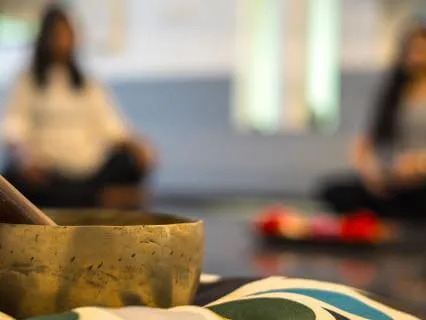
So we start by taking our seat.
Which can be any posture where we can be present,
Alert and focused with a sense of ease in the body.
We allow the eyes to rest,
Either closing or lowering the gaze.
And we establish mindfulness in front of ourselves,
So setting an intention,
Remembering what brought us to this practice today.
And then placing the awareness somewhere in the front of the body,
On the breath.
Could be the nostrils,
The chest,
The belly,
Whatever works best for you.
And then simply noticing that we're breathing in.
Noticing that we're breathing out.
Doesn't matter if the breath is long or short.
We're not trying to change it or perfect it.
Simply noticing the breath,
However it is,
Coming and going.
If the mind wanders,
Just noticing that it's wandered.
It's not a problem.
It's just part of the practice.
And then gently bringing the awareness back to the breath.
And starting again,
Watching it coming and going.
Simply knowing if you're breathing in.
Or breathing out.
And bringing attention to the body of the breath.
So you might do this by noticing the full duration of each breath,
Its body.
From the moment it arises.
And noticing the breath all the way through to the end of each breath,
Doing this for the inhalation and the exhalation.
You may be simply feeling the whole of the breath as it moves through your body.
Breathing in,
Breathing out.
Maybe as you're doing this noticing how the breath is calming the body Or if there's not that sense of calm,
If there's still quite a bit of tightness and tension in the body,
Then maybe actively using the breath just to soften and let go of those places where you're holding a little.
Whatever your posture is,
Whether you're seated or lying down,
Just being aware of that very gently,
Very softly too.
And then we start to move our awareness to the hindrances.
So with kindness and curiosity we begin to observe the state of the mind.
We're not trying to judge or get rid of anything.
The practice here is simply to know what is present and what is not.
Simply knowing if sensual desire is present or if sensual desire is not present.
Buddha likened this to adding a dye to the bowl of water.
So when it's present it makes things appear quite different to how they are.
So gently noticing,
Is there any sense of wanting present right now?
Any leaning towards something pleasant?
Wanting more comfort,
More ease,
More certainty.
Perhaps anticipating something.
If so,
Noting gently,
There's desire in me.
Not judging,
Not identifying.
Just knowing.
Even if you notice desire is present,
Perhaps being curious how it feels in the body.
Maybe there's a little pull,
A leaning forward,
A tightening.
Maybe some excitement or another quality.
Just being curious.
And maybe noticing also,
Maybe in another moment,
There is no desire present.
If this is the case,
Noticing how that feels.
Maybe there's a sense of ease or comfort.
Feeling of being settled.
So there's no judgment,
Just noticing,
Exploring,
Knowing the difference.
And Buddha also asks us to notice how each hindrance arises,
How it can be prevented,
How it can be removed.
So if desire is present,
Maybe being curious.
Without analysing or going into stories.
Just wondering what conditions might have contributed to this sense of wanting?
Maybe there was a pleasant feeling,
A memory,
An image,
An expectation.
And noticing too what happens when desire is simply known.
Without feeding it or following it How is it when we bring mindfulness to it?
Does it remain the same?
Does it shift?
Does it fade away?
Just being curious what happens.
And now we turn towards ill will Buddha taught,
If ill will is present,
You should know.
If it's absent,
We should know.
We should notice this,
The presence or the absence of this ill will.
And Buddha likened ill will to the boiling water in the bowl,
Which burns us and others.
So noticing is there any sense of irritation,
Resistance,
Judgment,
Frustration?
Maybe there's something directed towards another person.
Towards a situation.
Or maybe something directed towards yourself.
If ill will is present,
Simply knowing there is ill will.
Maybe being curious how it shows up in the body.
Maybe there's a sense of heat or tightness,
Contraction or pressure.
And if ill will is absent,
Noticing this too.
Being curious what it's like when the mind is not resisting experience.
Maybe it feels a little softer,
A little more spacious.
And again asking with curiosity.
What conditions might have contributed to this ill will?
Maybe an unpleasant feeling,
A memory.
An image.
Conversation.
And again being curious what happens when it's allowed to be known.
Without being acted upon.
Now we turn our attention towards sloth and torpor.
Buddha described this as water overgrown with algae,
Which results in stagnation.
These are the qualities of dullness,
Heaviness,
Sleepiness.
Perhaps the mind feels foggy.
Lacking energy,
Uninterested or heavy.
So maybe noticing that sloth and torpor present in me.
If so,
Noticing how it feels in the body.
Maybe a sense of drowsiness,
A loss of vitality.
A heaviness,
Sense of collapse.
Or maybe the mind is bright and alert right now,
And if so,
Knowing there is no sloth and torpor present.
And again,
Whatever you find,
Just recognizing without judgment.
Again being curious what conditions might have contributed to this sloth or torpor,
This lack of sloth or torpor.
Maybe the heat.
Lack of interest,
Maybe fatigue or sense of discouragement.
So simply noticing.
Being curious.
And noticing also what happens when we bring this mindful awareness to the sloth and torpor.
And then next we move to restlessness and worry.
This is where the mind is moving ahead,
Planning,
Remembering,
Feeling of being a little bit unsettled as we try and fix things that have happened or control outcomes so they go our way.
Buddha described this as water that's stirred by the wind,
Resulting in a great deal of movement that doesn't lead anywhere.
So maybe recognizing there is restlessness and worry in me.
And if so,
Noticing how it appears in the body.
Maybe there's a sense of movement,
Tension,
Agitation,
Pressure.
What unease.
Or perhaps the mind is relatively calm quite now,
And if so noticing there is no restlessness and worry in this moment.
And if so,
Noticing the difference,
What does a settled mind feel like?
If there's restlessness and worry,
Being curious what conditions might have fed this.
What's the mind trying to accomplish?
What's it trying to fix?
Why?
And noticing what happens when we stop feeding the movement for a few moments,
When we're simply mindful of any agitation.
And finally we turn towards doubt,
Towards uncertainty,
Hesitation,
Second-guessing.
It's questions such as,
Am I doing this practice correctly?
Is it working?
Can I really do this?
Buddha described this as mudded water,
Which prevents us from seeing reality as it is.
So again we check,
Is doubt present?
And if so,
Just recognizing yes,
There is doubt in me in this moment.
And if so,
Noticing how it feels in the body.
Maybe there's some texture of the breath,
The contraction,
Feeling of instability.
Or a feeling of being pulled in many different directions.
Or maybe there's confidence for this moment,
A willingness to simply continue.
And if so,
Recognizing there's no doubt and noticing how that feels.
What we're doing again is just knowing,
Just recognizing.
Nothing to push away,
Nothing to change.
And being curious also how the doubt arose if it's there.
And curious what happens when we put our mindfulness to observe the doubt.
And as we come to the end of the practice,
Taking a moment to reflect on what we've been exploring.
Maybe there's a little more understanding into the hindrances,
How they feel for you,
How they arise.
Maybe noticing what happens when we sit with them rather than reacting.
Maybe we saw that when we recognize a hindrance,
There's already a little more space,
A little less identification.
Might have noticed them changing,
Fading,
Passing away.
Maybe there were even moments when the mind was free from any hindrances.
Sense of clarity,
Balance,
Ease,
Like still water in the bowl.
We may simply notice the hindrances arising and passing away,
Seeing that none of them are permanent,
None of them define who we are.
And over time,
Through this patient observation,
We can begin to understand what strengthens these patterns.
What allows them to fade.
Not through force or suppression,
But just bringing this curious awareness to deepen our understanding.
And now gently coming back.
To the breath,
Just noticing the body breathing.
And noticing how the body is held and supported by the ground in some way in this moment,
And just letting yourself be held.
And then starting to bring a little movement back to the body,
The fingers,
The toes,
Or any other stretches that your body wants or needs in this moment.
This practice is now complete.