The world’s largest free audio library for everyday wellbeing
Somatic & Body Based
Lying Posture Awareness is a somatic practice of consciously noticing how the body is positioned and supported while lying down, attending to contact, pressure, and habitual holding against the floor (Quka et al., 2023).
Last Updated
4 Jul 2026
We are still reviewing this page. Our research team checks every technique page for accuracy and evidence quality before final release. Details may change as that review completes. The evidence badge shows our current reading of the published research.
RECOMMENDED DOSE
No direct dose-response literature exists for lying posture awareness, so this is a conservative introductory range. A short, gentle session a few times a week helps you build the habit of noticing body position without strain.
No direct dose evidence; editorial synthesis. This step up reflects a typical established body-awareness practice level and is inferred from general practice conventions rather than a measured protocol for this technique.
No direct dose evidence; editorial synthesis. A longer daily session suits experienced practitioners and is based on general body-awareness and relaxation practice conventions, not on a study reporting this dose for lying posture awareness.
Session length
Session length: 5–10 minutes
5
MIN
How long each individual practice session should last from start to finish.
Frequency
Frequency: 3–4 days
3
DAYS
The number of days per week to fit a session into your routine.
Session length
Session length: 15–20 minutes
15
MIN
How long each individual practice session should last from start to finish.
Frequency
Frequency: 5 days
5
DAYS
The number of days per week to fit a session into your routine.
Session length
Session length: 25–40 minutes
25
MIN
How long each individual practice session should last from start to finish.
Frequency
Frequency: 7 days
7
DAYS
The number of days per week to fit a session into your routine.
About this card. No direct dose-response literature exists for this technique; these recommendations are based on general practice conventions for body-awareness meditation and should be treated as starting points only. These recommendations are not a substitute for personalised guidance from a qualified practitioner.
Quick answers to what people most often ask. Each card links to the deeper section below.
evidence
Most findings come from broader posture- and body-awareness practices, not lying posture awareness itself. In chronic neck pain, gains in postural awareness predicted less pain; a mind-body program linked awareness to modestly lower pain intensity. No trial isolates this lying practice, and reliable effect sizes remain unavailable.
good for
Adults carrying everyday muscular tension, people with chronic pain who want a gentler relationship with their body, and anyone who struggles to feel grounded may benefit from lying posture awareness. It builds steadier body awareness and supports releasing tension, but is not a substitute for care when pain, trauma, or distress are severe.
Read moresafety
Most healthy adults find lying posture awareness low-risk and grounding. People with a trauma history, chronic pain with heightened pain vigilance, or anxiety that shows up as body monitoring should start with short sessions and keep attention broad, since turning inward can amplify distress. Return to sitting slowly afterward to avoid lightheadedness.
Read morehow it works
Lying with full support lets the postural muscles that hold you upright all day drop their load, so tightness in the neck, shoulders, or low back can soften. Sustained attention to contact and pressure is thought to sharpen your internal read on tension and your sense of where limbs and spine rest, though this remains inferred rather than directly measured.
Read moreA somatic practice of lying down and noticing how the body is positioned, weighted, and supported, tracking contact, pressure, and where tension is held against the floor.
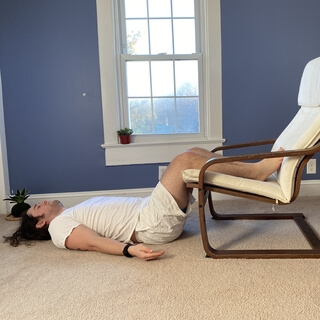
You lie supine, often in the Alexander Technique's semi-supine constructive-rest shape with knees bent and the head lightly supported, and let the floor take the body's full weight. Attention then moves slowly over points of contact, pressure distribution, and areas of habitual holding, noticing how the body organizes itself against the surface rather than scanning sensation region by region or aiming at relaxation as a goal.
Lying Posture Awareness overlaps with the opening stages of a mindfulness body scan and with yoga's Savasana, but stays distinct. It centers on postural organization and the body's relationship to gravity rather than the sequential sensation-scanning of a body scan, and it emphasizes active, curious awareness rather than the relaxation aim of Savasana. Its lineage sits most closely with the Alexander Technique's constructive rest.
Not to be confused with
Progressive Muscle Relaxation
Progressive muscle relaxation deliberately tenses and then releases muscle groups in sequence to produce relaxation. Lying posture awareness tenses nothing; it passively notices existing tension and contact with the floor without trying to manufacture release.
Yoga Nidra
Yoga Nidra is a guided lying practice aimed at deep relaxation and a sleep-like state through structured rotations of attention and imagery. Lying posture awareness stays wakeful and self-directed, focused on postural organization and gravity relationship rather than guided relaxation or reaching a near-sleep state.
Lying down to rest or nap
Lying down simply to rest or nap lets attention drift or fade toward sleep. Lying posture awareness uses the same position but keeps a light, wakeful attention on contact and holding, making it an active practice rather than passive downtime.
Lying Posture Awareness appears to work by training two kinds of body attention in a position where holding yourself up is no longer a demand. The first is interoceptive attention, the felt sense of internal signals like tension and breath. The second is proprioceptive attention, the body's own reading of where your limbs and spine rest (Weiniger & Schilaty, 2024). With the floor carrying your weight, the small asymmetries and holding patterns you brace with while upright become easier to detect, which can feel like discovering tightness you did not know you were maintaining. Building this kind of postural awareness may be one of the ways body-focused practice eases pain, though that link comes from research on upright, active exercise rather than this lying practice specifically (Romy et al., 2017).
As the floor takes your weight, it becomes easier to feel where the body is quietly holding on. That noticing draws on interoceptive awareness, your felt sense of internal signals like tension, breath movement, and pressure. As that inner sense sharpens, habitual holding becomes easier to detect and early signs of stress can register sooner, before they build (Weiniger & Schilaty, 2024).
Lying down and letting a supporting surface take your weight makes the small asymmetries and holding patterns you brace with while upright easier to notice. Sensing how your frame settles against the floor draws on postural integration, the body's knack for arranging head, spine, and limbs into balanced, efficient support, and building this kind of awareness may be one of the ways body-focused practice eases chronic pain (Weiniger & Schilaty, 2024), (Romy et al., 2017).
A clearer sense of where your body rests, its weight, its angles, and the small asymmetries where you meet the floor, is what proprioception gives you: the body's own reading of position and movement from receptors in muscles, joints, and tendons. Lying still and attending to how you contact the supporting surface appears to draw on these proprioceptive systems, sharpening that felt map of the body in space (Weiniger & Schilaty, 2024).
What happens in the body during Lying Posture Awareness has mostly been inferred from related research rather than measured directly for this specific practice. Lying with full support lets the postural muscles, the ones working quietly all day to hold you upright, drop much of their load, which practitioners often feel as tight areas in the neck, shoulders, or low back softening. Sustained attention to contact and pressure is thought to sharpen interoceptive accuracy, your internal read on tension, along with your proprioceptive sense of where the body rests, though neither has been measured for this lying practice itself (Weiniger & Schilaty, 2024). From the wider literature, one caveat is worth noting: body position on its own does not clearly shift measured stress hormones once study conditions are accounted for (Kurz et al., 2025).
As this inner sense sharpens, people often notice tightness and early stress cues sooner, and the body starts to feel more clearly and steadily present. That is interoceptive accuracy, the precision with which you read internal signals like breath, muscular tension, and the pressure of your body against the floor. It hasn't been measured directly for lying posture awareness, so any change is inferred from related interoception research (Weiniger & Schilaty, 2024).
As the floor takes your weight, you may notice a clearer, more grounded sense of where your limbs and spine are resting, a sharpening of proprioceptive accuracy, your body's internal read on its own position (Weiniger & Schilaty, 2024). This particular change hasn't been measured directly for lying posture awareness, so it's expected from closely related practices rather than proven for this one.
Lying still and tracking where your body meets the floor can leave you feeling more clearly present, with movement afterward feeling more coordinated and grounded. That steadier sense reflects sensorimotor integration, the way the brain blends signals from muscles, joints, and internal sensing into one clear read of where the body is, though it hasn't been measured directly for lying practice and is best treated as plausible rather than proven (Weiniger & Schilaty, 2024).
As the floor takes your full weight, tight areas like the neck, low back, and shoulders can soften as they stop bracing against gravity. That easing reflects postural strain, the constant low-level effort your muscles make to hold you upright, dropping away, though this is inferred from related research rather than measured directly in this practice (Romy et al., 2017).

Limited–Moderate evidence to date supports Lying Posture Awareness, and most of it is drawn from broader posture- and body-awareness practices rather than this lying-down practice specifically. That work links growing postural awareness with lower pain in people with chronic pain (Cramer et al., 2018), and connects mindfulness practices that build body awareness with better sleep and less distress in young adults (Tagliabue et al., 2025). A small study also found that lying supine felt calmer than standing while participants waited to perform a stressful task (Lipnicki & Byrne, 2008). Not yet supported: any trial isolating this specific lying practice, reliable effect-size estimates, long-term follow-up, or any claim that it treats a diagnosed condition.
Most of what we know about Lying Posture Awareness comes from studies of broader posture- and body-awareness practices, not this lying-down practice on its own. In adults with chronic neck pain, gains in postural awareness predicted reductions in pain (Romy et al., 2017). In chronic-pain patients, a mind-body program raised postural awareness, and those awareness gains tracked with lower pain intensity at a modest correlation of about r = -0.35, meaning greater awareness tended to accompany less pain but explained only part of the change (Cramer et al., 2018). Mindfulness training that builds body awareness has been linked to better sleep and less distress in young adults (Tagliabue et al., 2025), and lying supine felt calmer than standing before a stressful task in a small study (Lipnicki & Byrne, 2008). Because these findings come from related practices, and some rely on statistical significance rather than full effect sizes, they cannot be credited to lying posture awareness by itself.
0
Meta-analyses
1
RCTs
0
Systematic reviews
0
Observational
9
Pilot
Studied populations
Interoceptive posture awareness and accuracy: a novel photographic strategy towards making posture actionable
2024
Finding: This perspective article maps out how tuning into your posture works in the brain: the sense of your body's internal state (centred in a region called the insula) teams up with signals about where your limbs are in space and input from the movement-coordinating cerebellum, forming a network that underpins both balance and self-awareness. The authors propose that building this inner postural awareness can gradually reshape how you hold yourself day to day toward easier, more efficient movement. This is a theoretical account rather than a test of any specific practice, and it does not study lying posture awareness on its own, so treat it as an explanation of the mechanism at play, not proof that the technique delivers a particular result.
See full citation in referencesBody Posture Awareness and Its Application in the Seated Position
2023
Finding: In a study of 286 young adults (average age around 22) at two universities in Albania, researchers compared how much people understood about good posture with how well they actually put that knowledge into practice, and found that knowing the principles did not reliably translate into holding better postures day to day. For someone exploring lying posture awareness, the takeaway is that simply learning about body position is not the same as noticing and adjusting it in the moment, which is exactly the attention this kind of practice trains. Keep in mind this research looked at general postural awareness in a specific group of young students rather than the lying practice itself, so it speaks to the broader skill of body awareness rather than to any particular technique.
See full citation in referencesLying Posture Awareness draws its form from the Alexander Technique's semi-supine constructive-rest position and from the opening stages of the body scan used in mindfulness-based stress reduction. These roots help explain the practice's shape, lying down, letting the floor take the body's weight, and attending to postural organization, rather than proving any clinical effect. Its distinguishing emphasis, sensing the body's relationship to gravity instead of scanning sensation region by region or aiming purely at relaxation, comes directly from that Alexander lineage.
For most healthy adults, lying posture awareness is a low-risk practice, and many people find it grounding. The one caution worth naming is practice-informed rather than a documented harm from this specific technique: turning steady attention toward internal body sensations settles most people, but for some it can make discomfort or unease feel louder instead of calmer (Mehling et al., 2009). Keep the focus light, and give yourself full permission to soften your attention, shift position, or stop at any point. One further, milder point: return to sitting and standing slowly after lying still, so you do not feel lightheaded as you get up.
A slower, gentler approach suits people with a history of trauma, chronic pain that comes with heightened pain vigilance, or anxiety that shows up as close monitoring of body sensations, because turning attention inward can amplify distress rather than ease it for these groups. This is a practice-informed caution drawn from broader body-awareness research, not harm measured in lying posture awareness itself (Mehling et al., 2009). None of these situations rules the practice out, but each is a reason to start with short sessions, keep attention broad, and consider practising alongside a suitable health professional.
Turning steady attention toward internal body sensations settles most people, but for some it can make discomfort or unease feel louder instead of calmer. Keep your focus light and broad, and give yourself full permission to soften your attention, shift position, open your eyes, or stop at any point. Easing off is a normal part of the practice, not a failure.
A slower, gentler approach suits people with a history of trauma, chronic pain that comes with heightened pain vigilance, or anxiety that shows up as close monitoring of body sensations, because turning attention inward can amplify distress rather than ease it for these groups. None of these situations rules the practice out, but each is a reason to start with short sessions, keep attention broad, and consider practising alongside a suitable health professional. It does not replace clinical care.
| Technique | Best for | Use with care | Evidence strength | Distinction |
|---|---|---|---|---|
| Body Scan (as taught in MBSR) | Cultivating broad, non-judgmental awareness of sensation across the whole body, often within a structured mindfulness course. | strong EVIDENCE | Both are lying-down attention practices, but a body scan moves sequentially through the body noticing whatever sensation arises, holding a non-judgmental, whole-body awareness. Lying posture awareness instead keeps attention on how the body organizes against the floor, pressure distribution, and habitual holding, rather than sweeping region by region toward relaxation. | |
| Constructive Rest Position (Alexander Technique) | Learners working with an Alexander teacher on postural habits and releasing habitual over-effort in everyday movement. | moderate EVIDENCE | Lying posture awareness grows directly out of this Alexander Technique shape: lying semi-supine, knees bent, head supported. The Alexander version is framed as postural re-education, actively undoing unnecessary muscular effort with directed thought. Lying posture awareness borrows the position but centers on sensing contact and the body's relationship to gravity rather than on re-education instructions. |
It is a somatic practice of lying down, letting the floor take your full weight, and gently noticing where your body makes contact, where pressure gathers, and where you are still holding on (Quka et al., 2023).
+
It is a body-awareness practice done lying down: you settle onto a supported surface, let the floor carry your weight, and turn slow attention to contact, pressure distribution, and habitual holding (Quka et al., 2023). Because gravity no longer demands that you hold yourself up, subtle tension patterns become easier to feel. It draws on the Alexander Technique's semi-supine constructive-rest position and the opening of a mindfulness body scan, but keeps its focus on how the body organizes against the floor rather than on treating any condition (Eleonora et al., 2020).
No. It uses the same lying-down position as resting or napping, but the intent differs: instead of letting attention drift toward sleep, you keep a light, wakeful focus on how your body meets the floor, where pressure gathers, and where you are still holding (Quka et al., 2023).
+
No. The posture is the same, but lying posture awareness is an active practice rather than passive downtime. Where resting or napping lets attention fade, this practice keeps a wakeful focus on how the body is positioned and supported against the floor, noticing contact, pressure distribution, and habitual holding (Quka et al., 2023). The difference is one of intent and quality of attention, not of position; it is a way of sensing the body, not a route to sleep or a treatment for any condition.
The sense of your body's internal state, the ability to notice and interpret signals such as breath movement, muscular tension, temperature, and pressure. Strengthening it tends to feel like reading your body's cues earlier and more clearly.
Interoception (visceral afferent processing) integrated largely through the insula and related sensorimotor networks.
The body's built-in sense of where your limbs and spine are and how they are moving, drawn from receptors in muscles, joints, and tendons, without needing to look.
Consciously noticing how your body is positioned and supported. Researchers measure it with questionnaires such as the Postural Awareness Scale and relate changes in it to pain, sleep, and stress.
An Alexander Technique resting shape: lying on the back with knees bent, feet flat, and the head supported, so the spine can lengthen and postural muscles can let go.
A region of the brain that gathers internal body signals into a felt sense of the body's state, and is central to interoception.
The ongoing, low-level muscular effort that holds you upright through the day. Lying with full support lets much of that effort drop away, felt as tight areas softening.
How the brain blends signals from muscles, joints, and internal sensing into one coherent sense of where the body is and how it is moving.
The reduction of skeletal muscle tension so fibres lengthen and soften, experienced as a tangible letting go and often a spreading wave of physical ease.
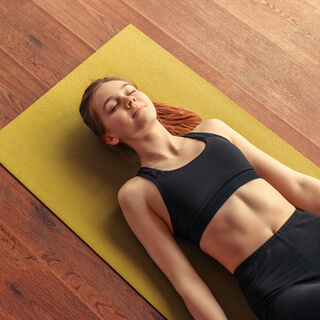
Lying flat on the back, face up, which is the position most lying posture awareness practice uses.
Steven P. Weiniger, Nathan D. Schilaty (2024). Interoceptive posture awareness and accuracy: a novel photographic strategy towards making posture actionable. https://doi.org/10.3389/fnins.2024.1359594
Cited in: How it works, Research, What happens in the body
Najada Quka, Rigerta Selenica, Marsela Shehu (2023). Body Posture Awareness and Its Application in the Seated Position. https://doi.org/10.13189/saj.2023.110620
Explore guided sessions to deepen your Lying Posture Awareness technique.
Outcomes measured
| Outcome | Effect size | 95% CI | N | Comparator | Source |
|---|---|---|---|---|---|
| neck pain intensity | reported significant; P=0.0033 | — | — | — | Romy et al., 2017 |
| postural awareness change vs pain intensity | correlation r = -0.35 | — | — | — | Cramer et al., 2018 |
| spine mobility / posture awareness | reported significant; p=0.005 (mobility); p>0.05 (awareness) | — | 15 | — | Lara et al., 2024 |
Research on this specific lying practice is limited, and most evidence comes from broader body- and posture-awareness work. Study methods and participant groups vary, and some findings rest on statistical significance rather than full effect-size estimates, so treat them as general guidance rather than a promise about any single session.
Postural awareness and its relation to pain: validation of an innovative instrument measuring awareness of body posture in patients with chronic pain
2018
Finding: This study followed 512 adults living with chronic pain through a 10-week mind-body program and found that their awareness of their own posture measurably grew over that time. Among those with spinal or shoulder pain, the people whose postural awareness rose the most also tended to report the largest drops in pain, a moderate link that suggests noticing how your body is positioned is a trainable skill that can travel alongside feeling better. Keep in mind that the practice studied here was a broad mind-body program rather than lying posture awareness on its own, so this shows the wider skill can be built and matters for symptoms, not that lying attention by itself eases pain.
correlation r = -0.35
Body Awareness: Construct and Self-Report Measures
2009
Finding: This review examined the questionnaires researchers use to measure body awareness, the felt sense of what is happening inside your body, and checked how well they actually capture that experience. It highlights that tuning into the body can cut both ways: greater awareness may help with conditions like chronic pain, disordered eating and post-traumatic stress, but it can also become unhelpful when it tips into anxious over-monitoring. For someone exploring lying posture awareness, the practical takeaway is that noticing bodily sensations is a skill worth cultivating with balance rather than intensity. Note that this is a methodological review of measurement tools, not a trial of any specific practice, so it describes how body awareness is studied rather than proving that a particular technique delivers these benefits.
See full citation in referencesDoes Postural Awareness Contribute to Exercise-Induced Improvements in Neck Pain Intensity? A Secondary Analysis of a Randomized Controlled Trial Evaluating Tai Chi and Neck Exercises.
n = 75
Finding: In this closer look at a trial of 75 adults with long-standing neck pain, people whose awareness of their own posture improved over the course of Tai Chi or neck exercises went on to have less intense pain, and this held up even after accounting for how much pain they started with and drops in anxiety. Together those factors explained about 40% of who improved, which led the researchers to suggest that learning to sense and adjust your posture may be one of the shared ways body-focused movement eases neck pain. Worth knowing: this study looked at postural awareness in general during active exercise, not at lying posture awareness on its own, so it points to a plausible mechanism rather than proof that this specific lying practice reduces pain.
reported narratively
Mind and Body: Italian Validation of the Postural Awareness Scale.
2020
Finding: This study tested a questionnaire designed to measure postural awareness, the conscious sense of how your body is positioned, in an Italian sample, and confirmed it reliably captures two distinct things: how easy and familiar noticing your posture feels, and how much active attention you need to stay aware of it. That two-part structure gives a useful way to think about lying posture awareness, which applies the same idea by directing attention to where your body meets the surface supporting it. Keep in mind this was a measurement-validation study rather than a test of whether the practice improves health or well-being, so it tells us the concept can be measured consistently, not what regular practice will do for you.
See full citation in referencesSomatic movement intervention among older adults to improve body awareness and spine mobility: A pilot study
n = 15
Finding: In a small 10-week pilot, 15 older adults (average age about 73) followed an online somatic movement program and measurably improved their spinal mobility, moving more freely through the back by the end. Notably, their scores for body and posture awareness and their confidence in balancing did not rise across the group, though people who started with the lowest awareness tended to gain the most. For someone considering this kind of gentle, attention-based movement practice, the takeaway is that a short program may help you move more easily even if it does not reliably sharpen your sense of your own posture. Keep in mind this was an early study with no comparison group and did not test lying posture awareness on its own, so the results speak to the broader family of somatic movement work rather than this specific technique.
reported significant; p=0.005 (mobility); p>0.05 (awareness)
Differential Effects of Body Posture on Biological and Psychological Responses in the Trier Social Stress Test
n = 104
Finding: In a randomised study of 104 adults, researchers compared how sitting versus standing affected the body's stress response during a demanding social-stress task. Stress hormones like cortisol looked higher when people stood, but that difference faded once the researchers accounted for the calm, non-stressful comparison condition, and how stressed people said they felt didn't differ by posture at all. The practical takeaway is honest but modest: changing your body position on its own doesn't appear to reliably move measured stress hormones or self-reported stress, so posture is best treated as one supporting part of a practice rather than a lever that lowers stress by itself. Keep in mind this looked only at sitting and standing during a short lab stress test, not at lying-down practice over time.
reported narratively
AN EFFECT OF POSTURE ON ANTICIPATORY ANXIETY
n = 20
Finding: In a small experiment with 20 healthy adults, people tackled a demanding mental arithmetic task both standing up and lying on their back, and they felt the tense build-up of anticipatory anxiety only when standing, not when lying down. That hints the lying position itself may take some of the edge off the nervous, waiting feeling before a stressful moment, though the researchers couldn't pin down why (one possibility is how lying down changes pressure signals from the body). Keep in mind this was a very small study about body position rather than any awareness practice, so treat it as an early clue rather than proof that lying down reliably lowers anxiety.
reported narratively
Effectiveness of Mindfulness-Based Intervention on Physical and Psychological Well-Being of Young Adults
n = 78
Finding: In a controlled trial with 78 young adults, an 8-session mindfulness-based stress reduction program improved sleep quality, lowered psychological distress, eased physical symptoms, and sharpened body and posture awareness compared with a group that did nothing, with several of these gains still holding three months later. Notably, the people who practised most often on their own showed the biggest improvements in posture awareness, which hints that regular self-practice is what makes the difference. Keep in mind this studied the broader mindfulness program rather than lying posture awareness on its own, so it points to what body-focused mindfulness can offer overall rather than to this one technique in isolation.
reported narratively
Return to sitting and standing slowly once you finish. Roll gently to one side and come up to sitting before you stand, giving the body a moment to reorient so you do not feel lightheaded as you get up.
Lying posture awareness is best approached lightly, in a supported position on a firm surface where your body can feel held rather than braced and you can let attention rest broadly across points of contact. Beginners are well served by short sessions with the freedom to open the eyes, shift position, or ease off at any moment, since keeping your focus soft and adjustable is what makes the practice feel grounding rather than intense.
Lie on a firm, comfortable surface and let the floor or mat take your full weight. A semi-supine shape, with knees bent, feet flat, and the head lightly supported, works well, so the postural muscles can stop working and the body feels held rather than braced.
Rather than fixing hard on one sensation, let awareness rest gently across points of contact and pressure. A soft, wide focus is less likely to amplify discomfort than an intense, narrow one.
Practise with the freedom to keep your eyes open, change position, or add support under the knees or head whenever you want. Nothing about the posture needs to be held rigidly.
If focusing inward makes tension, unease, or restlessness feel louder instead of settling, widen your attention, open your eyes, or pause. Backing off is a normal part of the practice, not a failure.
When you finish, roll gently to one side and come up to sitting before standing, giving the body a moment to adjust so you do not feel lightheaded.
If attending to body sensations consistently triggers strong distress, especially alongside a trauma history or high pain or anxiety sensitivity, work with a suitable health professional who can help you pace the practice.
This information is educational and is not medical advice. This practice is not a substitute for professional care and should not replace prescribed medication or treatment for any medical or mental-health condition. If you are managing a health condition or taking medication, talk with a qualified health professional before changing your practice. If you are in distress or crisis, seek professional support.
| Savasana (corpse pose) | Winding down and integrating after movement or yoga, when the aim is rest rather than active investigation. | EVIDENCE | Savasana and lying posture awareness use the same flat, supported supine position, but the aim differs. Savasana is a relaxation and integration pose, letting go and resting after movement or yoga. Lying posture awareness keeps an active, curious attention on how the body meets the floor and where it holds, so the goal is noticing and sensing rather than releasing into rest. |
Possibly, but the evidence is indirect. No trial has tested this specific lying practice for pain; in broader body- and posture-awareness research, greater postural awareness has tracked with lower pain (Cramer et al., 2018). Treat it as a possible support, not a proven pain treatment.
+
Possibly, but the signal is suggestive rather than confirmed. No study isolates lying posture awareness itself, so it cannot be credited with directly treating pain; the nearest evidence comes from related practices. In chronic-pain patients, gains in postural awareness, meaning a clearer conscious sense of how the body is positioned and supported, correlated modestly with less pain (Cramer et al., 2018), and in a chronic neck-pain trial, growth in postural awareness predicted reductions in pain (Romy et al., 2017). The evidence is limited-to-moderate and mostly indirect, so this is a practice that may support pain relief, not a substitute for care (Weiniger & Schilaty, 2024).

Limited and mostly indirect. No trial has tested lying posture awareness on its own, so its likely benefits are inferred from broader posture- and body-awareness research rather than established for this specific practice (Cramer et al., 2018).
+
Limited and mostly indirect. The nearest evidence comes from related practices: greater postural awareness has tracked with less pain in chronic-pain patients (Cramer et al., 2018), mindfulness that builds body awareness has been linked to better sleep and less distress in young adults (Tagliabue et al., 2025), and lying supine felt calmer than standing before a stressful task (Lipnicki & Byrne, 2008). But short somatic programs do not always raise measured body awareness (Lara et al., 2024), and because no trial isolates this lying practice, reliable effect sizes, long-term follow-up, and any diagnosed-condition treatment claim remain unconfirmed (Weiniger & Schilaty, 2024).
Because the floor carries your weight, the postural muscles that quietly hold you upright can drop much of their load. With that effort no longer needed, the habitual holding you would otherwise miss becomes easier to notice through internal body-sensing (Weiniger & Schilaty, 2024).
+
Lying down removes the demand to stay upright, so the postural muscles release much of their ongoing effort and their subtle tension patterns are no longer masked by the work of standing. In that gravity-supported position, sustained interoceptive attention, your felt read on internal signals like tension and breath, works together with proprioception, the sense that tells you where your limbs and spine are resting, to pick up holding you did not know you were maintaining (Weiniger & Schilaty, 2024). This explanation is drawn from broader body-awareness research rather than a directly measured effect of this specific lying practice, and it is not a claim about treating pain or any diagnosed condition.
Not on its own. When study conditions are accounted for, body position alone does not clearly shift measured stress hormones like cortisol (Kurz et al., 2025). Lying down may still feel calmer than standing before a stressful task, but that is a subjective sense of ease, not a proven hormonal change (Lipnicki & Byrne, 2008).
+
Not on its own. One study comparing sitting and standing during a stress test found that body position by itself did not clearly change biological stress markers such as cortisol once the experimental conditions were accounted for (Kurz et al., 2025). A separate small study did find that lying supine felt subjectively calmer than standing while people waited to perform a stressful task, but that was self-reported anxiety rather than a measured drop in stress hormones (Lipnicki & Byrne, 2008). So lying posture awareness may support a felt sense of settling without being a reliable way to lower cortisol.
Use care. For most adults it is low-risk, but if you are prone to anxious body monitoring, inward focus can make unease feel louder rather than calmer. Keep attention light and broad, and give yourself permission to open your eyes, shift position, or stop at any point (Mehling et al., 2009).
+
Use care. This is a practice-informed caution rather than a documented harm from lying posture awareness itself: body-awareness research notes that close attention to internal sensations settles most people but can amplify distress for some, especially those who already monitor the body anxiously (Mehling et al., 2009). Keep your focus soft and wide, ease off or open your eyes if sensations intensify, and consider working alongside a suitable health professional if inward attention reliably distresses you. It is not a treatment for anxiety, and easing off is a normal part of the practice rather than a failure.
Use care. For most people it is low-risk, but with a trauma history a gentler, gradual approach is wise, since turning attention inward toward body sensations can amplify distress rather than ease it (Mehling et al., 2009). It is not a substitute for trauma care.
+
Use care. There is no trauma-specific safety data for lying posture awareness itself; this is a practice-informed caution drawn from broader body-awareness research, which notes that close attention to internal sensations can be destabilising for some people rather than calming (Mehling et al., 2009). A trauma history does not rule the practice out, but it is a reason to start with short sessions, keep attention light and broad rather than narrowly fixed, and give yourself full permission to open your eyes, shift position, or stop at any point. If inward focus reliably brings up strong distress, work alongside a suitable professional; this practice does not replace trauma care.
Start simply: lie on a firm, supported surface, optionally with knees bent and head supported, let the floor take your full weight, and rest a light, broad attention on where your body makes contact. Keep it easy, and if inward focus feels unsettling rather than calming, widen your gaze, open your eyes, or stop (Mehling et al., 2009).
+
Set up on a firm mat or floor and let the surface carry your weight so the postural muscles can let go; a semi-supine shape, with knees bent and the head lightly supported, works well. Keep attention soft and wide across points of contact and pressure rather than fixing hard on one spot, and give yourself permission to shift position or open your eyes at any time. For some people, close attention to body sensation can feel uncomfortable instead of settling, so ease off if that happens (Mehling et al., 2009). When you finish, roll to one side and come up to sitting before standing so you do not feel lightheaded. This is a low-risk practice for most healthy adults, not a treatment for any condition.
The difference is focus, not effectiveness. Lying posture awareness keeps attention on how your body organizes against the floor, while an MBSR body scan sweeps sequentially through the body with non-judgmental, whole-body awareness (Quka et al., 2023). No head-to-head trial compares them, so this is about aim, not proof one works better (Weiniger & Schilaty, 2024).
+
The difference is one of aim and structure. Lying posture awareness centres on the body's relationship to gravity, sensing points of contact, how weight distributes against the supporting surface, and where habitual holding persists (Quka et al., 2023). A body scan, as taught in mindfulness-based stress reduction, instead moves region by region, noticing whatever sensation arises with open, non-judgmental attention. No direct comparison trial has tested one against the other, and most evidence for either comes from broader body- and posture-awareness research rather than this specific lying practice, so the distinction is about what you attend to, not which produces better outcomes (Weiniger & Schilaty, 2024).
Cited in: Research, What it is
H. Cramer, W. Mehling, F. Saha, G. Dobos, R. Lauche (2018). Postural awareness and its relation to pain: validation of an innovative instrument measuring awareness of body posture in patients with chronic pain. https://doi.org/10.1186/s12891-018-2031-9
Cited in: Benefits, Research, What it is
Wolf Mehling, Viranjini Gopisetty, Jennifer Daubenmier, Cynthia Price, Frederick Hecht, Anita L. Stewart (2009). Body Awareness: Construct and Self-Report Measures. https://doi.org/10.1371/journal.pone.0005614
Cited in: Use with care, Who should use care
Lauche Romy, Wayne Peter M, Fehr Johannes, Stumpe Christoph, Dobos Gustav, Cramer Holger (2017). Does Postural Awareness Contribute to Exercise-Induced Improvements in Neck Pain Intensity? A Secondary Analysis of a Randomized Controlled Trial Evaluating Tai Chi and Neck Exercises.. https://doi.org/10.1097/brs.0000000000002078
Cited in: How it works, Research
Topino Eleonora, Gori Alessio, Cramer Holger, Eleonora Topino, Alessio Gori, Holger Cramer (2020). Mind and Body: Italian Validation of the Postural Awareness Scale.. https://doi.org/10.3389/fpsyg.2020.00827
Cited in: What it is
Diana K. Lara, Kate Hamel, David I. Anderson (2024). Somatic movement intervention among older adults to improve body awareness and spine mobility: A pilot study. https://doi.org/10.1016/j.jbmt.2024.12.025
Cited in: Research
Miriam Kurz, Luca Abel, Felicitas Hauck, Robert Richer, Veronika Ringgold, Lena Schindler‐Gmelch (2025). Differential Effects of Body Posture on Biological and Psychological Responses in the Trier Social Stress Test. https://doi.org/10.1097/psy.0000000000001450
Cited in: Research, What happens in the body
Darren M. Lipnicki, Don Byrne (2008). AN EFFECT OF POSTURE ON ANTICIPATORY ANXIETY. https://doi.org/10.1080/00207450701750463
Luca Tagliabue, Daniele Piscitelli, Francesco Cerroni, Giulia Purpura (2025). Effectiveness of Mindfulness-Based Intervention on Physical and Psychological Well-Being of Young Adults. https://doi.org/10.1177/10901981251361963
Editorially curated. Tracks are not themselves clinically studied; evidence on the page applies to Lying Posture Awareness as a technique.
Beginner content for Lying Posture Awareness

★ 4.8
·
Guided
·
15 min
Amy Patee
How hard is Lying Posture Awareness?
Lying Posture Awareness sits at effort 2 because it is simple and gentle, but it is still more active than doing nothing.
2
Mental Effort
2 / 4
▾Emotional Depth
1 / 4
▾Physical Intensity
1 / 4
▾Prior Knowledge
1 / 4
▾