This is a meditative pose helpful in addressing symptoms of trauma and anxiety.
It is called the psoas pose.
The psoas muscles connect the legs to the front of the spine as well as the upper torso to the pelvis.
This muscle group can be considered the flight or fight muscles.
In trauma and anxiety these muscles can become chronically strained impacting posture and causing back,
Neck,
Or shoulder pain.
The following meditative pose helps relax this muscle group and is shown to reduce stress,
Increase our ability to concentrate,
Increase several brain areas and volume size as well including the memory center,
Thinking,
And body emotion awareness center.
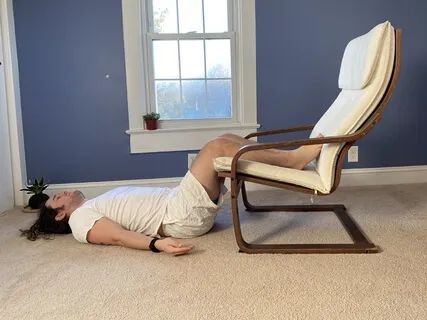
If you haven't done so already please take a look at the picture for this meditation as it shows how to do this meditative pose.
So to enter this pose find a chair or possibly a couch,
Just something that you're going to be able to elevate your feet onto.
Start by lying down on your back and placing your legs flat on the chair facing up.
Be sure that your lower back is flat against the floor and there's no arching in it.
Let your arms fall to your sides and have your palms facing up.
Next just start to feel your hips relax as your thighs start to relax back into your hip joints.
Start breathing deeply into your diaphragm.
In and out.
Continue to focus on the feeling of your thighs relaxing back into your hip joints,
Releasing the psoas muscles more and more.
Visualize how you are breathing relaxation and health into this area.
Continue to just stick with your breath for a few minutes.
Continue to visualize how you're breathing healing and relaxation into this area.
Now we're going to start to bring some movement.
You're going to slowly start pulling in one of your knees,
Doesn't matter which one,
Pick one and just slowly start to pull your knee into your chest,
Just grasping on your lower leg.
As you do this,
Keep your other leg flat on the chair.
You're going to pull it in and then once you bring it in,
You're going to release it and take it back out.
Return this leg to the chair and now do the same thing with the opposite leg.
You're going to hug that leg,
Hug that knee into your chest while you keep the other leg flat on the chair and then extend it back out.
And you're just going to continue alternating.
Keep on alternating legs.
You're going to want to breathe in as you extend the leg out and then exhale as you bring the leg in.
So as you pull your knee in,
You're going to breathe out and then as you extend the leg back out,
You're going to breathe in.
So continue this,
Continue to link up your breath with your movement.
And you're going to continue this alternating of the legs,
Hugging the knee to the chest,
Breathing out as you pull the leg in and then breathing in as you extend your leg back out and just continue to alternate.
At the end of three minutes,
You will hear the sound of the bell.
You're going to hear the sound of the bell.
One more time.