Hi,
I'm Neil Tranter and this is the relaxed breathing exercise.
In this guided audio,
We'll be exploring gentle awareness of the breath together with passive muscle relaxation.
During the exercise,
Your breathing will become softer and slow down a little.
This will help to calm your mind and your nervous system.
It will also gently improve blood flow and oxygen delivery to your body and brain.
This breathing exercise is suitable for most individuals,
But if you're pregnant or have any serious health conditions,
Then please check with your doctor before listening.
Also,
Please don't listen to this exercise while driving or operating machinery.
So when you're ready,
Coming into a comfortable upright posture.
And bringing a little bit of length into the upper body.
Having a sense of openness around your upper belly and your lower chest.
Good posture allows your main breathing muscle,
The diaphragm,
To move freely,
Which in turn slows your breathing down,
Sending signals of calm to the brain.
And then either closing your eyes or sitting with a soft,
Open gaze.
And letting your mouth close for the duration of the exercise.
Breathing softly and gently through your nose.
There's no need to take any big deep breaths during this breathing exercise.
And with your mouth closed,
Bringing a gentle smile to your face.
Smiling is another subtle way to send signals of safety and calm from your body to the brain and nervous system.
And then when you're ready,
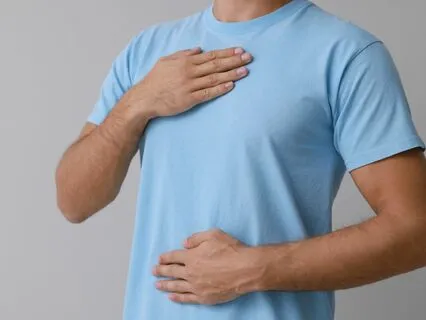
Bringing the palms of your hands to rest on your body.
One hand on your upper belly,
Just below the bottom of the rib cage.
And your other hand resting on your upper chest.
And then just letting your shoulders relax and soften down.
And then slowly we begin to tune in to the feel of your body breathing.
Feeling the movements and sensations of the breath in your body.
We're not trying to change the breath in any way,
Just allowing the body to breathe naturally.
It does this all the time when you're not paying attention.
And perhaps noticing whether there's more movement underneath the upper hand or the lower hand.
And then beginning to bring more awareness to what you feel under your lower hand.
Feeling your breathing here,
Down in the region of the upper belly and the diaphragm.
Allowing your belly to be soft and relaxed.
Getting a gentle sense of inflation and expansion as the body breathes in.
And a sense of deflation on the out-breath.
Letting your breathing be soft,
Relaxed and quiet.
And then if it feels okay to do so,
Just letting your hands rest down on your lap.
And feeling how your breathing feels from the inside.
Tuning in to the feel of the breath within your body.
Feeling the breath around the upper belly and also around the sides of the lower ribs.
Again we're not trying to push or pull the breath or change it.
Just feeling the subtle movements of the breath without needing to do anything else.
And then let's bring in some muscle relaxation.
So we begin by inviting the muscles around the mouth and the jaw to begin to soften and relax.
Checking that the mouth is still closed.
And just allowing the whole of the lower face to begin to soften and relax.
And the muscles down the sides of the neck are slowly beginning to soften and lengthen.
The whole of the neck beginning to open up,
To let go and relax.
And the tops of the shoulders are beginning to drop down away from the ears.
The shoulders are beginning to soften and relax.
And all the muscles in the chest and the ribcage are beginning to soften,
To open up.
The whole of the chest is beginning to soften and relax.
And the arms are relaxing,
Becoming heavier.
And the hands of the fingers are relaxing and letting go.
The belly is beginning to relax,
Becoming soft and round.
The whole of the abdomen is opening up,
Letting go.
The belly beginning to soften and relax.
And the pelvis starting to soften down and melt down into the chair.
And the buttocks and the pelvic floor beginning to release and relax.
So the whole of the pelvis is beginning to soften and relax.
The whole of the upper body slowly beginning to unwind.
The muscles gradually releasing and letting go.
The whole of the upper body is beginning to relax.
And as the body begins to relax,
So too does the breath.
The breath becomes more subtle,
A little softer,
Slower,
Quieter.
And perhaps now bringing your awareness back to the breath.
Turning your attention to the subtle sensations of breathing in the region of the upper belly and the diaphragm.
Feeling the slow rhythmic sensations of inflation on the in-breath and deflation on the out-breath.
Allowing the body to breathe all by itself.
Letting the breath be soft,
Quiet and relaxed.
Perhaps even noticing how the breath expands in all directions.
As the body breathes in,
You might notice the lower ribs gently expanding out to the sides.
And gently moving back inwards on the out-breath.
And on each out-breath just allowing your whole body to relax.
With each out-breath a sense of letting go.
Perhaps noticing any positive feedback from the mind and the body.
You might notice a sense of calm,
Feelings of warmth in the body or maybe more saliva in the mouth.
Perhaps your mind even feels a little bit clearer.
And any one of these signs tells you that your nervous system is feeling calmer.
And now letting go of your breath,
Coming back to the feel of your whole body sitting here.
And we'll begin to transition out of the exercise.
So if your eyes have been closed,
Just gently blinking the eyes open.
Perhaps slowly having a look around the room.
Reconnecting with your surroundings.
Having a bit of a stretch,
Just loosening up in the upper body.
And I'd just like to thank you for going through this exercise with me today.
If you found it helpful,
Then perhaps coming back for another listen in the future.
But for now,
Thank you once again for listening and I wish you all the best.
Thank you.