Welcome to Nourishing Inner Wisdom with Zen Story.
From a Zen perspective,
Wisdom is not something you learn or accumulate.
It is the clear seeing that is already your nature.
The Knowing that exists beneath the thought.
Beneath worry.
Beneath the endless commentary of the mind.
The stories that we will be journeying through together are all traditional tales from the Zen tradition.
Each one pointing to this wisdom.
That is part of each and every one of us,
Part of our design.
Part of our human nature.
At the end of each story I will prompt a suggestion for you to consider or a question to contemplate.
So And you can be with this or simply allow the mind to rest in the minute between each tail.
But first,
Let's begin with the breath.
And as you inhale now,
Imagine drawing in a quiet light.
Draw this in from the center of your chest.
And as you exhale,
Imagine this light spreading and warming you from the inside out.
And as you breathe in again to the center of your chest.
You now allow relaxation.
To flow through you as you exhale.
It's your breath.
Simply find comfortable rhythm now.
As we move to the first story of the old woman and the tea stall.
This is a traditional Zen tale from Japan.
In the town of Hara.
Along the great road that travelers took.
Between Kyoto and Iru.
It was a small tea stall.
It was run by an old woman,
Weathered by years of sun and wind.
Her hands rough from wick.
The back bent.
She was not a nun.
She had no teacher,
No lineage,
No title.
She simply poured tea for travelers.
And sweep the dust from her threshold.
But this old woman carried a gift.
She had studied Zen with the great master Hakuin.
And in the quiet of her daily work.
Boiling water,
Arranging cups,
Greeting strangers.
She had come to learn something.
And Hakuin had noticed this.
And it is because of her depth of wisdom that he sent many of his struggling monks to this old tea stall lady.
One by one the monks would travel to Hara.
That would enter her stall and bow.
She would look at them with sharp eyes and ask,
Studying Zen?
Yes,
They would reply.
Come in here,
She would say.
And they would retreat behind a folding screen.
As soon as they were behind it,
She would confront the monk with a Zen question.
Perhaps a koan,
Or a demand for the truth.
The moment the monk hesitated,
The moment He turned over possible answers.
She would drive him out with a pair of iron fire tongs.
Even long-time students of the Master were subjected to this treatment,
And few passed it.
Most were sent stumbling back out onto the road,
Their robes singed,
Their pride wounded.
Their clever answers revealed as the empty things they were.
As we know,
The old woman did not have a temple.
She did not wear a robe.
She had no disciples,
No fame.
But she had what the monks were still seeking.
The ability to see clearly.
To cut through the noise of the thinking mind.
To recognize the truth.
Before it became dressed in words.
One day a monk came who did not hesitate.
He stood before the old woman.
And when she demanded the truth.
He gave it.
But he didn't give it in words.
But rather in the way he stood.
The way he breathes.
Where he looked at her without flinching.
The old woman smiled.
And let him pass.
The story tells us that inner wisdom is not the property of the educated.
Titled or they're ordained.
It belongs to us all.
The old woman's fire tongues were not cruel.
They were a mirror.
They showed the monks where they were still grasping or calculating.
And it encouraged them to stop trying to know.
And you sense into the quiet wisdom that lives within you.
And you feel it in your bones.
In your prayer.
This is a wisdom and awareness.
It simply needs noticing.
So as you rest here now for the next minute.
Gently sense into this awareness and this wisdom that is yours.
Slowly moving your attention to your whole body.
And let's also move to our second story,
The White Rabbit.
Two monks,
Dongshan and Sengmi.
We're walking together on a pilgrimage.
They were both sincere seekers dedicated to the path and having years of practice.
On this particular day of travel which was a warm one.
They were both rather quiet.
Along their passage.
Out of the bushes,
A white rabbit darted across their path.
It was swift and beautiful,
Its fur bright against the green of the field.
Its movement elegant and sure.
In an instant.
It was gone.
Seeing me,
Watching it disappear,
Said,
Hmm,
How swift.
Gongshan asked him,
How so?
To which Xingmi replied,
Just like a commoner becoming a High Minister.
Function found.
How can such a venerable person as you speak like that?
" he asked.
Seeing me was surprised,
And he asked his friend what he meant.
Rongshan explained.
After generations of nobility.
There is a temporary falling into poverty.
The two masters looked at each other.
And in that moment,
Her lifetime of practice was revealed in a single exchange.
About a rabbit.
Seeing me saw the rabbit's swiftness as a commoner achieving sudden elevation.
A person of no status,
Through great effort and exertion,
Rising to become a minister.
The Path of Cultivation.
Of striving.
And with it perhaps the belief that wisdom must be earned,
Nobility achieved.
Zhang Shen saw something different.
The rabbit's nobility was not acquired.
It was inherent.
Like the nobility of a prince who had fallen into poverty.
Forgotten his birthright,
And yet it is still carried in his blood.
In this instance,
The rabbit was not becoming something.
It was simply being.
What it always was.
From this story we are reminded that the wisdom you seek is not something you need to attain.
Simply something that is with you.
You are not a commoner trying to become a minister.
You are the child of a noble house.
Maybe you are unaware of the treasure sewn into the lining of your coat.
Or maybe not.
Are ever.
The practice is not to earn the treasure.
Practice is to realize the treasure.
The story can be deeply encouraging in that you do not have to become wise.
Just like we do not have to achieve peace or earn grace.
These are all part of our nature.
Sometimes we simply forget them.
Forgetting can be part of the journey.
The rabbit forgot it is noble.
And then it runs,
And its nobility is revealed in its running.
Can you relax into what you already are?
Let's do that together for the next minute.
Our third story is a beloved Zen tale entitled Nangako polishes a tile.
And Goku was a great master.
One day he found his student,
Mazu,
Sitting in meditation.
Perfectly still,
His face set with determination.
Mazu had been sitting for a long time.
He was trying with all of his might to become enlightened.
Mangaku did not interrupt him.
He simply picked up a piece of broken tile from the ground.
And began to rub it against a stone.
And forth.
Bye.
The sound was steady and deliberate.
Mazu tried to ignore it.
But the sound was persistent.
He finally opened his eyes and said,
Master.
What are you doing?
Nangako did not stop rubbing.
He answered.
I am polishing this tile.
To make a mirror.
Mazu was confused.
But a tile is not a mirror.
Doesn't matter how much you polish it,
Master.
Attire will never become a mirror.
Now,
Nangako stopped.
He looked at Mazu with his steady eyes and said,
If a tile cannot become a mirror,
Then how can sitting Become Enlightenment.
Mazu had been sitting for years.
Trying to become something.
He had been polishing the tile of his practice.
Hoping to turn it into the mirror of enlightenment.
But enlightenment was not something to become.
It was something to recognize.
Ngaku continued.
If you want to learn the Zen,
Know that Zen is not in sitting,
Nor in lying down.
If you want to become enlightened by sitting.
No,
Enlightenment has no fixed form.
If you are attached to the form of sitting.
You can never attain enlightenment.
The very effort of Mazu's attention had become the obstacle.
He was not a tile trying to become a mirror.
You already was the mirror.
He had simply been covering it with the dust of his own effort.
And so from that day on,
Mazu sat without trying to become anything.
He sat because sitting was what he did.
And it was in that type of sitting,
Without grasping or striving,
That he became one of the greatest masters.
The Zen tradition has ever known.
The story has such a beautiful teaching for anyone who lies awake at night,
Trying to make themselves go to sleep.
And you will know that the effort to sleep is part of the thing that keeps you awake.
Striving to become peaceful is the thing that can keep you raceless.
So as you are here now,
Let go of any polishing you're doing.
Let go of the trying.
And simply raise.
Knowing that sleep will come or not.
Either way,
You will still be racing.
So as you rest here now,
Ask of yourself,
What tile am I polishing?
That is already a mirror.
As you breathe quietly in and out.
Continue to be in a restful state.
As we move into story number four,
The Monk and the Bamboo Whistle.
There was once a monk who was known throughout the monastery in China for his great learning.
He had memorized sutras,
Studied the common trees.
He could quote the masters of old with perfect precision.
But he had never had a personal moment of awakening.
He knew the words.
But he could not feel what was behind them.
His master saw the and he saw his student was like one who had read every map of the ocean.
But had never tasted the salt water.
So one day,
He called his student forward and said,
You have studied all the teachings.
I know you can explain every sutra.
But you have not yet seen your own nature.
Tell me,
What was your face before your parents were born?
The student was confident in his response because he had read every answer to this question in the old texts.
He began to recite traditional responses,
His voice clear and sure.
His master stopped him with a raised hand.
No,
" he said,
Those are not your words,
Those are the words of the dead.
I am not asking the masters of old.
I am asking you.
Give me your answer.
Student will silent.
He searched his mind.
Every answer he could think of belonged to someone else.
He couldn't find words of his own.
He begged his master to teach him the answer.
His master refused.
If I tell you,
He said.
You will carry my words and call them your own.
You will mistake my wisdom for yours.
My wisdom cannot serve you.
You must know your own.
Student was devastated.
He left the monastery and went to live alone in a small hut at the edge of the forest.
He burned all his books.
Stopped reciting sutras.
He stopped studying.
He did nothing but sit in his hut.
Watching the seasons change and continuing to turn that question.
Over and over in his heart.
What was my faith before my parents were born?
It did not try to answer it.
But he carried on holding it.
It was with him when he chopped wood,
When he fetched water.
While he swept the floor.
Christian had become his companion.
Was always there with him.
Sometimes in the background,
Sometimes in the foreground.
Months went by and even years passed,
And still.
There was no answer.
But he was no longer looking for one.
It was simply living the question.
One morning while he was sweeping the ground.
The broom caught a small stone and sent it flying.
The stone struck a bamboo stalk near the edge of the keyring.
It made a small tap sound.
Quite unremarkable.
The type of sound that the world probably hears thousands of times a day.
But something in the student opened.
He stopped sweeping.
He stood perfectly still,
Listening.
The sound,
For him,
Was not just a sound.
It was the stone.
The bamboo,
The air.
Ear that heard it.
It was his face before his parents were born.
It was the truth he had been seeking for years.
And had been here all along.
Waiting.
In the tap of a stone against a bamboo.
He smiled.
He laughed until tears ran down his cheek.
And he laughed so hard that his neighbors came to see what was wrong.
There was nothing wrong.
Everything was perfectly right.
He returned to his master and bowed.
His master immediately saw the light in his eyes.
You have found your answer,
He said.
His student nodded.
And it was never in the books,
He said.
It was in the sound of a stone against bamboo.
Was in the sweep of a broom.
Actually in the question itself.
I was looking for something great.
I found it in something small.
The mast is smiled.
That is the only way it is ever found.
And you now hold this question in your heart.
What ordinary sound might hold the answer I have been seeking?
As we move towards our fifth and final story.
We prepare to encounter a hermit and the monks.
There was once a hermit who lived alone in a small hut at the edge of a forest.
He was not a famous master.
He had no disciples.
He had simply lived in the forest for many,
Many years.
Sitting in silence,
Watching the weather turn,
Watching the cycles of day and night.
Two monks who were traveling together heard about this hermit.
And decided to visit him.
To test him.
To see if he was truly wise.
Or just a man who had run away from the world.
They found the hatch.
The hermit was sitting outside,
Mending a sandal.
He looked up as they approached.
But did not stand.
Did not fall.
Is simply weighted.
The elder monk,
Who was confident in his learning,
Asked the first question.
What is the meaning of Bodhidharma's coming from the West?
Now this is a classic Zen question,
And it asks for the fundamental truth.
The answer,
However,
Is not an explanation.
It is a direct pointing.
So the hermit looked at him.
Picked up a small stone from the ground and held it out.
The older monk frowned.
He did not quite understand.
So he looked at his companion.
The younger monk stepped forward.
And said,
I have another question.
What is the Buddha?
The hermit put the stone down.
He picked up his sandal and continued mending it.
And didn't speak.
The two monks stood there.
All the one grim patient.
The younger one.
Started to recognize something.
After some time,
The hermit looked up.
You have traveled far,
He said.
You are tired.
Sit.
Have tea.
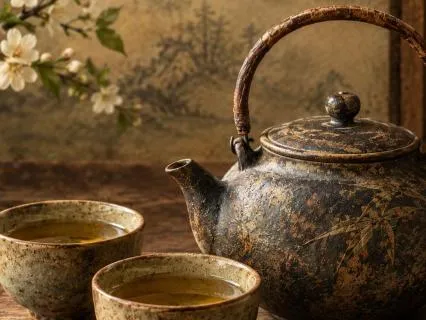
He went inside his hut and brought out a small pot of tea and three cups.
He poured for them.
They drank in silence.
The tea was simple and warm.
The forest was quiet.
The sun setting.
A little later the monks left.
And on the way back,
The older monk said,
It did not answer a single question.
He just showed us a stone,
Mended her sandal.
Hm,
What kind of teacher is that?
A little while later along the path,
The younger monk said,
I think he answered every question.
The story is such a beautiful teaching of explanations arising in presence.
Knowing that this moment,
Exactly as it is,
Is the answer.
And you sit with this contemplation for the next minute.
What would it be like to stop asking questions and simply drink tea?
And you gently move your attention once more to your breath.
The breath that is your teacher.
And yet does not test you.
N and R in and out.
It has been breathing you your entire life.
And it has never needed you to understand it.
Only to let it be.
So as we let these stories be now.
May you rest in peace.
May you live in the clarity of your own inner wisdom.
Thank you so much for being here,
Dear friends,
And for traveling through these Zen tales together.
May you go well and may you be well.