Welcome.
Do what you need to to settle into your space.
Let your body find its way into deep comfort.
And perhaps.
.
.
Let your eyes close gently.
That feels right for you.
And now let's move to the breath the elemental breath.
Where the air that moves through you.
It's like the air that moves through the bamboo.
So effortless,
So endless.
Always arriving.
Always receding.
Feel it as it arrives and enters and feel it as it moves on.
With each exhale,
Imagine releasing.
Another small piece of a weight you have been carrying.
Perhaps thoughts,
Plans,
Concerns,
Let them all drift away.
Like leaves on a slow,
Slow river.
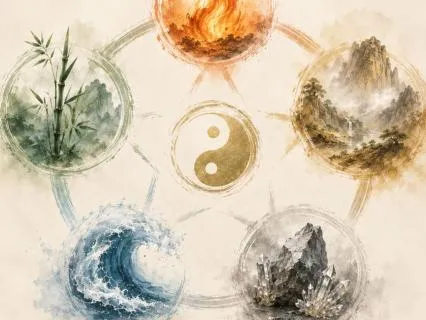
And today we turn our attention to the five elements.
In Zen and in many Eastern traditions,
The elements are not just physical substances.
They are energies.
Qualities.
And they carry profound teaching.
Fire teaches us about transformation and impermanence.
Water teaches us about flow and acceptance.
Earth teaches us about stability and grounding.
Word about growth and flexibility.
And metal.
Guides us to clarity.
And letting go.
And so the stories that follow weave these elements into tales of monks and seekers,
Ordinary people,
Unexpected moments of insight.
Some are traditional.
Passed down through generations.
And others are new.
Born from the same elemental wisdom.
At the end of each story,
We will pause together.
Now I will offer you a suggested question or prompt.
For you to hold.
As you drift for a minute.
You can choose to engage with those prompts or just let them fade into the background.
As you remain in a relaxed and rested position.
Before we continue with the next story.
Now.
Let's take a long slow breath in together and as you exhale Welcome the elements.
And let the elements welcome you.
And let the stories begin.
Our first tale is about the monk who burned his robe.
This is a traditional Zen tale.
And it starts with a young monk.
Who had spent 10 years at a monastery.
He had studied diligently,
Meditated for countless hours.
Had served his master with devotion.
And yet,
Deep inside,
He felt stuck.
He was just going through the motions,
Repeating the same routine.
And in his heart.
There was no longing for it like there used to be.
You feel dry.
Like kindling.
One day his master called him to his room.
The old monk was sitting beside a fire.
Slowly feeding it twigs and watching the flames dance.
He welcomed the young monk in and invited him to sit next to him.
The young monk did,
And for a long time neither spoke.
The fire crackled and popped.
Casting shadows on the wall.
Finally,
The master's spurt.
You have been here for 10 years,
He said.
You know the teaching.
You know the forms.
But yet.
.
.
You are not here.
You are elsewhere.
Waiting for something.
The young monk was startled.
Master,
He said.
I have given everything to this life.
I have followed every rule.
I have practiced every day.
What more do you want from me?
Master did not answer.
Then he reached.
The young monk's robe.
A simple brown robe that marked him as a student.
He pulled it gently from the monk's shoulders.
Master,
The young monk said,
Confused.
Master held the robe in his hands for a moment.
And then without hesitation.
Through it into the fire.
The young man gasped.
Master,
That is my robe.
It is all I have.
I coat the fabric.
Lens Lick and the robe began to burn.
The master looked at him calmly.
You have been wearing this robe for 10 years,
He said.
It is not the road.
It is the idea of the robe.
You seem to have become attached to the idea of being a student,
Of being here,
Of being this person.
Now the fire does not burn the robe.
It burns the attachment.
Watch.
The young monk watched as his robe was consumed by flame.
The fabric blackened,
Curled.
And turn to edge.
As it burns,
Something strange happens.
Young monk Both lighten.
He felt the tightness that was in his chest begin to loosen.
He had been carrying something he did not need.
Not the robe.
The identity it represented.
When the last piece of cloth had turned to ash,
Master spoke again.
You are free.
You can stay.
Or you can go You can be a monk.
Can be something else.
The robe is gone.
But you are still here.
This is what you needed to see.
Young monk bow deeply.
He did not stay.
He did not go.
Is simply set.
With his master.
Beside the fire,
Watching the flame.
Feeling the warmth.
And for the first time in years.
Be felt truly present.
The story so beautifully illustrates the transformative power of fire.
This element does not destroy for the sake of distraction.
It transforms.
It releases us from what we have outgrown.
Sometimes we do need to let something burn.
An identity,
A belief.
A story about who we are so that we can become who we are becoming.
Consider for yourself now what robe you are still wearing that you no longer need.
What identity,
What story,
What attachment?
And ask yourself.
What am I ready to let burn away?
So I can be free.
Consider this for the next minute as we pause in silence.
Our next story is entitled The River and the Stone.
In a mountain valley,
There was a river that had been flowing for thousands of years.
Began as a small spring.
Aye in the snowy peaks.
And grew as it travelled downwards.
Gathering streams and melting snow.
Until it became a wide,
Powerful river.
In the middle of this river stood a great stone.
It was massive.
Rough.
And it had been there since before anyone could remember.
The water flowed round it,
Over it,
Past it.
Every season the river rose and.
.
.
And the stone remain.
One day,
A mother came to the riverbank.
She was troubled.
She had been practicing meditation for years.
But her mind felt like a turbulent stream,
Always churning,
Always resisting.
And she could not find the stillness she sought.
And so,
This young mother sat by the river,
Watching the water flow.
Noticing that great stone in the middle.
That stone,
She thought,
Is like my mind,
Solid and moving.
And then she started to notice the water.
The water,
She thought,
Is like my thoughts.
Always moving,
Always changing.
I want my mind to be more like that stone,
But it is like the water.
I feel I'm fighting and losing that.
She grew frustrated and threw a pebble into the river.
Ripples spread disappeared.
An old fisherman who had been sitting nearby.
Noticed young woman's frustration.
He walked over and asked if he may sit beside her.
You look troubled,
" the fisherman said.
She explained.
She wanted her mind to be still.
She wanted to be like the stone,
Solid and moved by the flow of life.
And instead she was like this water,
Always moving,
Always changing.
The fisherman nodded.
You are right.
Your mind is like the water.
Perhaps you misunderstand the lesson.
The water does not try or want to be still.
It needs to flow.
Because it adapts.
It goes and moves around the stone,
Over the stone,
Under the stone.
Stone is rigid.
One day it will crack.
The water is sour.
It will flow forever.
He picked up a smooth pebble from the riverbank.
See this stone,
" he said.
It was once sharp and rough.
The water has smoothed it.
Over centuries,
The water has worn away every edge.
The water does not fight with the stone.
Simply flows.
And in its flowing.
Transforms.
The stone is not stronger than water.
It is just slower to change.
The young mother looked at the pebble in her hand.
Was smooth as silk.
Then she looked at the river.
Flowing endlessly,
Tirelessly.
Never fighting,
Never ceasing.
Your mind is the river,
The fisherman continues.
Do not try to become a stone.
Let your thoughts flow,
Let them move.
The stillness that you are seeking is the stillness of water that moves without struggle.
No need to stop the river.
Simply let the river flow.
NP.
The young woman sat by the river for a long time,
Watching the water.
Feeling its flow.
And slowly.
The thoughts began to move like the river.
Without resistance.
Art effort.
She was still thinking.
But was no longer fighting.
The story offers a profound teaching about water,
Its softness and its strength.
It does not resist,
It flows,
It adapts,
It wears down mountains over time.
And when we try to become still by force,
We are like a stone resisting the river.
Whereas when we allow our thoughts to flow,
To move,
To pass,
We become like water itself.
Always moving.
OAZP.
As you rest here now,
Feel your thoughts like water.
Don't try and stop any of this.
Don't try and hold any of them either.
Simply let them flow,
Let them pass.
You are not the thought.
You are the river.
Now,
Quietly ask yourself,
Can I simply be the river?
Breathe into that question and then exhale as you let it go.
Simply be.
For the next minute.
Our third story is a traditional Zen tale entitled,
The Farmer and the Seed.
A farmer went to a Zen master and asked for a teaching.
Farmer was a simple man.
Who work the land every day.
He had heard that the Master carried wisdom that could transform a person's life.
Master,
He said,
I have come to learn from you.
I want to grow.
Like a seed in good soil.
Tell me.
How can I become wise?
The master asked the farmer to bring him a seed.
Farmer reached into his pocket.
Produced a single seed from the grain he had carried.
Taking the seed,
The monster held it up.
And ask.
What is this?
It is a seed,
The pharmacy.
And what will it become?
Well,
With good soil and water and sun,
It will become a plant.
It will grow roots,
Then a stem.
And then leaves and then grain,
Many grains.
A master nodder.
And when you plant the seeds.
Do you dig it up every day to see if it is growing?
The farmer laughed.
Course not master,
If I dag it up every day it would never grow.
It needs to be left alone.
It needs to be in the darkness.
It needs time.
A master's smile.
And that,
" he said.
Is your teaching.
You come to me wanting to grow,
Wanting to become wise.
You are like the sea.
You may want to see the results immediately.
And so you perhaps want to dig yourself up every day and check your progress.
True growth happens in the darkness.
Unseen and hurried.
Plant yourself in the soil of your practice.
Water yourself with patience.
Past the wisdom of the earth you are planted in.
Do not dig yourself up to see if you are growing.
Just be.
And in time,
You will sprout.
The farmer sat in silence.
He understood.
He had been impatient,
Eager to see results.
And so instead of just letting himself grow,
He had been focused on always checking,
Always measuring,
Always comparing.
But the earth does not shake itself.
Earth simply waits.
And growth comes.
Bow to the master and return to his fields.
We continue to plant seeds.
And he still waited.
But now when he waited.
It did not free.
He trusted the dark soil beneath him.
As we reflect on the story.
Imagine yourself as a seed in warm,
Dark soil.
There is nothing to do.
Nothing to become.
Just rest.
Wait.
The growth is happening.
Even if you cannot see it.
Let's repeat for the next minute.
I trust the wisdom within me.
I trust.
Wisdom within me.
Hi.
Our fourth story is entitled The Bamboo and the Wind.
In a Zen garden,
There was a grove of bamboo.
It was old and tall,
Swaying gently in the breeze.
Its leaves whispering secrets to the sky.
A young pine tree grew nearby,
Straight and proud,
Its needles sharp and green.
One autumn,
A great storm came to the valley.
The wind howled,
The rain lashed,
The sky turned dark.
The young pine tree stood tall and defiant.
It pushed back against the wind,
Refusing to bend.
I am strong,
" told itself.
I will not yield.
The bamboo,
On the other hand,
Bent low.
Its tall stalks arch towards the earth.
Its leaves were flattened by the force of the wind.
And it looked as if it might break at any moment.
But the bamboo did not break.
It bends so low that its tips touch the ground.
And when the wind passed.
It rose.
Again and again.
Taller than before.
Unharmed.
The pine tree did not break either.
Stood firm throughout the storm.
But when the storm had passed,
Something was different.
The pine tree had not broken.
That it had cracked.
Great Split ran down its trunk.
A wound.
That would not fully heal.
A young child who had been watching the storm from her bedroom window.
Went to her father and said,
Father,
I do not understand.
The bamboo bent so low and looked so weak.
And yet,
Look!
It has survived without a scratch.
Now look at the pine tree.
It stood firm.
It looked so strong.
Now it looks wounded.
Why?
The father looked out into the garden.
Bamboo was swaying gently,
Its leaves green and full.
The pine stood with its great cracks.
Ever mark.
The bamboo,
The father explained,
Does not try to be strong.
It is flexible.
It gives way to the wind because it knows the wind will pass.
And it bends so that it does not break.
Pine tree tried to be strong,
Resisted the wind.
It refused to give way for the wind.
And so,
Its resistance Who's the one to crack it?
The pine was not stronger than the bamboo.
Perhaps it was a little less wise.
And then the dad turned to his young daughter and said,
You know your mind is like the bamboo.
Or the pun.
When thoughts come like a storm.
You can resist them.
And push back.
You can try to stand firm.
Or you can bend.
And give way.
And just let your thoughts and feelings pass through you,
Knowing they will not last.
The young girl looked out the window at the bamboo.
It was still swaying.
It was still bending.
And it was still standing.
As you rest here now after this tale.
Notice the thoughts that are with you.
Which ones can you so easily bend with?
Which ones do you resist?
Ask yourself to be like the bamboo,
Swaying.
Yielding.
Always returning to stillness.
Consider for yourself now.
Where you could be a little bit more flexible.
Our final tale is a traditional Zen one about a sword.
A young swordsman came to renowned master seeking to learn the way of the sword.
He was talented,
Strong,
And confident.
He had already defeated many opponents.
But he knew he was not yet a true master.
There was something missing.
The master agreed to teach him.
For months the young man trained.
He practiced his stances,
His strikes,
His footwork.
He grew faster,
Stronger,
More precise.
One day the master invited him to a match.
Young man was eager.
He bowed and drew his sword.
But the master did not draw his sword.
Is stirred.
Calmly.
His hands at his side.
Is sewed still in its sheath.
Fight me,
The master said.
The young man hesitated.
He did not want to strike an unarmed opponent.
Master said you are not holding your sword I cannot fight you like this.
The Master Smiles.
I am holding my sword.
It is just not in my hands.
It is in my mind.
Bite me.
The Young Man Lunge.
The Master stepped aside effortlessly.
The young man swung.
The Master dodged.
The young man thrust.
Again and again.
The master moved like water.
Wind like light.
He never seemed to be trying.
Never seemed to be exerting any effort.
He was simply not there when the sword arrived.
Finally exhausted.
The young man lowered his sword.
Master,
He said,
How do you do that?
You are not even holding your soul.
How can you defend yourself so?
The Master replied.
You are focused on the sword in your hand that you forget the sword in your mind.
I do not need to hold my sword to know where it should be.
The sword is not the weapon.
Mind is.
When your mind is clear.
Your body moves without effort.
When your mind is caught in the sword.
Sword becomes your master.
Not your seventh.
You may think the goal is to strike.
It is not.
The goal is to know what not to strike.
That is the true power of this metal object.
It's not about cutting.
It's about knowing when to stay in the sheet.
The young man sheathed his sword.
Bow deeply.
For the first time understood that mastery is not about force.
It is about presence.
He continued to train,
But now he trained his mind as much as his body.
And in time.
He did become a master.
Not because his sword was faster.
But because his mind was still there.
And clear.
Can you feel the sword of thought in its sheath?
You do not need to draw it.
You do not need to fight anything.
Simply let it rest in the stillness of the sheet.
As you continue to rest gently.
Softly recall the wisdom of fire.
Of water.
Of wood.
Of air.
And of metal.
The elements have spoken.
These stories are now complete.
May you rest as the earth rests,
Deep and still.
May you dream as water dreams,
Flowing and free.
And may you wake.
As fire awake.
Renewed.
And alive.
Remaining flexible.
Clear.
And present.