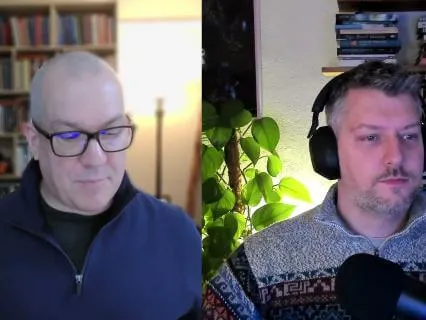
A very warm welcome,
Steve March.
I'm very pleased that you're willing to talk with me for a bit on my podcast.
Just as a kind of short introduction,
I know that you are the founder of Alethia Coaching.
That's the coaching method I'm also employing and learning myself.
I'm super inspired by it.
You've been a coach for 25 years I believe and you're training coaches for 22 years?
Is there anything you would add to that introduction before I bombard you with my questions?
Well,
First of all,
Thanks for the invitation.
It's always fun to talk about these topics.
Yeah,
What could I add?
I live in California with my wife,
Donna,
And we co-lead and co-operate Aletheia Academy,
Our coach training and soon-to-be design training.
Program.
Yeah,
That's really awesome.
And there's a question in the end about that design training,
As you just told me about that.
It sounds very interesting.
Just for a few basic questions as well for people who might not know what Aletheia Coaching is all about.
We probably can't cover all because it's quite an extensive framework that you created,
But maybe just an important thing.
So what is memory reconsolidation and what is its use in Aletheia Coaching?
So memory reconsolidation is the current,
The best neurological understanding of how enduring transformation actually occurs.
And it's been.
It was discovered,
I think,
Around 25 years or so ago in biology.
And neurology,
And then slowly kind of made its way into clinical application.
First in psychotherapy.
Um,
And when I first encountered it,
Which was,
Gee,
When would it have been?
Probably 2015,
I think.
Or 2016 I first encountered it.
And what I could immediately tell is that it explained the results that I was seeing,
Not just from Aletheia coaching,
But also the results I was seeing from a variety of other transformative approaches.
And essentially what happens is that our neurology,
Based upon our past learnings,
Has a certain kind of expectation about the present moment experience.
And,
You know,
That's a fair assumption that,
You know,
This is going to be a lot like that was.
However,
As we all know,
Sometimes this isn't like that was,
And we experience what I like to call an experiential mismatch.
And where our experience mismatches our expectations,
The expectations that our brain and nervous system have developed.
And so when that happens,
There's a biological mechanism where our neurology,
The neurology around the particular experience and expectation that's being mismatched.
Actually becomes malleable.
And prior to that,
It lives in a kind of crystallized form where it's not flexible.
It's not malleable.
But when we experience something new and different and fresh.
That becomes malleable in a way that it becomes editable or updatable or even erasable in some instances.
And amazingly,
The research shows that that that memory reconsolidation window,
As it's called,
Opens for a period of five hours.
And what you do in that five-hour time period makes all the difference in terms of what actually gets consolidated at the end of it or crystallized at the end of it.
And then as some kind of an enduring shift,
An enduring shift in your sense of the world,
In your sense of others,
And most importantly,
In the sense of yourself.
And so in Aletheia Metapsychology,
We work at various different depths,
Which,
I don't know,
Maybe we'll get a chance to talk about.
But at each different depth that we work with with coaching clients,
There are several different ways that these experiential mismatches naturally occur.
And so in some sense,
A coaching conversation is a kind of accumulation of these tiny little experiential mismatches.
That occur by the way in which we engage the present moment,
The way in which we focus on what's present.
We're not just taking the conclusions that we have,
The stories that we have,
And assuming that that is what's happening.
We actually pause and sense in,
Check,
What is really happening?
And as we do that,
These experiential mismatches begin to accumulate,
And that's what actually has this way of working be so transformative.
Navigating depth,
Dropping into depth is the most reliable way that I know of to create these experiential mismatches.
It's not just a mismatch of what I'm experiencing,
It's a mismatch in my sense of self.
And that's actually where the most dramatic.
Self-transformations actually unfold.
Yeah,
It's quite amazing and I'm very happy that I stumbled upon your method.
One of the,
I guess,
Proof of the pudding is that My ayahuasca journeys are quite a few years behind me at this point.
But I remember after having done,
You know,
Kind of a multiple day workshop or ceremony.
I would have this extended period of deeper self-connection.
I could literally feel my body better.
And this is this kind of visceral self-connection that I also noticed in some of my more powerful ayahuasca experiences.
I want to touch on something you said earlier.
You mentioned wholeness.
I have a whole question about that.
I'm going to read a bit of a paragraph here.
Yeah,
So one of the things you've been talking about in some of your work is authentic wholeness and how parts can sometimes be seen as holographic.
In the sense that our parts contain the whole.
At least if we are coming with skillful attunement of trusting the wholeness behind the part or beneath the part.
Can you say a little bit about what authentic wholeness is and how this translates into a metaphor of the holographic principle and how this is important in your style of coaching?
Is there a parallel,
If you can say a few words on it,
Between your notion of wholeness and the Buddhist notion of emptiness?
Yeah,
There's a lot packed into that question.
So.
There's a.
A philosopher named,
Uh,
Henry Bortoff.
And he created the distinction of authentic and counterfeit holes.
And this is a really important distinction in a lithium unfolding.
And the idea is that a counterfeit whole,
As he called it,
Is a whole that's assembled from the parts.
So if you look at any kind of piece of technology,
You know,
Like,
You know,
A car,
A bicycle,
Something like that,
You know,
We could have an entire,
You know,
We could have all of the parts of the bicycle,
But it isn't until we assemble them together that we actually have a bicycle in terms of its functioning and utility,
Right?
And so that's the normal way that we think about the relationship between parts and holes.
The parts come first and they're assembled to make a hole.
However,
If we take a look at something like a human being.
It's quite clear something different is happening here.
It isn't that human beings are made from human being parts.
Kind of disgusting image that that is,
Right?
It's not like we have a bunch of body parts and we assemble them together and that becomes a human being.
It's rather that the whole is there before the parts unfold or before the parts emerge.
And so we see this if you study embryology in some sense,
You know,
The child is conceived.
It begins this process of living,
Of becoming differentiated and structured,
And parts begin to form,
But they form as an unfolding expression of the wholeness that is essentially there from the beginning.
And as a result,
The parts as they form are expressive of that wholeness.
The parts as they form in relationship to each other.
Are expressive of that wholeness.
And so we can look at that sort of biologically,
As I just did,
But we can also understand that psychologically.
Right?
So after we're born on our birthday,
We're a whole human being,
But we don't yet have a developed ego structure,
A psychology.
And so we go through the first three years of life and actually stage by stage by stage,
We develop,
We develop an ego structure and a psychology.
This was studied by Margaret Mahler and her team of researchers.
She was a child physician and psychologist.
And at around three years old,
She coined the term psychological birth,
That we have our biological birth on our birthday,
But somewhere around age three,
We have our psychological birth.
And of course,
That's the time when we actually experience ourselves as a separate self.
We experience ourselves as separate from our mother and caregiver.
We experience ourselves as separate from other people.
Other people have inner worlds.
We have an inner world.
Now there's still a whole human being there,
But there's a lot more to develop,
To learn,
To grow,
Etc.
And that entire process is something that unfolds.
And unfoldment continues to happen on into adulthood completely through the dying process.
And so what's unfolding is wholeness.
So every unfoldment is the expression of wholeness in yet a deeper and more complete way in some sense.
And so wholeness is innate.
Wholeness is original.
And all of our parts in some sense,
Whether we're talking about body parts or whether we're talking about psychological parts,
Like as in parts work,
Which has become very popular and is also part of Aletheia coaching.
All of those parts sort of express the whole in some sense.
And so what that means psychologically is that we can work with our our eco parts in such a way that we sort of follow the breadcrumbs deeper back to the discovery of.
Of wholeness itself of our original wholeness.
And this,
I argue,
Is actually the remedy to this sort of prevailing sense of self-deficiency that we all experience in the world.
Now,
A lot of times when we feel like we're not enough,
We launch some kind of self-improvement project.
And that's well intended,
But one of my discoveries is that The more we try to improve ourselves,
The more self-improvement it seems we need.
That in some sense,
Self-improvement projects really never deliver freedom from not-enoughness.
They ironically reinforce not-enoughness.
And so how do we actually gain freedom from not-enoughness or from self-deficiency?
What we have to do is to recover a sense of our innate wholeness.
And so we can follow the breadcrumbs of what's here,
Tensions in the body,
Emotions,
Et cetera,
The actual experience of what's here.
And as we work with that in an ever deepening way,
We land into that sense of wholeness,
Which is original.
And that's the place where we really feel like ourselves.
It's like,
Oh,
That's me.
You know,
Yes,
I have this emotion,
But I'm not an emotion.
Yes,
I have these thoughts,
But I'm not my thoughts.
Yes,
I have these sensations,
But I'm not sensations.
I'm the one that experiences all that.
So we drop down into this.
And so I also tend to use the term presence.
For wholeness,
That these are in some sense synonymous.
That we land into ourselves as presence.
And presence isn't a content of awareness,
It's awareness itself.
And it's this awareness itself that is our original wholeness.
So there can be many different qualities of presence.
We could have qualities of love and peace and joy and compassion and strength and courage.
And will and perseverance and passion and bliss and pleasure.
Lots and lots of different qualities of presence.
And they're holographic in the sense that each one of them is an expression of wholeness.
Right,
So.
What happens is that,
You know,
When you're feeling courageous,
That doesn't mean that there isn't also joy.
There isn't also love.
There isn't also peacefulness.
And so all qualities of presence actually include all qualities of presence.
And that's the kind of holographic nature of wholeness.
And to view things in a holographic way is very different from the kind of mechanistic way.
That I first described.
So,
You know,
Authentic wholeness exists in this kind of holographic fashion.
We also see this in an even deeper way when we drop into non-dual work.
But counterfeit holes are just mechanistic.
And unfortunately,
This is a lot of the way that our culture tends to look at things.
We tend to look at things in a kind of mechanistic way.
And of course,
Breaking things down into mechanisms has been really fruitful for our culture in so many different ways.
Technologies have been created and invented.
Science has been advanced.
You know.
Lives have been saved by those technologies and that science.
So there is something really important about that.
It's just a matter of recognizing that when it comes to working with people,
When it comes to working with organic living beings,
That taking the view of counterfeit wholeness doesn't really work.
Right.
And so we have to shift into the kind of wholeness that we are and then learn to relate to that.
And unfortunately,
That's kind of been marginalized.
That view.
Has been marginalized in our contemporary culture.
I view the big project of Aletheia is to try to bring that view more back into the center of the conversation.
Into the center of life.
And,
You know,
It's my sense that actually an understanding of wholeness and how wholeness unfolds was central largely for Indigenous populations.
And,
You know,
They had a sense of the deep kind of connectedness that they all were with each other,
The deep kind of connectedness that they were with the ecologies that they lived in.
Now,
They didn't view these things as separate.
And so as separate parts in some sense.
And that's been the real problem,
You know,
Ever since sort of the birth of modernity in some sense.
You know,
Is the separation of everything.
And like I say,
These separations gave us a lot,
You know,
The separation of church and state and,
You know,
The separation of the secular and the scientific.
It gave us democracy,
It gave us the scientific method,
It gave us so many things that we look around in our world and we recognize we wouldn't know our world without these things.
But there's a deeper,
A deeper.
.
.
Sort of disaster in the midst of modernity.
And that's also resulted in the separation of culture and nature.
Us viewing nature as something to consume instead of something to steward.
You know,
So it's,
You know,
It's this this sort of distinction lies again at the very heart of the kind of unsustainable world that we live in right now.
Kind of at the heart of the meta-crisis in some sense.
So this shift of a view of innate or authentic wholeness and how wholeness unfolds more into the center of the conversation,
I think,
Is one of the most urgently needed things in these times.
That's a really amazing answer.
I would bet a dollar,
By the way,
That you've read the book,
The Spell of the Sensuous.
I know about it.
I've had a conversation with the author.
But uh.
.
.
But I haven't actually read the whole thing.
Yeah,
It seems really like that same paradigm.
I believe his name is David Abrams,
The author.
David Abrams,
Yeah.
Yeah,
You're speaking the same beautiful kind of non-dual ecology almost of his work.
Or inspired by a similar philosopher.
So if I remember,
A lot of his work was based upon Merleau-Ponty.
And Merleau-Ponty is an inspiration for me,
Although I'm more steeped in who Merleau-Ponty,
Who was an inspiration for Merleau-Ponty,
Which was Heidegger.
But yeah,
Similar sort of vein of continental philosophy.
Yeah.
Merleau-Ponty is my pet philosopher,
Along with Roeseril,
Who you also know.
Yeah.
And yeah,
As you were speaking,
Then two things kind of came to me.
One was kind of this image of,
You know,
When we're a leaf or like a plant unfolding,
It's already there,
This kind of,
You know,
This plant,
What is it,
Spiral,
And it really unfolds.
There's not a plant parts being put from the outside,
Not quite that way.
That's really curious.
Yeah.
And,
And also,
You know,
This beautiful paradigm that you're seeing with caring for the authentic whole by seeing wholeness and remembering wholeness.
I see it also,
And I'm curious if you resonate with that,
That our job as Aletheia coaches is we kind of embody the remembrance or that trust of wholeness when somebody is sitting in front of us.
Completely identified with a part or being fragmented.
That's exactly right.
I mean,
I think the most powerful move that we make in Aletheia coaching is the first move that I teach in our level one.
Which is the shift of attunement.
And this is a distinction I get again from Heidegger.
And attunement is,
You know,
We're always attuned in one way or another.
And attunement shapes how the world occurs for us.
And so you can think sort of metaphorically like attunement is maybe tuning a dial on a radio,
You know,
Where we tune it to a certain frequency and we get a particular radio station.
We tune to a different frequency,
It's a different radio station.
It's like changing the music in some sense,
Right?
And so this is a degree of freedom that all human beings have,
But very few human beings consciously work with.
And that's because when we're attuned,
We don't notice attunement itself.
We just notice the music that's being played.
We just,
You know,
We don't recognize that there's actually a way that we can shift things.
And,
You know,
A philosopher like Heidegger,
Who was a deep student of history,
You know,
As he studied history,
And he began to notice that each historical epoch was attuned in a different way.
And so the phenomena of attunement wasn't available in the immediacy of the moment.
It was available kind of in looking back over history and noticing that something was changing here.
And what was changing was the idea of being itself.
And so he created something that he called the history of being.
Which I think is a fascinating notion because being is just being.
How could it have a history?
And yet how it shows up for us,
What it means to be anything has shifted and changed.
And just as a further example.
The attunement that prevails in our current age.
Is what Heidegger would call a technological attunement.
And clearly,
We're living in a technological age.
We're having this conversation mediated by technology.
It wouldn't have been possible.
In the same way,
You know,
Years ago.
And when we attune to technology,
We see everything in terms of its purpose and its functioning or its dysfunctioning.
Um,
And,
Uh,
Of course,
You know,
That's.
You know,
It's everywhere.
The problem and Heidegger began to notice this,
You know,
I think in the 1930s and 1940s when he was writing about this.
Is that inside of this attunement,
Even people Even human beings show up as technology.
And you can see the casual way that we do this to ourselves.
It's like we want more bandwidth.
And we want to be upgraded.
We want Life 2.
0.
I've seen many programs,
Life 2.
0.
You know,
This is a very sort of technological way of viewing ourselves.
Except that Fundamentally,
Technology only really reveals counterfeit holes.
It doesn't really reveal authentic holes.
And so there's something kind of dehumanizing when we view people as technology.
And when people then try to upgrade themselves in some way so that they can do something like transact for value in the open marketplace more effectively.
This is all a very technological view.
And to be honest with you,
It's kind of leading to a sort of burnout society in some sense.
Know,
Where we're constantly trying to improve,
We're constantly trying to perform better,
Because that seems to be what's needed in order to actually navigate this world.
We need to be you know,
Upgraded technology.
Always functioning,
Always capable,
Always optimized,
Always efficient.
This is what's driving us.
Except that you don't look at a tree.
And say,
You need to be more optimized.
You need to be more efficient.
You need to perform better.
You know,
You don't look at a plant that way.
You know,
We don't look at animals in the wild that way.
But we forget we are animals.
Right?
We forget that we are actually biological,
Organic beings.
So we've applied this machine metaphor to ourselves.
We only see ourselves as counterfeit holes.
We've blinded ourselves to authentic wholeness.
And in order to become aware of authentic wholeness,
What we need to do is shift the attunement.
And so again,
Back to Heidegger,
Heidegger had a proposal and his proposal was instead of attuning technologically,
What if we attune poetically?
And notice that even when I say that,
You know,
Immediately we think,
Well,
Poetry is for the poets.
And they're not the primary economic engine of our world.
They're off.
They're off in the margins with the artists and the painters and.
And everyone,
And we grant them that they see the world in a particular way.
But that's not the way that everybody sees the world.
The challenge is that The way we see the world technologically is dehumanizing.
But actually noticing the world in a poetic way is humanizing.
So to actually learn to see authentic holes.
We actually have to adopt a way of viewing the world that is more like that of the poet.
In fact,
This is what's really fascinating about poetry is that when you read a poem,
There's a kind of economy of words on the page.
But what happens as you read the poem is a whole world becomes evoked.
In your imagination.
But that world wasn't described piece by piece by piece,
Part by part by part.
The parts didn't come first,
Assembled into the whole.
The whole was there at the beginning.
The poet was sitting in the whole,
Poetically attuned to the whole.
And out of that attunement,
They found this economy of words to evoke that.
They couldn't even if they wanted to describe that world to you.
They couldn't do it.
But they can use even fewer words.
To presence that world,
To evoke that world.
And so as coaches,
What we practice is we practice sitting in the poetic attunement with our coaching clients.
And we practice seeing them in a humanizing way,
Not as somebody that's in need of optimization or efficiency or improvement or upgrading.
Even if that's what they're coming to us with,
Asking us for,
We don't see them in that way.
We see them as already a whole human being.
And oftentimes clients will say,
But something feels like it's missing.
And what we do in Aletheia coaching is we say,
What does that feel like?
And we start to explore actually what's here.
There's a feeling,
There's a sense,
Something felt in your body.
That sense of deficiency,
That sense that something is missing.
It must be here in some way.
So when we actually shift into that sense,
That tension,
That feeling,
That emotion,
Whatever it is,
Now we're actually exploring something that's here.
And that allows us to follow the thread deeper and deeper and deeper until we recover that sense of innate wholeness.
And so the most powerful coaching move is actually shifting into a poetic attunement.
Because what becomes possible is a kind of deepening unfoldment,
Where if we just stay inside the technological attunement,
We just see the surface of life.
We see the surface of things.
And of course,
We'll try to launch another self-improvement project.
We'll try to get something done there.
But that never really deepens us in a way that recovers the wholeness that's already here.
In some way,
We're trying to accomplish something and assemble that wholeness.
And try as we might,
The wholeness that we are can never be assembled.
And so that's why improvement projects always fail in some sense.
You know,
Um.
So there's,
This is at the heart of the heart of transformation in some sense,
The heart of coaching,
And as I'm starting to articulate more and more,
Even the heart of design work.
That's really amazing.
Again,
I have two points that kind of stand out to me.
One is that a while ago I had a very similar insight.
You said a few minutes ago that we are also animals.
And I found that just remembering that I am an organism,
Beneath all my stories about myself,
Beneath all my,
I deserve this or I don't deserve that,
Everything like that.
I'm just a living,
Breathing,
Pulsating organism.
And it's for me kind of a direct path into compassion because I don't have to deserve anything.
I'm just already worthy like the tree or like,
You know,
The cow or whatever.
So I find it beautiful.
And another note,
Again,
To mention our common friend,
Maurice Moloponty.
What you're also describing to me is what he did in one of his later essays,
The Philosopher and His Shadow.
Where he is describing how he,
He says the philosopher,
But how he.
Wants to help the philosopher express himself.
And especially Husserl,
He tried to talk about super difficult stuff,
Like the core of what subjectivity is.
It cannot actually be spoken.
And Marlo Ponti invited us to be generous in our listening,
To help him express,
Not criticize,
But help him express.
So anyway,
I found that a cool little side note.
I want to pivot a slight bit towards,
You mentioned attunement.
A very small topic today is artificial intelligence.
I know,
You know,
Not a lot going on there.
But to maybe take it for a short run.
So again,
I'm going to read my paragraph question.
It seems that the technological attunement and technological human self-view has given or is giving birth to the ultimate machine,
Disembodied self-improving AI,
Naked rationality and logic.
It's devoid of.
The poetry of initiation,
And I use that phrase,
The initiation and the poetry also from the Emerald podcast,
Which is amazing.
And being also,
It's devoid of being balanced by eons of intelligence that our bodies hold as intuition,
As premonitions,
As doubts,
As wonderings.
Do you resonate with that assessment?
And if so,
What might we do?
What should we do with this golem of AI?
And does your answer perhaps lie in what you've called a new era of sustainment?
In another podcast,
You talked about an era of sustainment.
Yeah,
The concept of an era of sustainment comes from one of my favorite philosophers,
Tony Fry,
Who writes about ontological design and is also very,
Very influenced by Heidegger.
AI is so fascinating.
I mean,
In some sense it is.
It's a technology that's born of the technological attunement.
And in some sense,
In some sense,
It's presenting itself more and more in human ways.
And so I think I think that Our world is about to be completely transformed in some sense.
I think probably both.
In good ways and not good ways.
Um by the presence of artificial intelligence um you know you know what's the likelihood that you know in five years we realize that interacting with artificial intelligences for four to six hours a day you know,
Is just as bad or maybe even worse than interacting with social media for four or six hours a day.
I think it's probably more likely than not.
And so.
You know,
We really have to be careful,
I think here.
At the same time,
You know,
The capacity for.
The capacity for research,
The capacity for design prototyping,
Which is what I've been actually using AI for.
You know,
I'd like to consider myself relatively well read,
But AI has read everything.
There's no way I'm ever going to compete with that.
And so,
And,
You know,
The capacity to actually creatively weave together disciplines,
Ideas,
Bringing ideas from various authors together,
And prototyping what an integration might look like.
I mean,
I've been able to do frankly astounding work with that in a very brief amount of time.
I've been able to do in a day what probably would have taken me three months.
And I don't really have three months of.
Spare time right now.
So the capacities are astounding in some sense.
But,
You know.
And it is going to change our world in a significant way.
There's no doubt.
Um,
You know,
Uh,
People are going to have to start to,
You know,
Managers are not only going to be managing people.
They're going to be managing AI agents.
So there are whole new skill sets that need to be learned.
There's a fundamental economic reorganization that's probably going to happen.
It's hard to imagine that it's going to happen smoothly.
I think it's going to happen with fits and starts and with lots of unexpected ramifications as we see the deep way that our economy is interconnected.
So,
You know,
It's definitely a kind of shifting sands kind of situation.
You know,
We're standing on a sand pile and things are beginning to shift.
It's going to be destabilizing.
In some instances,
Amazing new possibilities open up.
But,
You know,
I think the big question is,
How do we learn to navigate this?
And this is actually one of the things that's taking me into my recent explorations around design and the recognition that in a sense,
What is a sort of future-proof skill set?
How do we actually learn to participate?
In this sort of fundamental redesign of the world.
So that we wind up with something that actually works.
We wind up with something that's actually ethical,
And we don't wind up with something that's just a kind of accumulation of wealth and capital to an even smaller group of people.
While it really doesn't work for the rest of the world.
So if we don't actually learn to design and we don't actually and everybody doesn't start to actually own their design agency in some sense.
We wind up just kind of being sort of swept along participants in this world.
And in this sort of destabilizing,
Shifting world.
So this is one of the questions that's occupying me right now.
What is a future-proof ecology of practices?
How do we actually understand our situation in the world in a way that we can participate with it?
In a designful way.
Um,
I think,
I think You know,
One of the things that I learned when I was working in tech,
You know,
I was working in tech before I was a coach.
And actually,
That's what brought me out here to California and came out here in the late 90s during the tech boom.
And I joined a company that when I joined them,
They were 600 people and already a pretty well-established company in their field.
And I was with them for nine years.
And over that time,
You know,
By mergers and acquisitions,
They grew and there was almost a new merger acquisition for a while every few months.
And so even within a few years,
The company,
It was 2,
500 people.
And it had swallowed its largest competitor.
And so one of the things I realized is that in times of flux like that,
Where there was near constant reorganization,
A lot actually,
There's a lot of flexibility.
It starts to open up.
Things can be reimagined in ways,
Fundamentally new ways,
That just,
It wasn't possible before.
So I also look at this kind of destabilization that we're beginning to move into,
I suspect.
As something that is definitely going to produce a lot of tragedy.
But it also produces a lot of opportunity.
To begin to shift things.
If we understand how to capitalize on the opportunity that's available.
And,
Um.
The thing is,
Is that you know,
Design,
I think,
As a profession is starting to evolve.
And.
.
.
It evolved.
It was originally the design of things and then products and services and then experiences.
But my sense is that the way it's starting to evolve is design of worlds.
But Design of Worlds functions really differently than all of the others.
You can not have a product,
You can not have a service,
You can not use a service,
You can not have an experience,
But everybody starts with a world.
Everybody's already living in a whirl.
And so the way world gets designed is it gets redesigned.
And the way it gets redesigned is it has to unfold.
That's the only way that design or redesign of worlds can happen,
Is we're already starting in the middle of it.
This is the kind of metaphorical,
You know,
Rebuilding the airplane as you fly it kind of thing.
That's the situation that we're in with the world.
We already have one.
Except it kind of needs to be redesigned in a way.
And not designed as something that we stand apart from.
This is another difference.
We stand apart from a product,
We stand apart from a service,
We stand apart from an experience.
But we are deeply embedded in worlds.
We're not apart from worlds.
There is no outside position of of leverage,
There's no outside perspective that we can understand the thing as a whole.
There's only our participation in the world.
And the other thing that's really different is that everybody is a designer of worlds,
Whether they realize it or not.
Everyone is actually working to design their life in some kind of way.
But many people are actually not recognizing their design agency,
Their design capacity in this world.
And as a result,
They wind up just kind of being sort of swept along.
By the currents of the times,
Which I think is this,
To keep mixing metaphors here,
Is this shifting sandpile in some sense.
That's happening.
So.
.
.
Yeah,
It's an amazing time to be alive.
And it's also a time to sort of wake up and own that we live in times of transformation.
So how do we learn to participate in the transformations that are happening?
And this is why for me,
You know,
Poaching and design are just,
You know,
Sort of like two sides of the same coin in some sense.
Yeah,
Thank you for that.
And also,
I think a few days ago in the Mighty Network server of Aletheia,
You posted a video,
I believe,
Around,
Not around,
But by one of the creators of Ontological Design.
Is that surrounded by the same topic for you?
Because I know it's a very core influence in Aletheia coaching as well.
Can you say a few words about that?
Yeah,
So,
You know.
This is that the redesign of worlds,
The unfolding of new worlds,
Is the subject of ontological design.
And ontology is the study of being.
And so when I talk about really the unfolding of a new world,
It's the unfolding of a new way of being in the world.
And so.
Really,
This is fundamentally what transformation is in every instance,
Is the unfolding or the transformation of our way of being in the world into a different way of being in the world.
And,
You know,
For me,
The kind of the lineage,
The legacy of this is,
You know,
I first learned about a lot of this stuff when I was working and studying at New Ventures West,
Which was the first coaching school that I went through.
And James Flaherty,
The founder of that school,
Had studied with Fernando Flores,
Who I had later then studied with as well.
And I worked with a variety of different people that surrounded themselves,
That Fernando was surrounded by,
And worked in that field.
And a lot of that was based upon Heidegger,
Was based upon speech act theory,
Was based upon Maturana and Varela's biology of cognition.
And so very much what we're currently doing in Aletheia is in that lineage.
Inspired by the work of those people.
So if I can kind of.
Extract your vision,
You know,
Living in a time of AI with,
You know,
On the horizon,
Maximum manipulability of our experience and going towards levels of ontological design and world design.
Is it then your,
Your kind of inspiration to,
As you say,
You didn't quite say that,
But to kind of step into collaboration with that wave and to make sure that poetic attunement has a place in the future going forward in this way.
Yeah,
That's exactly it.
We need to.
Be fully engaged with AI,
In some sense to understand it,
To leverage it.
You know,
As is often said,
AI is not going to take your job.
Somebody working with AI is going to take your job.
I think that's probably pretty close to true.
As far as I can tell.
So there's a way in which we have to leverage it.
Almost in a way to simultaneously compete against it.
Because here's the thing,
As AI is becoming more and more human-like,
I have a lot of concern about that.
But AI will never be human.
And at the end of the day,
Human beings need and value human contact.
And so in some sense,
I think that a possible silver lining is that we actually understand even more what it is to be human.
By noticing the failure of AI to truly be human.
Now,
You know.
Who knows if that's going to happen or not?
I mean,
Clearly the direction of that technology is to keep addressing the shortcomings.
I was just watching something earlier this week where You know,
All the current large language models are language models.
And the new AIs that are starting to be developed are world models.
And they believe that this is actually the jump that will take us into.
Superintelligence.
And so it's not just that the language is predicting the next word,
Or that the model is predicting the next word.
The model actually is predicting what will happen in the world.
Which is,
Of course,
What human beings are doing,
As we talked about at the beginning,
Right?
We're making some kind of a prediction.
Our neurology,
Our biology,
Our psychology is making some kind of prediction about what the next moment is going to be like,
And when it doesn't end.
Match that,
That's when we learn.
That's when we learn something new.
Well,
This is exactly fundamentally the way AIs are functioning.
They're just functioning,
They're just doing that with language right now in some sense.
But they already have,
We already have the first working model of an AI doing that with a world.
I don't think it's publicly available yet.
So yeah,
You know,
How do we leverage AI to ultimately continue being human in some sense?
When I hear you speak,
I agree with kind of everything you say.
I also have this view of,
You know,
We kind of have to embrace it literally almost and figuratively.
And also how eerily close to reality.
I have a poster here of the movie The Matrix and the first shot of Neo asleep on his desk.
And yeah,
It seems we're really going to that.
And when you're talking about world design,
That's almost exactly what of course is happening in the movie.
I want to make a switch from the cold AI to something more mysterious and magical.
And it's for me,
One of the most interesting questions that are truly alive in me,
You know,
Not just kind of what interesting thing can I ask Steve,
But something I'm really kind of thinking about.
And it is to do with what is truly self and what is maybe other.
And I know that your work at its depth is non-dual.
I actually found your work by somebody asking in a course I was doing on non-dual meditation with Michael Taft.
I think you know.
Somebody was asking for Kochi guinea pigs and that's how I entered.
So I came into your world from a non-dual world.
My understanding from at least one interpretation of non-duality is that ultimately you can say that everything is made of awareness.
That's one way of seeing non-duality.
First of all,
I'm not sure if you resonate with that,
Just to check first.
Do you resonate with that?
Definition or do you see it differently?
I think it's a workable definition.
Yeah?
Yeah.
So what that leads me to,
Even if just as an explanatory model,
Which is more verifiable than materialism,
Which is very interesting.
But one of the kind of benefits of it is that so much seems possible.
When you take that ground assumption.
Now I'm going to end into the topic of the question,
Which is that In one of my coaching sessions,
I have had a client describe something that they experienced as a part,
Let's say,
From a past life.
So that's one kind of part of the puzzle of my question.
Another part of the puzzle of my question is demonic possession,
Something very different.
But this is an experience that people have reported throughout the ages.
And I was listening to a Guru Viking podcast episode about somebody who had that experience.
And eventually they went through it and they got their healing.
And it was an amazing episode,
By the way.
But taking these two strange phenomena,
This kind of idea of past life stuff and demonic possession stuff.
First of all,
Have you ever witnessed something like that in your own practice?
And then also,
Yeah,
How to deal with that if you do encounter it as a coach.
So.
I have not witnessed demonic possession at all in my own practice.
About the closest that I've come is that I was in a breathwork training myself just as a participant in Bali.
Sometime before COVID,
Maybe a year or two before COVID.
I can't remember exactly.
And this was a kind of a style of breathwork that was very deep,
You know,
Consciously connected breathing,
Really kind of going for it.
And.
And there was a participant there who had an experience that seemed certainly like that.
And that's about as close as I've come to it.
And so I wasn't actually kind of in a practitioner relationship with him,
But tried to offer a little bit of support just as a fellow companion while we were at the retreat together.
I do periodically get this question about demonic possession,
And I think it also comes in the IFS world out of the work of James Falconer,
Who looked at this Thanks.
In my current view.
.
.
Um My view is,
I take a non-dual view of this.
I think that it's entirely possible to meet sort of split off selves.
In some sense,
That's what parts work is,
But an even deeper form of that is shadow work.
And there's a particular layer of the.
Of our psychology that is called the psychotic core.
This is a.
.
.
A coinage from one of my teachers,
Faisal Mukaddam,
One of the founders of the diamond approach and later the diamond logos.
And Faisal talks about the psychotic core.
And in my understanding,
It's what I would call in aletheia metapsychology,
The twofold layer.
Where consciousness is,
Where there's a kind of core distinction of splitting that happens.
So this is sometimes considered a kind of primitive defense.
And this primitive defense actually starts to kick in even within the first three,
Four months of life.
And what happens is the little baby experiences hot and cold.
They experience being hungry or satiated.
They experience being comfortable or uncomfortable.
And this kind of sort of bifurcation or distinction forms that is really the roots of our cognition.
So the very bottom layer of our cognition is this capacity for distinction,
For this and that,
Good and bad,
Right and wrong.
So what happens is that there is this kind of this kind of distinction that begins to form,
Good and bad.
And then there's another split,
Which is between conscious and unconscious.
And there's an attempt to sort of split and repress the bad into the unconscious.
And so splitting and repression,
These are two primitive defenses that very much form the shadow.
And there's a certain,
When we get into our non-dual part of our curriculum,
We actually have to talk about the psychotic core.
Because as a client is dropping in depth towards the depth of non-dual presence,
Very often they drop through this layer of the psychotic core,
Which starts to stir up a lot.
And it stirs up a lot of things that,
Well,
The shadow elements,
It stirs up hatred,
It stirs up badness.
Hatred of the bad,
But then curiously also hatred of the good because it reminds you of the bad,
Which really it's the hatred of the distinction between good and bad.
There's all kinds of sort of deep,
Almost like it can feel to the practitioner a little bit like a kind of toxic sludge.
That's starting to come out in your meditation practice.
And really what's happening is it's a process of detoxification.
A process of deep healing of these dual splits.
But,
You know,
I think it's surprising to a lot of practitioners originally because they think,
Well,
Nondual work,
It's all about peace and peacefulness and happiness and compassion and love.
And it's that too.
But there's also this kind of layer.
So my current suspicion is that when people have experienced something like this and call it demonic possession,
That they're actually dropping through the psychotic core.
And they're discovering sort of split off shadow elements.
Normally it doesn't happen in a in meditation until a person actually has dropped in some depth,
Cultivated some presence.
And so in some sense,
There is both the challenge of the experience,
But there's also some capacity to navigate it.
And especially when you're navigating that inside of a relationship with a spiritual teacher.
Who should know that territory inside and out as well.
Because if you don't First of all,
That can start to come up.
It may be surprising,
The strength of it,
The familiarity of it.
It does feel in some sense like an injection of something that you don't first recognize as you because it's been split off and pushed into the unconscious.
So that's my current interpretation about what's happening there.
But,
You know,
I want to come back and say that I don't have personal experience with something that I would call demonic possession.
I have experience of navigating through the psychotic core,
But it didn't show up to me in a way that I would call it demonic possession.
I just recognized it as this kind of a thing.
So it's sort of deep shadow work for sure.
Yeah,
That's extremely interesting and there's so much more to say about it.
One of the things I'm going to do in a few months time is to interview a friend who's a Jungian psychologist and we're going to do some dream analysis.
And one of the dreams I had,
Had this flavor of possession,
But that's for another moment.
Yeah.
I just wanna check briefly with you for time.
Can I ask you one last question or would you like to wrap it up?
Yeah,
I'm okay with that.
The one last question I want to ask you is something I want to ask and have been asking all my guests,
And that is the following.
You know,
We've been talking about AI,
Where society is going.
It's possible that it may not go so well,
And it's even possible that our society will come to an end.
So imagine that it does,
But a thousand years from now.
There's a USB stick found,
And this is the only remnant of our society.
And there's actually a podcast on there.
And it's this podcast right now that we're doing.
And it's actually only the last five minutes of the podcast are saved.
In that thought experiment,
What would you have as a message for those future humans that will find it?
Yeah,
That's such an interesting frame.
Um.
.
.
I mean,
So many of the topics that we've talked about today,
I think,
Fit.
I mean,
In some sense,
This is exactly what I'm trying to address.
Is what I think has been marginalized in our current society that is leading to this potential collapse of the worlds that we live in,
The contemporary world.
I'm not going to say that that's for sure destined.
I think it's not,
Which is why I'm working hard to bring you know,
To add something.
You know,
I think of Aletheia as a serious response to the Metacrisis.
You know,
Heidegger.
Heidegger did us a big favor.
He kind of restarted the whole project of philosophy in some sense.
And he argued we got started on the wrong foot.
And We got started on the foot of basically asking questions like,
You know,
What is the nature of stuff?
Like,
What is the nature of this cup?
And we came up with.
The description of atoms must be made of something more fundamental.
And then on the basis of that description,
We asked,
What is the nature of this,
The person themselves?
And we wound up with this kind of,
Well,
We're also made of atoms because that's what things are made of.
And we wound up in some sense with this very materialistic.
Kind of view of ourselves.
And Heidegger said,
We started the project.
On the wrong foot,
That we should have first asked,
What is the nature of the one asking the question?
What is the nature of the being asking about being?
And developed a sense of that first.
And then moved on to asking what is the nature of objects like a coffee cup or other things.
And I think that although he wrote about this and it's now 80 years.
Our culture really hasn't taken this to heart.
You know,
He didn't do himself any favor.
Heidegger is famous for being virtually impossible to read.
And You know,
It really takes an effort to kind of plow through what what he started.
In some ways,
That's kind of what I view my role as,
As a kind of translator,
In some sense,
A kind of pragmatist,
Like how do we actually How do we actually fundamentally reimagine what it is to be a human,
To be a community member,
To be a father or a brother or a mother or a sister,
Et cetera?
Um.
.
.
Because there is a kind of deep pragmatism to this.
And really it comes back to.
Really recognizing that who we fundamentally are is authentic wholeness,
Innate wholeness.
That it's really wholeness that is unfolding here.
And so as we approach.
Navigating life as we approach the inevitable change and transformation that has to occur.
That we should approach that as an unfolding of wholeness.
Essentially,
That's going to be fundamentally life affirming.
And it's when we approach it in this technological way,
When we approach it in this counterfeit whole way.
When we approach it as something that we can control,
Something separate from us.
And our endeavors are well intended there.
But.
.
.
Ironically,
Just like those efforts just don't save us from self-deficiency,
But reinforce it.
There's something about that way of approaching life.
That winds up being kind of life denying.
And so we're right now in a culture that is self-terminating.
And it's kind of the root of our culture has that built into it.
So it's clear something needs to unfold from this.
Something needs to be transformed here.
Whether Whether that's.
Can be done in parallel with our current existing culture,
Which I think is my effort,
Certainly.
I think it's everyone's,
Many people's effort.
Is to begin to build something in parallel that starts to just work better.
In some sense.
And what happens is people start jumping ships.
Or whether what's needed is some kind of more fundamental collapse before there's a rebuilding that happens.
I'm not really sure which way is going to work.
It's probably some hybrid of the two.
Right.
My hope is that the collapses are.
You know,
Much like COVID was sort of,
You know,
It hit us hard,
But it shook things in a way and built some resilience for,
You know,
Things falling apart.
And that it happens in this kind of progressive way instead of kind of all at the same moment.
But yeah,
My message to a future generation would be.
Cultivate an attunement toward innate wholeness.
Start with yourself.
Start with your relationship.
Start with each other.
Start with life.
And then unfold a way that is fundamentally life-affirming.
That,
As far as I can tell,
Is the way.
It sounds like ultimately a message of deep love and compassion for humanity.
Yeah,
It's deep love,
Deep love for being.
So I think it's humanity.
And humanity is not separate from place.
So it has to be a love for our home.
It has to be a love for this planet.
It has to be a love for the universe.
It's a universal kind of love.
That's what,
That's what.
This requires.
There's very deep wounds in our world,
This wound of separation.
This is,
By the way,
Also why I feel that non-dual work is pragmatic.
That nondual work is not this sort of esoteric field that is only relevant to cave yogis and monastics.
I don't believe that,
Or frankly experience,
That non-dual presence is rarefied air.
You know,
Non-dual presence is right here,
Right now.
Everyone,
Even people who don't have spiritual practices,
Flow in and out of non-dual presence constantly throughout their day.
Most of them don't realize it.
But it's in these moments when we feel deeply engaged in the world,
When boundaries melt,
When we're so engaged in cooking a meal.
You know,
The spoon in our hand is an extension of us.
It's not separate from us.
Right?
The words that we speak are not separate from us.
They are the expression of us in the world.
It's in this that we can start to recognize that fundamentally we are not separate.
And so I view non-dual work as.
Not esoteric,
But extremely practical and necessary in this time.
And this is one of the views that I try to communicate in Aletheia.
It's absolutely essential that we learn to heal this deep wound.
At the root of our culture.
I find it beautiful and I am dedicated to finish the Alicia work to meet you there also until the non-dual work and including the non-dual work.
I just want to really,
I could talk for hours with you or listen rather to you for hours.
So thank you.
I just want to thank you for your time,
But also thank you for the work you've been doing.
And I believe that Aletheia is really a gift to the world.
And yeah,
Just thank you for your time and I hope to see you soon.
Yeah.
Well,
Thank you for the opportunity to chat about this.
I really enjoyed our conversation.
Conversation and And yeah.
Thank you so much.