I'm so often asked,
What is trauma-informed practice?
Trauma-informed practice has a few key ingredients.
That can be applied to any modality.
Whether I am facilitating a yoga session.
Inviting people to explore their breath.
Guiding mindfulness and meditation or mindful movement.
I can apply this trauma-informed practice framework.
And pillows.
To every space.
So one of the first ingredients is offering options.
Modifications,
Adaptations.
Really encouraging people to know that they can.
Create their own options.
Adopt one of the options or suggestions.
I've made.
But there is no right way or one way to move,
To breathe,
To be in an experience.
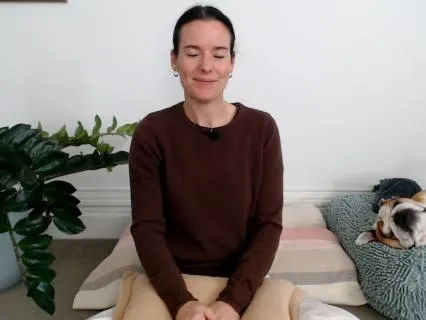
And just as Ginger is so beautifully demonstrating,
One of the other pillars is creating a sense of safety for people to rest.
To pause.
To maybe skip something.
Really encouraging that sense of rest,
Taking a pause.
In trauma-informed practice you might hear a lot of invitational language.
So rather than cues or directions or demands.
Language that invites you to maybe or perhaps.
You might like to.
Really offering that space for someone to choose.
Is this something that I want to do to explore?
Is this an option that is going to support me?
And then one of the other pillars.
Probably the one that really defines most of my own.
Facilitation.
Is agency choice.
Autonomy.
Empowering people to make.
Decisions and choices for themselves.
Encouraging exploration,
Discovery.
Life experiences,
Especially of trauma.
Can create a sense of hopelessness,
Helplessness.
As though we have no choice.
And so in movement or mindfulness or breathing.
We might start to practice.
Making choices and decisions.
Taking back some of our agency.
Seeing what it's like to Have that autonomy to decide.
To modify,
To adapt,
To skip.
So those are some of the ingredients of trauma-informed practice.
Not an exhaustive list.
Something you might look out for next time you are in a practice.
Thank you so much for joining me and Ginger and being patient with her sweet,
Sweet snores.
Perhaps we will see one another in a practice here on Insight Timer soon.