Reality is not what it seems.
Our brain works by filtering.
Thousands of data points that are entering us simultaneously through the eyes,
The ears,
Internally,
Everywhere.
It selects and filters the ones that are important,
Presents that to consciousness and discards the rest.
So even on a base biological level,
What we're perceiving is not the totality of the truth that is happening,
Right?
On top of that,
We add tricks or rather shortcuts of perception to make sense of the information coming in.
We have biases,
We have thinking patterns that derive from how we survived our past,
And a variety of other habits and processes and modes of behavior to get us through it.
Thoughts will pop in randomly into our mind and we simply just respond to them.
If you take a moment and just watch the contents of consciousness,
You'll start to notice that Things just pop in there and it's without or outside of our control.
Now we can insert thoughts into our mind.
We can say,
Hey,
I'm going to think of a giraffe wearing this hat.
And it will be put in there.
But I externally put that into you.
Now you can choose to think of a thought.
Let's try it right now.
Close your eyes and just Take a breath and settle.
And put a thought into your mind.
Do it now.
What thought did you put into your mind?
Who chose or what chose the thought that you inserted into your mind?
Where did that initial point come from?
Let's try something different.
Close your eyes once again and just.
.
.
And see what thoughts pop up.
I guarantee you,
Thoughts will be popping up.
Or maybe your focus moves to sensation or other things.
But the point is,
Is that you're not really even choosing what goes on.
It just sort of happens.
The information comes in,
We don't get it all.
The conscious part of our mind doesn't get it all.
We filter that through biases and habits and patterns of behavior and other things to best help us.
To save energy to best survive our environment.
And the way that we're even processing or thinking about it doesn't even really involve much choice.
So what are we left with?
Are we left with a system of or a processing machine,
So to speak,
That is devoid of free will.
There's a lot of discussion down the neuroscience route.
And down the free will route that suggests that maybe there is a literal conflict here.
Maybe we don't have as much choice,
If any.
Things happen,
We respond,
If we are purely biological.
Atoms hitting atoms and we trace back.
What we are.
The working of the mind to the initial point,
Whatever point that is,
And it goes stepwise to here.
Now that can be a confronting thought to face because it means we have no choice and it sort of really does feel like we have a choice.
You can choose to Do whatever you like.
But can you?
Because it will feel like the choice is yours to make.
But if I said to you,
Raise a hand,
Left or right?
You will raise one of those hands.
But did you truly choose the hand that you would raise?
Is the part of you that is choosing,
The part of you that is acting,
Is it all happening at the same time?
Maybe I'm speaking nonsense here.
Maybe this is all just like whatever.
But I know that the more that we meditate,
The more that we contemplate,
The more that we dive deep into a mindful observation of the mind.
The more I start to see how little control I actually have.
My mind,
When does I bring it back?
My mind,
When does I bring it back?
And I'm like,
Wow,
My mind really is.
Just a barrel of chaotic monkeys.
Practically speaking.
Whether or not we believe we have free will or not,
We should act like we do.
Why?
Because it guarantees us the best outcomes in life.
But what should we do with that free will?
We can gain some control over the chaos,
Over the lack of choice,
And grant ourselves a little bit more space and freedom.
Simple practice,
Base mindfulness practice.
You pick an anchor.
For example,
The sensations of the breath at the nose.
Your mind wanders,
You bring it back and you do that again and again and again.
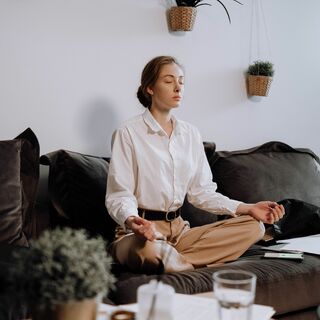
Let's try a little micro meditation on that.
Close down the eyes.
Allow your breath to return to its normal rate.
Focus your sensations on the breath.
Pay attention to the breath.
When your mind wanders,
Just gently,
Lovingly bring it back.
Goal of this practice is not to empty the mind,
It's to become aware of where the mind is in this moment,
And then bring it back to focus.
We're training awareness and focus.
So how did you go?
That is your first introduction to mindfulness meditation.
You may have found that your mind is wandering significantly,
Unable to maintain focus.
That is okay.
We practice,
Everything is a skill.
That means that you may not be that great,
Or it may be challenging at the start,
But with practice we get better.
We practice.
Returning our focus.
Discovering where our focus is.
It's gone.
Somewhere else.
Bring it back to focus.
Oh,
It's over there.
Bring it back.
That's the practice.
Granted,
All of the things we talked about.
During this session still hold true.
But we're granting ourselves a little bit of focus,
A little bit of choice,
A moment where we can go,
Oh,
Our mind's wandering.
I didn't choose where it wandered.
I've seen it.
And I'm taking control of it.
Putting it back here.
Oh,
Back here.
And over time.
With practice.
Daily repetitions.
With mindfulness.
We learn to focus the mind.
And eventually it calms and stays more focused.
It's a skill to practice.
Thank you,
And I'll see you in the next session.