Hello and welcome to today's mindfulness session.
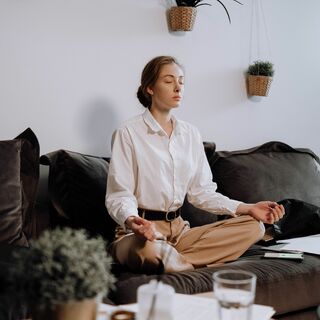
Please take a seat in a comfortable position and close your eyes.
When we begin a mindfulness session,
It's always good to set an intention.
Just a brief statement to remind ourselves of what we're doing.
To get us into the zone and to make sure that we're putting our efforts into the task at hand.
So say to yourself,
For the duration of this session,
I will observe my breath mindfully.
I will return my focus gently back to the breath when my mind wanders.
So now draw your attention to the sensations of your breath entering and leaving the nose.
And we are going to start by counting each in-breath and out-breath for 10 breaths.
So as you breathe in,
You will note to yourself 1,
1,
1.
And as you breathe out,
You note to yourself 1,
1,
1.
And I want you to repeat this process all the way up to 10.
At the end of the 10 breaths,
Stop counting.
Enjoy your attention.
Back to the breath at the nose.
Counting is a great tool to return your mind back to focus when it's wandering.
As well as a great way to get into the session at the start.
If at any stage you find your mind wandering,
If you notice that you're distracted,
If thoughts pop up,
Moods,
Emotions,
Memories,
Gently acknowledge them and return your focus back to the breath.
The act of noticing distraction is the act of mindfulness meditation.
You notice a distraction and return your focus back to the meditation object.
In this case,
It's the mindful focus of the breath entering and leaving the nose.
If you find your mind wandering and counting isn't quite helping,
You can also try the tool of labelling.
So if you notice a thought,
Turn and look at the thought.
Observe it mindfully.
Make it the temporary focus of your mindfulness meditation.
How big is it?
What does it feel like?
Are there any related sensations?
Just observe it for what it is.
And then label it.
Label it as thought.
You can use this process for emotions,
Moods,
Memories,
Physical sensations,
Sounds.
Simply observe them,
Investigate them,
Label them and watch them go.
And then gently and calmly return your focus back to the breath.
You can use this process for emotions,
Moods,
Memories,
Physical sensations,
Sounds.
You can use this process for emotions,
Moods,
Physical sensations,
Sounds.
For the remainder of the session,
I want you to redouble your efforts.
Focus on your breath like it's the first time you've ever focused on it.
Like it's the first time you've ever taken a breath.
Study it intently,
With full focused attention.
You can use this process for emotions,
Moods,
Physical sensations,
Sounds.
You can use this process for emotions,
Moods,
Physical sensations,
Sounds.
You can use this process for emotions,
Moods,
Physical sensations,
Sounds.
You can use this process for emotions,
Moods,
Physical sensations,
Sounds.
You can use this process for emotions,
Moods,
Physical sensations,
Sounds.
You can use this process for emotions,
Moods,
Physical sensations,
Sounds.
You can use this process for emotions,
Moods,
Physical sensations,
Sounds.
You can use this process for emotions,
Moods,
Physical sensations,
Sounds.
So rather than just ending this session and jumping up and going on social or talking to someone or eating or starting another task,
Right now set the intention to bring some mindful focus into your day.
Because that's the entire point of why we practice.
We don't practice mindfulness meditation to be good at meditating formally.
We practice mindfulness meditation to be mindful throughout the day.
It's the same as someone who exercises.
You work out in the gym so you're strong in everyday life.
The more mindful we are throughout our day,
The better our decision making.
We will be more calm when interacting with our family,
Friends and in the workplace.
And this calmness and clarity will produce better outcomes for everyone involved.
So repeat to yourself,
I intend to bring my mindful focus off the meditation mat and into the rest of my day.
This guided meditation has been taken from my book,
Mindfulness,
A guidebook to the present moment.