Today we are working with the face and the jaw.
When the nervous system moves into fight,
Flight,
Or freeze,
The jaw is one of the first places to respond.
Think of what happens when you are running away from danger.
Your teeth clench,
Your tongue tightens,
Your brow,
It furrows,
And your face takes on this hardened expression.
For many people,
This holding pattern does not fully unwind.
Modern life keeps us stressed.
We push,
We hold,
And our jaw learns to stay on duty.
Over time,
This can show up as prolonged clenching,
Grinding,
Facial tension,
Headaches,
And TMJ problems.
If you suffer from any of these,
This practice is going to be amazing for you.
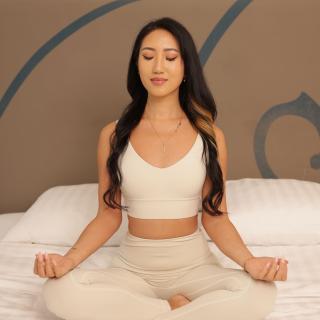
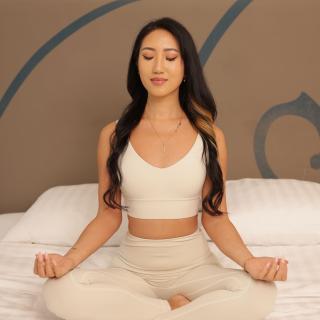
This practice will be done seated.
Please go now and wash your hands because you will be touching your face for the self-massage sections.
When I cue knuckles to massage,
Please note that I mean the knuckles you would use to knock on a door.
Dim your lights and get your seat set up,
And we will begin.
Sitting up straight,
Close your eyes,
And start to notice the way you're holding your face and jaw.
You don't need to change anything.
Simply observe.
Perhaps it feels tight,
Relaxed,
Tense.
Simply note.
Slow down your breaths,
And now separate your teeth just slightly,
Using your tongue.
Start to explore the roof of your mouth.
Move it to the front,
Back,
The sides.
Feel the backs of your teeth.
Note the texture of your palate.
And as you explore the roof of your mouth,
You may notice some changes occur in your body.
You may notice more saliva.
You may want to sigh or yawn.
These are all signs that your vagus nerve is shifting your body into a state of rest.
And bring your tongue back to centre,
Teeth slightly separated.
And let your tongue be completely heavy.
Deep,
Smooth breaths.
Moving in slow motion,
Very slowly.
Start to open your mouth.
If you have a clicky jaw,
Stop just before your jaw wants to click.
And then slowly close your jaw.
Everything in slow motion.
And again,
Open,
And close.
One last time.
Gently opening,
And gently closing.
And bring your jaw to a half-open position.
And start to shift your lower jaw from right to left.
Right to left.
Explore this range of motion of the joint.
Always moving within your pain-free range of motion.
Listen to your body.
Breathing deeply,
And bring your jaw back to the half-open position.
And now you're going to move it forwards and backwards.
Here we're exploring all the range of motion of the jaw.
Back to the half-open position.
And now move your lower jaw in a circle.
From the front to the side,
To the back,
To the side,
And to the front.
Have fun exploring this movement.
And draw your circle the other way.
And bring your jaw back to centre.
Now open your mouth wide.
Stretch your lips apart,
Both up and down,
And from side to side.
As if you are doing a silent scream.
Jaw open.
Lips spread.
And slowly close your mouth and your lips.
One more time.
Open your jaw wide.
Pull your lips back.
Contract your facial muscles.
And closing again.
And one last time.
Opening wide.
Contracting the muscles in your cheeks,
Your eyes,
Your jaw.
And close.
Feel the waves of relaxation spread across your face as your muscles relax.
Continue to sigh or yawn,
Release whatever needs to be released.
Keeping your teeth separated and your mouth closed.
Move your lips all the way over to the right side of your face.
Feel the stretch on the left side of your face.
Move your lips to the left,
Stretching out the right.
Back to centre.
Notice which side of your face feels tighter.
Lips to the right.
Back to centre.
And lips to the left.
Back to centre.
Deep inhale.
Slow and long exhale.
Using the knuckles you would use to knock on a door.
Bring them up to the area just in front of your ears,
Right where your TMJ sits.
Place firm pressure here.
And start to circle your knuckles backwards.
Massaging the joint.
Stretching the fascia that runs through the side of your face.
Note any imbalances between the left and the right.
Any discomfort.
Any tightness of the fascia.
Feel how the skin moves and glides over the joint.
And relax your hands down.
Shake out your wrists and your fingers.
And now bring those same knuckles up to your temples.
And move them backwards.
So they're resting on your scalp instead of your face.
Place moderate pressure here.
And again,
Start to massage in circles.
Backwards.
Releasing your temporalis muscle.
And the fascia that covers your skull.
Feel how your eyebrows and eyes relax as you do this.
Explore this area.
Moving your knuckles to different areas.
And you may find some tender points.
Spend some extra time here.
And release your hands away from your head.
Shake out your hands and wrists.
And place your hands back onto your lap.
Palms facing up.
Notice any shift in your facial muscles and your jaw.
Notice the relaxation of your forehead.
The heaviness of your eyes.
The softness of expression in your face.
You may find yourself smiling.
Stay in this moment.
Breathing deeply.
Enjoying the softness.
The openness.
And the complete relaxation of your face and jaw.
Stay in this moment.
For as long as you need.