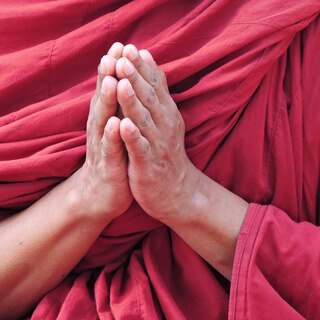
Is it possible to use pleasure as part of a meditation practice?
At a certain level of Buddhist practice,
Pleasure is something to avoid because it causes attachment.
Attachment is an agitated state of mind that can't ever be fully satisfied and leads to craving and addiction.
But from another perspective,
Pleasure can be used as a way to deepen just those qualities that we most want to expand through meditation—the qualities of concentration,
Loving-kindness,
And understanding the ultimate nature of reality.
Settle into your meditation posture,
Cross-legged on the floor with the cushion elevating your seat,
Or on a chair with your legs straight,
Feet flat on the floor.
Straighten your back,
Relax your shoulders,
Your neck,
Your face,
Your arms.
Let all the tension run out,
Slightly tilt down your head,
Just barely open your mouth.
Touch your tongue to the roof of your mouth if that's comfortable,
And half-close your eyes.
If any of these instructions don't suit you,
You can modify your posture so that you feel comfortable,
Relaxed,
And alert.
Now generate a positive motivation for meditating.
We're meditating not just to relax or to increase our focus,
But to bring out all our best qualities of kindness,
Generosity,
Patience,
Attention,
Ethical behavior,
And an everyday joy in the wonders of being alive.
In particular today,
We're meditating to understand how to enjoy life's pleasures in healthy ways that further our inner development.
To stabilize the mind,
Focus for one minute on the breath.
Pay attention to air as it flows in through the nostrils,
Then notice how there's a pause,
A still moment for an instant,
And then feel the breath as it goes out of your nostrils.
You're feeling the breath,
Not observing it as if it were separate from you,
But rather seeing that your breath is one of the many things that come together with the collection of atoms,
Cells,
Thoughts,
And processes that you call yourself.
For one minute,
Watch the breath and see that your breath is you.
Now we move into an analytical meditation.
The type of meditation that uses a stream of thoughts to steer our mind toward one of its good qualities.
In this meditation,
We use a memory of a pleasurable experience to enhance our ability to focus our mind single-pointedly,
Using pleasure to increase concentration.
Bring to mind an instance of pleasure you've had recently.
It could be a sensual pleasure like eating delicious food,
Being in a beautiful place,
A great conversation,
An enjoyable sexual experience,
Or the fun of reading a great book,
Listening to a song you love,
Or watching a great show on Netflix.
It could also be a pleasure of a good deed,
Like making dinner for your family,
Or listening to a friend who really needs help,
Or accomplishing something at work that benefited someone else.
Don't worry right now about whether you feel strong attachment to this pleasure.
Just bring it up without any guilt or worry,
Wishing to use a memory of pleasure to see how pleasure focuses our attention.
Now let your mind merge into that pleasurable experience as deeply as it can.
See if you can maintain a single-pointed focus on that pleasurable experience for a minute.
And as you do,
Notice how a smile may come to your lips.
See how that smile is not only a result of the pleasant memory,
But also notice how being focused on this experience and nothing else is also a pleasant feeling.
The concentration itself is also pleasurable.
See how you get a taste of the happiness of concentration,
What they call the bliss of meditative concentration,
When you focus on a pleasant memory.
And then,
Coming out of this meditation on a specific pleasure,
Make a small determination to try and notice the way your mind is focused and concentrated the next time you have such pleasure,
And to start to use pleasure when it occurs in life to enhance your concentration.
Next we'll look at pleasure as a way to understand impermanence.
Pleasurable experiences,
Like all of everyday life's experiences,
Are impermanent.
Whatever that pleasure is,
It runs out,
It finishes,
And it's often uncertain whether or even if we'll enjoy them again.
If we could enjoy pleasures without the anxiety of worry about when it ends or if we'll experience it again,
Wouldn't our enjoyment of that thing or experience be so much greater?
Then we could be fully present for that meal,
That walk on the beach,
Or for our lover.
So in this meditation,
We bring to mind the same pleasurable experience,
Or a different one,
If you like,
From recent memory.
Do that now.
And then,
As your mind settles into this pleasant memory,
See if you can first analyze how it's logical that this experience is impermanent.
It's natural for a meal to end,
Or a walk,
Or an intimate encounter.
In fact,
It's one of the most fundamental aspects of reality.
When our mind wants pleasurable experiences to last forever,
It's literally railing against the entire universe as we understand it.
Because nothing we've observed in the universe so far is permanent or unchanging.
So see if you can mix your memory of your pleasurable experience with an acceptance of change for one minute.
Now this is a little harder,
But imagine if this were the last time you enjoyed this experience.
There's so many reasons it could be the last time you enjoy something,
But we rarely think about this.
With a friend or an intimate partner,
That relationship could stop for any number of reasons.
For beautiful places,
We might move away.
For foods we enjoy,
We might be deprived of them.
And of course,
There's the possibility of death that eventually takes us away from all these pleasures.
So see for a moment if you can simply imagine that you might be okay enjoying this thing or experience for the last time.
It may be difficult,
But this is only a mental exercise,
A kind of fantasy to build the muscle of accepting impermanence.
So do this now in your imagination.
Try to be okay with the inevitable parting from this pleasure that might occur in a day or in a hundred years.
We go on now to using pleasure to expand our love and compassion.
Bring to mind again a pleasurable experience.
The same one is fine,
Or a different one if you want some variety.
Settle into the pleasant feeling of that memory now.
And then,
In your imagination,
Imagine that you share this pleasure with everyone on earth.
If it's food,
Imagine that you're giving all 7 billion people on earth this delicious meal.
Or being in a beautiful place,
Wish that everyone on earth had the access and free time to enjoy such a beautiful place.
Or if it's an experience of being with friends or family or with your intimate partner,
Wish that everyone is able to enjoy a good friend,
A loving family,
Or the love and care and sensual connection with an intimate partner.
Do this for a minute now,
Silently,
Visualizing as well as you can sharing your pleasure with the whole world.
Now we use pleasure to try and see more deeply into the nature of reality.
Bring to mind an object of pleasure again.
Settle into that good memory.
Enjoy it.
Notice how,
When we are absorbed in a pleasurable experience,
We don't feel separate from it.
Because it's so enjoyable,
And we're so focused,
It's like we merge with the pleasurable experience.
We fuse with it.
We are that pleasurable experience in a way that shows the non-duality of reality.
How in a way,
We become whatever we focus on.
And the stronger our focus,
The more we experience non-duality.
Now that you've thought about this intellectually,
Try and let yourself immerse more deeply in the experience of non-duality that's possible in a pleasurable experience.
See how you can let go of your separate sense of self a bit when you enjoy something pleasurable.
When you're enjoying that slice of cake,
It's like you become it.
When you're listening to a great song,
In a way,
You become the song.
Or when you make love,
You're not separate from the experience of making love and the partner you're making love with.
You fuse then too into the experience.
That softens and expands your sense of separateness.
So try and let yourself deepen this feeling of non-duality,
Of not being separate from your memory of pleasure now,
For a minute.
Finally,
Notice how in this meditation on pleasure,
You become fearless.
That sometimes when we think of ideas like non-duality or selflessness,
It can be scary,
Because we feel like we're losing something.
But when we meditate on our non-duality with a pleasurable experience,
There's no fear,
Because what we're dissolving ourselves into,
This pleasurable experience,
Is something we enjoy,
Something we like.
And it feels good to let go of our hard,
Separate ego and merge with something that feels good.
Notice this now as you stay with your memory of pleasure.
How even as you let go of a solid,
Separate,
Partless ego-self to merge with your object of pleasure,
How you're free from fear.
Fearless.
Now,
As you come out of the meditation,
Decide for yourself whether this experience was pleasurable.
Is meditating on pleasure pleasurable too?
Try and take away some of these ideas to apply the next time you enjoy pleasure in real life.
The purpose of meditation isn't to be separate from everyday life,
But to prepare us to have the same constructive thoughts and feelings and realizations we had on the cushion in real life.
If you found this meditation beneficial,
Make a small resolution now to try and bring back these ideas,
These mental tools,
The next time you enjoy pleasure.
Remember how we can use pleasure to increase our concentration.
We can use pleasure to understand impermanence.
We can use pleasure to increase our love and compassion.
We can use pleasure to see the non-duality of reality.
And we can use pleasure to become fearless.