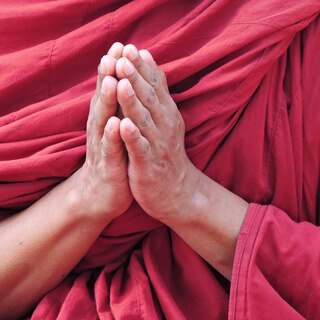
This is a skeptic's path to enlightenment,
And this is our very first meditation session.
I'm going to take you through a complete meditation session here,
Albeit a short one.
And there's going to be both a stabilizing component,
Where we focus on our breath quietly,
As well as an analytic component,
Where we look at our thoughts and even try to turn the mind on itself and look back at the thinker and see what the nature of our awareness is outside of those thoughts.
So to begin,
We want to arrange our body.
There's a very strong connection between the body and the mind,
And adjusting your posture in certain ways helps to support the concentrated,
Relaxed focus that you need for meditation.
If you're comfortable with it,
Sit on a cushion.
To elevate your spine a little bit helps to aid concentration.
You can cross your legs in any way that's comfortable.
And if you're not comfortable sitting on the floor,
Or if your knees hurt when you do that,
You can sit in a chair.
In that case,
Don't cross your legs.
Just let your feet rest flat on the floor.
And then whether you're in a chair or on the floor,
You can place your hands on your knees if you like,
Which is a very stable meditation posture.
Or you can place your right hand atop your left hand and touch your thumbs together.
That's a posture that focuses our awareness.
Just see which one is right for you and try to maintain that posture throughout the meditation.
After finding your seat,
The next thing we can do is adjust our spine.
Having a straight,
Aligned spine is the most important aspect of focusing your mind,
Adjusting the body to support concentrated awareness.
And so what you can do is tilt your body forward and back.
Adjust your spine until it feels straight up and down.
And you should actually be able to see subtle changes in your concentration even as you do this.
It's kind of like tuning a radio.
And when you find the right spot,
Just try to sit there.
Then tilt your head downward slightly.
It takes out the little curve in your spine.
Takes a little pressure off your neck.
You can look down on the floor and find a spot three or four feet in front of you to focus on.
And your eyes,
They say,
The most ideal way to hold them is to leave them about 80% closed and let a little bit of light come in.
That light keeps you awake and aware,
But the mostly closed eyelids help you focus inward.
If you start to get sleepy like this,
You can open your eyes.
And if you start to get distracted with open eyes,
You can close them completely.
Next we try to relax our body.
Try to relax your shoulders.
Sometimes that can be done by actually squeezing them up and then releasing them to release all the pressure in your neck and shoulders.
And then tell the muscles of your face to relax your brow,
Your cheek,
Your mouth,
Your ears,
The sides of your neck.
And slightly open your mouth and touch your tongue to the roof of your mouth,
Which helps to diminish the saliva accumulating.
And then with your posture adjusted like this,
You should already feel some greater focus to your mind.
A little bit better clarity.
And so we begin a meditation session with a motivation.
You can start personally just thinking whatever has brought you here.
There are many,
Many things you could have done with your time right now,
But you've chosen to do a meditation.
And so what is it that brought you here?
It might be some mental trouble you're trying to deal with,
Or it may be wanting to cultivate your better qualities.
A nice way to think about this is that there's nothing better I could be doing with my time right now.
It's rare that we can say that.
But there's nothing better that we could be doing than focusing inward,
Getting to know ourselves of who we are without stimulation,
Without plans and regrets.
Who are we underneath the busyness of daily life?
And we can think that we're working to gently improve ourselves,
To condition our mind towards beneficial and less neurotic states.
And to do this not just for our own happiness,
But for the happiness of everyone around us,
Our family,
Our friends,
Our coworkers,
And even the strangers.
Just a smile can make a difference in a stranger's day.
And next we use a simple visualization to help support our meditation.
And so what we can imagine in front of us is a great field of light.
It's like a dense fog that extends infinitely backward.
But the little particles of that space each emit light.
It's comforting and warm.
And within that space you can imagine all the best qualities of the human mind.
Imagine that that space is filled with kindness.
Imagine that it's filled with patience,
Generosity.
Imagine that it's filled with compassion,
The wish for others not to suffer.
Imagine that it's also a space of wisdom,
Space that understands the impermanence of things,
How things change and disappear.
And a space that even understands the interdependent nature of reality,
How all things are intertwined.
And if you know anybody who embodies these qualities,
You can imagine their mind mixed in with that space.
Their famous figures,
Historic figures.
They may be a teacher that you have.
But even better sometimes are ordinary people,
People that we've encountered in our lives,
Humble people who are naturally kind and warm and open.
They're often caregivers like nurses or hospice workers.
Very often mothers.
So think of the goodness of people that you know and mix their minds with that space.
And it can also be a good moment to remind ourselves of the goodness in the greater world.
Not that the articles and the news that we listen to emphasizes the divisions and the fights,
But is that really the bulk of thought and interaction that's happening in the world right now?
Even just considering the great mass of mothers in the world,
Few of them are angry,
Divisive,
And selfish.
Is it possible that the mass of activity in the world actually tends towards goodness,
Kindness,
And getting along?
And so now let that space of all of our best qualities advance towards us.
And as it does,
It envelops your body.
Your body feels lighter,
Becomes infused with these qualities.
And we feel our own potential to take on these qualities.
That within us is kindness,
Generosity,
Patience,
And openness,
Compassion.
A wish for others to be happy,
Not to suffer.
And also a mind attuned to how things really exist.
The changeability and fragility of life and the interdependence of things.
And so with this support,
The good qualities that we embody and that we can strengthen,
We let it color a stabilizing meditation on the breath.
So we move into focusing on the breath.
You can pay attention to the breath as it comes in and out of the nostrils.
As it comes in,
You can notice that it's cool.
You can feel your chest expanding.
As your lungs become full,
There's then a pause.
And then the breath naturally moves out,
Warmer,
Moister,
Out through the nostrils.
And there's no need to change the way that you're breathing.
You can notice whether your breath is fast and shallow or slow and deep,
Regular or irregular.
Simply try to put all your focus on the breath.
And it's quite likely that other thoughts may intrude on this focus.
You might find yourself having memories of the past.
You could find yourself planning for the future.
Different types of pain,
Cold or heat in the body,
Sounds.
So whatever they are,
As different thoughts and perceptions arise,
If you can just try to gently let them fade away on their own.
There's no need for you to pull those thoughts close and examine them,
Give them your attention.
But there's also no need to push them away.
The thoughts will naturally dissolve and you just gently steer your attention back to your breath.
So just for a few minutes,
We'll try this now silently.
Bring your awareness to your breath and try to remain aware of when you get distracted by another thought or feeling or perception and steer your mind back to the breath.
And now,
With a stabler mind,
We move into the analytic component.
We're going to take a moment of our meditation.
For this meditation,
You can allow thoughts to arise in your mind.
Don't try to control the mind at all.
But try to keep some distance from the thoughts.
To watch as they grow,
As they take your attention,
And then as they diminish.
And as you become aware of thoughts,
Simply try to label them for what they are.
One thought might be a memory,
Another might be a plan.
You might have a thought of regret or pride.
Other types of thoughts are associated with perceptions,
Feeling a pain in your body,
Hearing a sound,
The light coming through your eyelids.
And so with each of these,
Simply try to label it.
Let the thought pass.
Paradox of this meditation is that sometimes wanting the thoughts to appear,
Allowing the thoughts to appear,
Actually clears your mind better than the stabilizing meditation.
Because now we're trying to attend to our thoughts.
And that's okay too,
If you notice there are no thoughts in your mind.
Just notice that and label that.
And so for a couple minutes,
Let's do that.
Maintain the distance from your thoughts.
Watch them.
Label them.
Let them arise,
Abide,
And diminish.
Let them arise.
Let them arise.
Let them arise.
Let them arise.
Let them arise.
And now,
Try to direct the mind back upon itself.
The mind without thoughts,
Looking at the mind without thoughts.
Simply try to see who you are in that nature of awareness.
Through that meditation,
We've established that we aren't our thoughts.
We have a sense of ourself that's separate from the thoughts that pass through our minds.
But then what are we?
What is that awareness that sees the thoughts that can label them?
And so look at it with curiosity,
Without seeking any specific answer.
You can first look and see if there is a size or a shape to your consciousness.
Does it feel small and tight?
Does it feel big and expansive?
Does your consciousness have a location?
Does it feel like you're inside your head?
Or down near your heart?
Or through your whole body?
Or dissolving outside of your body,
Expanding part of the space around you,
The room?
And does your consciousness have any color to it?
Is it dark or light?
Is it tinted in any way,
Towards any hue?
Does it appear the same or does it seem to change?
For another minute or so,
Just let the consciousness look at itself,
Open-minded.
Something you may notice about your consciousness is that it has a mirror-like quality,
That it reflects the thoughts and feelings and perceptions that pass through the mind.
But it's not like a flat mirror,
It's three-dimensional,
Almost a holographic type of mirror.
Through this process of looking into your mind,
You also become aware that we never experience outer reality directly,
That everything we see is this reflection,
This model.
Whether it's a constructed model of the light coming through our retinas,
The vibrating air coming through our ears,
Or whether it's a fully fabricated construction coming from our memory,
Our imagination.
And so this is how you take the mind itself as an object of your meditation.
Then you can gently let your attention roll off the mind,
Becoming more aware of your body again,
Your breath.
Notice the quality of your consciousness now after the meditation session.
And then finally we make a dedication to end the meditation session,
The time you can feel quite good about yourself having spent a few minutes of real lasting benefit to your mind.
If you believe in the benefits of meditation or if you've seen them yourself,
We can think that we've advanced ever so slightly towards a calmer state of mind,
A more wholesome state of mind,
A more open state of mind,
A state of mind where we can be present and aware for others,
And we can control the disturbing thoughts and impulses a little better.
So we dedicate all the benefits that we might have gained from meditation towards moving ever so slightly towards those beneficial states of mind,
And just letting the disturbing states evaporate.
And to see if we can carry through that state of awareness where we're aware of the thoughts,
Aware of our perceptions,
Where we don't get entirely caught up,
Captivated and controlled by them,
See if we can take that state of mind into our everyday life as soon as we get up off the cushion out of this meditation.
See if you can carry that into the rest of your day,
Or if you can recall it at some times during the day,
To become fully present and aware.