Welcome to the space.
I've got a really lovely pranayama practice we're going to do today.
It's one that I was taught by a gentleman called Iyengar,
Who is Medhi,
Or certainly was based in Mysore.
And I studied with him several decades ago.
Mysore,
India that is.
It's a very traditional pranayama style.
And we're going to explore how it feels.
Our intention this week is equanimity.
Feeling the edges of where we can go to and then come back to ground.
Pranayama is a really great way to play with that.
Breath is really evocative,
Emotive.
The actual source of our life and ardour.
So don't be surprised if it feels too much or you need to take breaks.
It's the very nature of equanimity,
Isn't it?
Noticing how things are.
Going along when it feels okay,
Good enough.
And then changing direction,
Making a different choice.
When it starts to feel not okay.
So just be with that invitation.
To find your edges,
Your balance,
Your ability to come back.
If the edge feels too much.
Defining your seat.
Spine straight.
Back circling your shoulders.
Allowing all the space that your neck needs,
Your throat needs.
Releasing any tension in your jaw.
Noticing the sensation in the body as you start to ground,
Become heavier.
Almost a sense of the sediment within dropping.
We're going to start with some gentle alternate nostril breath.
Nadi Shadana.
Just a few rounds.
So bringing your hand up towards your face.
Gently placing the pad of your thumb on one side of your nose.
And the pad of your ring finger on the other side.
If that doesn't feel comfortable or is just too complicated,
You can do this as a visualization.
You can visualize the breath moving side to side.
If you are bringing your hands,
Your mudra up towards your face.
Let your elbow point downwards and just watch that the shoulder doesn't crawl its way up back towards the ear.
And sometimes that elbow just wants to go out to the side,
So try and keep the arm heavy.
And with both thumb and ring finger either side of your nose.
You can still breathe through the nose,
But it's slightly obstructed.
We're going to move towards a more supple kind of movement.
It doesn't need to be big physical movements.
We'll start perhaps by just noticing how it is to encourage the breath to move through one nostril.
And then breathe out through the other nostril.
And then reverse that.
Our breathing naturally moves from one side to the other throughout the day.
It has a,
Well I have been taught that it has about 45 minutes of breathing focused on one nostril.
And then a transition period and then about 45 minutes through the other nostril.
So it's likely that there is one nostril that's clearer than the other.
And then sometimes when you're in the transition,
Both nostrils just as easy as each other to breathe through.
And of course there's times when you can't breathe through either nostril because they're blocked.
In which case Nadi Shadana is probably not the practice for you today.
So all being well,
We're going to start by just gently holding both nostrils.
And then channeling the out breath out from your left nostril.
This is a cleansing palate of a breath.
You're just going to exhale out anything that needs to be gone before you begin your practice.
Left nostril.
A gentle pinch.
And then we're going to inhale through the right nostril.
And then you're going to pinch to close both nostrils and just hold with your breath in.
And then release the left nostril,
Breathe out through that side.
Breathing in through the left nostril.
Pinch and hold.
Exhaling through the right nostril.
Inhaling through the right nostril.
Pinch and hold.
Exhaling through the left nostril.
Inhale through the left nostril.
Pinch and hold.
Exhaling through the right nostril.
Inhaling through the right nostril.
Pinch and hold.
Exhaling through the left nostril.
Inhaling through the left.
Pinch and hold.
Exhaling through the right.
And bringing your hands down into your lap,
Let your breath go wherever it needs to go as you find that spaciousness.
You're allowed to breathe any way you like.
Where does your breath want to go?
You might start to notice what the count of your breath was.
But we can start to play with the ratios.
So if your in-breath and your out-breath are something like,
Let's say,
Four,
Then you can hold for eight.
You're going to hold for double the length.
And you might find that your in-breath and your out-breath are six,
In which case you're going to hold for twelve.
You might find,
If you have a strong lung capacity,
That your in-breath and your out-breath is more like eight,
Ten or even twelve.
In which case you're going to hold for sixteen if it was eight,
Twenty if it was ten and twenty-four if it was twelve.
There's a huge range in lung capacity.
And there's no shame around where you're at.
It's just interesting to know.
Now let's do another three rounds with the holding for twice the length of the in-breath and the out-breath.
So perhaps bringing your hand up to your face.
Letting the thumb and the ring finger gently press against the nose.
Either side of the nose.
And you're going to start with an exhale out through the left nostril,
Cleansing breath.
Pinch and hold.
And then we begin inhaling through the right.
Holding for as long as is good for you.
And then when you're ready on your count,
Exhaling through the left.
Inhaling through the left.
Your count.
You'll be holding for twice the length.
And when you're ready,
Exhaling through the right.
Two more rounds of that.
And then when you're done,
Releasing your hands,
Bringing them back down into your lap.
Doing a little check-in with yourself,
How's it feeling?
So what's interesting about the alternate nostril breath is the teaching is that we have a left-hand channel of prana and a right-hand channel of prana,
Both of which oscillate around a central channel of prana that is our midline.
So it's often in the imagery that depicts this,
It's often serpents that sort of curl their way around this central midline.
And so when we do this alternate breath practice,
We are deliberately stimulating one side,
Your left side being your feminine aspect,
Your state of being.
And then your right-hand side,
The other side,
Your state of doing,
Your masculine aspect.
And so as we're focusing on equanimity this week,
This plays into the balancing or the equanimity,
The equal priority of masculine self and feminine self,
Not gender related.
Those terms used to describe the ways that we are comfortable with moving in a direction that masculine,
Doing energy that we need.
It's really great,
It's not something to dismiss or sort of frown upon.
And then also our more feminine energy of being more receptive,
More reflective,
Tuning into something,
Some sense of something bigger than just the task at hand.
Again,
Really important,
Not something to be frowned upon,
But held in equal regard with the masculine.
They're both pointing us towards equanimity.
And our next practice is called Shakti Dhyana.
I'm going to guide you through it.
We're going to use a count of six.
So my hope is that that's going to work for you.
You can adapt it once you've got the flow of what we're doing.
Okay,
So for this practice,
We're going to start on the left hand side.
And we're going to inhale for six,
Hold for 12.
Actually change that,
We're going to inhale for six,
Hold for 15.
And then exhale for six,
All on the left hand side.
Inhale for six,
Hold for 15.
And exhale for six,
All on the left hand side.
And then on the third round,
Inhale for six,
Left hand side,
Hold for 15,
And then we'll switch across to the right.
So finding your position,
Bringing your hand,
Your mudra,
Up towards your face if that's what you're doing today.
Just checking no tension.
There's a lot of instruction today,
Unlike our usual practice.
So that's going to be taking you into your cognitive,
More masculine sense of practice.
And that's okay.
We're going to start by breathing in for six on the left hand side.
Hold.
And then we're going to hold for 15.
And then we're going to exhale on the left hand side,
Six.
Inhale,
Left hand side,
Six.
And hold.
Exhale,
Left hand side for six.
Inhale,
Left hand side for six.
Hold for 15.
And this time we move across,
So we're going to exhale right hand side for six.
Inhale,
Right hand side for six.
Hold for 15.
Exhale,
Right hand side for six.
Inhale,
Right hand side for six.
Exhale,
Right hand side for six.
Inhale,
Right hand side for six.
Hold for 15.
When you're done,
Bring your hands away from your face.
Let yourself take a gentle out-breath as you settle yourself into wherever your breath wants to take you.
Allowing yourself to become heavy.
Meeting your experience of that breath practice with kindness.
Allowing you to be you.
You don't have to be a different version.
However this moment is,
However that practice was.
It's okay.
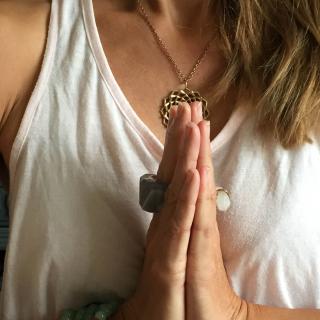
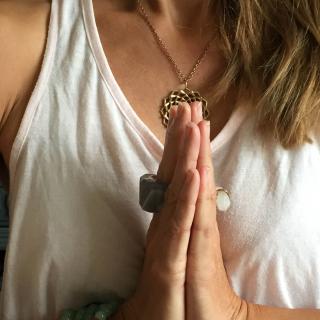
That's bringing your hands up towards your heart.
Equanimity isn't something you reach out for or seek elsewhere.
It's already here.
You already are it.
Offering the fruits of our practice to ourselves.
To each other.
And to all beings.
Namaste.