Hi,
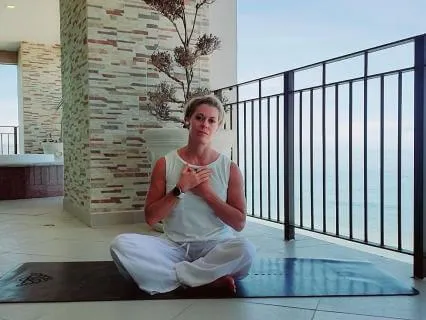
I'm Sherry.
If you've been feeling wired at night,
Holding tension in your body.
Are lying awake with racing thoughts.
You're not alone.
This practice.
Is designed to gently stimulate your vagus nerve.
And guide your nervous system toward rest.
Because this session is for sleep.
I encourage you to do this practice.
While lying down.
Allowing your body to fully relax.
You might also want a chair or wall nearby to rest your legs up later in the practice.
And something soft are weighted.
To place over your belly if that feels grounding.
We'll begin with a gentle reset at the base of the skull.
Lie on your back.
And interlace your fingers.
Place them behind your head.
Elbows resting down.
Without turning your head.
Gently allow your eyes to move to one side.
Whichever direction feels more comfortable right now.
Will hold this peripheral gaze.
For about a minute.
This practice stimulates key cranial nerves that connect your eyes,
Neck,
And head.
To your Vegas note.
When you hold the gaze softly.
Your nervous system gets a chance to shift.
From alertness into ease,
Without effort or force.
Bring your eyes gently back to center.
Pause here and let your gaze softly move to the other side.
As you hold this side,
Notice what begins to happen internally.
You might feel a sigh,
A softening behind the eyes,
Or a swallow.
Whatever you notice is part of the experience,
Even if it's nothing at all.
You're allowing your system to respond in its own way.
Bring the eyes softly back to center.
Allow yourself.
To feel the residue of that practice.
What sensations linger behind the eyes,
Across the forehead,
Or at the base of the skull?
Noted If the quality of your awareness has shifted,
Even slightly,
Gently release your hands.
And rest your arms beside you.
Allow the back of the bed to soften into the support beneath you.
Feel the subtle weight of your hand.
The ground holding me.
Few moments here.
When you're ready.
Bring one hand to the side of your head.
And the other across your body.
To rest on the side of your ribs Allow your head to gently tip toward the hand that's supporting it.
Same time find light pressure with the hand on your ribs to gently pull them across the body creating a soft C shape through your neck and side body.
Shape lengthens tissue along the side of the neck and rib cage areas closely tied to the vagus nerve.
The gentle pressure and breath awareness.
Help regulate vagal tone.
Through both mechanoreceptors and interoception.
Key elements in supporting rest.
Bring your head back to center and pause.
Take your time.
To set up on the other side.
Switching your hands.
And allowing the stretch to gently unfold again as you settle here feel into the space you're creating notice the movement of your breath The contact of your hands.
Any shifts in sensation.
Return your head to center and release your arms alongside you.
Allow yourself.
To feel what's different now.
Is there more space across the collarbones?
More weight in the back body?
Just a little more ease.
Sense how your body is lengthening and softening.
At the same time.
Like water settling into stillness.
You're allowing your nervous system to follow the shape of rest.
In this next practice,
We'll offer gentle touch to the diaphragm.
An area that holds much of the day's tension.
Slide your hands to rest.
Below your rib cage.
Where the ribs curve upward and meet in the center.
Allow your fingers to gently angle upward under the edge of the ribs.
On each exhale,
Apply soft.
Inward pressure.
Toward the diaphragm.
On each inhale release the pressure.
As the breath continues,
Allow your hands to slowly travel outward along the lower edges of the rib cage,
Following the natural curve.
The diaphragm is a key muscle of both breath and nervous system regulation.
And it often holds the imprint of stress.
Most animals evolved with their bellies facing the ground.
Protecting their vital organs.
But humans walk upright.
Which means our soft front body is always exposed.
When we encounter stress or danger,
We often unconsciously brace the diaphragm.
As a way to protect ourselves.
This gentle massage helps release that tension.
And signals to your system that you're safe.
As you continue this gentle massage.
Allow yourself.
To feel the grass moving beneath your hands.
Notice the rhythm of pressing and releasing.
And how your body responds with each rough cycle.
You might sense more,
Softening,
Or a quiet shift in attention.
Whatever is present is welcome.
Slowly release your hands and allow your arms to rest alongside you.
Feel the space.
Across your belly the ease in your breath.
You might notice a little more softness.
Are simply a quiet sense of presence.
Now that the breath has been softened from within one fight the body.
Into a longer wave of ease.
Bring your hands to your temples Begin.
To gently stroke down the sides of your face continuing along the jaw down the neck and across the sternum it feels supportive allow the movement to continue up and down the inner and outer arms Keep the contact soft and slow.
There's no rush.
This type of slow,
Intentional touch activates sea tactile fibers in the skin.
Specialized nerve endings that respond to gentle pressure and warmth.
They signal safety to the brain.
Increase oxytocin and help shift the body into parasympathetic regulation.
As you continue the stroke.
Notice.
How your system responds to this rhythm.
Feel the warmth of your hands.
The softness of your skin.
Are the smooth saddling of the tension.
Allow the movement to become less about doing and more about feeling.
When you're ready allow the stroke to come to a natural close Rest your hands wherever they feel comfortable.
At your sides,
On your chest,
Or over your belly.
Notice what lingers the trace of warmth a change in breath.
Are the sensation of being gently met.
From this quiet contact.
Will move into a position of support and grounding.
Shift into a position where your legs can rest up a chair or a wall,
Knees soft.
If it feels grounding.
You can place a folded blanket,
Pillow,
Are lightweight over your belly or chest.
Allow your arms to rest beside you or gently on your body.
Elevating the legs reduces sympathetic tone by shifting blood flow and calming the lower back and pelvis.
Adding gentle weight to the torso.
Increases vagal tone.
Through pressure receptors that signal safety and containment.
If it feels good in your system.
We can add in a four seven eight breath pattern to deepen this effect slowing the heart rate and reinforcing parasympathetic dominance.
Completing your current exhale,
Prepare to inhale together for 4,
3,
2,
1.
Hold.
6,
5,
4,
3,
2,
1.
Exhale.
7,
6,
5,
4,
3,
3.
.
.
2.
.
.
1 Continuing on to your own pace now.
Allow the breath to follow this four,
Seven,
Eight pattern.
For a few quiet rounds without forcing or rushing.
Feel the weight of your body.
Supported from beneath.
Notice the length of your exhale.
The quality of your attention.
Are the stillness beginning to saddle in?
Allow yourself to feel held from within and around you.
When you feel complete,
Release the breath pattern and return to your natural rhythm.
You can stay in this position or adjust slightly for comfort.
Allow the body to fully rest here.
Nothing to do,
Nowhere to go.
Of this place of stillness.
We'll close with a soft vocal tone.
Using sound.
To soothe the body.
And guided towards sleep.
Staying just as you are.
Bring one hand to your belly or chest.
Wherever you feel the most connection.
Allow your lips to part slightly and prepare to exhale with a soft VOOOMM.
Cell.
V.
O-L.
The.
Repeating at your own pace here.
Feel the vibration in your body.
As you continue.
For a few rounds Resting between each sound.
Allow your voice to settle your system.
Like a lullaby for the nerves.
This Wu sound vibrates through the chest and throat.
Directly stimulating the vagus nerve through the vocal cords.
This kind of sound-based vagal toning encourages the body to shift into a deeply restful parasympathetic state.
Ideal before sleep.
Notice the feeling of vibration under your hand.
Sense the quiet between sounds Feel how your body is responding to your own voice Perhaps softening.
Slowing.
Are gently fading inward.
When you're ready,
Allow the sound to dissolve.
And the breath to return to its own rhythm.
Feel the stillness after sound.
The way silence wraps around you.
Allow yourself to linger here.
Just as you are.
For as long as you need.
There's nothing more to solve or do.
Simply trust the body to take what it needs.
In its own time.
Studies show that sleep is a biological imperative.
You don't have to force it.
Your body knows how to rest.
And you will always.
Find a way to give you the sleep you need.
All we need is get out of the way.
If something in today's practice resonated with you,
I'd love to hear what landed.
I'm a somatic practitioner,
And I work with the nervous system to support trauma recovery.
Go gently and remember.
The body is always communicating with you.
All we need to do Just pause and listen.