Hello there.
Good morning,
Good afternoon,
Good evening,
Wherever you are.
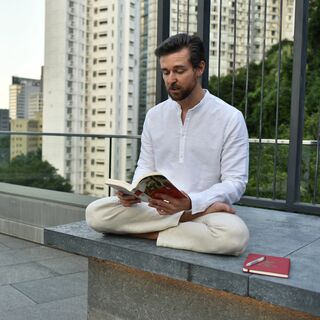
I'm Ryan in Singapore.
Welcome to our mindfulness practice.
Today's topic is.
.
.
What's the difference between mindfulness and meditation?
We hear about both of these things.
But they're not the same.
And there is definitely a distinction between the two.
Why does the distinction matter?
So we'll walk through some of that today.
And I just want to make sure as well that I kind of link it back.
To what we've been talking about.
And so what we came from was respond rather than react.
Responding rather than reacting.
Comes partially from knowing emotions in the body.
And emotions in the body are known through Practicing.
Paying attention to what the body feels like.
So we might.
Notice anger comes with tightness in the chest.
We might notice that sadness comes with a feeling of dropping in the belly.
And of course,
We all experience emotions in different ways.
So I'm just kind of.
.
.
Giving some random examples,
Which may or may not be how you experience these emotions.
The way you're going to find out how you experience emotions is through practice.
So mindfulness is paying attention on purpose in the present moment non-judgmentally.
Observing what's going on right now,
Being aware of What feelings?
That we have.
And I guess when I first say feelings.
.
.
One thing that might pop into your mind is emotions.
And so emotions,
Although.
.
.
Experience cognitively are also experienced as physical sensations in the body.
So when I say feelings,
I don't intend to mean emotions,
But feelings,
Physical sensations.
So what physical sensations can we experience?
So paying attention on purpose.
Intentionally paying attention.
Our attention gets grabbed a lot by a lot of different things in our worlds,
In our daily lives.
And you'll find that these days.
.
.
It's especially easy to get distracted,
That our attention is hijacked.
In fact,
Our attention is maybe one of the most important pieces of capital.
That companies are trying to get.
That you'll find that Pretty much all of your online activity is a war for your attention.
And so.
.
.
Mindfulness.
Is paying attention on purpose.
So having an intention to pay attention and to do our best to focus our attention.
Of course.
We won't always be successful in our attempts to hold our attention in one place.
And the mind wanders away from what we're working on.
As we practice mindfulness more and more,
We might start to see those moments that the attention gets pulled away.
And this is one of the huge benefits of mindfulness,
Especially in today's war for the attention.
So paying attention on purpose in the present moment.
Because.
.
.
The mind is wandering often into the future,
Wandering back into the past,
And doing so without us being aware of it.
So is it possible to intentionally bring attention to what's going on right now?
Instead of being lost in thoughts about the future or thoughts about the past.
And you'll find,
Of course,
That thoughts are happening right now.
So part of being mindful and paying attention on purpose in the present moment is to become aware of thoughts as they happen.
And you'll find that sometimes you're a prisoner of your thoughts,
That your thoughts are happening unwillingly.
And.
When you begin to explore thoughts and thinking.
You can kind of ask yourself where do these thoughts come from?
Is it me who wills these thoughts to generate,
Or are they.
.
.
Where are they coming from?
I think this is a pretty interesting little exploration as we do our practice.
Paying attention on purpose in the present moment non-judgmentally.
So one good reason.
.
.
To not judge our thoughts as they come and go is that exact thing that I just mentioned.
We're not willing those thoughts into our minds.
So.
It can be easy to label a thought as this is a good thought.
This is a bad thought.
I should think more like this.
I should think less of these thoughts.
And you'll find that as much as you.
.
.
Should and say it should all the time It doesn't actually change what is showing up.
That thoughts are just showing up.
The way that they do.
And without your willing.
.
.
Control or your willingness for thoughts to come and thoughts to go.
And maybe that one especially,
Willingness of thoughts to go.
If you can understand that thoughts are just like weather patterns in the brain.
The wind blows,
The clouds come.
And here in Singapore is a really great one for weather because weather is – it really – You know,
I swim.
A couple days a week three days a week and and when i get in the water sometimes the sky is blue and beautiful with a few puffy white clouds and and i i swim a few hundred meters and i look back up and the sky is black and angry.
And that's just something that I've had to accept about weather in this place,
You know.
And you are like a locality.
You know,
Maybe you're.
.
.
Maybe your weather is one that is super chill and predictable and you can even get a weather forecast for your mind.
You can kind of predict when things are coming.
And then there are those of us whose.
.
.
Weather patterns are completely unpredictable and we have no idea when it's going to be a sunny day and when it's going to be pouring rain.
And.
Is it possible for you not?
To judge the place that you're in.
The weather patterns that you're having because the more you examine it,
The more you realize that you don't have control over it.
And so that's mindfulness.
Paying attention on purpose in the present moment non-judgmentally.
Which you can do at any time throughout your day.
You can drop into present moment awareness.
Quite simply by observing the body.
If you're walking around,
You can use the sensation of your feet inside of the soles of your shoes.
And feel how the pressure is changing as you walk.
Each step.
You can tune into the feeling of breathing.
You can feel in any moment or you notice,
Hey,
Wait a minute.
My mind is all over the place.
I'm in the future.
I'm in the past.
I'm anywhere but here.
Is it possible for me?
To bring my mind back to this moment by using the physical sensations of my body,
Which are here all of the time.
We can always Anchor in.
Moment just by noticing.
Physical sensations in the body or sounds,
Which also are only here right now or smells or anything that is coming in through the doors of the five senses.
But sometimes.
.
.
We find that doing this isn't automatic.
And that it's really easy to get lost.
And our train of thought.
And.
.
.
Thinking all of these thoughts about me and how all of this affects me.
So how?
Can I remind myself to come back into the present?
When I'm in my daily life,
When I'm facing a hard situation.
One way is through meditation.
So meditation is setting aside a dedicated time.
To practice being mindful.
And you will discover as you meditate more and more,
This ability is a trainable ability,
This ability of mindfulness to be aware in the present moment when you're walking around in your daily life.
And so as you spend more time in dedicated practice,
Having time dedicated to sit,
To lie down,
To intentionally pay attention on purpose in the present moment non-judgmentally.
You will find that this skill naturally starts to come out into our daily lives.
Just like when we're going to the gym more often and we're feeling more fit,
Hey,
What a surprise.
I noticed today that walking.
You know,
Five kilometers or.
.
.
Or three miles.
I don't get as tired as I used to and that's because I've been training.
I've been working on my body.
And I can do the same with my mind.
So can you.
.
.
Set aside this time and I've learned that daily practice is what is most beneficial to me.
That when I'm practicing every day,
I really see.
The change in my reactivity that I can be a lot more aware of what it is that I'm going to do.
In the next moments or what it is that I'm what it is that it looks like I'm going to do And so when that awareness comes,
Then I start to have this.
Small ability to make a change.
The words for meditate and.
.
.
Tibetan for example the word is gom which means to habituate to familiarize so it's nothing magical it's not connecting with the ether or the universe or drifting off somewhere or having a special feeling.
Meditation is.
.
.
Ordinary.
And it's just.
.
.
Becoming familiar with ourselves.
In the present moment and seeing as thoughts come and go,
Like weather patterns in the mind.
How do my emotions change?
So this familiarization with myself.
The poly word.
Which is the language of the Buddha.
Is Bavana.
And bhavana means to cultivate.
So meditation is about sowing seeds.
And waiting sometimes waiting for a very,
Very long time.
To start to see the practice taking root.
Starting to eventually bear fruit and you know you can start to see fruit and in a relatively short amount of time.
And for me,
I saw my first fruits of meditation in about two weeks.
And then it's just like a few little berries.
It's not like I'm harvesting watermelons yet.
Be patient as you work on your practice.
As Ngoinka says,
You are bound to be successful.
You are bound to be successful.
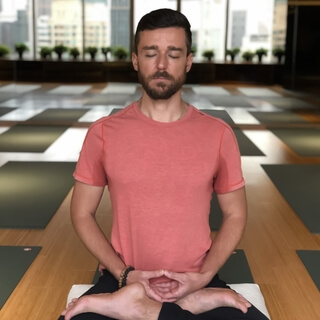
So I just encourage you to find a posture that's comfortable.
One that brings relaxation and alertness together.
So for me,
That's sitting up straight and tall.
And start to notice that you have a body.
You're not just some disembodied soul floating around.
Imprisoned in this body.
In fact,
The more that you meditate and the more you explore.
And cultivate this awareness.
The more you'll notice how much of you is your body.
And I'm not just a passenger inside of this vehicle.
That I am.
And my perception of me.
Is not separable from this body.
So what does this body feel like?
What do your toes feel like?
What do your feet feel like?
What are you observing as you bring attention to your ankles?
Me,
I'm sitting cross-legged today,
So I.
.
.
I have feeling in each of these.
Areas of my body because my legs are touching my my cushion.
My legs are touching each other.
What do your calves feel like and lower legs everything between the ankle and the knee on both legs.
What do you feel?
And now,
How about the knees?
How about the thighs?
What do you feel as you explore the pelvis?
So as you're sitting,
As you're perhaps lying down,
You will feel that your buttocks are taking some of the weight of your body.
And that comes in.
As the perception of pressure.
So exploring to the rest of the pelvis.
Now the lower back.
Now the upper back.
What do you feel?
Are the muscles tight?
Are they relaxed?
How about the belly?
And if we notice tightness in the body.
Awareness of that tightness may cause relaxation,
But understand and remember that this is not the goal of meditation.
Relaxation.
May or may not be there.
We aren't meditating to change anything.
We are meditating to become aware of what's happening right now.
As you pay attention to the belly,
Can you feel it moving as you breathe?
How about the chest?
Can you feel the heart beating?
Can you feel the chest rising and falling with each breath?
Can you bring attention now to your fingers?
To your hands and wrists.
To your forearms.
The elbows.
The upper arms.
The armpits.
Shoulders.
The neck feeling the spine.
Coming up.
Into the base of the skull The throat.
Arteries and veins.
Bringing life,
Giving blood to the head.
Air moving through the windpipe.
The chin.
The jaw.
Mouth.
The teeth.
The tongue.
The nose,
The nostrils.
The cheeks and the ears.
The eyes.
The eyebrows.
The forehead.
Just a reminder,
Right now you don't need to be.
.
.
Having a facial expression.
You're not communicating outwards with your face.
It's possible to just let your face.
.
.
Relax.
And maybe it won't.
Maybe there's residual stress that's just causing your face to stay tight.
Just accepting.
As best you can the way things already are.
So we move attention to the crown of the head.
The scalp.
In the back of the head.
So feel free to allow your attention to expand to the entire body.
From the crown of the head to the tips of the toes.
It's noticing everything.
What's the most prominent sensation you're experiencing right now?
Maybe an itch.
Maybe tingling.
Maybe it's that gentle movement.
Of the body with the breath.
Maybe it's tension.
Other strong sensations.
So I'm going to open up the last six minutes of our time together.
For you to explore This present moment awareness.
For you to really meditate.
Take this time.
So be aware of everything that's going on in the present,
Including.
.
.
As thoughts come.
Can feature those thoughts center stage.
Hey,
Welcome thought.
What is the nature of this thought?
How does it affect my body?
How does it affect my mind?
How does it affect my emotions?
So not daydreaming.
Paying attention to the body as best you can,
And then as thoughts come,
Just being aware of that thought.
Before as best you can releasing it.
Letting it go.
Refocusing attention back to the body.
Maybe thoughts come up and maybe they don't.
Congratulations for having made it through today's practice.
I'll close with three rings of the bell.
Okay,
Feel free to.
.
.
Start to move,
Open your eyes if they were closed.
You can shift out of your meditation posture.
Something that I notice when I meditate is.
.
.
If my posture becomes uncomfortable,
That discomfort can actually become an object of meditation.
I can start to.
.
.
Pay attention to what discomfort feels like.
So.
Thanks everybody for being here.
How did your practice go today?
Feel free to share what came up.
What you experienced?
Were you staying focused?
Was the silence harder?
Or maybe the guided part was harder?
Or maybe it was all really easy.
So what did you experience today?
If you're interested in the research and a lot of the research around emotional intelligence,
And mindfulness's role in emotional intelligence.
There is a book called Emotional Intelligence by Daniel Goldman that he's written.
This is quite a few years now,
But it's interesting.
And I think one of the things that helps to make it interesting and applicable to mindfulness is how.
.
.
What a key role that self-awareness plays in emotional intelligence.
So it's really this,
There's a multi-step process to being able to regulate emotions and awareness is one of the key pieces of.
.
.
Of that being able to have some control.
Our attention gets hijacked so easily.
And as our attention gets hijacked,
We lose that self awareness.
One of the important things to cultivate,
To use the.
.
.
The Polly word for mindfulness.
Is cultivate bodily awareness so that we have an anchor.
To anchor back into.
When we find ourselves getting lost.
And sometimes when we try to look for thoughts,
We find that there's nothing there and then we have nothing to meditate on.
So I do tend to use the body as the foundation of my mindfulness practice and encourage others to do that as well.
So you start with.
.
.
The body and There's reasons for this too in the idea of monkey mind and that the mind is constantly wanting to do things.
This is why we get hijacked.
Because.
.
.
Attention is fleeting,
And attention loves to go to the most stimulating thing,
And sometimes the most stimulating thing is our thoughts.
I mean,
I,
A person who goes on meditation retreat every year,
Can tell you that that's,
You know,
The first few days of meditation retreat are my mind is so used to being stimulated that it comes up with all kinds of thoughts to stimulate me.
So that I so that I won't Stay focused in the present.
And says,
Hey,
I'm bored.
I'm going to stimulate you by thinking all of these crazy thoughts and ideas.
Just to summarize.
Thoughts are an important thing to be aware of.
When we're practicing.
It's.
.
.
For the lay person like you and me.
Very difficult to use thoughts as the primary object of meditation.
Mindfulness is kind of that.
Ground layer right the foundation or the foundation of a strong house the foundation of your mental health And as you become more mindful,
Then this is why we go to therapy and get psychiatric help.
Or read self-help books is to come up with strategies.
Impossible to change the state that you're in when you don't know what state you're in.
Let's close practice now as we do with some well wishes to ourselves and well wishes to everybody else who's here.
So follow along with me if you like.
May I be happy and peaceful.
May everyone watching,
Listening,
Wherever you are.
I wish you all happiness and peace.
May all sentient life here on planet Earth and throughout the universe.
May everyone everywhere be happy and peaceful.
Thanks a lot for joining