Come to a comfortable seat.
You don't have to sit cross-legged.
Any position that allows for a nice tall spine.
Maybe hips a little higher than your knee.
You might close your eyes or find a soft gaze down in front of you.
And just begin to tune in.
Might take a nice full inhale.
And maybe sigh out your exhale.
Let it go.
And just begin to notice.
Your body,
Any sensations in your body.
The weight of your body.
Notice your hips and legs.
And allow.
Your lower body to sink into the support beneath you.
And gently lengthen through your spine.
Reaching the top back of your head.
Towards the sky.
Lengthening the back of your neck.
Soften your shoulders and arms.
You might place your hands,
Palms down on your knees.
To invite a more sense of grounding.
If you've been feeling lethargic,
Or you want to have more of a sense of receiving energy,
You might place your palms up.
And an option to connect to your thumb.
Point your finger into a mudra.
Your palms are up.
Referred to as chin mudra.
Or turning the palms down,
Same position.
Jyana Mudra.
And begin to tune into your breath.
Watch your breath.
Without trying to change it just yet.
You Notice the quality of your breath.
Perhaps it's shallow or deep.
Smooth or choppy.
And then see if you can gently begin to deepen your brow.
And elongate your exhale.
About two counts longer than you're in.
Breathe in and out through your nose.
Soften your lower belly.
So your inhale,
Your lower belly expands gently.
And then just softening and releasing as you exit.
And as we move through our practice today,
Our poses will be held for about five minutes.
You can always come back to your breath.
Or notice sensations in your body.
Take a few more breaths here.
On your next inhale.
Imagine the breath is moving from your tailbone all the way up your spine to the.
.
.
Crown of your head.
Keep that length in your spine.
As you slowly exhale,
Maybe through the mouth,
Like a soft soft.
And gently open your eyes.
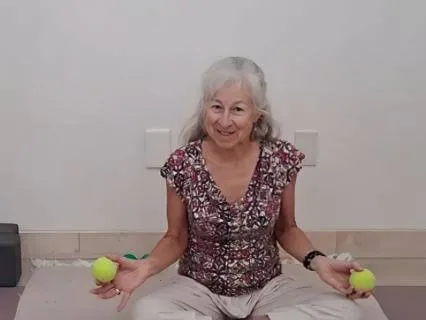
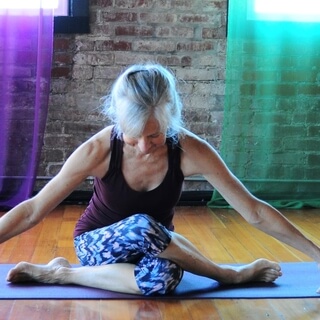
Our first pose is going to be butterfly with an option to use one of your balls.
I'm going to use one of my therapy balls more for the texture.
Of the Tennis ball.
Because we're going to use it on our feet.
So the feet are about a foot away from your hips.
Rather than like a traditional Baddha Konasana.
And then just an option for one of the balls to place it in between the arches of your feet.
And then your hands can sort of help push the feet together.
Or you might have your blocks handy.
One option as you hinge forward slowly is just to have your hands in front of you for support or on your feet or lower legs.
Or you might use the blocks at whatever height works for you.
To rest your forearms on.
Or even your elbows so that your hands can come maybe into a prayer position.
So you can always support your head,
Maybe with your hands or a prop like a block.
You can also use a block to rest your forehead on if you're coming forward a little bit further.
So find your physician.
Maybe not as far as you normally might go because we're going to hold it for about five minutes.
Lengthen through your spine.
And gently press your feet.
Against the ball.
I like it at my arch,
But if you want,
You can put the ball in between any part.
Of your foot a little closer towards your heels or the balls of your feet you prefer.
As you inhale,
Think of lengthening through your spine all the way through the crown of your head.
And then as you exhale,
Invite a softening.
Like you're surrendering into gravity.
To come a little deeper into the pose without forcing.
Legs are relaxed.
And if you can support your arms,
Either on your lower legs or the props like the blocks.
It's a little easier to relax your shoulders and upper back.
If you're not supporting your head,
Keep your neck neutral.
Rather than letting your head hang.
Breathe in and out through your nose.
Inhale option to visualize your breath moving up your spine.
Lengthening.
Creating that space between all your vertebrae.
And then soften into the shape.
Releasing and surrendering into gravity.
Another option here if you're not supporting your hand.
Is to find a little movement into the head and neck.
Just an option.
Maybe slowly turn your head in one direction.
And then slowly come back to center and turn it in the other direction.
Or maybe take one ear towards the nearest shoulder.
Find what feels good to you.
We will get into the neck in another pose as well.
Notice where you're feeling the sensation of stretch.
Probably in the outer hips,
Maybe one more than the other.
You can also send your breath into that area.
Filling the area,
Say your outer hips,
With that prana,
Your life force.
And then as you exhale.
Visualize tension,
Tightness releasing out of that area.
Take a nice inhale through your nose.
And then exhale,
Sigh it out in your mouth.
Let it go.
Slowly press your way back up.
Set your props aside.
Set your ball aside.
And straighten one leg and then the other.
Notice sensation in those outer hips.
Sometimes we'll come into a pose called rebound,
Just like Shavasana,
Or you might find some counter poses.
After butterfly,
I like to do some counter poses.
Of windshield wipers.
So you can sit back a little bit,
Come off a blanket if you were sitting on it,
Widen your feet.
Keep your knees bent and just take your knees over to one side.
And then back up and over to the other.
Now,
If you prefer counter poses,
Over a rebound or vice versa,
Always feel free to listen to your body.
And do what your body needs.
And if anything I suggest doesn't work for you,
Find a modification,
Different pose,
Get creative.
This is your practice.
Okay,
Our next pose.
We're going to get into the net.
So using our blanket,
And opening it up.
Sort of like this shape.
Fringe towards the one end of your mat.
And then start to roll your blanket from the short folded edge.
And roll it about halfway.
This is going to be a myofascial release for the neck.
And place the blanket.
The end of your mat.
And the rolled part of your blanket will be just about the thickness of the width of your hand.
If your neck is longer,
You might want to roll it more.
If you have a shorter neck,
You might need to unroll it a little bit.
Your neck is going to be on the blanket.
Shoulders.
Will be at one side of the blanket,
Not on.
Come to a position with your knees bent initially.
And lay yourself down on that blanket.
Get any hair or fabric of the way.
And make sure that it feels doable for you to lay here.
So the shoulders again are not on top of the blanket.
If they are,
You might need to adjust and unroll the blanket a little bit.
And you might feel pressure on your neck.
But it shouldn't have any sharp sensation.
Once you've found your position,
Then you're going to slowly straighten one leg and then the other.
Now since we didn't do a rebound after the first pose,
This is sort of like a rebound.
So you might notice your hips a little more from what we just did in the first pose.
And as you straighten your leg,
You might notice a little bit of sense of elongation.
Through the neck.
That's what we want.
There'll be some pressure and a sense of stretching through the neck.
But nothing sharp.
Or uncomfortable.
So we're going to relax here.
Not as long as the first pose.
Let your head be heavy.
Take a nice inhale through your nose,
And as you exhale,
Surrender into gravity.
Let your whole body soften.
Little bit deeper with each exhale.
And will have an option for some variations.
Stay present with your breath.
HX here.
Invite.
Your body to relax and release.
A little bit deeper.
Surrendering into gravity.
Letting up.
You Take a few more breaths here.
And then just an option.
To have a little variation here with a slight turning of the head.
Take an inhale.
And as you exhale,
Ever so slightly.
To turn your head to the right.
So you're not going very far.
Just getting a little more pressure onto the right side of the cervical spine.
Take a few breaths here.
Slowly on your next inhale,
Bring your head back to neutral center.
And on your exhale,
Slowly and slightly.
Turn your head to your left.
Getting a little more pressure to the left side.
Head is heavy.
Exel.
Slowly on your next inhale,
Bring your head back to neutral if you were doing that variation.
Take a few more breaths here.
Soften your jaw.
Take a nice inhale through your nose.
Exhale,
Sigh it out your mouth.
Let it go.
Thoughtfully bend one knee and then the other.
You might shift your hips and then roll over,
Keeping your head on the blanket.
Initially and then use your hands and arms.
And slowly press yourself back up.
Come to any comfortable seat.
And pause.
Notice sensation.
And then you might have your hands on either side of you.
Take an inhale,
Lengthen through your spine.
And just slowly turn your head to the right.
Inhale back to center.
Exhale slowly.
Turn your head to your left.
Inhale back to center and just notice how your neck feels if you need any other movement in your head and neck Feel free to find it.
And we're going to move into our next coves.
Set your wool blanket aside.
Bring your blocks back.
You may need them.
We're gonna get back into those hips.
Bring one of your balls with you.
We're going to get a little bit into the calves.
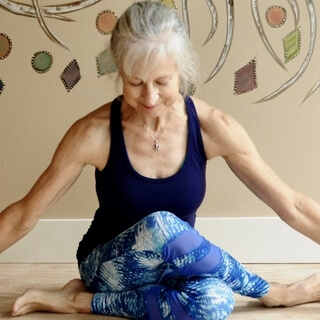
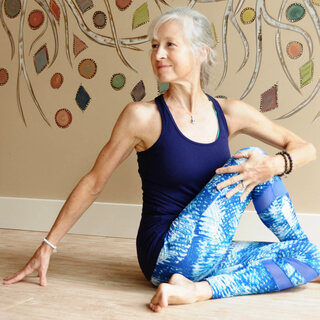
The next one is going to be square.
Similar to sitting cross-legged,
Except instead of the feet being close to your hips,
You're going to move your feet more in line with your knee.
If this bothers your knees,
Is too tight in your hips you might move your knees out a little bit but to deepen the pose you're going to move your knees closer and your feet further away from each other The front leg,
Whichever one is easier for you to start with,
Is going to be pretty much parallel to your mat or your blanket.
And even just sitting here,
You might feel something in one or both outer hips.
Before we come forward,
Into more of the stretch we're going to take one of those balls And in your front,
Now we're going to give it a little bit of massage.
So if you just take the ball,
Which either whichever hand feels best to you,
Opposite hand or same hand.
I like to use the opposite hand.
And with some pressure,
Slowly start to move the ball along that inner part of your calf.
And you might find an area.
It's like really sensational.
And you might just move it slowly over this area.
Might come a little bit more towards the thickest part of the calf.
Notice what you're feeling you might find some at least i find some very tender areas here my cavistin would be pretty tight.
Especially if you're active.
With either cycling or hiking or running.
Calves can sometimes get really tight.
You might find a spot that you just want to press into and hold a little bit.
You can either continue to pay attention to that calf.
Or as I start the timer here.
Begin to come forward.
And find your edge of sensation in your outer hips.
If you're not coming forward very far,
You might rest one arm on a block and continue.
To pay attention to that cap.
If you prefer,
If you're able to come much deeper into the pose,
You might position your blocks in front of you,
One or two blocks,
And just relax your forearms down.
Maybe support your head,
Something like this.
And just not worry about your calf.
It's totally up to you.
My calf is really appreciating this,
So I'm going to continue.
Just make sure that you're able to feel some sensation in at least one or both outer hips.
So you're getting that benefit.
Of this stretch there.
And if you find a good spot on your calf,
Might just do some gentle pressure.
Holding the ball in that one spot.
You might be able to rest.
Your other arm on the opposite knee.
As you hold here,
You might get the invitation to come forward a little bit more,
Go a little deeper.
And at any time,
You can set the ball aside and just focus on the hips.
Like before,
You can always find that support.
Your elbows and rest your head on your hands or the wall.
Find your variation.
Again,
You might visualize your breath as you inhale,
Moving up the sushumna,
The center channel of your spine.
From your tailbone all the way up to the crown of your head.
Lengthening as you inhale.
And softening.
As you exhale.
Release into gravity.
With each exhale.
Hips and legs and feet,
Soft and relaxed.
Can either support your head or keep your neck long.
Begin to gently deepen your breath.
Take a nice inhale through your nose.
Exhale,
Let it go.
Slowly press your way back up.
Set your blocks aside if you were using them.
Set your ball aside for a moment.
So the other side is going to be our counter pose.
But it might feel nice to just straighten one leg and then the other.
Maybe point and flex through your feet for a moment.
And notice sensation.
If you need a couple windshield wipers before we come into the other side.
Feel free to find that.
Any movement your body needs.
And at any time,
Feel free to drink some water.
So other side since we started with our more comfortable side the second side usually feels more awkward So you might have to adjust your legs a little differently.
Make sure your knees are happy.
You don't want any sense of discomfort in the knee.
You should feel it in the hips.
Bring your blocks handy and again the ball.
Front thigh.
Again,
Option to get into that calf.
So before we come forward,
Just start to work that cap a little bit.
Start to notice Now this cat feels.
.
.
I like to get fabric out of the way when I'm working.
This area.
It's up to you.
It works a little better,
I think,
The myofascial release on skin rather than clothing.
So begin to lengthen through your spine.
Start to hinge forward.
Find where that edge of sensation is for you.
Maybe you support yourself with one hand and continue working.
That area of the calf.
Maybe you use a block to rest one arm on.
At any time You can just set the ball aside and just focus on your outer hips and soften into the coves.
Especially if you'd like to come forward a little more deeper.
Or you continue to work.
You can choose to continue to focus a little more on the calf,
Maybe finding a certain area to hold the pressure.
Again,
Option,
You can set the ball aside at any time.
Either support your head.
Or keep your neck long.
Relax your feet and ankles.
Soften and relax your lower legs Soften into your upper legs and hips.
Lengthen through your spine as you inhale.
Soften.
And release as you exit.
You might find you can go a little deeper after a minute or so.
Or you might choose to stay right where you are.
You you A few more breaths here.
Begin to gently deepen your breath.
Take a nice full inhale,
Exhale,
Sigh it out,
Let it go.
Slowly on your next inhale,
Press your weight back.
Set your blocks aside.
Set your ball aside.
And we're going to be straightening out our legs into the next pose.
It'll sort of be like a rebound for our hips.
Take your old blanket.
Just like we did for the neck.
So it's rolled halfway.
Maybe not quite as thick,
So you have enough room.
To lay your head on.
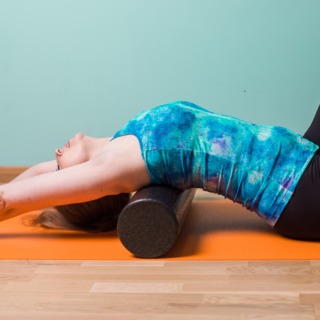
We're going to get into the upper back.
So this one we're going to lay sort of the back of our heart,
Our mid upper back on the.
.
.
Rolled part of the blanket,
Arms will be above the blanket.
So the head and your shoulders and arms are gonna be on this unrolled part of your blanket.
Bend your knees at first,
Maybe bring your elbows onto that rolled blanket.
Lower yourself onto the blanket,
One hand behind your head to support your head and neck.
Make sure your arms and shoulders are not on the blanket.
And then thoughtfully lower your head down.
Arms any position that works for you.
So you might have goal post arms or arms out in a T shape.
And then straighten one leg and then the other.
Should feel really good in your hips and legs.
You can widen the legs a little bit.
Taking the eyes,
Inhale.
Exhale,
Soften.
And melt over the rolled blanket.
Initially it might feel like your upper back is sort of tight.
But there should not be any sharp sensation.
Imagine you're melting.
Over this rolled white coat.
A few more breaths here.
Take a nice full inhale.
Tie it out,
Let it go.
Come out of this pose.
Bend one knee and then the other.
One hand behind your neck and head.
Lift your head.
And then make your way over to one side.
Use your hands and arms to press your way back up to a seat.
And pause.
Notice your upper back and shoulder area.
Any sensations?
Drink some water if you haven't already.
Set your rolled blanket aside.
And we're going to get into the upper back and shoulders a little more with a yin stretch.
We're not going to hold it quite as long as the others.
Lots of options in this one.
You'll use two blocks,
Maybe.
If it's too much with the blocks,
You can just have your elbows on the mat.
Position the blocks about shoulder distance apart.
On the low setting.
If you want to get into the hips a little bit more,
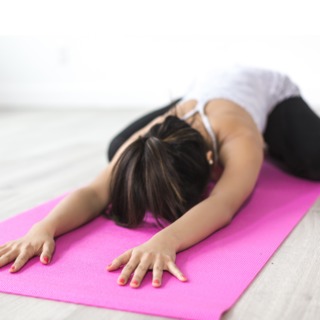
You'll come into tadpole which is sort of like positioning your legs like child's pose.
But separating the feet slightly.
So your hips are sitting in between.
Your heels.
And then you'll bring your blocks.
A little closer.
So that your elbows are on the blocks,
Hands in a prayer position inch your elbows forward a little bit.
And then maybe your hands come behind your head and neck as you place your forehead to your mat or blanket.
So that's option one.
If your knees do not like this position or your hips don't want to be here,
Option 2 Knees under your hips.
You'll place your elbows on the blocks again.
And then take your hips slightly back.
Maybe not all the way back,
And then again,
Forehead to the mat or blanket.
Sort of like a melting heart pose.
The second variation is going to get you a deeper stretch into the upper back and shoulders.
So if you want that.
This second option might be for you.
If you're sort of like me,
I like to start with the shoulder stretch and then shift back.
Into the hip stretch.
Find your variation.
Your option.
Just make sure your forehead is supported.
And if it's too much in your shoulders,
You might just have your elbows on your mat instead of the block.
Slowly.
On your next inhale,
Press yourself up out of this pose.
Whatever variation you're in.
Set your blocks aside.
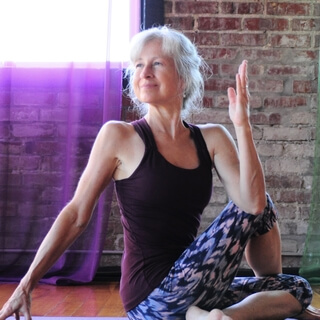
And we're going to come into a twist.
That should feel really nice into the upper back.
Thread the needle from hands and knees.
Move your left hand forward on your mat.
Reach your right arm up.
Little twist to your right.
And then thread your right arm underneath the left.
Come onto your right shoulder,
Right side of the head.
If you need more support,
Maybe place a blanket or block under your head.
You Inhale,
Come back up into table.
And we'll do the other side.
Move your right hand slightly forward on your mat.
Extend your left arm out to the side,
Maybe a little twist to the left.
And then thread that left arm underneath your right.
Come onto your left shoulder.
Left side of your head.
On your next inhale,
Press into that right hand.
Bring yourself back up into table.
And it might feel nice from table to just do a few cat cows.
Inhale count.
Exhale cap.
Notice your upper back and shoulders.
And then bring yourself to a seat.
We're going to do one more pose before Shavasana.
I think we'll do the hips.
Because that always feels so good.
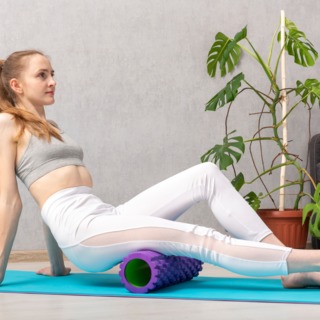
So we're going to be doing this with two balls,
Either two lacrosse balls or other therapy balls or two tennis balls.
I'm going to use my tennis balls for this one.
And we're going to be laying down.
And then positioning the balls under our glutes.
There's a lot of variation that you can position the balls.
You just don't want the balls right on your sitz bumps.
So it should feel like it's on soft tissue.
You can do it more to the outer hips,
A little more lower,
A little higher.
Find what works for you.
So I'll guide you,
A couple options you might do,
But find what feels best.
So we're going to just lay on the balls and then we'll remove the balls and it's going to be shavasana.
So if you know you want to have a blanket handy to put over your hips or under your head for Shavasana,
Make sure you have that handy.
You might want to drink some water before we lay down.
Because again,
We're going to be moving right into Shavasana after this pose.
So bring your two bowls with you if you have them.
And if you just have one,
Just use your.
.
.
Sort of internal clock.
And do one on one side,
One on the other.
About halfway.
So think about,
Like.
.
.
Two,
Two and a half minutes on each side if you only have one ball.
So from constructive rest,
With your knees bent,
Feet flat on your mat,
Couple options.
You can keep your hips down and just sort of Tip your pelvis so your lower back is going towards the mat.
And then sort of tuck the balls.
Under your glutes as far as you can without lifting your hips.
And then straighten one leg and then the other.
That's option one.
If that feels really good,
You might just stay there.
Or you might prefer to lift the hips and inch them just like maybe a centimeter more.
And then lower your hips so you're a little more on the balls.
So find what works for you.
And relax over the bowl.
You should feel pressure.
Into soft tissue not bone.
And if you're using both balls,
Try to get them fairly even on each side.
So you don't feel lopsided.
Take a nice inhale.
Through your nose,
Exhale,
Soften and relax.
Feet and ankles soft and relaxed.
Legs heavy and soft.
Hips soft.
Relax your whole bath.
Soften your shoulders and arms.
Each exhale is an invitation.
To surrender into gravity.
Let go what no longer serves you.
Release.
And let go.
And if you only have one ball,
We're about halfway,
You might switch it to the other side.
If you still want to get into your neck a little bit,
You can sort of keep your head heavy and neck soft.
Slowly turn your head in one direction.
And just stay there for a few breaths.
And then you can bring your head back to neutral and over to the other side.
Just an option.
Begin to gently deepen your breath.
And we're going to remove the balls.
You might need to bend one knee and then the other.
Press into your heels.
Lift your hips slightly to remove the balls if you need to.
Set your balls aside,
Straighten your legs back out.
So make your way into Shavasana.
Provide your body to be heavy and soft.
And let go.
You you Gently bring your awareness.
Back to being on your mat.
Notice your body.
Notice your breath.
And observe your mind.
When you feel ready,
Begin to make small movements.
Wiggle fingers,
Toes,
Whatever would delight you.
Eventually bend one knee and then the other.
Maybe drawing your knees in towards your chest to give yourself a little hug.
And then roll over to one side.
Support your head with your bottom arm.
Pause there.
And when you feel ready,
Slowly press your way back up to a comfortable seat.
Maybe keeping your eyes closed.
And with appreciation for your awareness and your focus,
Bring your hands together at your heart in Anjali Mudra.
The light in me sees and honors the light in each of you.
Namaste.
Thank you so much for joining me today for this yin myofascial release practice.
Make sure you drink some water.
And I hope you have a lovely rest of your day.