Welcome.
So this myofascial release is for the lower part of the body,
The hips,
The legs,
And the feet.
Today you will need a tennis ball or therapy ball,
A foam roller if you have one,
And I like to use a medium density foam roller.
It's really up to you.
Some people prefer the softer density.
If you're really used to this and can stand the harder density,
By all means you don't go for it.
So usually I just like to use the medium density foam roller.
Choose what works best for you.
So today we're going to start in a Tadasana,
Mountain Pose,
And just notice how you feel.
Standing with your feet about hip distance apart,
You might lift the toes,
Spread the toes,
And lower them back down.
Grounding through your feet,
Rooting down to rise up,
Energetically reaching the crown of the head up to the sky,
And just notice how your body feels.
Maybe notice any energy or tightness or tension just be the observer.
So if your eyes are closed,
Go ahead and open the eyes,
And let's start with the tennis ball or whatever ball you're using,
And bring the tennis ball under the ball of your right foot.
Keep the heel of the right foot on the mat and put some weight on the tennis ball.
So the ball is just under the ball of the foot,
The heel is on the mat,
And your toes are overhanging the ball.
So you could lift the toes,
Spread them,
And then curl the toes like you're trying to grip the ball.
So putting as much pressure on the ball that feels appropriate to you,
Keep the pressure on the ball as you lift the toes,
Maybe as you inhale,
And as you exhale,
Curl the toes.
We'll be here for a few breaths.
You decide on the amount of pressure here.
If the ball seems too intense,
Back off some of the pressure.
Don't put as much weight on the ball.
Just a little bit more,
And then we're going to move the ball to the middle of the foot.
Lighten up on the pressure a little bit.
Your heel comes up off of the mat,
So your foot is on the ball.
The ball is right under the middle part of the foot,
And just start to move your foot over the ball with just light pressure or however much pressure you want.
So just a gentle pressure here.
Explore how the bottom of your foot feels,
Moving the ball around.
Notice how that feels,
And then start to go a little bit faster.
So keeping the pressure on the ball,
But just doing little squiggles.
Sometimes the ball will get away from you,
And you've got to go chase it down.
That sometimes happens,
But just little faster squiggles,
Moving the foot around on the ball,
And then step that foot off the ball and pause.
Come back into your Tadasana.
Notice the difference between left and right,
Not only the foot but also the legs.
Does your right leg and left leg feel different?
And then we'll do the other side.
So put the tennis ball under the ball of your left foot.
Keep the heel of the left foot on the mat.
You decide on the amount of pressure,
And then again inhale,
Lifting the toes,
Spreading them wide,
And as you exhale,
Maybe curling the toes around the ball,
Just like you're trying to grip the ball.
Keep a pretty steady amount of pressure on the ball.
You can have the knee bent,
Or some people like to have the legs straight,
Whatever feels best to you.
This is your practice.
You decide on the intensity.
Couple more breaths here,
And then shift the ball to the middle part of your foot,
Lift the heel,
And start to move the foot with gentle pressure,
Just around the middle part of the foot under the arch.
Find some areas here,
Maybe might be tender.
Just explore here,
Moving the ball around slowly.
Notice the different areas on the bottom of your foot.
Notice how this feels,
Keeping gentle pressure,
And then a little bit faster doing those little squiggles,
Keeping some pressure on the ball.
You decide how much.
Little fast squiggles,
Moving the ball a little faster,
Moving your foot over the ball a little faster,
And then stop.
Step off the ball,
Come back to Tadasana,
And pause.
Notice the difference between left and right.
Hopefully both legs feel just about the same now.
We've compared in Tadasana the before and after into the legs,
So let's do another assessment.
There'll be a little bit of action that's already started,
But we're just going to come into a downward dog.
Notice how this down dog feels.
You might start in table pose,
Hands and knees,
Tuck your toes,
And lift your hips up and back.
Just notice how your down dog feels.
If you've already done a down dog earlier,
It might feel a little bit better because we have started to get into the feet a little bit,
But just notice how it feels.
You might find some movement pedaling the feet,
Whatever feels good.
And then whatever way makes sense to you,
You can lower the knees or walk your feet towards your hands,
Passing through a forward fold,
Thoughtfully coming back up to standing.
So now we're going to get into the legs and hips a little bit.
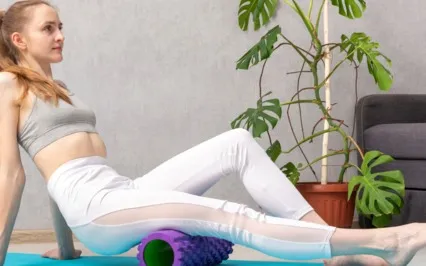
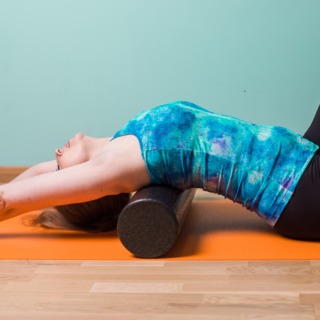
So get your roller,
We'll start with the roller,
Placing it across the center of your mat,
And come to a seat on the roller.
Hands might be behind you,
Knees are bent,
And just getting into the glutes a little bit here.
Move a little bit forward and back,
You're rolling onto the glutes,
Just sort of warming up the tissue here.
Notice how that feels.
So one thing that we're not going to roll is the IT band.
That can be a little bit more sensitive.
We can roll onto the TFL,
Which is the outer hip,
And we can roll into sort of the outer front thigh,
Which helps access the tight areas of the IT band.
But I usually discourage rolling on the IT band.
One way you can access the IT band is maybe with a ball in your hand,
Rather than laying your whole weight on the ball or roller.
So there are ways you can access into the IT band safely,
But I would really discourage rolling on it,
Especially if the roller is high density or even medium density.
It can be too much.
If you have a very soft roller,
You might be totally fine,
But you can access the IT band in other ways.
With just the ball in your hand,
Rolling down the side of the leg,
That can feel really nice.
So now come to stillness on your roller,
And with your hands,
Wherever they make sense to you,
Maybe slightly behind you,
Widen your feet just a little bit about hip distance apart,
And drop your knees over to the right.
So now you're more on the right glute,
And again,
Rolling forward and back,
A little bit more on the right glute.
Find where it feels good to you.
This might be tender.
Find where it works best for you,
And then pause.
Bring your knees back up to center,
And drop your knees over to the left,
Again focusing now on the left glute.
A little bit of movement forward and back.
Notice how this left glute feels.
One side might feel different than the other,
And then come back to center.
So now we're going to roll a little bit more into the hamstrings if you haven't already.
So the hands might be behind you,
So we're going to let the roller go up maybe to the low back,
And then coming forward to just about behind,
Above the knee on the hamstrings.
So you're just going to roll a little bit more forward and back,
Just starting to get into the hamstrings here.
This should feel pretty good,
And usually this isn't too intense for the hamstrings,
But if you have anything going on in your hamstrings and this is too much,
Then just listen to your body.
Find variations as you need to.
And then come off the roller.
You can set it aside.
We'll come back to the roller in a minute.
We're going to get our ball,
Our tennis ball or therapy ball,
And you can do this next one.
We're going to get into the glutes a little bit more.
You can either lay down,
You can sit on your mat,
Or you can just use a wall standing up against a wall.
So bring the tennis ball under the right glute.
If you're seated or laying down,
You're going to keep that right leg straight.
So the ball is under the right glute,
Right leg is straight,
Left knee is bent.
If you're seated,
Hands are going to be behind you for support,
And sometimes this can be a little too much on wrists,
So you might want to lay down to do this.
The tennis ball is going to be just about across the middle of your glute,
So the thickest part of the glute.
And using your hands and your left foot to sort of lift the hips up a little bit to find movement,
Begin to move a little bit over the tennis ball.
So you can move a little bit left to right,
Might move up and down.
It's a little easier to move up and down.
If you're seated,
You can point and flex the right foot.
That sometimes can make the ball go up and down on the glute.
And if you find a good spot,
You might just want to pause and breathe into it.
You can move a little bit more to the outer part of the hip there,
Into the TFL,
If that works for you.
Notice how this feels.
This can be sort of intense.
So again,
You might be standing up against a wall,
Leaning into the wall with your hips.
Especially if it's too intense on your wrists or too much to lay down,
Maybe it's too much to have that weight on the ball.
You can always use the wall.
So find good areas that work for you.
Listen to your body.
Where do you want to place that ball?
Where does it feel good to get some release?
And again,
You might find a good spot and you might want to just hold there,
Breathe into it,
And just sort of relax the weight of the body over the ball.
Then you might move the ball a couple centimeters or a quarter inch or whatever that works for you to another spot.
And again,
Same thing here,
Moving a little bit,
Find what works for you.
A couple more breaths here.
And then remove the ball.
Staying where you are,
Just remove the ball,
Either seated or laying down or standing if you're up against a wall.
Notice the difference between left and right.
And when you're ready,
Place the ball under your left glute.
Same thing on this side.
Again,
If your hands are getting tired,
If you're seated,
Lay down,
Keep your left leg straight,
Ball is under the left glute,
Right knee is bent,
Right foot flat on the mat,
Little movement in the hip side to side or up and down,
Maybe pointing and flexing that left foot if you're seated.
If you're laying down,
You can still find a little movement through pointing and flexing the foot,
But it may not be quite as much.
Listen to the body.
Where would it feel good?
What part of the glutes?
Again,
You might move a little bit left to right,
Getting a little more to the outer left TFL.
You might pause and just let the weight of your body get on to that ball.
Listen to what feels best to you.
Then maybe moving the ball a little bit,
Finding another area.
Notice if this side feels any different than the other side.
You hold a lot of tension in our hips.
Couple more breaths here.
And then thoughtfully remove the tennis ball.
Pause for a moment,
Notice sensation.
So set the tennis ball aside.
And we're going to use the roller again for our quads.
Get your roller and come towards the back of your mat into a kneeling position and place your roller maybe about a foot and a half from the edge of your mat.
So come on to the roller on your hip crease.
So on the upper thighs there,
Right up near the hip flexors.
Come on to your forearms and reach your arms as far forward as you can.
The toes might be touching the floor so that you're laying over the roller here.
We're going to use our arms,
Reaching our arms forward onto the mat,
Extending the arms forward.
Listen to your shoulders here,
Staying on the forearms and then pulling yourself forward over the roller.
So we're rolling on the quads.
And then just gradually push yourself back to the starting position,
Avoiding the knees.
So you're stopping just about above the knee there.
And then again,
Pulling yourself forward.
So move slowly here as you pull yourself forward.
Notice how the tops of the thighs feel.
And then as you go back to the starting position,
That's just sort of to get back to the starting position.
That's also warming up the fascia here a little bit.
Again,
Pull yourself forward using your forearms.
You're starting just about at the hip flexors and going towards the lower quad,
Stopping before you get to the knee.
So do this a few more times and then start to slow it down.
So sometimes the slower we go,
The more intense we're going to feel this.
As we get into the fascia,
Which sometimes can be quite dense,
That's when it's like really sticky.
So you want to make sure that you have had enough water.
We want to have the fascia and our body hydrated.
So make sure you're drinking enough water before as well as after.
It can sometimes really give you a little bit more benefit to this practice.
But if you are dehydrated and if you've not had enough water and if you've not been moving enough,
The fascia tends to get really sticky and dense and it could be very painful and sensitive.
So really listen to what your body is telling you.
If this is too intense,
Back off.
If it gets too intense when you're starting to really slow it down,
You might want to keep the movement a little bit quicker until you get more acclimated to this.
So again,
As you're pulling yourself forward,
Start to slow it down and maybe pause in a certain area.
Breathe into it.
Send your breath into the thighs where you're feeling the most intensity.
You can also do this with just one thigh on the edge of the roller and the other knee is bent,
Sort of off the mat,
Maybe onto a blanket.
And that way you have more pressure on that one leg that's on the roller.
But if you're feeling plenty of pressure right now with both legs on the roller,
You want to stick with having two legs on the roller at once.
And a few more breaths here.
Listen to your body,
Pulling yourself forward slowly,
Breathing into the areas of most sensation.
Those open mouth sighs when exhaled are so beneficial.
Good.
And then slowly make your way back,
Coming off the roller.
And we're going to get into the calves next.
There's many ways to get into the calves,
But today we're just going to use a blanket.
So take your blanket.
You can also use a towel,
Like a beach towel or a bath towel also works.
Take your blanket and it's going to be folded maybe in half.
If it's just a towel,
You might just be having it folded in half and then start to roll it from the folded edge.
If you're using a yoga blanket,
It's probably folded in half and then in half again,
And then start to roll it from the folded edge.
So you're making a nice tight roll with your blanket or towel and then you'll come to kneeling on your knees and place that rolled blanket behind your knee crease.
You might want to block handy and you might need to use one hand or the other and make sure that blanket is going to stay right up behind the knee crease as you sit your hips back towards your heels.
So the legs are compressing that blanket into the calves.
This might feel quite intense or you might find it feels really good.
So if you can sit onto the blanket completely with your full weight,
You can just do that.
If it's like,
Ooh,
Too sensitive to do that,
You might need to come forward on your hands a little bit,
Keeping the weight on your hands.
If that is still too much,
You might come down onto your forearms and place that block in between your hands so that you can rest your forehead on the block.
Maybe on the medium or high setting.
So pause wherever you are and just let the weight of your hips start to compress those thighs a little bit.
Send your breath to the area of most sensation.
And as we hold here,
You might notice that the intensity dissipates a little bit.
And if you were on your forearms,
You might be able to come up a little bit,
Maybe coming onto your hands.
If you were on your hands,
You might be able to walk your hands back a little bit closer towards your knees or maybe even sit back completely towards the heels.
Listen to your body.
And depending on the type of towel or blanket you're using and the thickness of it,
All these variations might make it feel more intense or less intense.
So you can experiment and try different ways of rolling the towel thicker or not as thick,
Different blankets or towels,
Whatever works for you.
And if you're not rolling the towel,
You can try different blankets or towels,
Whatever works for you until you find what works best.
So we're going to stay here a few more breaths.
Use your breath,
Nice full inhales.
Five and exhale,
Let it go.
This is one of my favorite ways to get into the calves.
We can also use the ball and roller.
But today we're just going to do this one.
Breathe into it.
If you haven't already tried to come up a little bit,
Maybe explore that,
See if you can invite a little more intensity into this position.
And then gradually lift your hips up,
Remove the blankets.
Set the blanket and block aside and come back into table pose and come into your downward facing dog.
Tucking the toes,
Lift your hips up and back.
Notice how this down dog feels.
Any movement that feels good to you,
Maybe pedaling your feet,
Shifting the hips side to side,
Listen to the body.
And so hold the giant Moyu counter tap,
Holding the opposed leg back up,
Lifting up the toes side,
Listen to the body,
And notice how this down dog feels compared to your earlier one.
Nice full breaths.
Stay here as long as you would like.
And then when you're ready,
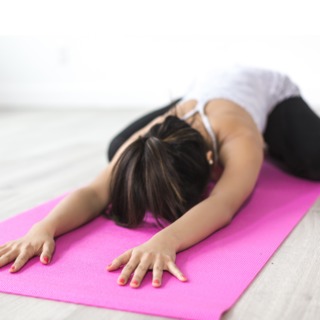
Lower the knees and find your child's pose and rest.
Make sure your head is supported.
If it doesn't quite make it to the mat,
Use your hands or a prop.
Tune into your breath.
Relax and release.
And of course,
Find any variations if child's pose doesn't work for you or if any of the poses don't work for you.
Always listen to your body.
Take a nice full inhale and soft sigh of an exhale,
Let it go.
And then thoughtfully bring yourself back up to a seat.
Find any comfortable seat that works for you.
Notice how you feel.
So this might be the start of your daily practice or maybe it's just what you needed to end your day.
Listening to your body.
Remember to drink water.
And with appreciation for taking this time for your self-care,
Bringing the hands together in your heart.
Just taking a moment.
Notice this moment.
Thank you for joining me today.
Thank you.