Hello,
Everyone.
Thank you for joining me for this gentle self-myofascial release yoga practice.
Today,
We'll just be getting into the upper body primarily.
We'll be holding the poses for about five minutes.
That way we can really get deeply into the fascia for a sustained release.
And if anything doesn't work for you,
Please find a variation or modify as you need to.
Listen to your body.
This is your practice.
So let's get started.
Any comfortable position for your legs?
Bring your blocks on either side of you Before we come into the pose,
We're just going to get it set up,
And then we'll just center ourselves for a few moments before we come into the pose.
And position the blocks on whatever height is comfortable for you and you can turn them slightly so you can use them like an armrest.
So just testing it out.
Maybe lift one arm up and see how that feels.
And then position the other block.
As close to you as you need to,
Lift the other arm up and make sure that the bottom arm is supported the top arm will have some options so once your blocks are in place Just bring yourself to a comfortable seat.
Elongate your spine.
Might sit on one of your blankets,
Any position for your legs.
Lengthen through your spine,
Crown of the head,
Reaching up to the scalp.
And just start to notice your brow.
Remember,
This is your practice.
If anything I suggest doesn't work for you.
Find a variation.
So we'll be holding the poses.
About five minutes.
So that we can get a release into the fascia.
If you're doing it for shorter,
You'll get into like the last.
First layer of the fascia.
And when there's releases there usually they're more temporary.
To get a lasting release,
We need to hold it for about five minutes.
To get into that collagenous,
That collagen layer,
The deep fascia.
Inhale through your nose.
And a slow,
Long exhale through your mouth.
Let it go.
So we'll come into our first pose.
Bring one arm,
Doesn't matter which side you start.
Onto the block nearest you.
Lift your other arm up.
And come into a side bend.
If your arm feels good where it is up here,
You might leave it up for a deeper side stretch.
Or an option to get more into the net.
Option one,
Bending the elbow.
And maybe just gently supporting the head with your other hand.
The top hand.
And maybe you look slightly up.
Or down.
Or bring that top arm up.
So your fingertips are just on the edge of the block.
Lengthen through your neck and let your Ear go towards your nearest shoulder.
So I'm going to hold here because my neck wants a little deeper stretch.
If this is too much,
Adjust slightly.
And you can also position your head as you're looking sort of straight ahead.
Or slowly or slightly begin to turn.
Your nose towards the floor.
Getting a stretch maybe slightly more.
In like the back corner of your note.
And you can reach those fingertips.
Away from you to deepen that stretch and elongate that arm.
Or if that arm is up overhead.
Think of lengthening more through your side body.
Breathe here.
If you need to slowly and slightly move that arm or your head and neck.
Feel free to do so.
Just go very slowly.
So you're still feeling the stretch.
Notice your breath.
You might also imagine your breath going into the area of your body where you feel the most sensation of stress.
So two of the ways to really find release into the fascia.
Is through elongation.
And compression.
Some poses we just might do one or the other.
Some poses we might do both.
Breathe here.
Just about another minute.
Think of softening into the area you're feeling the strap.
If you're getting a deep stretch in your neck you might slowly turn your head to look down a little bit.
Take one more breath here.
Sigh out your exhale.
Let it go.
Slowly push yourself up using that arm that was on the block initially.
And pause.
You might feel a little uneven.
Or a lot uneven.
Okay.
If you need to slowly move your head or.
Roll your shoulders a little bit,
Whatever might feel good.
Maybe look slightly down.
Maybe look slightly left and right.
Slowly.
And then we'll come into the other side.
So again,
Position your bottom arm on that block.
Make sure it feels supportive.
Can have it on whatever height,
Maybe the tall setting is easier for you.
Bring that other arm up overhead.
And again,
Explore,
Where does it feel like you need the most stretch?
Maybe that arm stays up and you just move through that arm or hand or fingers.
Elongating the side body,
Getting into the ribs.
Maybe you just turn the head slowly left or right.
Or maybe you lower the arm,
Elongating through that arm.
Fingertips lightly on the block.
And then drop your head towards that bottom shoulder.
Getting a stretch in the neck.
Again,
If it's too much.
You might just bring that arm back up.
Maybe bending the elbow,
Supporting your head with that top.
Hand.
Each side is different.
Getting into the neck you might reach through those fingertips.
You move the block a little away so it feels like you can elongate through that arm.
And use that bottom arm for support.
Like I'm feeling getting a little too crunchy there.
So I'm moving my block up a notch.
Find what works for you.
Again,
Maybe just an option.
Slowly turning your head.
Notice where the sensation moves.
Notice your brow.
Five minutes is the general rule.
To get a release.
Into the Valsha.
You might feel a release happen sooner.
Or it might take a little longer.
For the neck because it just seems.
Pretty intense.
I don't think I want to hold it longer than five minutes.
So I'm going to just find a little variation with that top arm.
Listen to your body.
I think on this side I'm going to do.
.
.
Sort of half one variation,
Half the other.
Top arm can be elongated.
Or you can bend it and just elongate through your elbow.
Notice your breath.
Make sure you're still breathing.
A calm,
Easy manner.
If you're moving through your head,
Neck,
Or arm,
Do so slowly and thoughtfully.
Maybe you look up slightly.
I like to support my head with the top.
Hand when i look up Another 30 seconds.
Begin to gently deepen your breath.
Sigh out your next exhale.
Let it go.
Come up slowly.
And pause.
Notice sensation.
That can be intense.
Set your blocks aside come off of your blanket.
And we're going to find just a little bit of movement before we come into our next pose.
Come into table.
Lengthen through your spine.
And then do about three rounds of cat-cow.
Slowly inhale into cow.
Exhale,
Catch.
Notice how this feels.
And then come back.
To a seat.
Actually Let's do a downward facing dog.
We'll see how that feels.
Come back into table So hands and knees,
Move your hands slightly forward on your mat,
Tuck your toes.
And lift your hips up and back.
Maybe pedal out your feet.
We're not going to get much into the lower body today,
So a down dog might feel nice to get some movement.
Going into the feet and ankles.
Press into your hands.
Bend your knees a little bit as you lift your tail up.
And think of taking your heart towards your toes.
Notice how this down dog feels.
Keep your neck long.
And then lower your knee.
And come back to the seats.
Taking your fall.
And you might want a blanket.
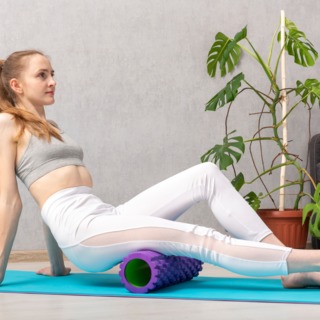
So we're going to get into the upper traps with the ball.
So we'll just need one blanket under the head.
We don't want our neck to be on the blanket.
Come into constructive rest.
Move the blanket up if your neck is on it.
So the edge of the blanket is just.
.
.
Right at the base of your skull there.
Or your hairline.
Keep your knees bent,
Feet flat on the mat.
And just lift one shoulder up and place the tennis ball on.
I'm doing the left side first.
Write anywhere feels like it's tight or not.
So we're going to take just a few moments here and see if you can find the spot that you want to focus on.
Maybe it's closer to your.
.
.
Shoulder blade,
Maybe it's more towards the top area of the upper traps.
Find a spot.
It's like,
Oh,
There's a spot.
There's a knot.
So once you've found the spot,
We're going to hold.
And I'll start learning.
We're here.
So from here,
You might keep your arms bent and use your elbows for support.
Or maybe you just have your arms by the side.
You might move your arms up,
Overhead.
Sort of resting on the blanket.
If you want you can move that arm,
The side the ball is on,
It's my left.
Maybe you move that around a little bit.
And then find a spot,
Position for your arms.
That feels comfortable that you can hold and just relax and soften into this area.
Imagine your upper body is melting over the ball.
If you would like you could slowly turn your head.
There's one side.
Maybe you just pause there.
Or maybe you slowly turn your head.
From one direction to the other.
Very slowly.
Allow your upper body to be heavy.
And I find it easier to keep the pressure on the ball.
With the knees bent,
Feet flat on the mat.
Breathe into the area you're feeling the most sensation.
And as you exhale,
Invite your body to soften.
And release a little bit more I mean,
The size of an exhale at any time.
If you want more you might push into your feet.
Pushing the upper body more onto the ball.
Ever so slightly.
Notice what you're feeling.
If you need to move ever so slightly over the ball,
That's fine.
Sometimes it might feel like the area you want to focus on has shifted or released a little bit.
And you might have to just.
.
.
Ever so slightly.
Adjust to continue that release happening.
Just allow your body to.
.
.
Intuitively know where to go.
Trust that.
Trust your body knows what it means.
Few more breaths here.
Take a nice inhale through your nose.
Exhale.
Sigh it out in your mouth.
Let it go.
Not fully rock off the ball.
Just hold it and pause.
Notice sensation.
Notice any difference between left and right.
And then other side.
I'm going to turn on my mat but you can stay right where you are.
Put it under your other shoulder.
Under your upper traps.
Maybe a little bit of movement again.
Just a little bit of exploring.
Binding.
Best spot on this side.
Sometimes it just feels good to move around on the ball a little bit first.
There's so many spots to choose.
Sometimes it's like,
I don't know.
And then once you've found that spot that you want to focus on,
Come to stillness.
Timer again.
Focus on what you're feeling.
Focus on your bra.
You choose the level of pressure on the ball Find the position with your arm.
Find the position with your arm or both arms that works for you.
I like to keep my elbows on the mat for a little more support.
And control.
More stability rather.
Maybe a slight movement of your head.
See if you can sort of soften the side you're not working,
The side you had done first.
The other shoulder might be lifted using that elbow to help keep it level,
Or you might soften it down a little bit so you can relax a little more.
Whichever variation works for you.
Breathe in.
And if you feel a little bit of release or maybe the ball just sort of shifted out from where you want it to be.
Just adjust it now.
Send your breath into the area you're feeling the most sensation.
And if you can,
Relax the other part of your back.
When we do that variation of sort of moving over the ball before we find that spot.
Our upper back.
Might be lifted off the mat.
But as we're holding it in that one spot,
I find it a little easier to soften into the area.
If you just relax your upper body completely.
Or at least a little bit more.
Notice sensation.
It's sort of hard not to notice sensation.
Can you notice the sensation without labeling it?
Just experiencing the sensation.
Observing.
If it's the first time you've experienced this sensation.
Keep your neck soft.
Dead heavy on the blanket.
Anytime,
Do those soft open mouth sighs of an exhale to aid and release.
Another 30 seconds or so.
Breathe in through your nose.
Longer exhale either through your nose or your mouth.
And come off the ball.
Oh.
Pause,
Notice sensation.
Set your ball aside.
And when you're ready,
Shift your hips slightly to one side,
Roll over.
Use your hands and arms.
Press your way back up to a seat.
And pause.
Going to have a seat either on a block or somewhere where you can have that tall spot.
I'm going to demonstrate a position that I like using the block.
Sit on.
So placing the block in between the ankles.
And then just sitting on the block here.
If that is not enough and your knees complain,
You can take your blanket.
At whatever thickness.
Place it over the block so the blanket's over your heels.
And then sit on the plate.
So this allows for a nice tall spine.
So that is my suggestion,
But if you can find another scene.
Even in a chair is fine for this next one we're going to do.
To make sure that you're not uncomfortable in your low back.
For this next pose.
I'm gonna turn forward.
I think I'll just sit on the block instead of the block.
Make sure your knees are okay.
So for this next one,
We're going to get into that area of the upper back between the shoulder blades.
And as we sit here,
We're going to think of lengthening through the spine,
Creating that space between all your vertebrae.
And again,
If this position is not comfortable for you,
Find any seat that you can hold.
And then Arms.
Whichever arm on top feels most comfortable for you.
And we're going to hold the opposite.
Shoulder.
And then.
.
.
You can relax the arms down.
I'm not going to do that just yet because I'll stifle the microphone.
And then gently pull.
So you feel that stretch.
Around the shoulder blades,
The space between the shoulder blades.
And soft.
So we'll hold it for about five minutes again.
Lengthen through the spine,
Crown of the head reaching up.
Whichever arm on top doesn't matter.
And gently pulling.
With your hands,
Letting your arms relax so you can feel that pull without much effort.
Relax your arms down.
And then option as well.
You can have the crown of your head reaching up.
Or you might slightly lower your chin and get a deeper stretch into the back of your neck and upper back as well.
Find your variation.
We're just letting the arms do the work.
Just letting the weight of the arms do the work.
Actively pulling is just sort of holding the shoulders and letting the weight of your arms.
Notice where you're feeling the strap.
Think of sitting tall.
Creating that space in between your vertebrae.
We're about halfway Find your variation.
If you're going to move the head at all,
Move it slowly.
The other variation,
Of course,
Especially if holding your shoulders is uncomfortable,
Is just eagle arms.
Could always do this variation.
But I think holding hands on the shoulder,
You get a little deeper stretch because your cervix could be pulling that area.
Away from Rhomboid's getting a nice stretch there.
A few more breaths here.
Take an eyes,
Inhale through your nose.
Exhale,
Sigh it out.
Thoughtfully release your arms,
Extending them out.
Stretching long through your arms and hands and fingers.
And then when you're ready,
This feels pretty good to stretch here.
When you're ready,
Slowly soften your arms down.
And pause.
Any movement that feels good to you.
Maybe roll your shoulders a little bit.
And set your block aside and set your blanket aside.
Unless you're going to sit on the blanket.
Option for the next one,
You could sit on the blank if you wanted.
So now.
.
.
Straighten your legs out in front of you.
We're going to get into some twists.
After all that we've been doing,
These should feel pretty good.
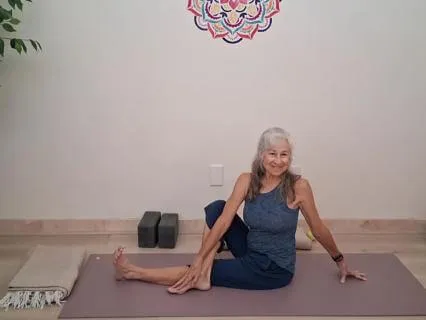
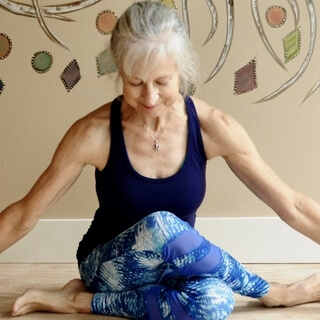
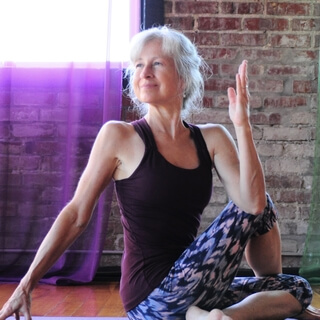
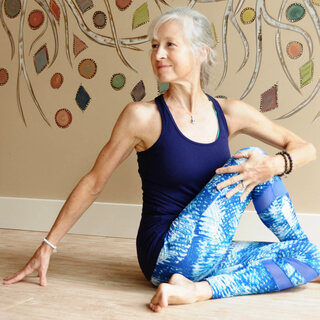
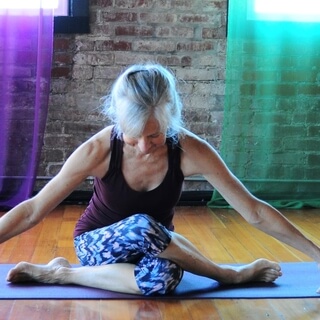
So we're going to do a variation of a seated twist.
The twist to the right first.
So if you sit with your legs out in front of you,
And you're going to twist to the right in this variation that we're doing.
Lift your left sits bone and move your left heel forward.
So your left leg looks longer.
Your pelvis has started to twist to the right.
And this variation is really good if you have any SI joint issues.
You should do this in almost all twists,
Letting your pelvis move.
And then you can take that left foot across.
And you've already started to move into the twist.
That might feel like you can twist a little further.
And that was the variation.
You would do it,
Of course,
On yourself.
Cross your left foot over your right leg.
Move over just a little bit Keep your right leg out.
Pressing through that heel.
Sit up nice and tall.
If you don't feel like you can sit up nice and tall.
Maybe that blanket under your hips or just so that your sits bones are coming off the edge of the blanket might be nice.
So bring your right hand.
Behind you Reach your left arm up.
And bring that left arm on the inside of that lower left leg.
So this variation I find a little bit better because you're not.
.
.
Using a lot of effort with that left arm.
You can press your upper left arm gently into your left leg.
Stability and you can relax your left hand on your foot.
Or whatever feels best to you.
Lengthen through your spine.
Right hand or fingertips behind you and then exhale twist to your right.
So remember,
We're doing this for five minutes.
You may not want to twist as far as you think you can.
Each inhale lengthens through your spine.
Crown of your head reaching nice and tall to the sky.
Drawing your navel in towards your spine.
As you move maybe a little deeper into the twist.
Micro movements.
Do your best to keep that sense of openness across your upper chest.
And again,
You can use your left arm to sort of press into your left leg.
Your left Legs.
And arm are sort of pressing into each other equally.
Creating more stability.
Lengthen as you inhale.
Twist as you exhale.
And if you've gone as far as you want to go then just hold.
You might find after a minute or so there's a little bit of a release.
And you might find you can lengthen a little more or twist a little more.
As you exhale,
Remember,
Never force.
Keep lengthening through that straight right leg.
Pressing where you think of elongating through that right leg,
Through your heel.
It's just a gentle action without strain.
So your upper back and shoulder girdle are engaged.
But see if you can also find some softness.
Especially as you exhale.
Inhale to lengthen.
Exhale.
Sob and slow.
Your gaze might be over your right shoulder.
Maybe just looking slightly.
At eye level.
Or you might lower your gains.
Lengthening the back of your neck.
And after you've twisted as far through your bow.
Maybe find a little more of the twist through your nap.
If your right wrist is uncomfortable having the palm flat on the mat.
You might reach your arm a little further away and just use your fingertips to support.
With the arms straight.
If you want to get into that right wrist,
You might keep it a little closer to you and get a little bonus of getting a myofascial stretch into that right wrist as well.
Breathe in.
Just about another minute.
Inhale to lengthen,
Exhale release into that twist.
Twists are so great for releasing.
Like we're wringing everything out.
Few more breaths here.
Before we come out of the twist.
Inhale to lengthen,
Turning your head just slightly.
And then exhale,
Turn your head to look over towards your left shoulder.
Looking slightly down.
Take another breath here.
Exhale,
Sigh it out.
And then inhale.
Unwind.
Straighten that left leg out.
Notice sensation.
Notice how you might feel uneven.
And it's a great time to drink some water if you haven't already done so.
Always good to drink water anytime you feel thirsty.
Other side.
Straighten your legs out in front of you bend your right knee Cross your right foot over your left leg.
Activate that left leg,
Press through your heel,
Elongating through that left leg through the heel.
Sit up nice and tall.
Bring your left hand behind you for support.
Reach your right arm up to the sky,
And then bring your right arm on the inside of your lower right leg.
Your hand might relax on your foot.
And again,
You might gently press your right arm and right knee in towards each other.
Lengthen through your spine.
Exhale,
Twist to your left.
Use your back left hand.
Support you.
So that you're not leaning back on that hand but you're sort of pushing yourself.
So you can get that nice tall spot.
Inhale,
Lengthen.
Exhale,
Twist.
And again,
Initially you might focus more into the back.
Getting the twist,
And then neck a little bit.
Gently drawing navel towards your spine.
As you exhale into the choice.
Each inhale think of sitting a little bit taller Exhale,
Releasing into the twist.
Micro movements.
Gaze might be slightly down to lengthen through the back of your neck.
Or just a neutral gaze,
But avoid looking up.
That sort of.
.
.
Compresses the cervical.
Vertebrae.
Make sure both sits bones are on the mat.
If you're twisting to the left,
Have your right sits bone a little bit more forward.
To ease into the twist a little easier.
Especially if you have any SI joint issues.
You don't ever want to force anything.
Think of keeping that area of your upper chest.
Open.
Like you're lifting your heart.
And change the position of your back hand to support you as you need to.
Notice your left foot.
Is the ankle active.
Press through that left heel.
You might notice if there's one side that's easier to twist than the other.
Can be.
Very common.
Just another minute.
Inhale lengthen through your spine And as you exhale slowly,
Just the head.
It starts to slowly turn.
Looking towards your right shoulder,
Slightly down.
And then on your next inhale,
Unwind.
Ah!
Straighten both legs out Notice sensation.
So our last pose,
We're going to have some variation.
So if you want to get more.
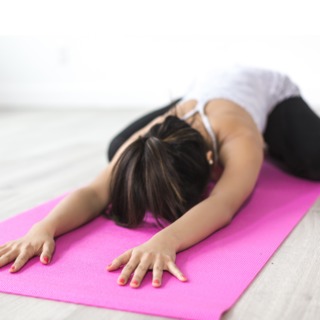
Of a stretch into the upper back I'm going to suggest child's pose with a block.
Your head.
So this one.
.
.
You'll think of taking your lower back.
Hips towards your heels and your mid upper back forward.
So you might come into this position here.
Knees maybe a little wide,
Maybe toes touch or separate a little.
And not taking your hips back all the way just yet,
But positioning the block for your head.
At whatever height works for you.
And then think of lengthening your tailbone towards your heels.
So you can soften into the upper back.
So this is option one.
Option two.
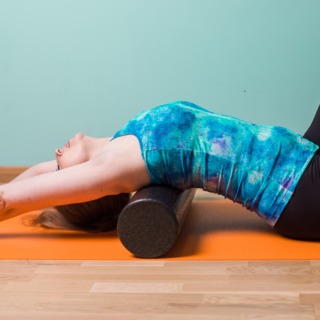
Using a rolled blanket.
Maybe having another blanket at the end of your mat that you might need for your arms or your head.
Roll the other blanket.
If you just have one blanket,
Roll it halfway.
If you have two blankets and if you would like for a deeper stretch.
Roll your blanket all the way,
Smoothing it out as you go.
To have something like this.
So we'll be.
.
.
Laying over this rolled blanket just about at our mid bath.
Arms up overhead.
So this stretches into the shoulders,
The arms,
And the upper chest.
As well as getting into the upper back.
And you might feel a stretch through the torso as well.
So just to show you what it will look like.
And then I'll start the timer.
Might come on to the roll blanket with your elbows.
So if your head is going back too far,
You can either unroll the blanket you're on.
Or lift your head and bring that second blanket under your head.
And then option for the arms up above.
Elongating through your arms and fingertips.
Straightening one leg and then the other.
Or if that doesn't feel good in your shoulders.
Find a variation,
Arms out in a T.
Or goal post arms.
So either that child's pose variation.
Or this stretch,
Sort of like and widen the legs once you position yourself with your knees bent.
And you're on the rolled blanket and your head is supported the way you want,
Then straighten one leg and then the other.
Think of lengthening through your legs and arms as if someone is pulling your arms and someone's pulling your legs gently.
Giving you a nice full body stretch.
And then soft.
Relax as much as you can.
Into this position whether you're on the rolled blanket or in your child's pose.
Watching your breath surrender.
Into this present moment.
Surrender into gravity.
Let go of the need to control.
Let go of having to do anything.
Just be present with your breath.
Observing as your body is being breathed.
Each exhale an invitation to soften and release a little bit more.
Imagine your body.
Soft and heavy.
Just sinking.
Towards the earth.
Soft and heavy.
Notice your exhale.
And maybe that brief pause at the bottom of your exhale.
For your next inhale.
Just invite your exhale to be longer than your inhale.
Notice that stillness.
A brief moment of silence.
Bottom of your exhale.
Take one more nice full inhale here.
And sigh it out.
Really bring your arms in a little closer.
And one knee and then the other.
Bring one hand behind your neck.
Support your head as you lift your head.
And then thoughtfully make your way Slowly back up to a seat and pause.
Notice sensation.
Drink some water.
Then you can set your blankets aside.
So it's time for Shavasana.
Make sure you feel comfortable and warm enough.
You might have a blanket over your hips or under your head.
And just allow your body to be heavy and soft.
Allowing your legs to be heavy and soft.
Hips.
Soft and heavy.
Visualize space between all your vertebrae.
And invite your shoulders to soften and release.
Head is heavy.
Next song.
Relax your jaw.
And soften all the muscles around your heart.
Soften the tiny muscles around your eyes.
And let go Gently bring your awareness.
Back to being on your mat.
Notice your body.
Notice your breath.
And observe your mind.
When you feel ready Begin to make small movements.
Maybe wiggling fingers or toes.
Whatever would delight you.
And then bend one knee and then the other.
And make a thoughtful transition over onto whichever side you prefer.
Pause there.
Support your head with your bottom arm.
And then slowly press your way back up to a comfortable seat.
And with appreciation for your awareness and your focus.
Bring your hands together at your heart and Anjali Mutra.
The light in me sees and honors the light in each of you.
Namaste.