In this video,
I'm going to teach you the breathing technique that has helped me to heal and reset my nervous system.
I'll explain what this breathing exercise is.
We'll cover the science.
I'll also cover the common mistakes that people make when they try to do it.
And then I'm going to guide you through it step by step so that you can experience it for yourself and check that you're doing it right.
So if you're feeling tired and wired,
Then this is the video for you.
Let's get on with it.
Okay so after I burnt out I found that my body was in a constant mild state of fight-or-flight mode.
So what that meant is I would wake up feeling mildly stressed and even the most simple things would trigger me.
Just five minutes on my phone would frazz me and it would take me a couple of hours to recover.
I found it very difficult to relax during the day,
Difficult to get to sleep at night.
And all of this was really exhausting.
People often refer to this as being tired,
But wired.
And this is really a key sign of having a dysregulated nervous system.
I tried lots of different things to heal my nervous system.
And I tried a wide variety of breathing exercises.
Some of those breathing exercises really helped with my brain fog.
Breathing issues and the inflammation,
But they didn't help so much with these nervous system issues that I was having.
But eventually I began to see a pattern.
It was the slower breathing exercises,
Especially those ones at about five and a half,
Six breaths per minute,
That sometimes seemed to calm me down and then I would stay calm for a few hours afterwards.
But sometimes these same slow breathing exercises would make my other symptoms worse.
Over time,
Began to recognise the mistakes that I was making.
First of all,
For most people,
When you ask them to breathe more slowly,
They take big breaths.
But when we do so,
This is a big mistake because we over-breathe levels of carbon dioxide in the body drop and this really stresses out our nervous system.
It also reduces oxygen delivery to the brain so we can start to feel that unpleasant light-headed feeling as well.
So learning number one,
We need to breathe quietly,
Gently and softly.
If you can hear yourself breathing or if you can see yourself breathing,
You're probably taking too big a breath.
The second mistake that I was making is when I was breathing,
I was doing this.
Can you see up here,
All of the muscles across my chest and my shoulders and even my neck are beginning to activate.
And again,
This is a common mistake that people make.
When these muscles activate and tighten,
This also sends signals of stress to the brain.
So what we actually need to do is we need to focus our attention down around our diaphragm,
Especially around to the sides,
Around the lower two ribs,
And focus our attention here when we breathe.
When we do so,
This happens.
So what you can see is there's no movement up here.
And my breath is naturally slower and quieter as well.
Eventually,
Over time,
With lots of experimentation,
With lots of learning and persistence,
I finally found a method that worked for me.
It was a combined approach that brought together coherent breathing with Botteco reduced breathing and diaphragmatic breathing.
The combination of the three had a very powerful effect on my body.
Not only could I access calm within a few minutes,
But over the days and the weeks,
I started to see a longer term change in my body.
My morning symptoms were beginning to reduce.
I was much less triggerable.
Sleep was improving and my heart rate variability measured by my aura ring was beginning to trend upwards over time.
So it wasn't psychosomatic,
There was literally a measurable difference in my body.
This was really exciting and it gave me a lot of hope.
So what about the science?
There's actually been more research done around slow paced breathing than any other type of breathing exercise.
When we breathe slowly and from the diaphragm,
There are movement and stretch receptors in our chest cavity.
They detect this and they send signals up to the brain and the brain interprets this that we are safe and then it releases three key neurotransmitters.
It releases acetylcholine.
This is what slows down our heart rate and this happens almost immediately.
The next chemical is called GABA or G-A-B-A.
And this gives us a sense of clarity and it calms a busy mind.
And then thirdly,
After a couple more minutes of slow breathing,
We release a chemical called oxytocin.
This is also known as the hug hormone and it gives us that warm,
Huggy,
Safe feeling.
So these three chemicals help us to feel calmer almost immediately and that calm continues and deepens over the first few minutes of breathing slowly.
But what's really exciting is that when we breathe in this way on a regular basis,
It improves the wiring in our brain in terms of how quickly and how effectively these chemicals are released.
Calm more quickly and it lasts for longer even after the breathing session has finished.
We are literally rewiring our nervous system and improving our body's ability to find calm,
To come back to calm and to stay calm for longer.
OK,
So let's do this breathing exercise together now so that you can experience it for yourself.
We're going to listen to a version that I've pre-recorded so that we can practice this together.
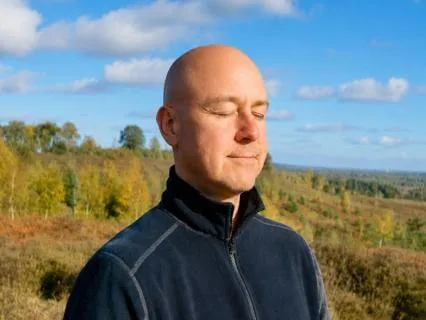
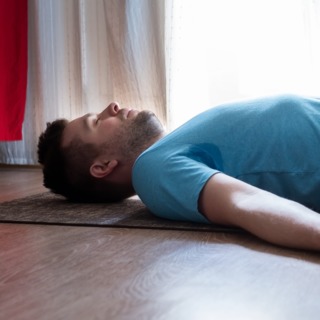
Finding a comfortable position either seated or lying down and gently closing them out.
Breathing through your nose for the rest of the recording.
We're aiming for a breath that is soft,
Light and quiet.
The first step is breathing with the diaphragm.
So when you're ready,
Just bringing your attention to the area around the bottom of your ribcage,
Around the sides of the lower ribs.
And noticing the movement there as you breathe.
You might place the palms of your hands around the sides of the lower ribs to help you feel this.
And then just let your shoulders soften down.
Simply noticing how your breathing is already happening.
How as the body breathes in There's a subtle expansion around the lower ribs.
And actually breathe out A gentle return.
Now once we've found the breath at the diaphragm,
The next step is to breathe slowly and gently.
And this is what really helps to heal the nervous system.
We'll use the sound of bells to guide the pace.
So the rhythm we're going to use is about five and a half breaths per minute.
If it feels too fast or too slow for you,
Then simply allowing your body to settle into a pace that feels natural for you.
So let's start the bells now.
And when you're ready.
.
.
Gently breathing in.
.
.
And gently breathing out.
Breathing softly and quietly.
Breathing gently.
And smoothly.
Breathing in through the nose.
And breathing out through the nose.
Feeling the breath in the belly.
And down in the lower ribs.
Gentle expansion on the in-breath.
And toward deflation.
On the out breath.
Gently breathing in and gently breathing out.
Feeling the calming rhythm of the breath.
Adjusting the size of the breath.
So you have just enough air.
You start to feel dizzy or lightheaded.
And just making your breaths smaller.
And lighter.
Taking a break at any time if you need to.
You can pause the recording at any time.
So we're gently breathing in and gently breathing out.
It's as if there's a balloon in the middle of the body.
Gently inflating on the in-breath slowly deflating on the out breath.
Breathing softly,
Gently.
Quietly.
With the bowels.
On each out breath.
Allowing the body to relax.
Letting the mouth and jaw soften.
The shoulders drop down away from the ears.
Releasing any gripping in the hands allowing the belly to relax.
Belly soft like jelly.
Letting the pelvis melt down into the surface beneath you.
Releasing the buttocks and the pelvic floor Feeling the legs soften.
Happy.
And supported.
On each out breath,
Allowing the whole body to relax.
So we're gently breathing in and gently breathing out The breath is quiet and gentle.
No big breaths.
We're just finding the sweet spot.
We have just enough air.
No straining or forcing.
Just finding a gentle air hunger.
Let me breathe less air I actually get more oxygen to the brain.
More blood flow to our muscles and our heart.
We reset our breath to be lighter and quieter.
So we're gently breathing in and gently breathing out Noticing any positive feedback from your body.
Perhaps feeling a calmness or warmth.
Maybe more saliva in the mouth.
Perhaps the mind is slowing down.
Or there's a gentle sense of clarity.
So we're gently breathing in and gently breathing out.
Breathing in through the nose.
And breathing out through the nose.
Noticing how much calmer you feel knowing that this is healing your body.
Let's go for three more cycles of the breath.
Okay and then letting the breath go now having a bit of a stretch and just notice how you feel.
If you found the right rhythm for your body,
You should feel calmer.
Clearer in the mind.
And just a sense of well-being and oxygenation in the body.
If you feel more stressed or if you feel dizzy,
Lightheaded,
If your fingers are tingling chances are that you were over-breathing,
That the breaths were too big.
And then it's worth trying again but with softer,
Quieter breaths.
If the air hunger felt too strong for you.
It might be that the rhythm was too slow for your body.
And then keep an eye out in the channel,
I'll be releasing some.
Breathing timers with different speeds.
Thank you so much for practicing with me today.
And I wish you all the best.