Hello and welcome,
Everyone,
Whether you are just listening through a single time or are in for the long haul,
Coming back again and again over the years,
That this will hopefully be up,
At least somewhere.
To both of you,
I am holding you in my mind and in my heart over these next 152 lessons.
Whether you are listening to this on the first day of its release or long after my death,
I welcome you.
Though I do apologize that if it is the latter of those,
Your questions may not get answered,
But I am sure that in that case you will be able to find another wonderful Dharma teacher who can help you.
After all,
Time is relative and we can have good hopes for future practitioners of meditation and of the Dharma.
As well,
There is a certain perspective where all of this is happening simultaneously anyway.
Before we dive in,
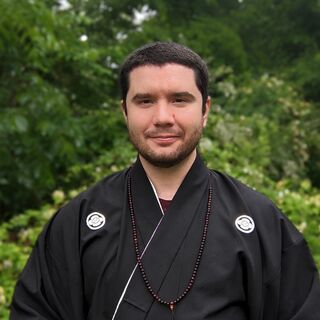
I just wanted to tell you a little bit about myself and this course,
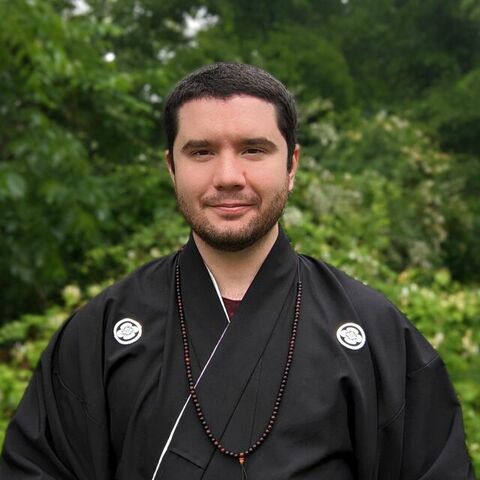
So you might know who you are going to be listening to and who will be responding to any and all questions you have in the upcoming or already released mentorship program on Insight Timer through your reviews or your emails to me.
I as well hope to get to know some of you better through your questions and our conversation on this absolutely fascinating,
Incredibly deep and fathom long body of text that is the Mashima Nikaya,
Or in English,
The middle length discourses of the Buddha.
What it is,
We will get to soon.
To give you a little information on me and perhaps a bit of my pedigree,
I have been studying and practicing the teachings and methods of the Buddha and of the vast myriad of Buddhist schools of thought now for a decade.
To some of you that will seem like a lot and to others that will seem like I'm just starting my journey.
So please give me allowances and cut me some slack where you think I need it sometimes.
I am excited to share with you what I have discovered and what you can discover through the methods taught here.
The great thing about a 152 day pre-course like this over the Mashima Nikaya is that we have time to really soak up a lot of the information,
Regardless of whether we are an absolute beginner who has not even heard of the middle length discourses until this point,
Or if we are a seasoned scholar and practitioner just wondering what a different perspective could bring to the table of our understanding of the Dharma and our meditative practice as a whole.
If you are familiar with the Mashima Nikaya,
Know that you may hear repeated information from your other studies,
As some things are fairly plainly put throughout the text.
I am,
However,
At the end of the day a pragmatist when it comes to the teachings,
Theories,
And methods found not only in Buddhism,
But the variety of the world's spiritual systems,
Whether they be Indic,
Chinese,
Western,
Or shamanic in nature.
I find that well thought out spiritual philosophy and personally realized truths through repeated practice are far more interesting and valuable than those that may seem to come from a text,
Or told to you as some truth from a guru.
It is of my opinion that through this self-discovery we may understand not only the world around us,
But turn the lamplight of curiosity,
Discovery,
Insight,
Concentration,
And wisdom inward.
You may call me a Buddhist,
But that does not mean I do not take the advice or the understanding from other traditions,
For at the end of the day I must remember that I am a Westerner,
And a perennialist in this point of view,
Many paths up to the same mountain peak.
A foreigner to the tradition that I practice,
In a way,
And so mustn't forget my home,
Those of the Stoics,
The Desert Fathers,
And the Mystical Fellows all throughout the ages that kept the flame of inquiry and deep spiritual practice alive in my own culture.
If you are at all curious of the other aspects of my practice or pedigree,
Please ask.
I am always happy to assuage any anguish in those regards.
As well,
If you want to get updates on when these new free course lessons come out,
Please follow me here on Insight Timer to get notified.
And with that business out of the way,
Let's begin.
Now,
What is the Majhima Nikaya?
The Majhima Nikaya is a collection of 152 suttas of a middle length,
Covering a wide range of topics.
It has been suggested that the sutras in this collection were intended as a set of study texts for newly ordained monks as they pursued spiritual development.
The Majhima Nikaya,
Or middle length discourses as we can translate it in English,
Of the Buddha is the second of five Nikayas,
Or collections,
In the Sutta Pitaka of something called the Tipitaka.
But what are those?
Most of what are considered to be the original teachings of the Buddha and his disciples were composed around 550 BCE,
Or thereabouts.
The one exception being what is called the Abhidhamma,
Which was clearly composed a little later by the community explaining and going through the deep details of the Buddha's teaching.
It even says it in its name,
Abhidhamma roughly translated means to discuss the Dharma.
The teachings of the Buddha were not written down until much later,
Though,
First beginning to be written down sometime around the first century BCE.
Before this they were fully memorized and translated over years of study by monks and nuns who specialized in specific parts of the sutras,
Or with specific portions.
The reason that they were written down is due to war and famine,
And many of the monks feared that they would be lost to time because so many of the monks and nuns were dying to do this war.
So they chose to write down the Nikayas on large leaves,
And then later papyrus and paper as we know it today.
A Nikaya is a word meaning volume.
It is often used like the Sanskrit word agama to mean collection,
Assemblage,
Class,
Or group in both Pali and Sanskrit.
The Majhima Nikaya is contained within the Sutta Pitaka,
Which is the collection of sutras given by Buddha and his close disciples.
And the Sutta Pitaka is contained within the Tipitaka,
Or the categories of teaching given by the Buddha.
The three are the Vinaya Pitaka,
Which are the rules for being a monk and a nun and living a holy life.
The Sutta Pitaka,
Which we talked about before,
And the Abhidhamma Pitaka,
Which is the more esoteric and systematic teaching of the Buddha and his monks.
Think of it as the theoretical physics of the Buddha Dharma.
While vastly interesting to go through,
It doesn't have much practical use unless you've spent many years making your way to it.
Much like how you wouldn't begin with theoretical physics and mathematics if you didn't have a simple understanding of algebra.
So to work our way down,
It goes Tipitaka,
Sutta Pitaka,
Majhima Nikaya,
Or to put it all in plain English,
It goes the three baskets of teaching,
The sutra collection,
And then the middle length discourses.
The best way to really get a deep understanding of what the Buddha taught is to simply read just a lot of sutras,
But I've found that that can be rather intimidating.
Especially if one does not understand the grammar,
The cultural context,
Or the reason something is said one way versus another in one sutra or the next.
There is a huge variety of topics and a bewildering array of teaching,
But the important points do emerge by themselves with repeated encounters.
So throughout this course we will be covering sutras found within the Majhima Nikaya that may cover the same topic,
But will come at it from a different angle or a different perspective depending on who is teaching and who is being taught.
Just like a skilled orator or performer would try and read his crowd,
The Buddha and the original Sangha did the same.
We will not be going over these sutras word for word though.
The structure of this course will consist of helping you to understand the ideas and teaching presented in the individual sutras,
Allowing you to have a beginner's grasp on them,
And then continue deeper on your own if you so wish to.
If I were to go into the fine details,
This course would be well over 500 hours long,
And any hope to keep these lessons under half an hour so that they are still digestible to the everyday listener and not barred off by some time or intellectual constraint is just too much.
This doesn't mean that if you're not going to do that,
And you shouldn't listen to this course,
Because it will still provide a good teaching and wet many spiritual and scholarly curiosities in you,
As well as being an easy access to the foray of the total Buddhist and foreign way of thinking to most people who I think will come across this course.
We will,
Going in order,
Start with the first sutta and move on from there.
I think two to four lessons should come out a week depending on my schedule,
And you will also notice that these will be a little informal because I'm kind of doing this off the cuff and just have some notes.
I'll be talking about the sutta in general,
So if you hear me pause to take a moment to think that's what's going on.
Thank you so much for coming on this with me.
I hope that you will enjoy this course and find it interesting and helpful,
Whether it is something just to expand your mind and stay curious about the world,
Or it's your first foray into spiritual practice.
Or maybe it's merely another perspective to try and see this strange reality we inhabit from.
It is my passion and my joy to share it with you.
If you enjoy it or want to use it as a resource,
Please again follow me here on Insight Timer,
And if you have questions or comments,
Please feel free to ask them.
You can send me an email,
And if you want a longer video face-to-face discussion with me over just about anything concerning Buddhism,
Meditation,
Or spiritual practice,
Insight Timer is actually now offering mentoring sessions,
Which I think are pretty cool.
I will see you starting in the next lesson,
Where we will talk about and take a look at what is considered a somewhat complex sutra,
But when put out plainly is easy to understand.
It is called the Root Sequence Sutra,
And I look forward to seeing you there.
I'm Silas Day,
And have a wonderful day.